Table of Contents
After permitting 126 ADU projects over nine years, we’ve seen the same design mistakes cost homeowners tens of thousands of dollars — and months of wasted time. The painful part? Almost every one of these mistakes is avoidable if you know what to look for before you commit to a design. This is our unfiltered list of the biggest ADU design mistakes California homeowners make, drawn from real projects and real consequences.
Some of these will seem obvious in hindsight. Others are traps that even experienced homeowners walk into because the ADU process is unlike anything else in residential construction. The rules are different, the constraints are specific, and the stakes are high — you’re building a complete home on a lot that already has one.
Here are the mistakes we see most often, and exactly how to avoid each one.
1. Designing Before You Know What Your Property Allows
This is the number one ADU design mistake, and it’s the most expensive. Homeowners get excited, find a plan they love online, maybe even hire an architect — and only then discover that their property won’t accommodate the design they’ve already paid for.
Before you sketch a single line, you need to understand exactly what your lot allows. That means checking:
- Setbacks: Under Gov. Code §66321(b)(3), new construction detached ADUs require 4-foot side and rear setbacks. That sounds simple until you realize your lot has an irregular shape, an angled property line, or an existing structure that eats into your buildable area.
- Height limits: Gov. Code §66321(b)(4) sets the baseline at 16 feet for a detached ADU on a single-family lot. You get 18 feet if you’re within a half-mile of transit or on a multifamily lot, and up to 25 feet for an attached ADU. These numbers determine whether a two-story design is even possible on your property.
- Easements: Sewer easements, utility easements, drainage easements — they don’t show up on Google Maps, and they can cut right through what you assumed was buildable space.
- Existing utility locations: Where’s the sewer lateral? Where does the electrical service enter the property? Relocating utilities is expensive and time-consuming.
- Grade and topography: A sloped lot changes everything about foundation costs, drainage requirements, and even which models are feasible.
Real-World Example: The $18K Lesson in Eagle Rock
A homeowner in Eagle Rock hired an architect and spent $18,000 on plans for a 1,000 sqft ADU. The design was beautiful. It was also impossible to build. A 10-foot sewer easement ran directly through the planned footprint — something a basic title report and site survey would have revealed before a single dollar was spent on design. The project had to be completely redesigned with a smaller footprint shifted to the opposite side of the lot, and those original plans went in the trash.
How to avoid it: Start with a site assessment, not a design. Get a survey, pull a title report, check with the city on any overlays or specific plan requirements, and talk to someone who understands ADU-specific zoning before you fall in love with a floor plan. We cover the full permitting process in our guide to ADU permitting in California.
2. Maxing Out Square Footage When It Doesn’t Make Sense
We get it — bigger feels like more value. But not every lot needs the largest ADU the law allows, and forcing maximum square footage onto a tight lot is one of the most common design mistakes we see.
First, let’s get the state size limits straight. Under Gov. Code §66321, the “interior livable space” limits are 850 sqft for a studio or one-bedroom and 1,000 sqft for two or more bedrooms. (SB 543 clarified this by changing the old “living area” language to “interior livable space.”) The 1,200 sqft figure you’ll see referenced elsewhere is total floor area, which includes non-livable space like garages, storage, and mechanical rooms.
But legal maximums and smart design are different things. Here’s what happens when you max out square footage on a lot that can’t handle it:
- The ADU consumes all usable yard space, making the primary home feel boxed in.
- The unit itself feels cramped because you’re pushing walls to the setback lines, limiting window placement and natural light.
- You spend more on construction without a proportional increase in rental income or property value.
The ROI math often favors a smaller, smarter unit. Consider this comparison from our Signature Home lineup:
| Model | Size | Bedrooms | Est. project cost (plan price + build midpoint) | Estimated Rent | Annual Gross Yield |
|---|---|---|---|---|---|
| The Laurel Canyon | 660 sqft | 2 BR | $261,500 | $2,300/month | 10.55% |
| The Lincoln | 1,000 sqft | 3 BR / 2 BA | $350,500 | $2,800/month | 9.59% |
The Laurel Canyon costs roughly $89,000 less in total, and its gross yield is nearly a full percentage point higher. That difference in construction cost could fund an entire second investment — or simply stay in your pocket. We break down the full financial picture in our ADU rental income guide.
How to avoid it: Define your goals before you pick a size. If you’re building for rental income, model the actual ROI at different price points. If you’re building for family, think about what they actually need — not what the zoning code allows.
3. Ignoring How the ADU Relates to the Main House
Your ADU doesn’t exist in a vacuum. It shares a lot with the primary dwelling, and the relationship between the two structures determines whether both households are comfortable — or miserable.
This is the design consideration homeowners skip most often. They focus entirely on the ADU interior and forget that two separate households will be living in close proximity, sharing outdoor space, sight lines, noise, and access.
Here’s what you need to think through:
Window-to-Window Sight Lines
If your ADU bedroom window faces your main house kitchen window from 15 feet away, neither household has privacy. This is especially problematic with rental units, where your tenant is a stranger. Thoughtful window placement — high clerestory windows, frosted glass, or windows oriented toward the side yard instead of the main house — solves this without sacrificing natural light.
Entrance Placement
Does your ADU tenant walk through your backyard to get home? That destroys privacy for both parties. A separate entrance from the street or side yard is critical for rental units. For multigenerational use, you might actually want a shared path — but it should be a conscious decision, not an accident of site planning.
Outdoor Space Allocation
A 1,000 sqft ADU on a 5,000 sqft lot can easily consume the entire backyard. Before committing to a footprint, lay out what outdoor space remains for the primary home — and whether the ADU gets any dedicated outdoor area of its own. A small private patio for the ADU and a preserved yard for the main house beats a shared space that neither household feels ownership over.
Noise Transmission
This matters most for attached ADUs, where units share a wall. But even detached units that are 10 feet from the main house can create noise issues if the ADU’s living room or kitchen faces the primary home’s bedrooms. Think about which rooms in each structure face each other, and design accordingly.
Parking and Access
Under Gov. Code §66322, cities can require a maximum of one parking space for an ADU, with exemptions within a half-mile of transit. But even where parking isn’t required, think about how vehicles access the property. Will the ADU block driveway access? Will your tenant’s car be parked in your sight line? Small details, big impact on daily life.
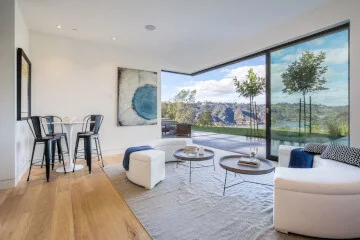
Good ADU design considers the relationship between the new unit and the existing home — not just the ADU in isolation.
How to avoid it: Before you finalize any ADU design, walk your property and visualize daily life for both households. Where does each person enter? What does each person see from their windows? Where does each household spend time outdoors? If you can’t answer those questions comfortably, the site plan needs work.
4. Choosing a Design That Can’t Be Built for the Budget
This is where the gap between design and construction becomes a financial black hole. An architect creates a gorgeous custom ADU. You fall in love with it. Then the contractor bids come back, and the number is $60,000 to $100,000 more than you expected.
The problem isn’t that your architect is bad — it’s that many architects design without a construction cost discipline. They’re trained to create beautiful spaces, not to optimize for buildability. Here are the specific design choices that blow ADU budgets:
- Custom rooflines: Butterfly roofs, asymmetric shed roofs, and complex hip-and-valley designs look great on paper. They add $20,000-$50,000+ in structural engineering, framing labor, and specialized roofing materials compared to a standard gable or flat roof.
- Excessive glazing: Floor-to-ceiling glass walls are beautiful but expensive. Each large pane requires structural headers, costs significantly more than standard windows, and increases energy costs that must be offset elsewhere to meet Title 24 requirements.
- Split-level foundations on sloped lots: Instead of a simple slab or raised foundation, a split-level design on a sloped lot can double your foundation cost. Retaining walls, stepped footings, and waterproofing add up fast.
- High-end finishes spec’d before knowing construction cost: When you pick $15,000 in imported tile before you know that site work is going to cost $30,000 more than expected, something has to give — and it’s usually the budget.
- Unusual floor plans: Non-rectangular footprints, angled walls, and complex geometries waste framing material, increase labor hours, and slow down every trade on the job.
Real-World Example: The $45K Butterfly Roof in Mar Vista
A homeowner in Mar Vista worked with an architect who designed a stunning ADU with a butterfly roof — two opposing roof planes that slope inward to create a dramatic V-shaped profile. The design won compliments from everyone who saw the renderings. Then the structural engineer priced the steel and custom connections, the framing contractor priced the labor, and the roofing contractor priced the specialty membrane and drainage system. Total added cost over a standard gable roof: $45,000. The homeowner had to choose between the roof and their kitchen finishes. They chose the roof — and ended up with laminate countertops in a unit they’d designed around high-end materials.
How to avoid it: Design and construction should be integrated from day one. That’s the core argument for plans that have been built before — when the designer and the builder have worked together, there’s far less of a gap between what’s drawn and what’s buildable within your budget. For a detailed breakdown of where ADU money actually goes, see our complete guide to ADU construction costs.
5. Not Designing for the Intended Use
An ADU built for rental income needs different design priorities than one built for your aging parents. An ADU built to maximize property value at resale needs something different from both. Yet we regularly see homeowners design without a clear use case — or worse, try to optimize for everything and end up optimized for nothing.
Here’s what each use case actually demands:
If You’re Building for Rental Income
- Durable finishes: Luxury vinyl plank over hardwood. Quartz over marble. Porcelain tile over natural stone. Materials that look good, clean easily, and survive tenant turnover without replacement.
- Separate entrance with real privacy: Street-facing or side-yard access so tenants don’t walk through your personal space.
- In-unit laundry: This is non-negotiable for competitive rental rates in Los Angeles. A unit without washer/dryer hookups rents for measurably less.
- Efficient kitchen layout: A galley or L-shaped kitchen with standard-size appliances. Renters want functional, not Instagram-worthy.
- Parking access: Even where not required by code, providing a parking spot significantly increases your rental pool in car-dependent LA neighborhoods.
If You’re Building for Family (Multigenerational)
- Accessibility features: Wider doorways (36” minimum), blocking in bathroom walls for future grab bars, a curbless shower, lever door handles instead of knobs, and minimal thresholds between rooms. Even if your parents are mobile now, designing for accessibility from the start costs almost nothing compared to retrofitting later.
- Connection to the main house: A covered walkway, a shared courtyard, or simply a clear and well-lit path between the two front doors. The goal is independence with easy connection — not isolation.
- Privacy from shared spaces: Bedrooms and bathrooms positioned away from windows that face the main house’s high-traffic areas.
If You’re Building for Property Value and Resale
- Broad design appeal: Neutral colors, clean lines, standard layouts. Don’t design for your taste — design for the next buyer’s taste.
- Full kitchen: A kitchenette limits the ADU’s perceived value. Full-size appliances, adequate counter space, and proper ventilation signal “real home,” not “converted garage.”
- Maximum bedrooms for the square footage: A 660 sqft two-bedroom will appraise higher than a 660 sqft one-bedroom with a large living room. Bedroom count drives both rental value and resale comps.
How to avoid it: Write down your primary use case before you start designing. If it’s rental income, every decision should pass the question: “Does this increase what a tenant will pay?” If it’s family, every decision passes: “Does this make daily life better for the person living here?” One filter. Every decision. For more on what kills an ADU project before it gets started, read our breakdown of the 5 things that can derail your ADU project.
6. Overcomplicating the Design When Productized Models Exist
This might be the most expensive design mistake on the list — not because any single decision goes wrong, but because the entire approach is wrong from the start.
Going fully custom on an ADU means paying $15,000 to $30,000 for architectural plans, waiting 2-4 months for design development, navigating plan check with an untested design, and accepting all the risk of a one-off build. Every custom plan is a prototype — and prototypes have problems.
Meanwhile, pre-engineered models exist that have already solved the hard problems. The structural engineering is done. The Title 24 energy calculations are done. The floor plans have been optimized through multiple iterations. The construction details have been refined across dozens of builds.
At CALI ADU, our nine Signature Home models range from 400 to 1,200 sqft and cover every common use case:
| Model | Type | Size | Bedrooms/Baths | Plan price / est. cost to build |
|---|---|---|---|---|
| The Wilshire | Single-Story | 400 sqft | Studio | Plans $7,490 Est. $180K–$200K to build |
| The Sunset | Single-Story | 480 sqft | 1 BR | Plans $7,490 Est. $200K–$215K to build |
| The Westwood | Single-Story | 550 sqft | 1 BR | Plans $8,990 Est. $215K–$235K to build |
| The Laurel Canyon | Single-Story | 660 sqft | 2 BR | Plans $8,990 Est. $240K–$265K to build |
| The Melrose | Single-Story | 800 sqft | 2 BR / 2 BA | Plans $8,990 Est. $275K–$295K to build |
| The Lincoln | Single-Story | 1,000 sqft | 3 BR / 2 BA | Plans $12,990 Est. $325K–$350K to build |
| The Fairfax | Two-Story | 840 sqft | 2 BR / 1.5 BA | Plans $12,990 Est. $280K–$310K to build |
| The Venice | Two-Story | 1,080 sqft | 2 BR / 2.5 BA | Plans $12,990 Est. $335K–$365K to build |
| The Culver | Two-Story | 1,200 sqft | 3 BR / 2.5 BA | Plans $12,990 Est. $385K–$420K to build |
And “pre-engineered” doesn’t mean cookie-cutter. Our à la carte configurator offers over 15,000 unique combinations per model. You choose from:
- Exterior selections: Roof form (flat or gable), four siding options, two window frame colors, and multiple color schemes — 48 exterior combinations per model.
- Interior selections: Four cabinet styles, three countertop materials, three plumbing hardware finishes, three flooring options, and three backsplash choices — 324 interior combinations per model.
Every interior selection is specified in your plans. You’re not paying extra to pick the countertop you actually want. The plan prices in the table above are fixed, and the build figures are estimates based on recent similar projects. See the full breakdown on our pricing page.
Our two-story models deserve special attention. The Fairfax, Venice, and Culver give you significantly more living space on a smaller footprint — critical on tight Los Angeles lots where yard space is at a premium. The Fairfax (840 sqft) occupies roughly the same footprint as a 420 sqft single-story unit, giving you double the livable space without sacrificing outdoor area. That’s a design advantage you simply can’t replicate with a custom single-story plan on a constrained lot.
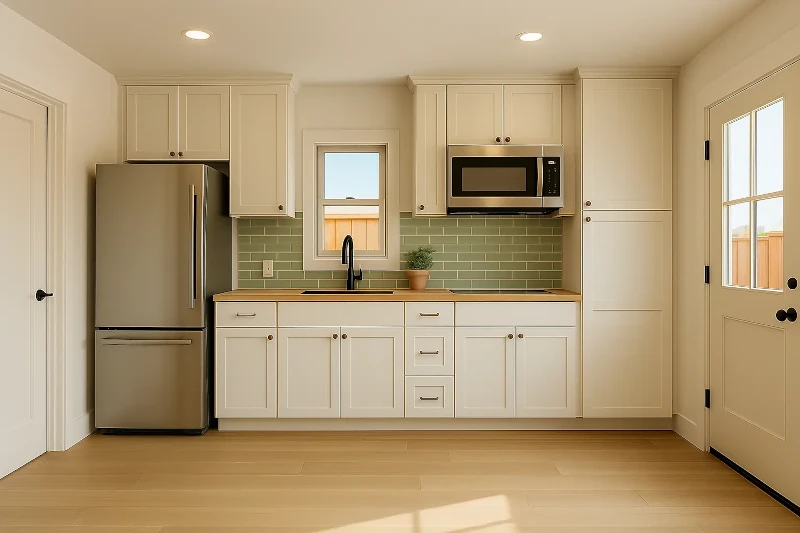
Every interior finish in a CALI ADU Signature Home — cabinets, countertops, flooring, hardware — is specified in your plans. No surprise upgrade costs.
How to avoid it: Before you hire an architect for a custom design, look at what’s already available. If a pre-engineered model fits your lot, your use case, and your aesthetic preferences — and with 15,000+ configurations per model, it probably does — you’ll save $15,000-$30,000 in design costs, months in timeline, and significant construction risk. Explore all our Signature Home models here.
The Common Thread: Design With Constraints First, Creativity Second
Every mistake on this list comes from the same root cause: designing in a vacuum. Homeowners start with what they want instead of what their property, budget, and use case allow. Then reality intervenes, and the result is wasted money, wasted time, and a compromised final product.
The best ADU designs start with constraints:
- What does the property allow? Setbacks, height, easements, grade, utility locations.
- What does the budget allow? Not just total cost, but construction cost per square foot for the level of finish you want.
- What does the use case require? Rental, family, resale — each drives different design priorities.
- What does the lot’s relationship with the main house demand? Privacy, access, outdoor space, sight lines.
Once you know the constraints, creativity fills in the rest — and the result is a design that actually works, actually fits the budget, and actually gets built without painful compromises along the way.
If you’re early in the process and want to make sure you’re not walking into any of these traps, we’re happy to look at your specific property and give you a straight answer about what’s possible.