Table of Contents
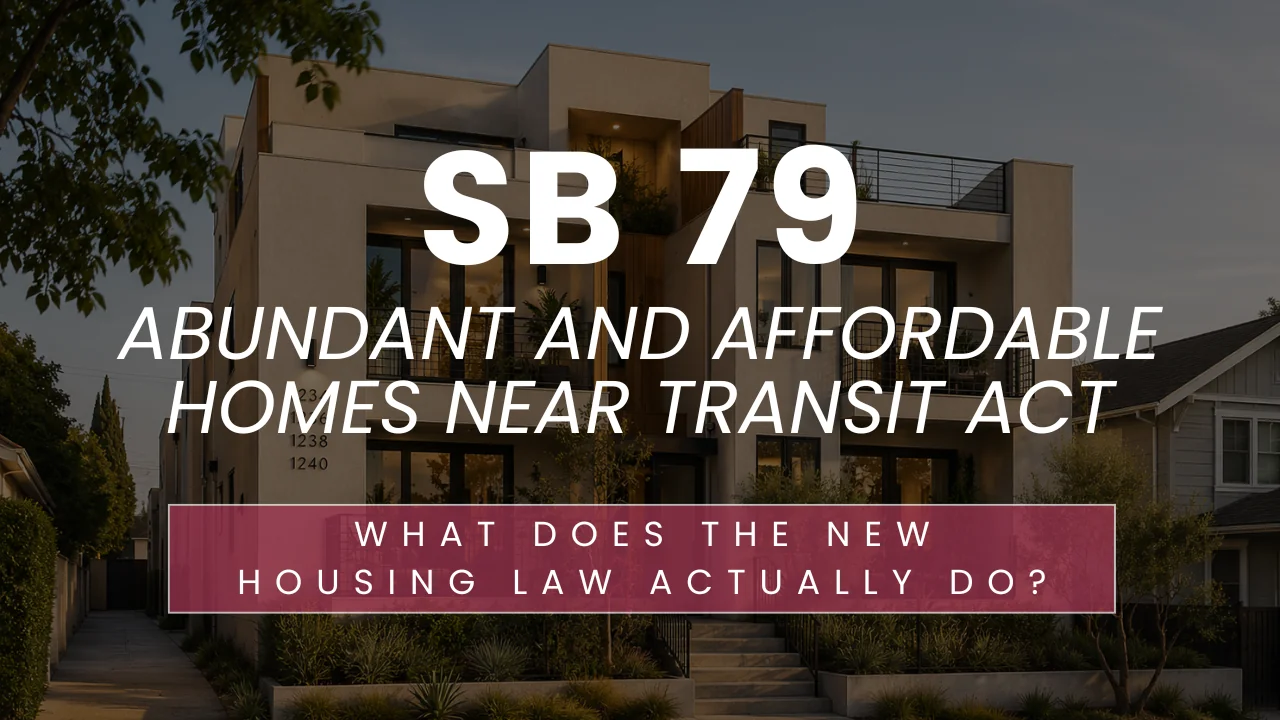
California’s most significant housing law in years goes live July 1, 2026 — and Los Angeles has already done everything it legally can to slow it down. Senate Bill 79, the “Abundant and Affordable Homes Near Transit Act” (Chapter 512, Statutes of 2025), is real, it is law, and it does fundamentally change what can be built near major transit stops across Southern California. But after nine years of permitting ADUs across Los Angeles, I can tell you the two things homeowners most need to know right now: first, this law has nothing to do with your ADU rights, and second, the City of LA has bought itself until approximately 2030 before the full version of SB 79 applies here.
Here’s what actually happened, what it means for your property, and what — if anything — you need to do differently.
First, What SB 79 Is Not
Before anything else: SB 79 is not an ADU law. It does not amend, modify, or replace the California ADU Statute (Government Code §§66310–66342). Your right to build an ADU — the setback rules, the height limits for detached units, the parking exemptions near transit, the 60-day approval clock, the prohibition on minimum lot sizes — every one of those rules comes from a completely separate section of state law and is untouched by SB 79.
The online coverage of SB 79 has been confusing on this point. Articles aimed at homeowners tend to describe it as a sweeping ADU reform. It is not. SB 79 adds a new chapter to an entirely different part of the Government Code (§§65912.155–65912.162) that governs large multifamily development near transit — the kind of project that requires a professional developer, construction financing, a full design team, and years of work. A homeowner who wants to add a rental unit to their backyard is operating under different law entirely, and that law hasn’t changed.
What SB 79 Actually Does: Housing Near Transit
SB 79 was signed by Governor Gavin Newsom on October 10, 2025 and takes effect July 1, 2026. Its official name — the “Abundant and Affordable Homes Near Transit Act” — captures its purpose: unlock higher residential density on parcels within a half-mile of major transit stops across eight California counties, including Los Angeles.
The core mechanic: if a parcel is within the qualifying distance of a qualifying transit stop, SB 79 overrides local zoning and makes it an “allowed use” to build a multifamily residential project — by right, without discretionary review, without a public hearing, without a conditional use permit. The city cannot block it if the project meets the law’s baseline thresholds: at least five dwelling units, a minimum density of 30 units per acre, and an average unit size no larger than 1,750 square feet.
The Three-Tier System: Height by Distance
SB 79 creates a tiered system that scales allowable height with proximity to transit:
| Tier | Distance from Transit Stop | Allowable Height |
|---|---|---|
| Tier 1 — Heavy Rail | Within ¼ mile of major rail station | 7–9 stories |
| Tier 2 — Rail / BRT | ¼ to ½ mile from major rail | 5–6 stories |
| Tier 3 — Light Rail / Bus | Within ½ mile of qualifying bus service | 4–5 stories |
These are state-mandated minimums. Local governments can allow taller buildings; they cannot restrict below these floors once a parcel qualifies under the law.
What Counts as a Qualifying Transit Stop
SB 79 defines eligible stops by reference to “major transit stop” as defined in Public Resources Code §21064.3: heavy rail transit, very high frequency commuter rail, high frequency commuter rail, light rail transit, or qualifying bus service with sufficiently high service frequency. In the Los Angeles context, this generally includes Metro Rail stations (Red, Purple, Gold, Blue, Green, and Expo lines), Metrolink commuter rail stops, and dedicated bus rapid transit corridors.
One important caveat: the Southern California Association of Governments (SCAG) is responsible for creating the definitive map of qualifying TOD stops for the LA region, and as of July 2026 that map remains in draft form. The LA City Planning Department’s own SB 79 page describes current eligibility maps as “draft format and intended for exploratory purposes only.” If a specific parcel’s eligibility matters to you, verify against the finalized SCAG map before making any development decisions.
What Los Angeles Did: A Strategy of Maximum Delay
Los Angeles chose maximum delay. At a series of votes between November 2025 and June 2026, the City Council deployed every escape clause written into SB 79 for local governments. The result: full SB 79 implementation is deferred in most of Los Angeles until approximately 2030 — a year after the next state-mandated housing planning period concludes for Southern California.
The legal mechanism for the delay comes from SB 79 itself: transit-adjacent areas that already allow at least 50 percent of the housing density required under the law can opt out temporarily, until the next Housing Element update. Los Angeles’s City Council voted on March 24, 2026 (Council File 25-1083) to pursue this approach, called “Approach C” in the City Planning Department’s internal analysis.
The Low-Rise Ordinance
To push qualifying neighborhoods over the 50-percent threshold needed for the delay, LA adopted the Low-Rise Ordinance — a zone change that allows 2-to-4-story multifamily buildings containing 4 to 16 units in single-family and low-density residential areas near 57 transit station areas across the city. Previously, those zones allowed single-family construction only.
The ordinance was recommended by the City Planning Commission on May 14, 2026 and approved by the City Council on June 3, 2026. By accepting a modest density increase now — small apartment buildings of up to four stories — the city cleared the 50-percent threshold and qualified for the four-year reprieve from full SB 79 compliance.
The Phased Implementation Ordinance
Alongside the Low-Rise Ordinance, the City Council also approved the Phased Implementation Ordinance (CF 25-1083-S4, June 3, 2026), which formally defers full SB 79 compliance in qualifying areas until one year after the next Housing Element update — roughly 2030. When 2030 arrives, the city will either adopt its own alternative plan that meets SB 79’s overall density requirements (with some flexibility over where density goes), or accept the state’s version wholesale.
Governor Newsom publicly criticized Los Angeles for the delay strategy. He did not, however, claim that the city’s approach violates state law. SB 79 was written with enough built-in flexibility that the delay — while politically contentious — appears to be legally authorized under the escape clauses the Legislature included.
What’s Exempt from Both SB 79 and LA’s Delay
Certain properties are excluded from SB 79 regardless of what the city does. The law itself exempts properties in “low resource” areas (per the state’s equity classification), very high fire hazard severity zones, sea-level-rise risk areas, and sites listed on a historic preservation registry. Given the scale of the 2025 Palisades Fire, the fire hazard exemption covers a significant swath of west and northwest LA.
Los Angeles added additional local exemptions on top of the state baseline. Most notably, HPOZs (Historic Preservation Overlay Zones) — which cover neighborhoods like Angelino Heights, Hancock Park, West Adams, Leimert Park, and dozens more — are excluded from the Low-Rise Ordinance. They already benefit from the state’s historic preservation exemption as well.
What This Means in Practice:
If your property is in a fire hazard zone, an HPOZ, or a low-resource neighborhood, SB 79 has limited or no applicability — in its full state form or LA’s modified version. If your property is in a higher-income, transit-adjacent neighborhood not in those categories (think Silver Lake near the Metro, Palms near the Expo Line, or a mid-city neighborhood near a BRT corridor), the Low-Rise Ordinance may now allow your neighbors to build 4-to-16-unit buildings where only single-family homes were previously permitted.
What SB 79 Means for Your ADU — The Short Answer
Nothing changes for your ADU on July 1. This deserves to be said plainly.
California’s ADU statute (Gov. Code §§66310–66342) already gives you the right to build a detached ADU on virtually any single-family or multifamily lot in the state. SB 79 does not amend, restrict, or expand those rights. The key rules — all unchanged — remain:
- Detached ADUs are guaranteed a minimum 16-foot height limit (§66321(b)(4)(A))
- Maximum 4-foot side and rear setbacks for new detached construction (§66321(b)(3))
- No parking required for ADUs within ½ mile of transit (§66322) — already the rule across most of LA
- Ministerial approval with a 60-day clock (§66317) — unchanged
- No minimum lot size (§66314(b)(1)) — unchanged
If you are building a detached new construction ADU in Los Angeles, the permitting process works exactly the same way on July 2 as it does today. The law governing your project is the ADU statute. SB 79 governs something else entirely.
What SB 79 Might Mean for Your Property Value
Here’s where things get more interesting for some LA homeowners. Even though SB 79 doesn’t change what you can build as a single-family homeowner adding an ADU, it does change the development potential of transit-adjacent land — and that has real long-term implications.
If your property is near a qualifying Metro station and is not in an exempt category, two things are now true (or will be by 2030): your neighbors can now build modestly larger multifamily buildings in some areas, and eventually — when full SB 79 comes into effect — some transit-adjacent lots may carry by-right approval for 5-to-9-story buildings. If you own land in one of those corridors, the development potential underlying your property may increase substantially over the next decade. That is not an immediate change, but it is a real one.
In the near term, the most practical use of this information is to build your ADU now. An ADU adds documented rental income, locks in permitted living space, and increases the improvement value of your lot — regardless of what SB 79 eventually does to underlying land values. The ADU captures income today; the land-value appreciation from SB 79’s full implementation is still years away.
Real-World Example: Eagle Rock, Near the Metro L Line
Consider a homeowner with a 6,000-square-foot lot in Eagle Rock, within a half-mile of the Metro L Line (formerly Gold Line). Under existing ADU law, they can build a 1,000-square-foot, three-bedroom detached ADU with 4-foot setbacks and no parking requirement — our Lincoln model (plans $12,990, est. $325K–$350K to build). That project produces a legal rental unit worth $2,800–$3,200 per month in that market. By 2030, SB 79’s full implementation could entitle a developer to build a 5-to-6-story apartment on a similar nearby lot, which would likely push land values in the corridor higher over time. The homeowner who builds an ADU today captures rental income now, while also positioning their property in a corridor that state policy is actively designating as a growth zone.
The Bottom Line for LA Homeowners
Here is the plain-English version: SB 79 goes live July 1, 2026 — but in most of Los Angeles, you won’t notice. The City Council approved a legally authorized delay strategy that defers full SB 79 implementation until approximately 2030 for most qualifying neighborhoods. In the meantime, the new Low-Rise Ordinance allows 2-to-4-story multifamily buildings near 57 transit corridors — a meaningful change for those neighborhoods, but far short of what full SB 79 would have required.
Your ADU rights are unaffected. Your permitting timeline is unaffected. Your setbacks, height limits, and parking exemptions are unaffected. If you want to add a legal dwelling unit to your property and begin collecting rental income, the path forward is the same as it has been: a well-designed, properly permitted detached ADU, processed through LADBS under the same statute it’s always been processed under.
Nine years and more than 100 projects into this work, the one thing I can tell you confidently is that state housing law in California changes constantly — and the homeowners who do best are the ones who build within the current rules rather than waiting to see what comes next. SB 79 is the biggest housing story of 2026. For the homeowners we work with, it changes the background. The foreground — your lot, your setbacks, your ADU — is the same as it was yesterday.
If you want to understand what your specific lot can support, both under current ADU law and under the longer-term picture that SB 79 creates, that’s exactly what we cover in a 15-minute Backyard Review. We run a lot analysis, model an ADU that fits your setbacks and budget, and give you a clear picture of your options — including whether your transit-adjacent lot has any larger development potential worth knowing about.