
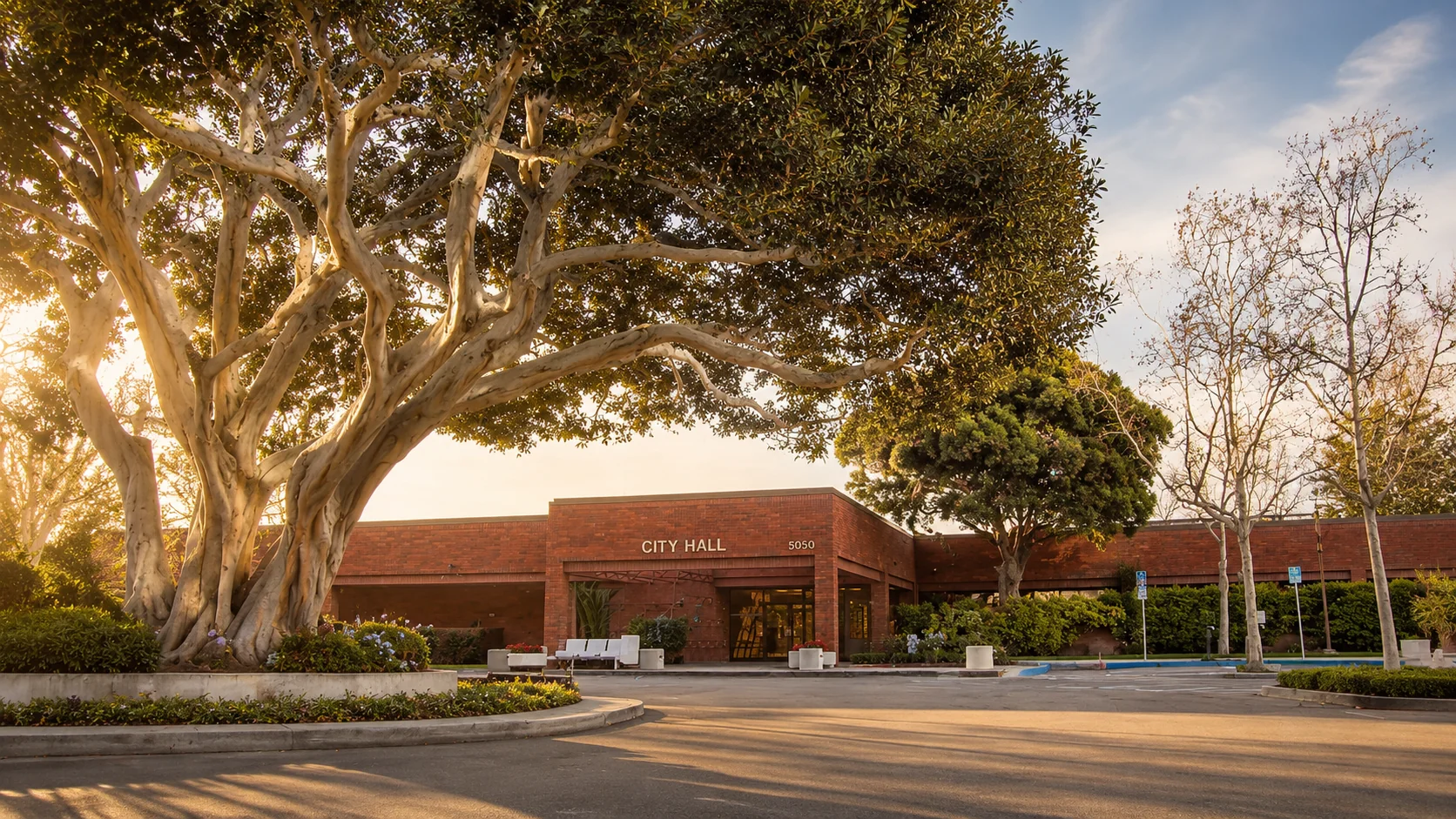
Building an ADU in Lakewood. Rules, costs, timeline.
What Lakewood Municipal Code § 9302.21a actually allows, why its 35-foot height limit makes two-story ADUs buildable where most flat suburbs cap out, and what an all-in build costs on a Lakewood lot in 2026.
What you can build — at a glance
Reviewed by CALI ADU’s ADU specialists · September 2026
- Max ADU size
- 150–1,200 sqft new build; conversions may exceed 1,200. Attached/converted capped at 50% of the house, but 800 sqft always allowed (LMC § 9302.21a(D)(3); Gov. Code § 66321(b)(2)–(3))
- Detached height
- Up to 2½ stories / 35 ft — more than double the 16-ft state floor. Front-yard detached held to 18 ft (LMC § 9302.21a(D)(4)(a),(d); Gov. Code § 66321(b)(4))
- Attached height
- Up to 2½ stories / 35 ft; front-yard attached held to 25 ft. Exceeds the 25-ft attached floor at Gov. Code § 66321(b)(4)(D) (LMC § 9302.21a(D)(4))
- Side & rear setbacks
- 4 ft each, plus 4 ft eave-to-eave from other buildings; none for a conversion or same-footprint replacement (LMC § 9302.21a(D)(2); Gov. Code § 66314(d)(7))
- Units per SFR lot
- One conversion ADU + one new-build ADU + one JADU — four dwelling units max counting the house (LMC § 9302.21a(A)(1), (D)(1); Gov. Code § 66323(a)(1)–(2); HCD ADU Handbook)
- Parking required
- One space by default, waived by six exemptions that cover most Lakewood lots; no replacement parking on a garage conversion (LMC § 9302.21a(D)(6); Gov. Code §§ 66322, 66314(d)(11))
- Permit timeline
- 60 days · ministerial review, no hearing (Gov. Code § 66317). LMC § 9302.21a(C)(2) states 60 business days — the shorter state clock governs
- Owner-occupancy
- Not required for an ADU. Lakewood’s post-Jan-2025 rule (LMC § 9302.1(B)(1)(b)) is preempted by Gov. Code § 66315. JADU: only where it shares a bathroom (Gov. Code § 66333(b), AB 1154)
- Detached Up to 1,200 sqft · up to 2½ stories / 35 ft in the rear yard (18 ft in the front yard)
- Attached Up to 50% of the house or 800 sqft, whichever allows more, capped at 1,200 sqft (LMC § 9302.21a(D)(3))
- Garage conversion Within the existing garage footprint · no replacement parking required
- Interior conversion Carved from existing house or accessory space · existing setbacks kept, may exceed 1,200 sqft
- Junior ADU Up to 500 sqft inside the single-family home, independent entrance (LMC § 9302.21b; Gov. Code § 66313(d))
Per Lakewood Municipal Code, Article IX, §§ 9302.1, 9302.21a and 9302.21b as amended through Ordinance No. 2025-3 (November 11, 2025), and Gov. Code §§ 66310–66342. Cross-checked against the HCD ADU Handbook (March 2026) and HCD’s letter to the City dated May 11, 2026. Full citations in the sections below.
On this page
Can I build an ADU in Lakewood?
Five things to know before you start
If you read nothing else here, read these. They are the five points that change the most Lakewood projects.
| What to know | Why it matters for your project |
|---|---|
| 1. Two stories is a real option here | A newly built ADU may reach 2½ stories or 35 feet (LMC § 9302.21a(D)(4)(a)). State law obliges cities to allow only 16 feet for a standard detached unit (Gov. Code § 66321(b)(4)); Lakewood roughly doubles that. This is the single biggest design advantage of building in Lakewood, and it needs no variance. |
| 2. You are not limited to one unit | The code directs the City to approve one conversion ADU and one new-build ADU on the same lot, plus a junior ADU (LMC § 9302.21a(A)(1)). Most homeowners assume the limit is one. Counting the house and an SB 9 unit, the ceiling is four dwelling units. |
| 3. The city cannot make you live there | LMC § 9302.1(B)(1)(b) still requires owner-occupancy for ADUs permitted after January 2025. Gov. Code § 66315 forbids that, and HCD flagged the clause to Lakewood in May 2026. If a planner cites it, the state rule wins. |
| 4. Parking is usually waived | The default is one space, but six exemptions in LMC § 9302.21a(D)(6) cover most of the city — garage conversion, half a mile from transit, car-share within a block, and three more. Converting a garage never triggers replacement parking (Gov. Code § 66314(d)(11)). |
| 5. Short-term rental is off the table | Both ADUs and junior ADUs must be rented for 31 days or more, and that restriction is recorded against the property and runs with the land (LMC § 9302.21a(D)(12)). If your numbers depend on nightly income, they will not work here. |
How many units your lot can hold
Lakewood is the archetypal post-war planned community: roughly 22,700 single-family homes on flat, regular tract lots. The ordinance treats those lots generously. LMC § 9302.21a(A)(1) directs the City to ministerially approve up to two ADUs per single-family lot — one carved out of existing space, one built new — and LMC § 9302.21b adds a junior ADU inside the house. That mirrors the state stack at Gov. Code § 66323(a)(1)–(2), which the HCD ADU Handbook reads the same way.
The ordinance sets its own ceiling on top of that: no more than four dwelling units on a lot that existed on January 1, 2022, counting the primary house, any ADUs, a junior ADU, and a second primary unit created under SB 9. The code also says lots created after that date are held to two units of any type. State law allows that only for a lot created by an SB 9 urban lot split (Gov. Code § 66411.7(j)); on any other newer lot, the state unit stack in Gov. Code § 66323(a) still applies and the local cap gives way (Gov. Code § 66316).
What the city cannot do
Review is ministerial. Lakewood applies objective standards to your drawings and issues the permit, or it tells you in writing what is deficient and how to fix it. There is no public hearing, no discretionary design review, and no neighbor appeal path (Gov. Code § 66317). The City may not require you to live on the property, may not demand replacement parking for a converted garage, and may not use floor-area ratio, lot coverage or open-space rules to stop an 800-square-foot ADU with 4-foot setbacks.
What you can build on a Lakewood lot
Everything in this section comes from Lakewood Municipal Code Article IX — § 9302.21a for ADUs and § 9302.21b for junior ADUs — as rewritten by Ordinance No. 2023-1 and last amended by Ordinance No. 2025-3, read against Gov. Code §§ 66310–66342. On height and unit count, Lakewood is more permissive than the state floor. On owner-occupancy and multifamily lots it is behind, and state law fills the gap.
Which ADU type fits your property?
Lakewood permits five types. The right one is usually decided by your lot and your goal, not by preference. Start here, then read the standards below against the type you land on.
| If this sounds like you | Start with | What that means |
|---|---|---|
| You want the most living space you can get and you want to keep backyard | Two-story detached ADU | Roughly half the footprint for the same floor area. The 35-ft allowance in LMC § 9302.21a(D)(4)(a) is what makes this legal here and not in most neighbouring cities. |
| You have usable rear yard and want no stairs | Single-story detached ADU | Up to 1,200 sqft, 4-ft side and rear setbacks, 4 ft clear between eaves and the house. The workhorse on a standard Lakewood tract lot. |
| You have a detached garage you rarely use | Garage conversion | No additional setback required because it reuses the footprint, no replacement parking, and up to 150 sqft may be added for entry and exit. |
| Your yard is small or you want the cheapest route to a rentable unit | Interior conversion | Carved from existing house or accessory space. Not subject to the 1,200 sqft cap, and built at the existing setbacks. |
| You want a small unit for family and you are not adding a structure | Junior ADU | Up to 500 sqft inside the house, its own entrance, an efficiency kitchen, and optionally its own bathroom. No parking may be required at all. |
Height — the thing that makes Lakewood different
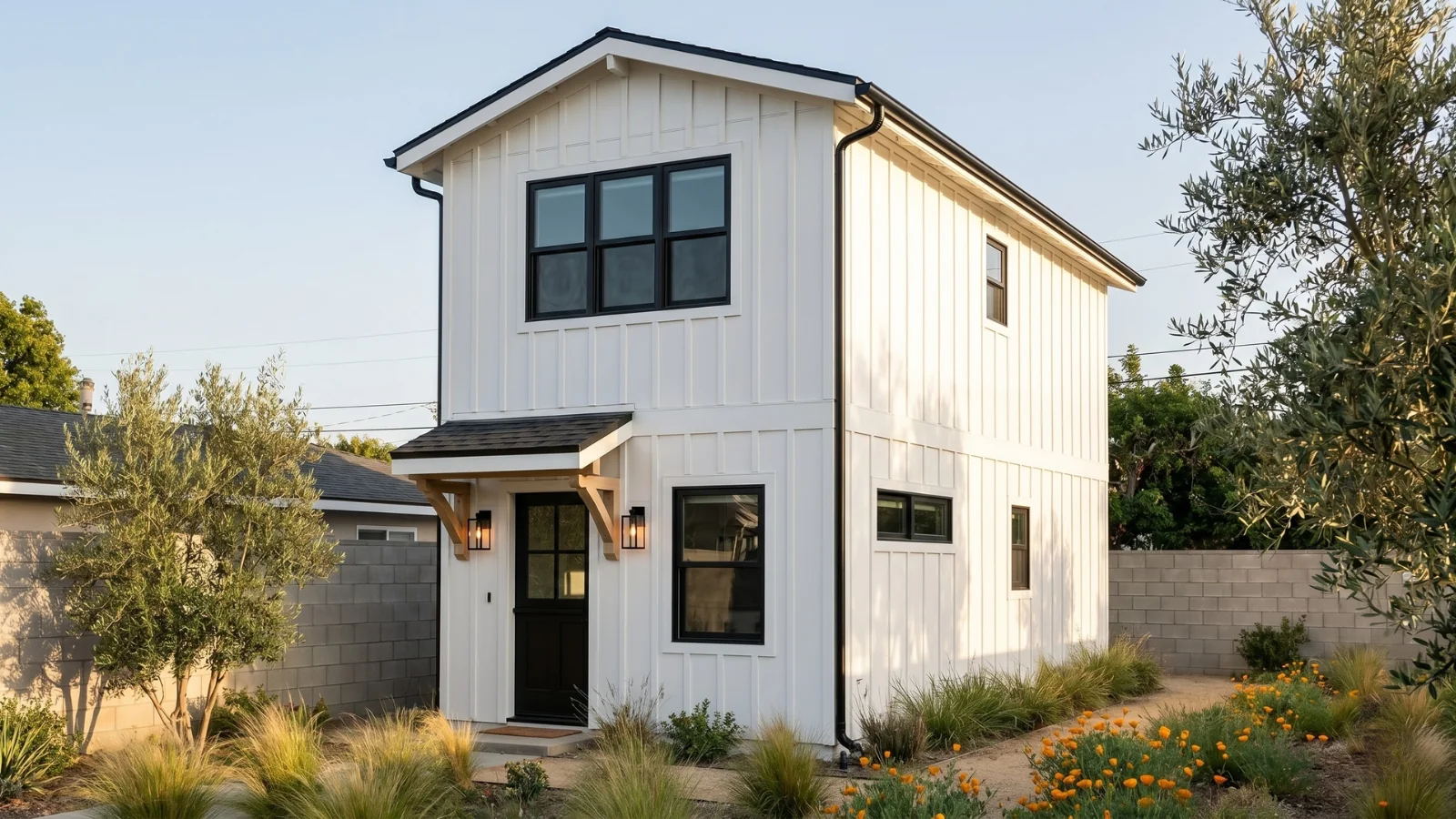
A newly built ADU in Lakewood may reach two and one-half stories, or 35 feet measured from finished grade to the highest roof ridge. A vertical addition above an existing building, such as a unit over a garage, gets the same 35 feet. A conversion takes the height of the structure it converts, and lofts are allowed wherever the building code permits them.
For comparison, Gov. Code § 66321(b)(4) obliges every California city to allow only 16 feet for a standard detached ADU, rising to 18 feet near high-quality transit or on a multistory multifamily lot. Lakewood roughly doubles that. A two-story detached ADU therefore reads as unusual here even though it is routine in this code.
Size, setbacks and the 800-square-foot floor
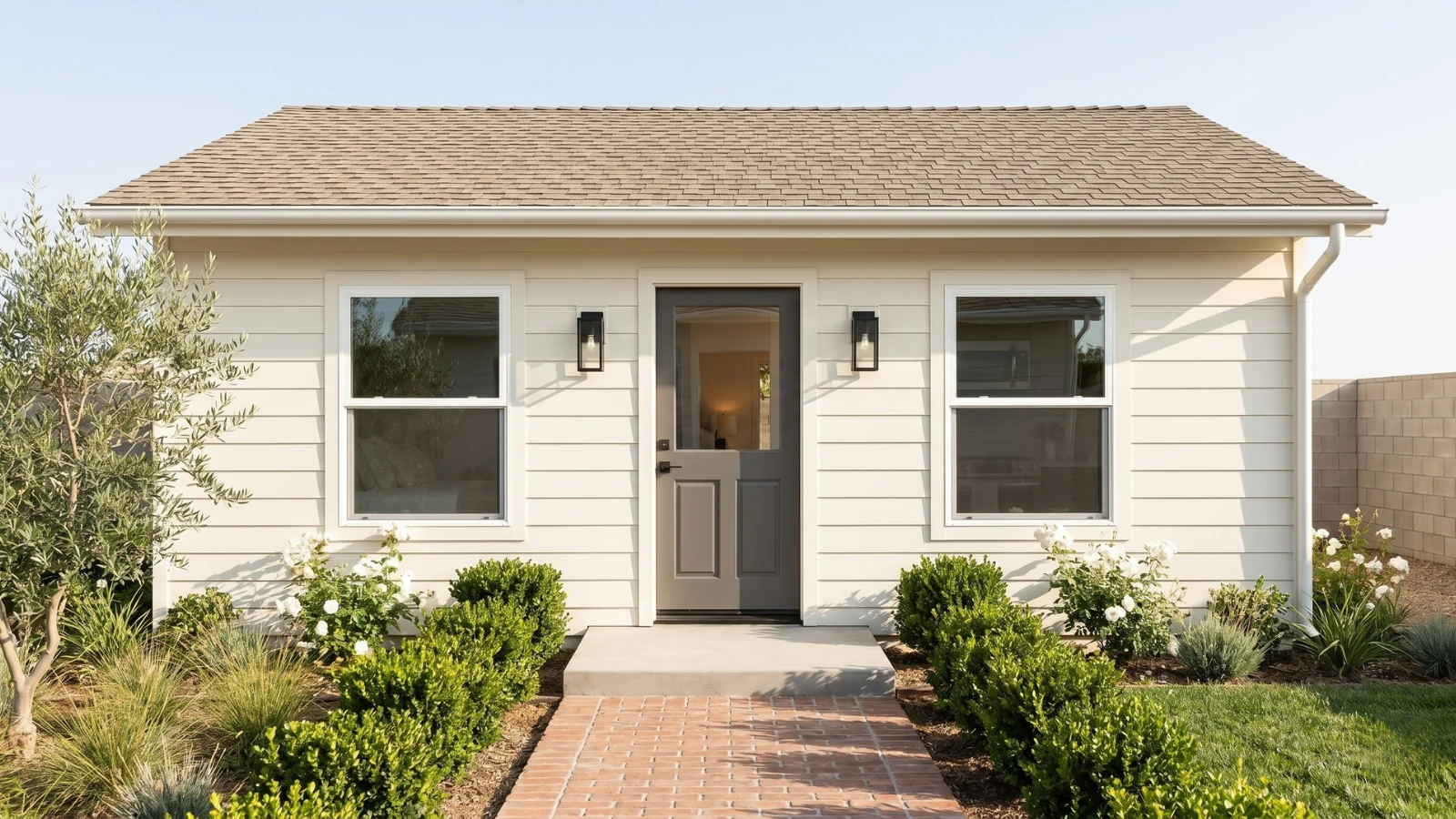
A new ADU runs from a 150-square-foot efficiency unit up to 1,200 square feet. A conversion of an existing structure may go beyond 1,200. An ADU attached to or carved out of the primary house is held to half that house’s floor area, with a hard carve-out: at least 800 square feet is always permitted, even when half the house is less than that.
Setbacks are four feet from the side and rear lines, with four feet clear between eaves. A conversion or a same-footprint replacement needs no additional setback and may add up to 150 square feet for ingress and egress. Los Angeles County Fire reviews access.
Parking, utilities and the small print
One parking space is the default, and six exemptions in LMC § 9302.21a(D)(6) remove it: a conversion of an existing garage, carport or covered parking; an ADU inside the existing house or an existing accessory structure; a location within half a mile of public transit; a historic district; an on-street permit area where the ADU occupant is not offered a permit; or a car-share vehicle within one block. Converting a garage never obliges you to replace the lost spaces.
Two further requirements catch people out. Every fully detached ADU must carry photovoltaic solar panels and be prewired for battery storage (LMC § 9302.21a(D)(8)(a)). And every ADU, attached or detached, must be designed with mobility accommodations — wider doorways and wider shower openings than older residential standards required (LMC § 9302.21a(D)(9)). Neither is expensive if it is drawn in from the start, and both are costly to retrofit after a correction letter.
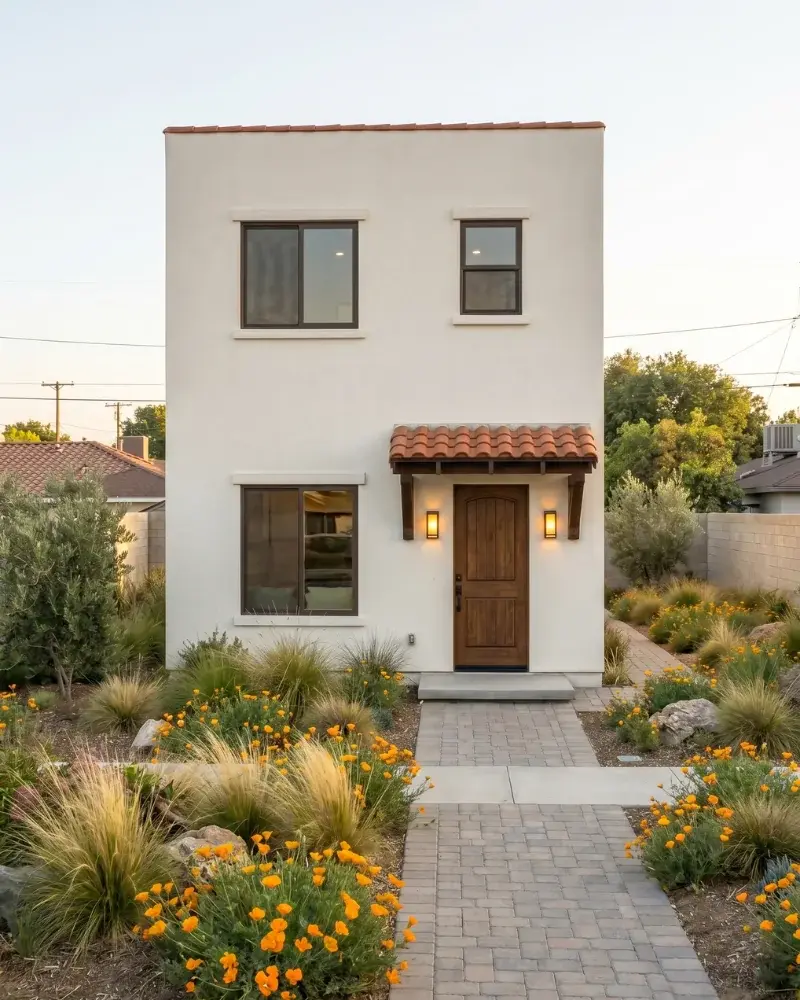
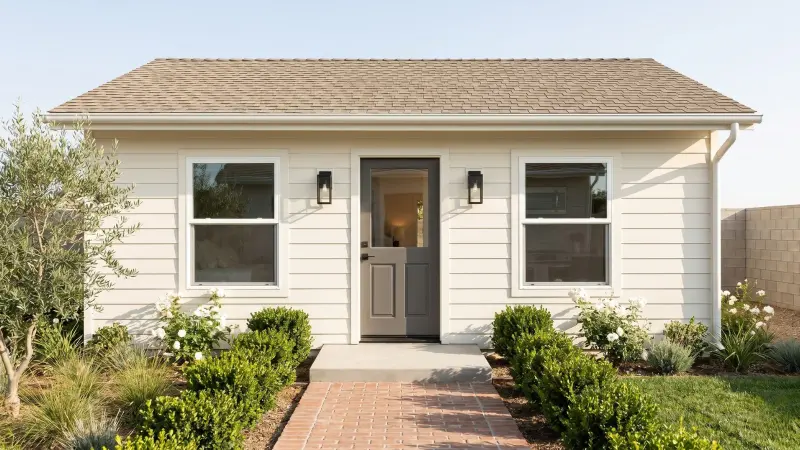
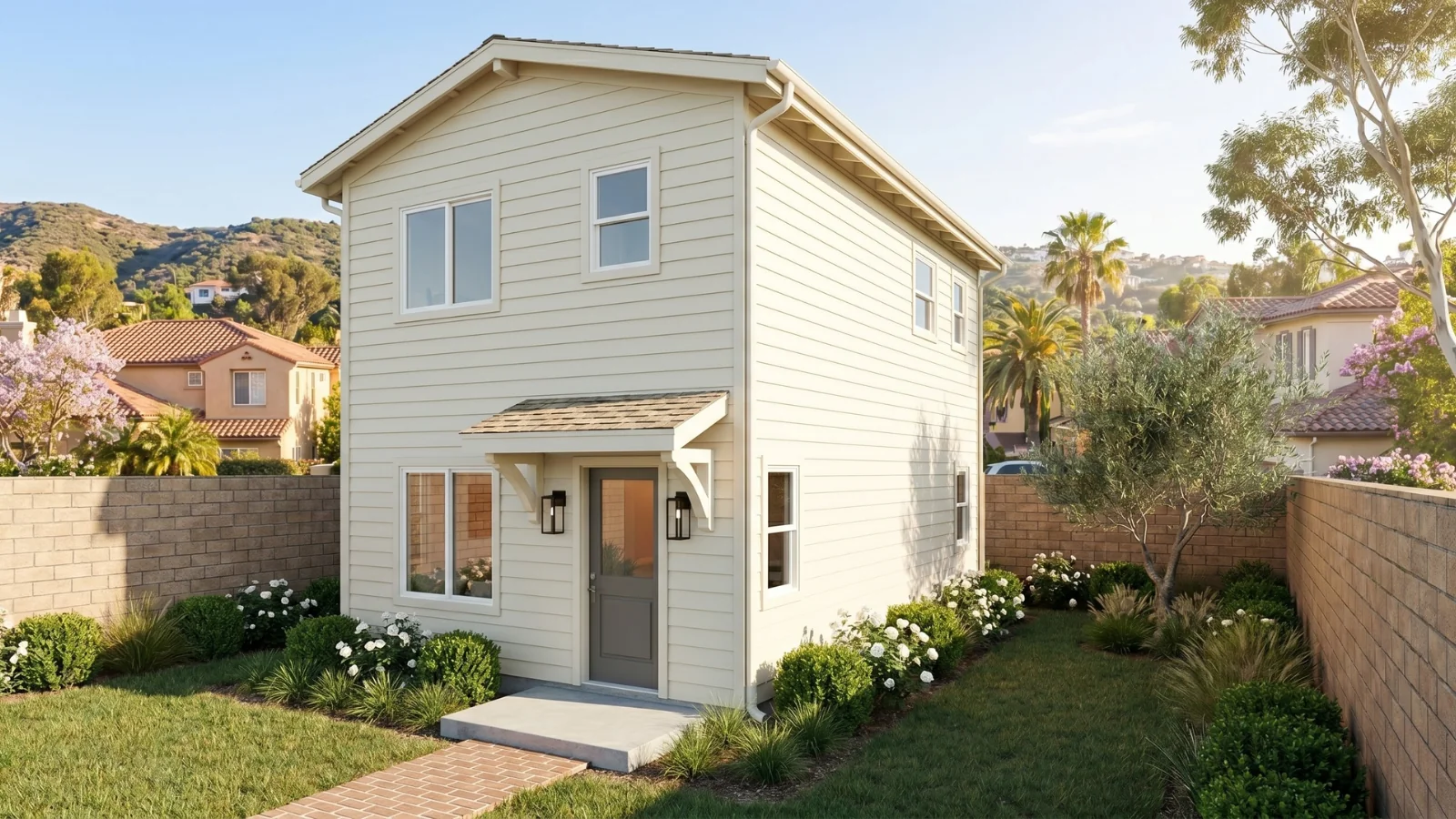
Signature Homes that fit Lakewood
Lakewood’s 35-foot allowance is one of the few in the county that lets our two-story plans stand detached exactly as drawn, so they lead here. Compact footprints, fixed pricing.
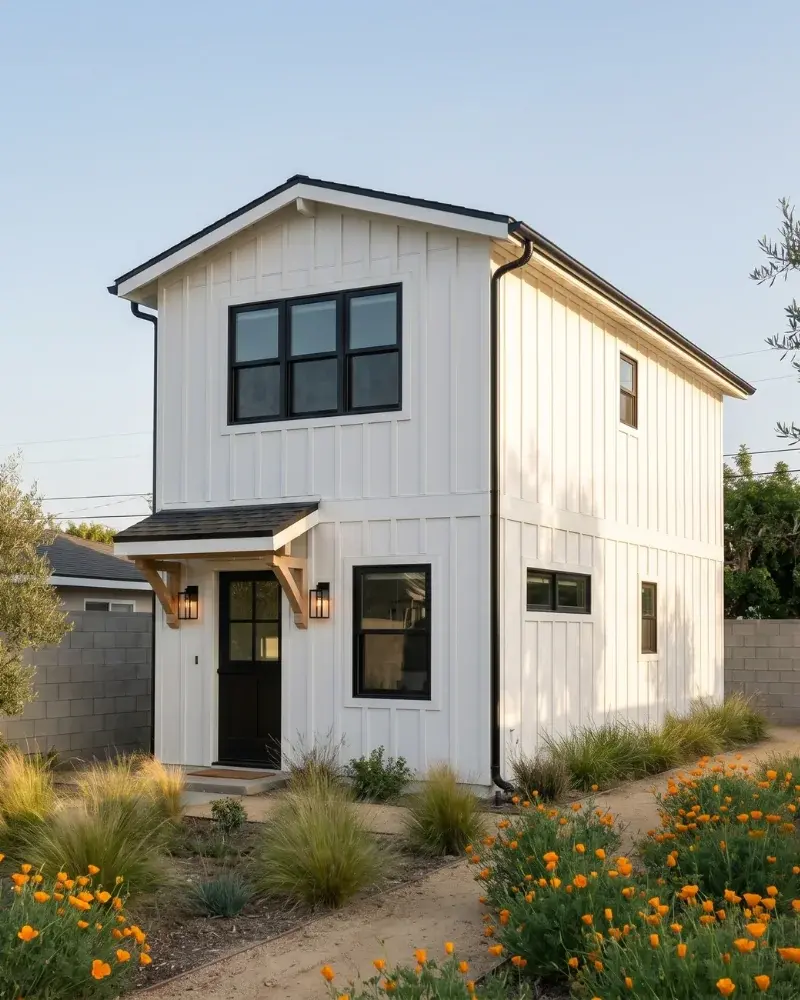
The Fairfax
The Venice
The Melrose
Those three are the plans that suit a Lakewood tract lot most often, not the whole range. If none of them is right, a Signature plan can be modified to your lot, or we design a custom ADU from scratch for $9,990 to $19,990 covering design and permit processing, with construction bid per project. See the full two-story collection.
What an ADU costs here in 2026
An ADU budget has three parts that behave very differently. The plan fee is fixed and known before you start. Construction is a range that narrows once we see your lot. City fees are mostly small and published, with one variable piece tied to construction valuation.
What the City of Lakewood charges
Two ADU-specific charges appear on the City Planning Fee Schedule revised April 28, 2025: an ADU / JADU / SB 9 review fee of $320 for one to three units, and a Construction of Dwelling Units Tax of $330 per dwelling unit under LMC § 6527.2.D.3. Building plan-check and permit fees are calculated on construction valuation rather than a flat rate, and school fees are paid directly to the school district.
What it returns
Lakewood sits inside the Los Angeles–Long Beach–Glendale HUD Metro Fair Market Rent Area. HUD’s revised FY 2026 Fair Market Rents for that area, published at 91 FR 21301 and effective May 21, 2026, are $2,079 for a studio, $2,328 for one bedroom, $2,903 for two bedrooms and $3,681 for three.
Read those as a floor, not a forecast. Fair Market Rents average across the entire metro and across housing of every age and condition, most of it decades older than anything you would build now. A new, permitted, detached two-bedroom unit typically rents at or above the two-bedroom figure. What it will actually fetch on your street is a question for a local agent, and worth asking before you commit.
The other half of the return is resale. A permitted ADU adds recorded square footage that comps into the sale of the property. An unpermitted conversion does the opposite: it is a disclosure problem and a financing problem, and it is the reason the state created a legalisation path for pre-2020 units at Gov. Code § 66311.7.
When an ADU isn’t the right move
Not every Lakewood property is a good candidate, and it is cheaper to learn that now than after you have paid for drawings. Four situations where we would tell you to wait, change type, or not build:
- Your numbers depend on short-term rental income. They will not work. Rentals under 31 days are prohibited for both ADUs and junior ADUs, the restriction is recorded against the title, and there is no carve-out to apply for. Run the maths on a 31-day-plus tenancy or reconsider the project.
- You need to sell the unit separately. Lakewood has not adopted an AB 1033 opt-in, so an ADU here cannot be conveyed as its own condominium. If a separate sale is the exit you are planning for, this is the wrong city and the wrong year to count on it.
- What is left of your lot after setbacks is very small. After four-foot side and rear setbacks and four feet of eave clearance from the house, some parcels cannot take a detached structure worth building. On those lots a garage conversion or a junior ADU usually returns more than forcing a new build into the gap.
- Your ADU depends on utility capacity the City says is not there. LMC § 9302.21a(D)(8) lets Lakewood deny a new detached ADU where it finds water, fire flow, sewer or electrical capacity inadequate. An ADU attached to the existing house is treated as an expansion of that house and is not subject to the finding. If your block is flagged, the attached or conversion route may be the only one open — find that out before you design.
How long the process takes
The permit step is the part people over-estimate. Because a Signature plan is pre-engineered and customised to your lot rather than drawn from nothing, the City is running a conformance review against objective standards, not evaluating a novel design. That clears plan check in weeks, not months.
| Phase | How long | What governs it |
|---|---|---|
| Signature plan preparation | ~2 weeks | Pre-engineered plan customised to your lot |
| Completeness determination | 15 business days | Written notice required — Gov. Code § 66317(a)(2)(A), added by SB 543 effective January 1, 2026 |
| Ministerial approval | 60 days | Deemed approved if the City misses it — Gov. Code § 66317(a) |
| Construction | 4–6 months | Under 600 sqft, 4 months · 600–800 sqft, 5 months · over 800 sqft, 6 months |
| Start to finish | ~6–9 months | Signature plans only |
Custom designs are slower, and it is worth being plain about why. A custom ADU adds bespoke design time at the front, and the City is reviewing those drawings for the first time rather than checking a familiar set against a lot. Both ends stretch. The six-to-nine-month figure above describes Signature plans.
The construction schedule is guaranteed in writing, with a daily delay penalty if the contracted finish date is missed. Design and permitting run under a single agreement, which is what keeps the handoff between them from becoming the delay.
The rules that make Lakewood different
Lakewood has no Coastal Zone, no state-designated very-high fire hazard severity zone, and no historic-preservation overlay. The complications that dominate ADU projects on the Westside or in the foothills simply are not here. What is here is a permissive height rule and an ordinance that the state has flagged as ageing.
The 2023 ordinance, and what the state said about it in 2026
Lakewood rewrote its ADU chapter through Ordinance No. 2023-1, amending LMC §§ 9302.1, 9302.21a and 9302.21b to conform to the 2022 state amendments — principally SB 897 on heights and AB 2221 on objective standards. The City has amended that text twice since — Ordinance No. 2023-6 and Ordinance No. 2025-3 (November 11, 2025) — and a further 2026 ADU ordinance went to the Planning and Environment Commission on September 3, 2026. As of this update the post-2025-3 text is the operative local law.
On May 11, 2026, HCD wrote to the City’s Community Development Director. The letter notes that the most recent ADU ordinance on file for Lakewood is from 2023 and that, given the volume of statutory change since, it may be outdated and out of compliance. HCD then listed the amendments — owner-occupancy, junior-ADU sanitation, the eight-detached multifamily rule, impact fees, the fifteen-business-day completeness notice, the SB 477 renumbering — and asked the City to respond by June 10, 2026 with either an explanation of continued compliance or a plan to repeal or amend.
Multifamily lots — the local cap is too low
On a lot with an existing or proposed multifamily complex of two or more attached units, LMC § 9302.21a(A)(2) allows no more than two externally detached ADUs, plus at least one internal ADU converted from non-habitable space, plus further internal conversions up to 25 percent of the existing primary units.
Junior ADUs and the bathroom question
A junior ADU in Lakewood is converted from existing or proposed floor area inside a single-family home or an attached accessory building. It runs 150 to 500 square feet, needs an efficiency kitchen and its own exterior door, and may either share the house’s bathroom through an internal doorway or have its own. It is allowed in the R-1, R-A, A and PD-SF zones, or wherever a legally established non-conforming single-family home stands.
Separate sale, and the one exception
Lakewood has adopted no AB 1033 opt-in ordinance, which is the precondition Gov. Code §§ 66340–66342 set before an ADU can be sold separately as a condominium. The Notice of Condition recorded against the property bars separate sale except as otherwise authorised by state law. The exception state law does provide, at Gov. Code § 66340, is a sale to a qualified nonprofit housing organisation. Unless the City opts in, that is the only separate-sale route available.
The fire-hydrant rule
LMC § 9302.21a(D)(8)(b) requires an ADU to sit within 450 feet of a fire hydrant with a clear path to run a hose to all parts of the unit. Fire sprinklers are not required for an ADU if they are not required for the primary dwelling, which tracks Gov. Code § 66314(d)(12). HCD’s 2023 review of the City’s previous ordinance objected to the 450-foot rule as an ADU-only standard unless it applies to all residential development. The provision survives in the 2023 text. On a flat, hydrant-dense grid like Lakewood it is rarely the binding constraint, but it is worth checking early if your lot is deep.
How much of this is actually happening
The City publishes its own counts. As of February 1, 2025 there were 320 ADUs permitted and built in Lakewood with another 349 in review or under construction, against roughly 22,700 single-family homes. Annual completions went from 46 in 2022 to 81 in 2023 to 120 in 2024. Around 1.4 percent of Lakewood houses have an ADU today and about the same share again have one in the pipeline. Staff see these applications constantly, which is generally good news for how smoothly a conforming set moves.
How permit approval actually works
Lakewood runs ADU applications through two desks in sequence, and knowing the order helps. Before Building and Safety will accept a plan-check application, planning staff screen the site plan, roof plan, floor plan and elevations for compliance with the objective design standards in the code. The City calls this the Ministerial Staff Review. It is a checklist exercise, not a judgement call — ministerial review means the City has no discretion to reject a conforming plan on taste.
| Step | What happens |
|---|---|
| 1. Ministerial Staff Review | Planning screens the site plan, roof plan, floor plan and elevations against the objective standards in LMC Article IX. Materials are submitted through the City’s OpenGov planning portal. |
| 2. Plan-check submittal | Building and Safety accepts the application once plans, structural calculations, Title 24 energy calculations and fees are complete. An incomplete package is returned with written comments listing each deficiency and how to cure it. |
| 3. Completeness notice | Written determination required within 15 business days (Gov. Code § 66317(a)(2)(A)). |
| 4. Ministerial decision | 60 days from a complete application, or deemed approved (Gov. Code § 66317(a)). Any demolition permit for a garage conversion or a same-footprint replacement is processed alongside the ADU, not before it. |
| 5. Construction and final | The primary house must have a passed final inspection before or at the same time as the ADU’s, so the ADU can be occupied. |
Two procedural points are worth holding on to. First, if the City denies or returns your plans it must give you a full set of written comments identifying what is deficient and describing how the application can be remedied. That is your correction list, and it is an obligation, not a courtesy. Second, since January 1, 2026 the City must also provide an appeal process for a denied or incomplete application, with a final written determination within 60 business days of a written appeal (Gov. Code § 66317(d)(1)).
If you already have an unpermitted unit on the property, there is a separate and more forgiving path. Gov. Code § 66311.7 bars a city from denying a permit for an ADU or junior ADU built before January 1, 2020 on building-code grounds, unless correcting the violation is necessary to stop the building being substandard. Lakewood also offers a five-year delay of code enforcement, on written request, where an existing violation would otherwise block an ADU and enforcement is not needed to protect health or safety (LMC § 9302.21a(C)(3)).
Lakewood ADU questions, answered
The questions Lakewood homeowners actually ask before they start — each answered from LMC §§ 9302.21a–9302.21b or the Government Code.
How tall can a detached ADU be in Lakewood?
Up to two and one-half stories, or 35 feet from finished grade to the highest roof ridge, for a newly built ADU (LMC § 9302.21a(D)(4)(a)). That is well above the 16-foot floor California requires every city to allow under Gov. Code § 66321(b)(4), and it is why a true two-story detached ADU is a by-right option in Lakewood. One exception: an ADU placed in the front yard is held to 18 feet if fully detached, or 25 feet if attached (LMC § 9302.21a(D)(4)(d)).
Can I build a two-story ADU in Lakewood without a variance?
Yes. A two-story detached ADU fits inside the 35-foot limit in LMC § 9302.21a(D)(4)(a) with room to spare, and ADU applications in Lakewood are reviewed ministerially — no hearing, no discretionary design review, no neighbor sign-off (Gov. Code § 66317). Build it in the rear yard rather than the front yard, where the detached limit drops to 18 feet.
How many ADUs can I have on a single-family lot in Lakewood?
Two, plus a junior ADU. LMC § 9302.21a(A)(1) directs the City to ministerially approve one conversion ADU carved from existing space and one newly constructed attached or detached ADU on the same lot, and LMC § 9302.21b allows one JADU on top of that. This matches the state stack at Gov. Code § 66323(a)(1)–(2). Counting your existing house and an SB 9 second unit, the ordinance sets a ceiling of four dwelling units on a lot that existed on January 1, 2022.
How big can a Lakewood ADU be?
A newly built ADU may run from 150 up to 1,200 square feet (LMC § 9302.21a(D)(3)). A conversion of an existing structure may exceed 1,200 square feet. An ADU attached to or converted from the primary house is limited to 50 percent of that house, except that at least 800 square feet is always allowed. Separately, LMC § 9302.21a(D)(7) bars the City from using lot coverage, floor-area ratio, open space, front setback or minimum lot size to block an 800-square-foot ADU with 4-foot side and rear setbacks — the same protection state law gives at Gov. Code § 66321(b)(3).
Does Lakewood require me to live on the property to build an ADU?
No — not for an ADU, despite what the local code still says. LMC § 9302.1(B)(1)(b) and LMC § 9302.21a(D)(12) require the owner to reside on the property for any ADU permitted on or after January 1, 2025, and call for a recorded Notice of Condition. That requirement is preempted: Gov. Code § 66315 prohibits a local agency from imposing owner-occupancy on an ADU, and HCD flagged this exact provision to Lakewood in its letter of May 11, 2026. Junior ADUs are different — see the next question.
Do the owner-occupancy rules apply to a junior ADU?
Only when the junior ADU shares a bathroom with the main house. AB 1154, effective January 1, 2026, narrowed Gov. Code § 66333(b) so that owner-occupancy attaches to a JADU only where sanitation facilities are shared. LMC § 9302.21b(C)(4)(a) still describes the older, broader rule and has not been amended, so state law controls. A JADU with its own bathroom is not subject to the mandate going forward.
Do I need to add a parking space for a Lakewood ADU?
Usually not. LMC § 9302.21a(D)(6) sets a default of one space but waives it under six conditions that cover most of the city: the ADU converts an existing garage, carport or covered parking structure; it is part of the existing house or an existing accessory building; it sits within half a mile of public transit; it is in a historic district; on-street permits are required but not offered to the ADU occupant; or a car-share vehicle is within one block. If you convert a garage, no replacement parking may be required at all (Gov. Code § 66314(d)(11)).
What are the setbacks for an ADU in Lakewood?
Four feet from the side and rear property lines, and a minimum four feet eave-to-eave between an ADU and any other building on the lot (LMC § 9302.21a(D)(2)). The front-yard setback is 20 feet, but an ADU of 800 square feet or less may project into it. A conversion, or a replacement built in the same location and dimensions as the structure it replaces, needs no additional setback, and up to 150 square feet may be added for ingress and egress.
How long does Lakewood take to approve an ADU permit?
State law gives the City 60 days to act on a complete application, and the application is deemed approved if it misses that deadline (Gov. Code § 66317(a)). Since January 1, 2026 the City must also tell you in writing within 15 business days whether your application is complete (Gov. Code § 66317(a)(2)(A), added by SB 543). Note that LMC § 9302.21a(C)(2) states a longer 60 business-day period and says a resubmittal restarts the clock. The shorter state deadline is the one that governs.
What does the City of Lakewood charge for an ADU permit?
Two ADU-specific charges are published on the City Planning Fee Schedule revised April 28, 2025: an ADU / JADU / SB 9 review fee of $320 for one to three units, and a Construction of Dwelling Units Tax of $330 per dwelling unit under LMC § 6527.2.D.3. Building plan-check and permit fees are calculated on construction valuation, and school fees are paid to the school district. Impact fees are a separate matter: an ADU of 750 square feet or less is exempt, and anything larger is charged proportionally to the size of the main house (Gov. Code § 66311.5(c)(1)).
Can I sell a Lakewood ADU separately from the main house?
No. Lakewood has not adopted an AB 1033 opt-in ordinance, which is what Gov. Code §§ 66340–66342 require before an ADU can be conveyed separately as a condominium. The Notice of Condition recorded against the property bars separate sale except as otherwise authorized by state law (LMC § 9302.21a(D)(12)(c)(4)). The narrow exception state law does provide is a sale to a qualified nonprofit housing organization under Gov. Code § 66340.
Can I rent a Lakewood ADU on Airbnb?
No. Both an ADU and a junior ADU may only be rented for terms of 31 days or more, and short-term home-share or whole-home rentals under 31 days are prohibited (LMC § 9302.21a(D)(12)(b); LMC § 9302.21b(C)(4)(b)). That restriction is also recorded in the Notice of Condition and runs with the land. State law points the same direction, requiring rental terms longer than 30 days (Gov. Code § 66323(e)).
Is Lakewood's ADU ordinance under review by the state?
Yes. On May 11, 2026 the California Department of Housing and Community Development sent Lakewood a Letter of Technical Assistance stating that the most recent ADU ordinance on file for the City is from 2023 and, given the volume of statutory change since, may be outdated and out of compliance. HCD listed the 2023 through 2025 amendments and asked the City to respond by June 10, 2026 with either an explanation of continued compliance or a plan to repeal or amend. Under Gov. Code § 66316 a noncompliant local ADU ordinance is null and void and the city must apply state law directly. Practically, this means where the local text is stricter than the Government Code, the Government Code is what governs your project.
Official sources
Where the local code and state law differ, the more permissive of the two controls. State law sets a floor no city may drop below, and Lakewood sets ceilings that on height and unit count sit well above that floor. On owner-occupancy and on multifamily lots the local text falls short and the Government Code fills in.
| Source | What it governs |
|---|---|
| Lakewood Ordinance No. 2023-1 (opens in a new tab) City of Lakewood, Office of the City Clerk · amends LMC §§ 9302.1, 9302.21a, 9302.21b, 9322.7, 9386 and 9477 | The operative local ADU chapter. Source for the 35-ft height limit, the 1,200 sqft cap, 4-ft setbacks, the six parking exemptions, the two-ADU stack, and the junior-ADU standards. |
| California Government Code §§ 66310–66342 (opens in a new tab) California Legislative Information · renumbered from former § 65852.2 et seq. by SB 477, eff. March 25, 2024 | State ADU law — the floor every city must meet. Source for the 60-day ministerial clock, the owner-occupancy and parking preemptions, the impact-fee exemption, and the multifamily unit counts. |
| HCD Letter of Technical Assistance to the City of Lakewood, May 11, 2026 (opens in a new tab) California Department of Housing and Community Development, Housing Accountability Unit | The state’s notice to Lakewood that its 2023 ordinance may be out of compliance, with the full list of 2023–2025 statutory changes and a requested response by June 10, 2026. |
| HCD ADU Handbook (opens in a new tab) California Department of Housing and Community Development · March 2026 edition | The state’s official interpretation of that law, and the position that controls where a local rule reads more narrowly. Every regulatory claim on this page was checked against it. |
| City of Lakewood — ADUs in Lakewood (opens in a new tab) lakewoodca.gov, Planning Division | The City’s own ADU explainer and the source of the permit counts quoted above. Start here to confirm anything with staff directly. |
| City of Lakewood — Pre-Approved ADU Program (opens in a new tab) lakewoodca.gov, Building and Safety · AB 1332 / Gov. Code § 65852.27 | The City’s pre-approved plan catalogue, the hold-harmless forms, and the OpenGov submittal portal. Also lists which fee categories apply to an ADU project. |
| City of Lakewood Planning Fee Schedule (opens in a new tab) lakewoodca.gov · revised April 28, 2025 | Source for the $320 ADU / JADU / SB 9 review fee and the $330 per-unit Construction of Dwelling Units Tax under LMC § 6527.2.D.3. |
Last verified against primary sources on September 23, 2026, including the full text of LMC §§ 9302.21a–9302.21b as amended through Ordinance No. 2025-3 and HCD’s letter of May 11, 2026. California ADU law changes every January 1, and Lakewood’s ordinance is currently under state review. If you are reading this six months from now, confirm the current version before you commit to a design — or call us and we will confirm it for you.
Not sure what your lot
can actually support?
Get clarity before you spend anything on plans. In 15 minutes we will pull up your property, run the LMC § 9302.21a numbers against your lot, tell you whether a two-story unit makes sense there, and give you an honest read on your options and a realistic budget — including whether an ADU is the right move at all.
15-minute video call · No obligation