
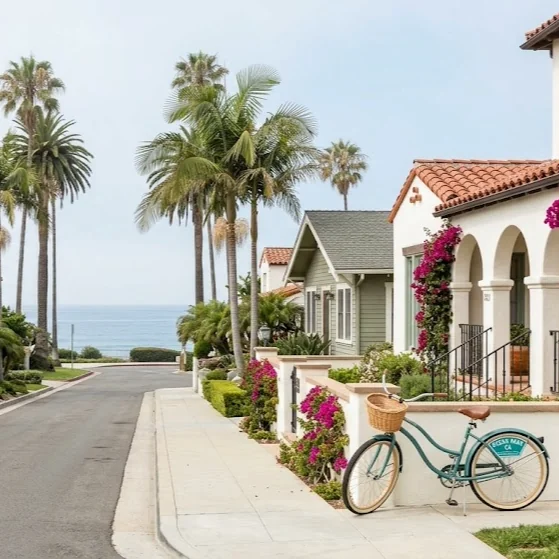
Building an ADU in Santa Monica. Rules, costs, timeline.
What SMMC § 9.31.025 actually allows, how the California Coastal Zone affects your permit timeline, and what it actually costs to build one on a Santa Monica lot in 2026.
What you can build — at a glance
Reviewed by CALI ADU’s ADU specialists · June 2026
- Max ADU size
- 850–1,200 sqft 850 sqft for a studio or one-bedroom, 1,200 sqft with two or more bedrooms.
- Detached height
- 24 ft, 2 stories A full two-story detached ADU by right — well above the 16 to 18 ft that state law sets as the minimum a city has to permit.
- Attached height
- Matches your house An attached ADU gets whatever height limit already applies to the primary dwelling in your zoning district.
- Side & rear setbacks
- 4 ft Four feet from the side and rear property lines, plus four feet of separation between the ADU and the main house.
- Units per SFR lot
- Up to 5 total Santa Monica allows four accessory units alongside your existing house: a converted ADU, a Junior ADU, a detached ADU and an attached ADU. That is more generous than the state floor, which guarantees a conversion ADU, a Junior ADU and a detached unit of up to 800 sqft.
- Parking required
- None Santa Monica imposes no on-site parking requirement for an ADU at all.
- Permit timeline
- 60 days Ministerial review with no public hearing. The clock starts once your application is complete.
- AB 1033 separate sale
- Yes — allowed Santa Monica has opted in, so an ADU can be sold separately from the main house through a condominium map. Most California cities have not done this.
- Detached Up to 1,200 sqft (2BR+) · 24 ft / 2 stories by right
- Attached Matches primary dwelling zoning height
- Junior ADU Up to 500 sqft inside primary dwelling
- Conversion Existing accessory structure to ADU
- Exemption ADU 800 sqft / 16 ft state-law floor (Gov. Code § 66323)
Per SMMC § 9.31.025 and Gov. Code §§ 66310–66342. Units-per-lot figure reflects the state-law stack confirmed by the HCD ADU Handbook (March 2026). Full citations in the sections below.
On this page
Can I build an ADU in Santa Monica?
Five things to know before you start
If you read nothing else on this page, read these. They are the five points that change the most Santa Monica projects.
| What to know | Why it matters for your project |
|---|---|
| 1. State law overrides parts of the local code | Santa Monica cannot require you to live on the property (Gov. Code § 66315), cannot make you replace parking lost to a garage conversion (Gov. Code § 66314(d)(11)), and must decide a complete application in 60 days (Gov. Code § 66317). Older advice you may have read no longer applies. |
| 2. Two stories is by right here | A detached ADU may be 2 stories / 24 ft (SMMC § 9.31.025) — taller than the 16–18 ft floor most LA-area cities enforce. No variance, no hearing. It is the single biggest design advantage of building in Santa Monica. |
| 3. Your lot may allow more than one unit | On an R1 parcel the City’s ADU Guide permits a converted ADU, a JADU, a detached ADU, and an attached ADU in combination — four accessory units on top of your existing house, for five dwelling units on the parcel. Most homeowners assume the limit is one. |
| 4. The Coastal Zone runs alongside, not afterwards | West of Lincoln Boulevard (plus parts of Ocean Park and the beachfront), expect a Coastal Development Permit or Waiver through the California Coastal Commission. Since October 2025, Gov. Code § 66329 requires that review to run concurrently with your building permit, on its own 60-day clock, with no public hearing. Confirm your parcel’s status before you commit to a schedule. |
| 5. Short-term rental is off the table | The City’s ADU Guide prohibits rentals of 30 days or less, and SMMC Chapter 6.20 bans vacation rentals citywide. If your numbers depend on nightly income, they will not work here — plan for a 30+ day tenancy. |
Number of ADUs per parcel — Santa Monica allows four accessory units on an R1 lot
The Guide allows all of the following on a parcel with a Single-Unit Dwelling, in combination:
| Unit | How many | Conditions |
|---|---|---|
| Converted ADU | 1 | Carved out of the existing or proposed SUD, an attached accessory structure (like an attached garage), or a detached accessory structure |
| JADU | 1 | Within the SUD footprint · ≤ 500 sqft · deed restricted |
| Detached ADU | 1 | A new free-standing structure |
| Attached ADU | 1 | R1 Zoning District parcels only · requires a deed restriction |
On an R1 lot that is four accessory units in addition to your existing house — five dwelling units on the parcel. Outside R1 the attached ADU is not available, so the maximum is three accessory units plus the house, for four in all. Either way it is materially more generous than the state-law floor, which is itself a stack: a conversion ADU, a JADU, and a detached ADU (Gov. Code § 66323(a)(1)–(2)). On multifamily parcels, Gov. Code § 66323(a)(4) (as amended by SB 1211, 2024) independently allows up to eight detached ADUs on a lot with an existing multifamily dwelling.
Owner-occupancy
You do not have to live on the property to build or rent an ADU. Gov. Code § 66315 bars Santa Monica from imposing an owner-occupancy requirement on an accessory dwelling unit. A junior ADU is the one exception — and a narrow one after AB 1154 (effective January 1, 2026), which amended Gov. Code § 66333 so the requirement reaches only a JADU that shares sanitation facilities with the primary home. Give the JADU its own bathroom and owner-occupancy no longer applies. The JADU still records the deed restriction prohibiting separate sale (SMMC § 9.31.025).
What can you build?
The numbers below come directly from the City's official ADU and JADU Guide — Parcels with a Single-Unit Dwelling (Santa Monica CDD, November 2025) and SMMC § 9.31.025. On several standards — most notably height and the number of ADUs permitted per parcel — Santa Monica is more permissive than the state-law floor. On the rest, the City meets the state minimum. Homeowners may also elect to build under the State Mandated standards instead of Santa Monica's standards where that produces a better result.
Which ADU type fits your property?
Santa Monica permits five types, and the right one is usually decided by your lot and your goal rather than by preference. Start here, then read the standards below against the type you land on.
| If this sounds like you | Start with | What that means |
|---|---|---|
| You have usable backyard and want the most space, privacy, and rental value | Detached ADU | Up to 850 sqft (studio/1BR) or 1,200 sqft (2BR+), 2 stories / 24 ft by right, 4-ft setbacks, 4-ft separation from the house |
| Your lot is tight, or you want to keep as much yard as possible | Two-story detached ADU | The same 1,000–1,200 sqft on roughly half the footprint — the reason Santa Monica’s 24-ft allowance matters |
| You have an existing garage or accessory structure you rarely use | Conversion ADU | Limited to the existing floor area (expandable up to the size caps if other standards are met), no setback required for reusing the structure, and no replacement parking |
| You want to attach the unit to the house, or the yard cannot take a separate structure | Attached ADU | Follows the underlying zoning district’s height limit for the primary dwelling. In the R1 zone only, it can be added in addition to a detached ADU, with a deed restriction. |
| You are housing a family member and want the simplest, lowest-cost path | Junior ADU (JADU) | Up to 500 sqft carved out of the existing house, deed restricted. Owner-occupancy applies only if it shares a bathroom with the main home (AB 1154). A JADU may not be sold separately. |
| You want the option to sell the unit on its own one day | Detached or converted ADU | Santa Monica opted into AB 1033, so an ADU can be sold separately as a condominium under SMMC § 9.31.026. JADUs are excluded from that path. |
Maximum size
| Standard | Limit |
|---|---|
| Studio or 1-bedroom ADU | Up to 850 sqft |
| 2-bedroom or more | Up to 1,200 sqft |
| Minimum size | 150 sqft of floor area |
| JADU | Up to 500 sqft (Gov. Code § 66313(d); SMMC § 9.31.025) |
| Conversion of an existing SUD | May not exceed 50% of the existing primary dwelling or the caps above, whichever is less — but a minimum of 800 sqft is expressly guaranteed regardless |
| Conversion of an existing detached accessory structure | Limited to the existing floor area, with expansion permitted up to the maximum size caps if all other standards are met |
The 800-sqft guaranteed floor is the number to remember: it is what makes a conversion on a small primary dwelling still viable.
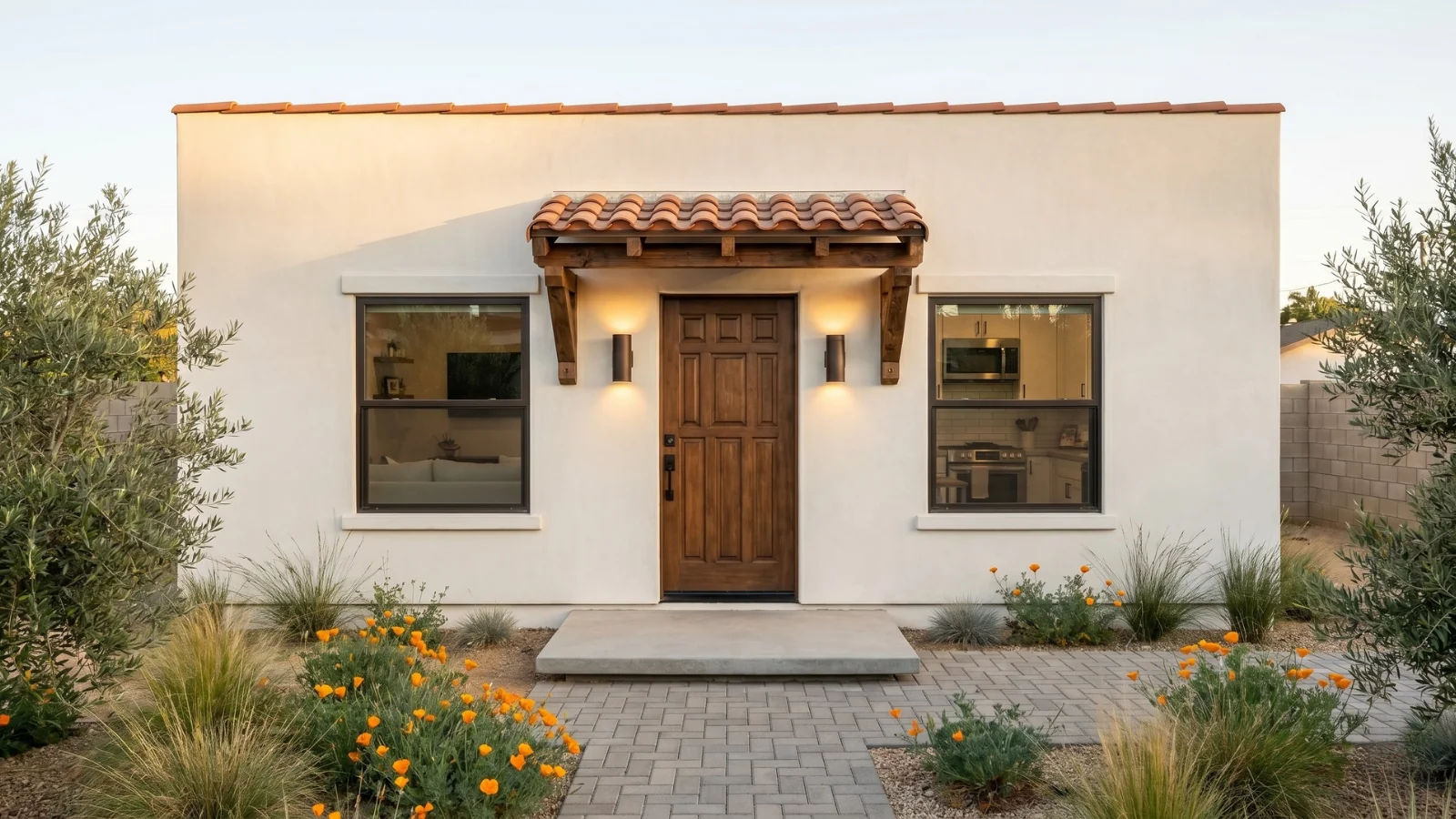
Maximum height in Santa Monica: 2 stories, 24 feet by right
| ADU type | Height limit |
|---|---|
| Detached ADU | 2 stories or 24 feet, by right (SMMC § 9.31.025; ADU Guide p. 9) |
| ADU within an existing or proposed SUD | Underlying zoning district’s height limit for the primary dwelling |
| Attached ADU (R1 zone) | Underlying zoning district’s height limit for the primary dwelling |
| How height is measured | Per SMMC § 9.04.050 (Measuring Height) — most flat parcels use Average Natural Grade (ANG) |
The 24-foot standard is taller than the 16-foot and 18-foot floors state law (Gov. Code § 66321) requires every California city to allow. If you want two stories on a detached ADU in Santa Monica, you can have them without variance or discretionary approval.
Setbacks and separation
| Standard | Rule |
|---|---|
| Side and rear setbacks | 4 feet |
| Front setback | ADUs are not permitted within the required front setback of the underlying zoning district |
| Separation from the primary dwelling | 4 feet minimum between a detached ADU and the primary dwelling, measured between exterior walls — unenclosed access features like exterior stairs may intrude into that separation |
| Conversions and rebuilds | No setback required for an ADU that reuses an existing living area or accessory structure, or a structure rebuilt in the same location and dimensions — including existing unpermitted structures built before January 1, 2020 (AB 2533, 2024) |
Parking
| Requirement | Santa Monica rule |
|---|---|
| On-site parking for the ADU or JADU | None. Per the ADU Guide and SMMC § 9.31.025 — independent of the transit-proximity and car-share exemptions in Gov. Code § 66322 (2022). Santa Monica simply does not impose the requirement in the first place. |
| Replacement parking when a garage is converted | Not required. Eliminated parking need not be replaced; SB 1211 (2024) separately eliminated replacement parking for uncovered off-street spaces at the state level. |
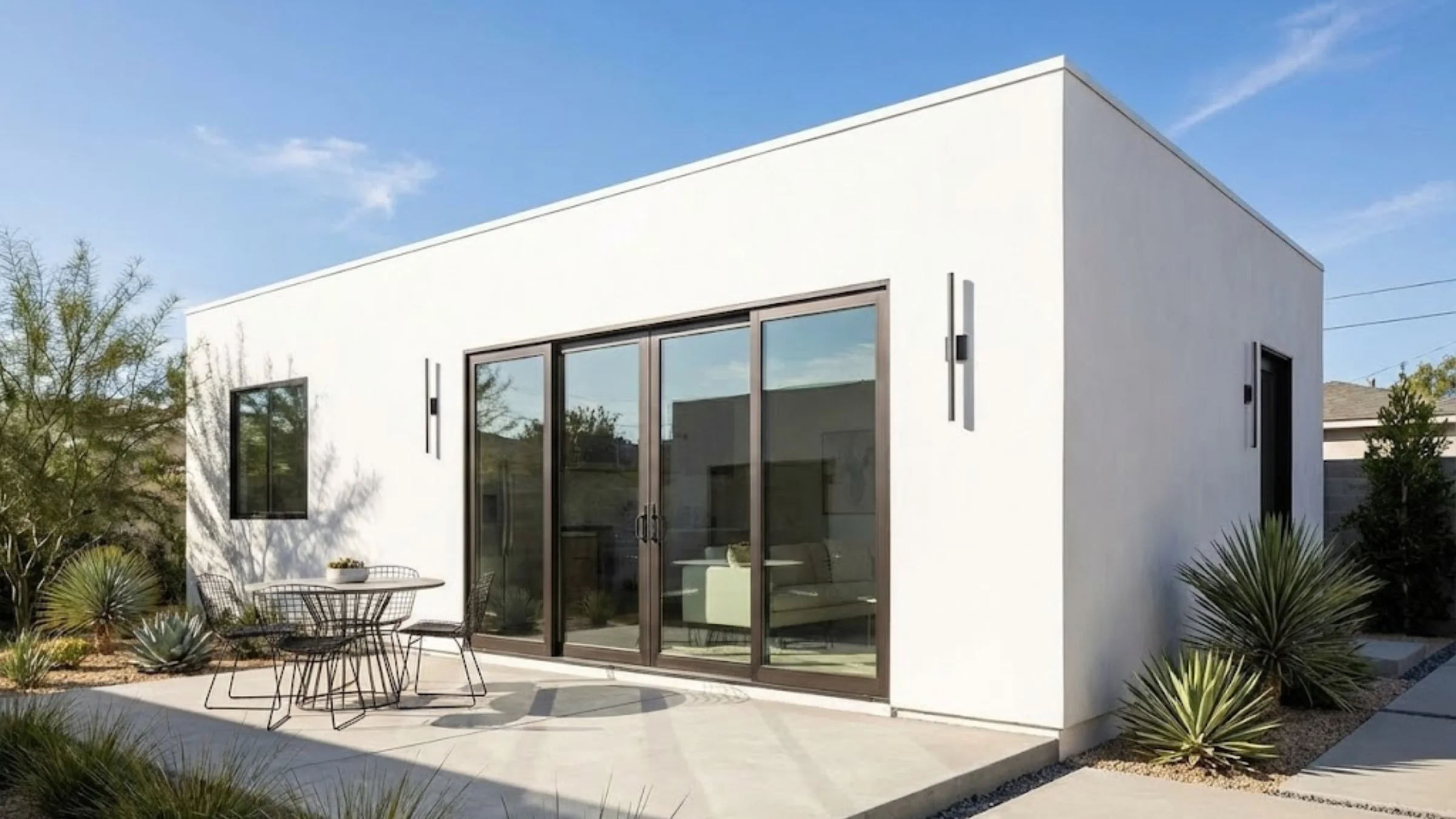
The dual-track option: state standards as an alternative
The Guide repeats a sentence on every section — converted ADU, JADU, detached ADU, and R1 attached ADU — that is worth reading carefully: "Alternative to the above Santa Monica standards, ADUs may be established ... with the State Mandated standards as set for in SMMC Section 9.31.025." Translation: if the Santa Monica standard is more restrictive than state law in a given situation, you can elect to build under the state-mandated standard instead.
Two stories is the Santa Monica advantage
Santa Monica's typical single-family lot is 5,000 to 7,500 sqft. Subtract the existing house footprint, the 4-foot separation between the detached ADU and the primary dwelling, the 4-foot side and rear setbacks, and the front setback, and the footprint math for a 1,000 sqft single-story ADU gets tight fast — and eats most of your usable yard.
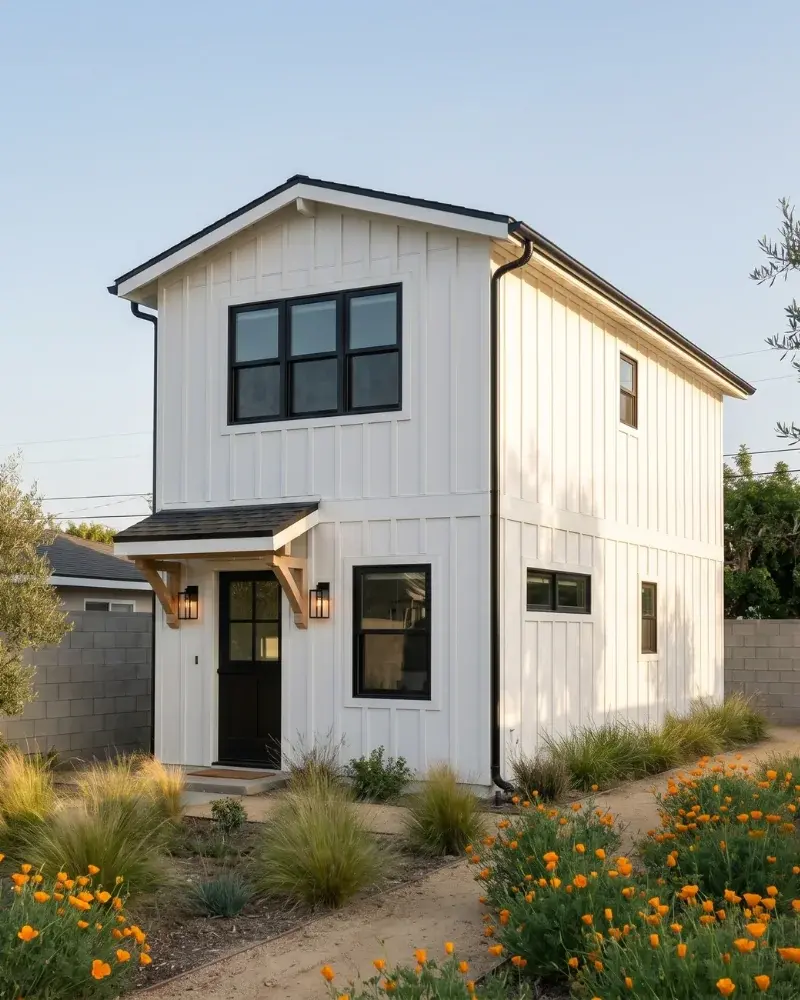
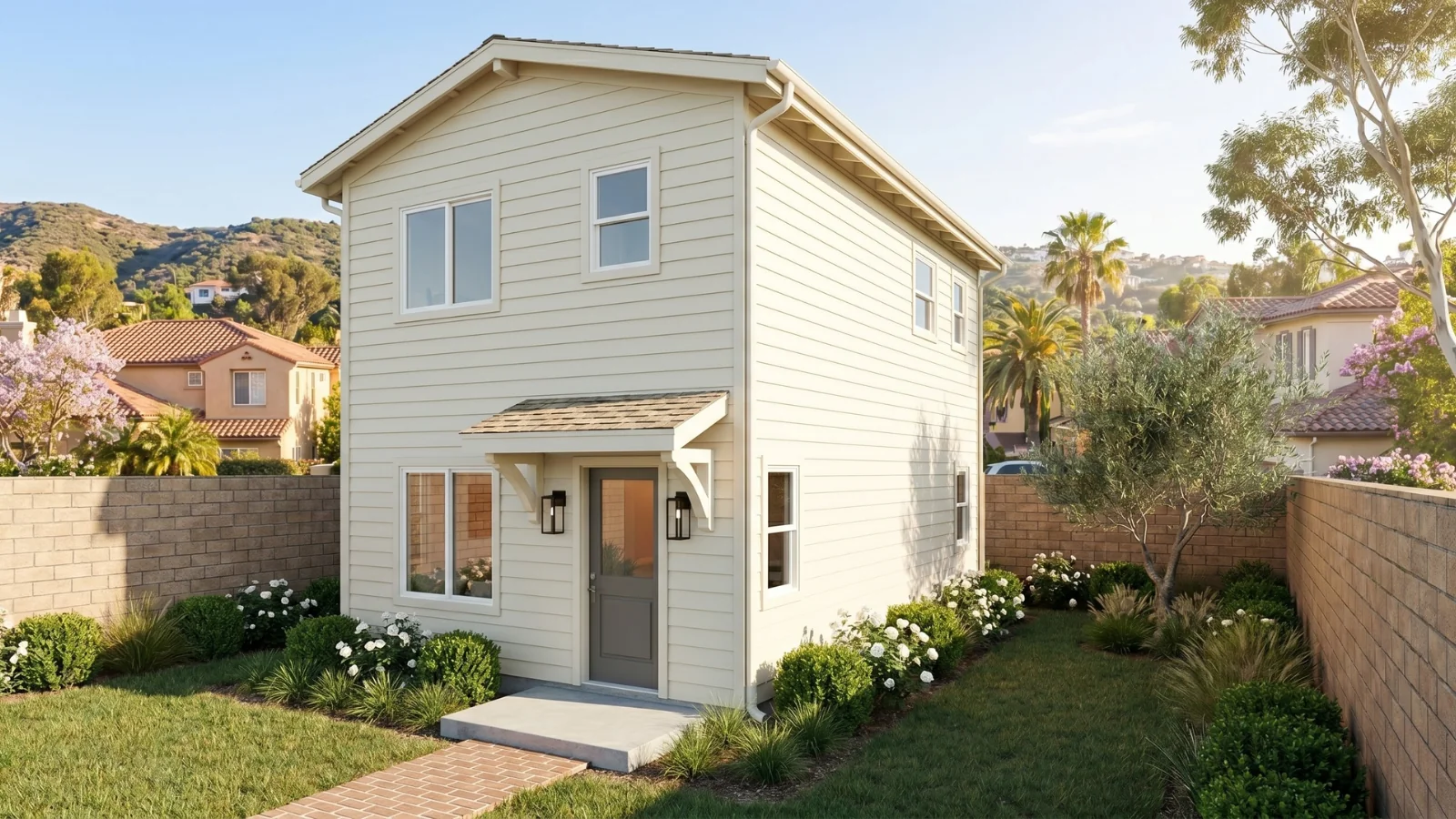
A two-story ADU solves the problem by building up instead of out. The same 1,000–1,200 sqft fits on a footprint half the size. You keep your yard, you keep sight lines from the main house, and you comply with SMMC § 9.31.025's 24-foot / 2-story by-right detached-ADU standard — which is taller than the 16-foot and 18-foot minimums state law requires. Santa Monica is one of the few LA-area cities where the two-story detached ADU is not a variance conversation; it is the ordinance.
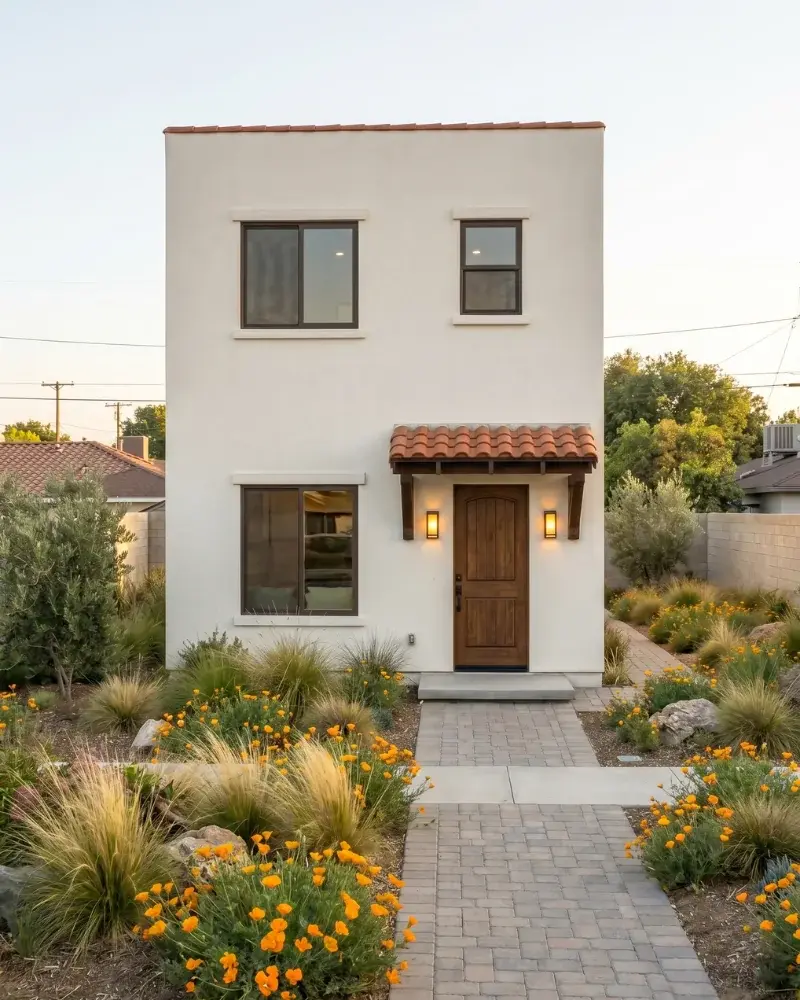
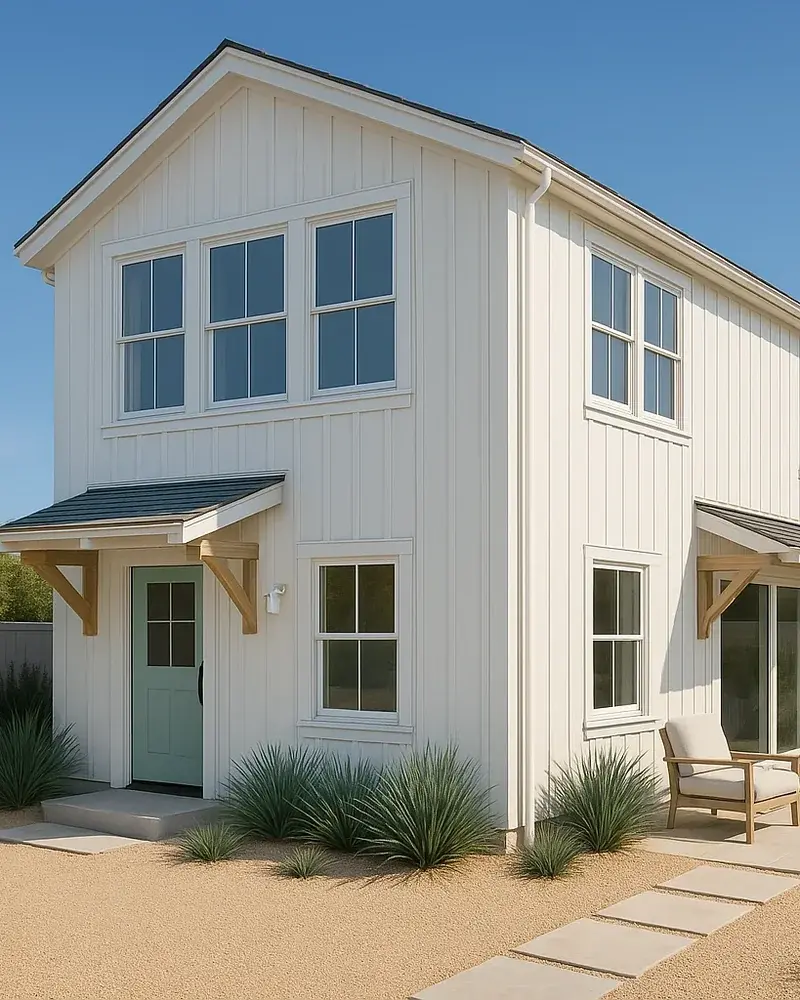
Several of our Signature Homes are two-story and designed specifically for this condition:
- The Fairfax ADU — 2BR/1.5BA, 840 sqft, 448 sqft footprint. The smallest two-story option we offer.
- The Venice ADU — 2BR/2.5BA, 1,080 sqft, 540 sqft footprint. Our most popular two-story for Westside lots.
- The Culver ADU — 3BR/2.5BA, 1,200 sqft, 600 sqft footprint. Sized at the ceiling Santa Monica permits for a 2BR+ detached ADU, on the minimum feasible footprint.
All three clear SMMC § 9.31.025's objective standards (24-ft / 2-story height, 4-ft setbacks, 4-ft separation) and Gov. Code §§ 66314–66323 floors. Coastal Zone parcels also run a CDP or Waiver in parallel.
The two-story Signature ADU
Designed for Santa Monica's by-right 2-story / 24-foot envelope under SMMC § 9.31.025. Compact footprints. Transparent pricing. The only productized two-story ADU lineup in LA.
What an ADU costs in Santa Monica (2026)
Our Signature plans are fixed-price — architectural design and full permit processing included, the same number whether the lot is in Santa Monica, Culver City, or the Valley. Construction is separate: once your plans are permitted, you build with our construction partner or your own licensed contractor. The figures below are the estimated cost to build each model. Here is the lineup:
| Model | Configuration | Size | Collection | Est. cost to build |
|---|---|---|---|---|
| The Wilshire | Studio / 1BR | 400 sqft | Single-story | $180K–$200K |
| The Sunset | 1BR/1BA | 480 sqft | Single-story | $200K–$215K |
| The Westwood | 1BR/1BA | 550 sqft | Single-story | $215K–$235K |
| The Laurel Canyon | 2BR/1BA | 660 sqft | Single-story | $240K–$265K |
| The Melrose | 2BR/2BA | 800 sqft | Single-story | $275K–$295K |
| The Fairfax | 2BR/1.5BA | 840 sqft | Two-story | $280K–$310K |
| The Lincoln | 3BR/2BA | 1,000 sqft | Single-story | $325K–$350K |
| The Venice | 2BR/2.5BA | 1,080 sqft | Two-story | $335K–$365K |
| The Culver | 3BR/2.5BA | 1,200 sqft | Two-story | $385K–$420K |
What is fixed is the plan: our Signature plan fees run $7,490 to $12,990 — architectural design and full permit processing included. We can quote it because our Signature Homes were engineered to pass Santa Monica's objective standards in SMMC § 9.31.025 on paper. The build figures above are estimates, roughly $180K–$420K across the lineup. Build with our construction partner or your own licensed contractor.
Not in either number: your standard Santa Monica building-permit and plan-check fees (based on valuation, payable directly to the City), utility connection fees (SoCal Edison, Southern California Gas, Santa Monica Water), and — if your parcel is in the Coastal Zone — your CDP processing fee. Your Backyard Review includes a line-item estimate of those pass-through costs for your specific lot.
For sizing and payback math: try our ADU calculator and the ROI calculator.
Development fees
State law (Gov. Code § 66311.5(c)(1)) prohibits impact fees on any ADU under 750 sqft and caps fees on larger ADUs at a share proportional to the primary dwelling. You will still pay standard building-permit and plan-check fees — which are based on project valuation, not on the fact that you are building an ADU — and utility connection fees where required.
What it returns: renting your ADU
Santa Monica blocks short-term rentals (SMMC Chapter 6.20). That sounds restrictive. It actually helps owners.
Long-term rents in Santa Monica are among the highest in LA County. Supply of legal, fully-permitted detached rentals is tight. Tight supply protects pricing.
The trusted benchmark is HUD’s Fair Market Rent for the Los Angeles–Long Beach–Glendale metro area (FY 2026, revised effective May 21, 2026). A new, fully permitted detached ADU in Santa Monica typically rents at or above the metro FMR. Here is how the market breaks down by unit type:
| Unit type | Typical ADU size | HUD FMR (FY 2026, LA metro) | Typical Santa Monica rent |
|---|---|---|---|
| Studio | ~400 sqft | $2,079 | $2,800 – $3,400 |
| 1 bedroom | 480–550 sqft | $2,328 | $3,200 – $4,000 |
| 2 bedroom | 660–1,080 sqft | $2,903 | $3,800 – $5,600 |
| 3 bedroom | 1,000–1,200 sqft | $3,681 | $5,200 – $7,000 |
Every Signature Home maps onto these bands — the Melrose rents as a 2-bedroom, the Lincoln as a 3-bedroom. The full lineup with build costs is in the cost table above. For payback math keyed to your specific lot and financing assumptions, use the ADU ROI calculator.
HUD FMR figures: FY 2026 Fair Market Rents, Los Angeles–Long Beach–Glendale HUD Metro FMR Area, as revised effective May 21, 2026 (huduser.gov; Federal Register, Apr. 21, 2026). The Santa Monica rent ranges are estimates drawn from publicly available Santa Monica listings for comparable 30+ day rentals — a typical spread, not an average or an appraisal. They are not a guarantee. Your specific ADU's performance depends on finish level, lot, access, parking, and the rental market at the time you lease it. Ranges reflect typical market variability between a "good" and "very good" Santa Monica micro-location; truly premium blocks (e.g. north of Montana, direct beach-adjacent) can exceed the high end.
Why the Santa Monica market rewards the investment
Between the Coastal Zone overlay, the Chapter 6.20 short- term rental rules, and the rent-control regime, Santa Monica has more regulatory complexity than most LA County jurisdictions. Why build here anyway?
- Two-story, 24-foot detached ADUs by right. SMMC § 9.31.025 is more permissive than state law on detached-ADU height. Most LA-area cities build to the 16/18-ft state floor. Santa Monica gives you the extra story without a variance conversation.
- Four accessory units on an R1 lot — five dwelling units in all. The Guide's combination rule (1 converted + 1 JADU + 1 detached + 1 attached on R1), added to the house already standing, is materially more generous than the state-law floor. That is real density — and real rental yield — on a single-family parcel.
- ADU-as-condo is on the table. SMMC § 9.31.026 gives you a separate-sale exit under AB 1033 that most LA-area cities simply do not offer.
- On-site parking is not required. The ordinance does not impose it. For a Westside lot where every square foot matters, that is worth five figures in design optionality alone.
- Long-term rents are among the highest in the county. The absence of STR supply tightens the long-term rental market, which benefits legal, fully-permitted ADU owners.
- Ministerial approval is real. If the plan meets SMMC § 9.31.025 on paper, the City has no discretion to reject it. No design review, no neighbor appeal path.
- Property values among the most resilient in California. A fully permitted ADU adds square footage that comps directly into resale. In a market where comps are rare because turnover is low, that is real money.
- State law backstops the city. Even when the City is slow on something, Gov. Code §§ 66310–66342 preempts. The 60-day clock under § 66317 runs. The state-mandated minimums apply.
When an ADU isn’t the right move
Not every Santa Monica property is a good ADU candidate, and it is cheaper to learn that now than after you have paid for plans. Four situations where we would tell you to wait, choose a different unit type, or not build at all:
- Your numbers depend on short-term rental income. They will not work. Rentals of 30 days or less are prohibited (SMMC Chapter 6.20), and no ADU carve-out exists. Run the math on a 30+ day tenancy or reconsider the project.
- You need to sell the unit soon. Santa Monica does allow a separate ADU sale under SMMC § 9.31.026 — but a condominium conversion is its own process on top of building the unit. As a fast exit, it is the wrong plan.
- What is left of your lot after setbacks is very small. After the 4-ft side and rear setbacks and the 4-ft separation from the house, some parcels simply cannot take a detached structure worth building. On those lots a garage conversion or a JADU usually delivers more value than forcing a new build.
- You are in the Coastal Zone and need a firm, short timeline. The Coastal Development Permit or Waiver runs on the Coastal Commission’s schedule, not the City’s 60-day ministerial clock. If a hard deadline drives the project, factor that in before you start — it is not something any builder can compress.
How long an ADU takes
Here is what the timeline actually looks like on a Signature plan:
| Phase | Duration | Notes |
|---|---|---|
| Signature plan preparation | ~2 weeks | Pre-engineered plan customized to your lot |
| City completeness check | 15 business days | SB 543 (eff. Jan. 1, 2026); Gov. Code § 66317(a)(2) |
| Plan check & approval | 60 days to a decision · plan on 3–5 months with corrections | Gov. Code § 66317(a) requires the City to approve or deny a complete application within 60 days, and the project is deemed approved if it misses that window. Santa Monica generally meets it on the first pass. The added months come from what follows: most submittals come back with plan-check corrections, and the calendar then depends on your turnaround and the City’s — typically a couple of weeks per round, though it varies. |
| Construction | 4–6 months | By model size — the schedule is guaranteed in writing, with a daily delay penalty if the contracted finish date is missed |
| Total, start to finish | 9–12 months | Signature plans in Santa Monica. Our company-wide baseline is 6–9 months; Santa Monica has consistently run longer for us, so this page quotes what we actually see here. Custom designs add bespoke design time and a longer plan check, because the City is reviewing the drawings for the first time. |
If your parcel is in the Coastal Zone
Expect the coastal review to add weeks, not months, to an otherwise ministerial ADU permit. The state 60-day clock under Gov. Code § 66317 applies to the building permit itself, and the coastal review runs in parallel. For higher-risk lots — beachfront, bluff-top, or in an appealable zone — we build extra float into the schedule.
That parallel track is not just how it tends to work. Since October 10, 2025, Gov. Code § 66329 requires it. AB 462 rewrote the section to put a Coastal Development Permit for an ADU on its own clock, and the terms are better than most homeowners expect.
The rules that make Santa Monica different
The Coastal Zone
The California Coastal Act (Pub. Resources Code § 30000 et seq.) designates a Coastal Zone along the state's coastline. If your parcel sits inside that zone, the City's ADU Guide states plainly: "if the parcel is within the Coastal Zone, a Coastal Development Permit or Waiver may also be required through the California Coastal Commission." That is the big distinction — coastal review is processed through the California Coastal Commission, not through the City's ministerial ADU approval. The ADU building permit itself remains ministerial. The coastal overlay is separate.
Is my lot in the Coastal Zone?
The zone generally extends inland from the mean high tide line to Lincoln Boulevard, plus portions of Ocean Park and the beachfront blocks. If you are west of Lincoln, assume yes and verify. If you are east of Lincoln, assume no and verify. We confirm the coastal designation for every Santa Monica parcel before we commit to a schedule.
Two pathways: CDP or Waiver
| Pathway | When it applies |
|---|---|
| Coastal Development Permit (CDP) | Required for a new detached ADU in most Coastal Zone contexts — a new structure with its own footprint, roofline, and use is “development” under the Coastal Act |
| CDP Waiver | Projects the Coastal Commission determines are consistent with the Local Coastal Program but do not rise to full CDP review — interior conversions and same-footprint/same-dimension rebuilds often fit here |
The ADU Guide also calls out parking: "If subject parcel is located within the Coastal Zone, please contact the California Coastal Commission regarding parking requirements." That is the one place Santa Monica's blanket no-parking rule may be subject to Coastal Commission conditions.
Can you Airbnb a Santa Monica ADU?
If your investment thesis depends on short-term rental income, Santa Monica is the wrong city. SMMC Chapter 6.20 (Home-Sharing and Vacation Rentals), first adopted May 12, 2015 and amended through 2019, is the strictest STR ordinance in LA County.
The City's ADU and JADU Guide states the rule in one sentence, repeated on every ADU type (converted, JADU, detached, and R1 attached): "Short-term rentals (30 days or less) are not permitted." There is no carve-out for ADUs. There is no exception for primary residence. An ADU or JADU in Santa Monica is a 30+ day tenancy, full stop.
Citywide, SMMC Chapter 6.20 (Home-Sharing and Vacation Rentals) prohibits vacation rentals outright and permits home-sharing only in a host's primary residence while the host is present. Chapter 6.20 governs the primary home; the ADU Guide governs the ADU. Both point to the same conclusion.
The practical effect: a Santa Monica ADU is a long-term rental asset (30+ day tenancies), a multigenerational space, or a home office / studio. Which is fine, because Santa Monica long-term rents are among the highest in LA County.
Selling your ADU separately — and other recent state-law changes
California ADU law has been amended almost every year since 2017. Santa Monica's ordinance is required to comply with the current state statute even where the City has not formally updated its own text. The five changes that matter right now:
| Bill | What changed | On a Santa Monica lot |
|---|---|---|
| SB 1211 (2024) | On multifamily parcels, up to eight detached ADUs allowed (up from two), not to exceed the number of existing or proposed primary units. Also eliminated replacement requirements for uncovered off-street parking lost to ADU construction. | Applies directly — state law preempts |
| AB 1332 (2024) | Every city must offer a preapproved ADU plan program by January 1, 2025 | Santa Monica has one (see the permitting section) |
| AB 2533 (2024) | Amnesty for unpermitted ADUs and JADUs built before January 1, 2020 | The City cannot deny a permit to legalize such a unit on the basis of building-code violations, provided the structure is not substandard |
| AB 2097 (2022) | No parking requirement within one-half mile of a major transit stop | Most of Santa Monica qualifies — though the City imposes no ADU parking requirement anyway |
| AB 1033 (2023) | Cities may permit ADUs to be sold separately from the primary dwelling as condominiums (Gov. Code § 66342, post-SB 477 renumbering from former § 65852.26) | Opted in — SMMC § 9.31.026 sets the local standards |
The AB 1033 opt-in deserves the emphasis: most cities have not adopted an ordinance. Santa Monica has — SMMC § 9.31.026 (Accessory Dwelling Unit Condominiums) — and the City's ADU Guide confirms it on both converted ADUs and detached ADUs on SUD parcels, stating the unit is "permitted to be sold separately from the SUD following the standards of SMMC Section 9.31.026." That makes Santa Monica one of the few LA-area cities where an ADU-as-condo exit is actually on the table.
How the permit process works
SMMC § 9.31.025 and Gov. Code § 66317 require Santa Monica to approve or deny a complete ADU application without discretionary review or public hearing. If your plans meet the objective standards in the ordinance, the City has to approve them. (For ADUs permitted with a new primary dwelling, the 60-day clock runs with the primary dwelling's review.)
The mechanics: your application goes to the Santa Monica Community Development Department (CDD) — Building & Safety Division and Planning Division — through the City's Electronic Plan Review System, where plans, site information, and the Hold Harmless Agreement are all submitted digitally. Standard plan-check fees apply, based on project valuation (these are not the development fees state and city law exempt). Coastal Zone parcels run their CDP or Waiver in parallel with the permit timeline above.
The preapproved ADU program (AB 1332)
California AB 1332 (2024) required every city to establish a preapproved ADU plan program by January 1, 2025. Santa Monica has. The program lets third-party vendors submit Standard ADU Plans for preapproval without site-specific detail; once a plan is on the approved list, homeowners select it, the vendor adds site-specific detail, and the combined submittal goes through expedited review.
CALI ADU does not participate in Santa Monica's Preapproved ADU Program. We design our Signature Homes as a full design and project management package, not as inventory on a City-managed catalog. The practical difference: a preapproved plan is faster through the counter but cannot be modified; our Signature Homes are individually permitted on your lot, engineered from day one to pass SMMC § 9.31.025 on paper, and adaptable to your site's specific conditions (setback geometry, grade, utilities, existing structures). If you want the fastest possible permit on a standard lot and are willing to build a plan exactly as the City has it on file, the preapproved program is a real option. If you want a transparently priced design and project management partner, that is us.
Santa Monica ADU questions, answered
The questions Santa Monica homeowners actually ask before they start — with citations to SMMC § 9.31.025 and the City’s ADU and JADU Guide.
Does Santa Monica allow two-story ADUs?
Yes — and Santa Monica is more generous than the state floor. Per the City’s official ADU and JADU Guide (November 2025) and SMMC § 9.31.025, a detached ADU in Santa Monica may be built up to 2 stories or 24 feet tall by right. That is taller than the 16 ft / 18 ft minimums state law (Gov. Code § 66321) requires every city to allow.
For ADUs built within or attached to the primary dwelling, the underlying zoning district’s height limit for the primary dwelling applies.
Do I need a Coastal Development Permit for a Santa Monica ADU?
If your property is inside Santa Monica’s Coastal Zone (generally the area west of Lincoln Boulevard plus portions of Ocean Park and the beachfront), a new detached ADU typically requires a Coastal Development Permit (CDP) issued through the California Coastal Commission.
Conversions that do not change the building footprint or roofline — like converting an attached garage to a JADU — may qualify for a CDP waiver or exemption. The CDP is processed alongside the building permit.
How large an ADU can I build in Santa Monica?
Per the City’s ADU and JADU Guide (November 2025) and SMMC § 9.31.025: a detached ADU is capped at 850 sqft for a studio or 1-bedroom, and at 1,200 sqft for a 2-bedroom or larger. Minimum size is 150 sqft. JADUs are capped at 500 sqft.
ADUs created by converting an existing single-unit dwelling may not exceed 50% of the primary dwelling’s floor area or the size caps above, whichever is less — but a minimum of 800 sqft is guaranteed regardless.
Can I rent a Santa Monica ADU on Airbnb?
No — not as a traditional short-term rental. Santa Monica’s official ADU and JADU Guide states plainly: “Short-term rentals (30 days or less) are not permitted.”
Citywide, SMMC Chapter 6.20 (Home-Sharing and Vacation Rentals) prohibits vacation rentals outright and permits home-sharing only where the host is present throughout the stay in the host’s primary residence. The practical effect: a Santa Monica ADU is a 30+ day tenancy asset, not a nightly rental.
What are Santa Monica’s ADU setback requirements?
Per SMMC § 9.31.025 and the City’s ADU and JADU Guide: side and rear setbacks are 4 feet. ADUs are not permitted within the required front setback of the underlying zoning district.
A detached ADU must be separated at least 4 feet from the primary dwelling, measured between exterior walls — unenclosed access features like exterior stairs may intrude into that 4-ft separation. No setback is required for a converted ADU that reuses an existing living area or accessory structure, or for a structure rebuilt in the same location and dimensions — including existing unpermitted structures built before January 1, 2020.
Can a Santa Monica ADU be sold separately from the main house?
Yes. Santa Monica has opted into AB 1033 through SMMC § 9.31.026 (Accessory Dwelling Unit Condominiums). The City’s ADU and JADU Guide states — for both converted ADUs and detached ADUs on Single-Unit Dwelling parcels — that the ADU is “permitted to be sold separately from the SUD following the standards of SMMC Section 9.31.026.”
That makes Santa Monica one of the relatively few LA-area cities where an ADU-as-condo sale is actually available. JADUs may not be sold separately.
Do I have to live on the property to build a Santa Monica ADU?
No — not for an ADU. Gov. Code § 66315 bars Santa Monica from requiring owner-occupancy on an accessory dwelling unit, so you can build one and rent it whether or not you live on the lot.
A junior ADU is different, but only narrowly. After AB 1154 (effective January 1, 2026, amending Gov. Code § 66333), owner-occupancy applies to a JADU only when it shares sanitation facilities with the primary home. Give the JADU its own bathroom and the requirement does not apply.
Does Santa Monica require parking for an ADU?
No. Per the City’s ADU and JADU Guide and SMMC § 9.31.025, Santa Monica imposes no on-site parking requirement for an ADU or a JADU. That is independent of the transit-proximity and car-share exemptions in Gov. Code § 66322 — the City simply does not require it.
Replacement parking is not required either when a garage or parking area is converted into the ADU. Parcels inside the Coastal Zone should confirm parking with the California Coastal Commission.
Can I convert my garage into an ADU in Santa Monica?
Yes. A conversion ADU may be created from an existing garage or other accessory structure. It is limited to the existing floor area, with expansion permitted up to the size caps (850 sqft for a studio or 1-bedroom, 1,200 sqft for 2 bedrooms or more) if all other standards are met.
No setback is required for an ADU that reuses an existing structure, and you do not have to replace the parking the garage provided (Gov. Code § 66314(d)(11)).
How many ADUs can I build on my Santa Monica lot?
On a parcel with a single-unit dwelling, Santa Monica’s ADU and JADU Guide permits a converted ADU, a JADU (up to 500 sqft, deed restricted), a detached ADU, and — on R1 parcels — an additional attached ADU with a deed restriction, in combination. On an R1 lot that is four accessory units in addition to your existing house — five dwelling units on the parcel. Outside R1 the attached ADU is not available, so the maximum is three accessory units plus the house, for four in all.
On multifamily parcels, Gov. Code § 66323(a)(4), as amended by SB 1211, independently allows up to eight detached ADUs on a lot with an existing multifamily dwelling.
How long does it take to build an ADU in Santa Monica?
Plan on 9 to 12 months from design through move-in on a pre-engineered Signature plan: roughly 2 weeks of plan preparation, a 15-business-day completeness check (SB 543; Gov. Code § 66317(a)(2)), plan check and approval, then 4 to 6 months of construction depending on model size. Gov. Code § 66317(a) requires the City to approve or deny a complete application within 60 days and deems the project approved if it misses that window, and Santa Monica is generally diligent about that first round. The added months come afterwards, from plan-check corrections and resubmittals — usually a couple of weeks per round, though it varies — which is why we quote longer here than our 6-to-9-month company baseline.
Custom designs take longer, because the City is reviewing the drawings for the first time. Coastal Zone parcels run a Coastal Development Permit or Waiver in parallel.
What does an ADU cost in Santa Monica?
Signature plan fees are fixed at $7,490 to $12,990, which includes architectural design and full permit processing. Building the unit is estimated at roughly $180K–$420K across the nine-model lineup, depending on size.
Separate pass-through costs include Santa Monica building-permit and plan-check fees (based on project valuation), utility connection fees, and — for Coastal Zone parcels — the Coastal Development Permit fee. State law exempts ADUs under 750 sqft from impact fees (Gov. Code § 66311.5(c)(1)).
Does Santa Monica have a preapproved ADU plan program?
Yes. AB 1332 (2024) required every California city to establish a preapproved ADU plan program by January 1, 2025, and Santa Monica has one. Third-party vendors submit standard ADU plans for preapproval; a homeowner selects an approved plan, the vendor adds site-specific detail, and the combined submittal goes through expedited review.
A preapproved plan moves faster through the counter but cannot be modified. CALI ADU does not participate in the program — our Signature plans are individually permitted on your lot and adapted to its setbacks, grade, utilities, and existing structures.
Is a new Santa Monica ADU subject to rent control?
Newly constructed ADUs first occupied after February 1995 are generally exempt from Santa Monica’s rent-ceiling controls under the Costa-Hawkins Rental Housing Act (Civ. Code § 1954.50 et seq.).
They are not exempt from the City’s just-cause eviction protections or from registration requirements. Confirm your specific situation with the Santa Monica Rent Control Board before you lease.
Do I need a land survey for a Santa Monica ADU?
For a two-story ADU or a sloped parcel, yes. Height in Santa Monica is measured under SMMC § 9.04.050, and most flat parcels use Average Natural Grade.
Two-story or sloped-lot ADUs require a land survey submitted with the building-permit application, so it is worth ordering early — the City’s completeness check cannot finish without it.
Official sources
Where the Guide and state law differ, the more permissive of the two controls: state law sets a floor cities cannot drop below, and the Santa Monica ordinance sets ceilings that in several places go higher than that floor (most notably on height).
| Source | What it governs |
|---|---|
| ADU and JADU Guide — Parcels with a Single-Unit Dwelling (opens in a new tab) Santa Monica Community Development Department, City Planning Division · November 2025 (PDF) | The City’s own plain-language statement of what you may build: unit combinations, size caps, height, setbacks, parking, and the short-term-rental prohibition. Most figures on this page trace here first. |
| Santa Monica Municipal Code (opens in a new tab) Article 9, Chapter 9.31 — § 9.31.025 (ADUs and JADUs) and § 9.31.026 (ADU Condominiums) | The binding local ordinance behind the Guide, plus the AB 1033 condominium path that lets a Santa Monica ADU be sold separately. Chapter 6.20 in the same code governs home-sharing and vacation rentals. |
| California Government Code §§ 66310–66342 (opens in a new tab) California Legislative Information · renumbered from former § 65852.2 et seq. by SB 477, eff. March 25, 2024 | State ADU law — the floor every city must meet. Source for the 60-day ministerial clock, the owner-occupancy and parking preemptions, the 800 sqft entitlement, and the unit stack. |
| HCD ADU Handbook (opens in a new tab) California Department of Housing and Community Development · updated March 2026, with a December 2025 addendum covering the January 1, 2026 changes | The state’s official interpretation of that law, and the position that controls when a local rule reads more narrowly. Every regulatory claim on this page was cross-checked against it. |
| City of Santa Monica — Accessory Dwelling Units (opens in a new tab) santamonica.gov topic explainer | The City’s ADU landing page: current bulletins, submittal information, and the housing dashboard. Start here if you want to confirm anything with staff directly. |
Last verified against primary sources on April 23, 2026. State ADU law changes every January 1. If you are reading this six months from now, confirm the current version before you commit to a design — or call us and we will confirm it for you.
Not sure what your lot
can actually support?
Get clarity before you spend anything on plans. In 15 minutes we will pull up your property, confirm whether you are in the Coastal Zone, run the SMMC § 9.31.025 numbers against your lot, and give you an honest read on your options and a realistic budget — including whether an ADU is the right move at all.
15-minute video call · No obligation