
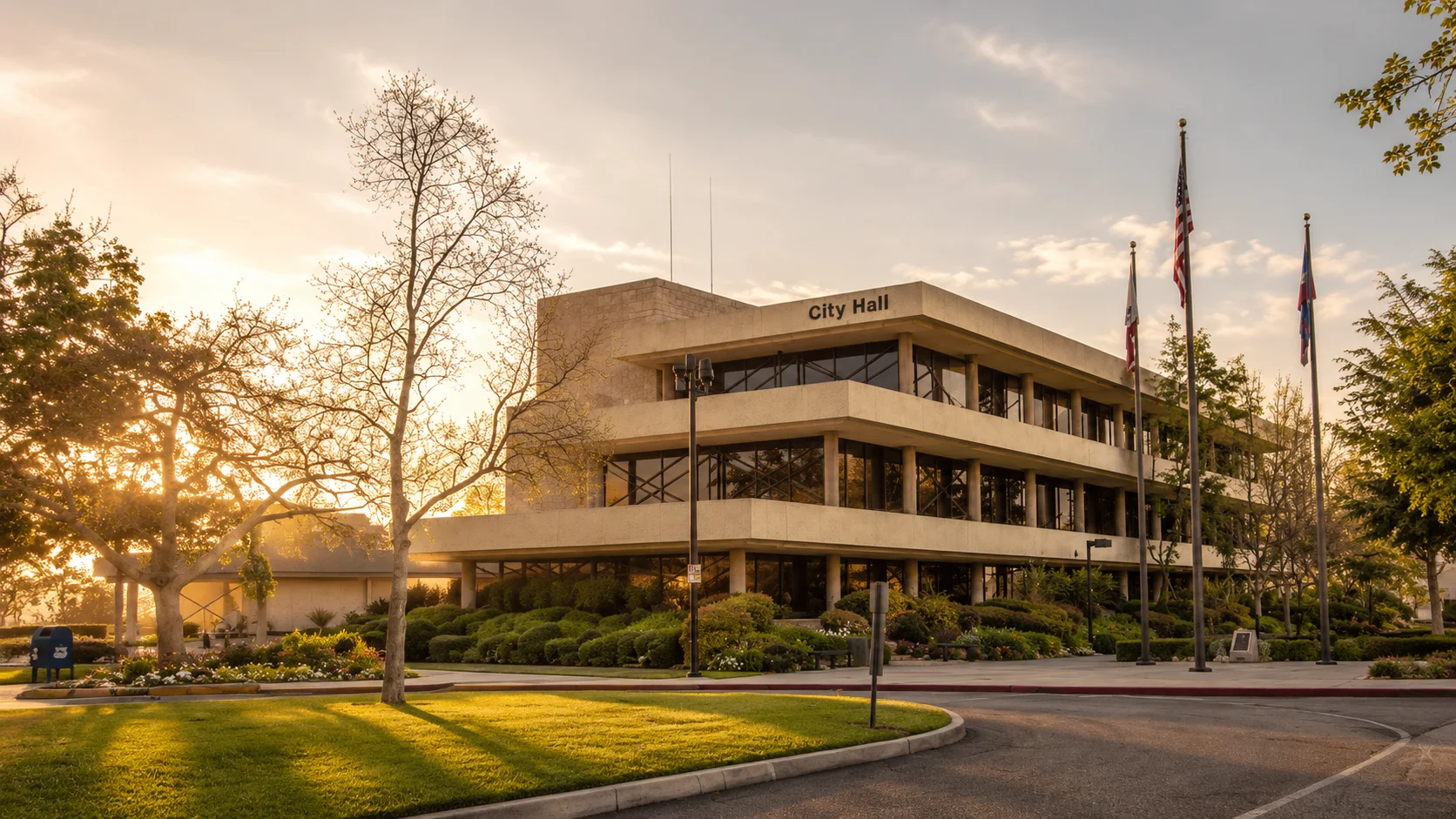
Building an ADU in Downey. Rules, costs, timeline.
Downey rewrote its ADU rules twice in fourteen months to keep pace with state law, and issued more ADU permits last year than every city in the county except Los Angeles, Glendale, Long Beach and Lakewood. This page is short on argument and long on numbers.
What you can build — at a glance
Reviewed by CALI ADU’s ADU specialists · August 2026
- Units per single-family lot
- 2 ADUs + 1 JADU Written into the Downey code, not something you argue for from the statute: § 9414.08(a)(1) allows “a maximum of two ADUs” — one new build plus one conversion — and (a)(2) adds a junior ADU. Most cities we cover write “one.” One caveat on the junior ADU, in the rules section below.
- Maximum size
- 850–1,000 sqft 850 sqft for a studio or one-bedroom, 1,000 sqft with two or more bedrooms. An attached ADU is also limited to 800 sqft or 50% of the main house, whichever is more, capped at 1,000. Conversions are exempt from the size caps entirely.
- The 800 sqft line
- Where the rules change At 800 sqft or under, an ADU is exempt from floor area ratio, lot coverage, design standards, open space — and, under § 9414.08(b)(4), the front setback. Above it, all of them apply. That single number decides more about a Downey project than any other.
- Design standards
- Must match the house Finish materials, colors, roof forms, windows and doors “shall match those of the primary dwelling.” The roof slope must match the dominant slope of the main house. Real constraints — and they do not reach a state ADU or a unit at 800 sqft or under.
- Setbacks
- 4 ft side and rear Including for an ADU built above an existing structure. A conversion, or a rebuild on the same footprint, may keep the existing setback. An unpermitted accessory structure may keep its nonconforming setbacks in a conversion.
- Front setback
- An exception exists Off limits for the larger ordinance ADU — a § 66323 unit and an 800 sqft ADU are exempt from front setbacks outright. Where it does apply, § 9414.08(c)(2)(i) still allows an encroachment if fitting an 800 sqft ADU elsewhere is physically infeasible, with a defined test. We have not seen that written down in any other city we cover.
- Height
- 16 ft, or 18 near transit 16 ft detached; 18 ft within a half-mile walking distance of a major transit stop or high-quality transit corridor, plus 2 ft for a matching roof pitch. Attached gets 25 ft or the zone limit if lower. Never more than two stories, and no second-floor balconies or decks.
- Parking
- Your driveway counts One uncovered space per ADU — and it may sit on the existing legal driveway, including in setback areas, or as tandem parking. Six exemptions remove it entirely, the broadest covering any conversion. No replacement parking for a converted garage.
- Conversion Exempt from the size caps · +150 sqft for ingress and egress
- Detached Up to 1,000 sqft with 2+ bedrooms · 16 ft, or 18 ft near transit
- Attached 800 sqft or 50% of the house, whichever is more · 25 ft or the zone limit
- Junior ADU Up to 500 sqft of interior livable space inside the house · not on multifamily lots
- Legalization Pre-2020 unpermitted units · no impact or connection fees
Per Downey Municipal Code § 9414, as amended by Ordinance No. 26-1544, adopted June 9, 2026 and written to conform to AB 1154 and SB 543. Standards on this page are taken from the adopting ordinance rather than from the city’s online code viewer, which was still serving the superseded 2025 text when this page was written. Read together with Gov. Code §§ 66310–66342 and cross-checked against the HCD ADU Handbook (March 2026). Permit counts are the city’s own annual filings with the State; home value and rent figures are Zillow indices by ZIP, June 2026.
On this page
Can I build an ADU in Downey?
Downey has its own ADU ordinance at Municipal Code § 9414. It has been rewritten twice in fourteen months — once in April 2025 and again in Ordinance 26-1544, adopted June 9, 2026, specifically to keep pace with the state laws that took effect this January.
That matters more than it sounds. A current ordinance means fewer arguments at the counter, and it means the local rules and the state rules mostly point the same way.
Five things to know before you start
Three of these are specific to Downey. Everything else on this page sits underneath them.
| What to know | Why it matters for your project |
|---|---|
| You can have three additional units | Two ADUs plus a junior ADU on a single-family lot, written into the local code rather than argued from the statute. |
| 800 square feet is the hinge | At or under it you are exempt from floor area ratio, lot coverage, design standards and open space. Above it, all four apply. |
| The ADU has to match your house | Materials, colors, roof forms, windows, doors and roof slope. Unless you build a state ADU or stay at 800 sqft, where the design standards fall away. |
| Your driveway can be the parking | One uncovered space, and it may sit on the existing legal driveway or as tandem parking. Several exemptions remove it entirely. |
| Check the ordinance date, not the code website | Downey’s online code viewer was still showing the superseded 2025 text when we wrote this. The June 2026 ordinance is the one that governs. |
Where ADUs are allowed
Section 9414.06 allows ADUs and junior ADUs in the R-1, R-2, R-3, R-3-O and M-U zones. The ordinance then goes further. ADUs “are not limited to particular zones but allowed anywhere where single-family or multi-family residential uses are allowed.” The same subsection adds that the residential zone has to be consistent with the existing General Plan designation, which is a question for the zoning counter on an unusual parcel rather than a typical one. One exception worth knowing — junior ADUs are not allowed on multifamily-zoned property. A second: a vacant residential lot with no dwelling on it cannot establish an ADU on its own. You either finish the primary dwelling first and pass its final inspection, or you submit the house and the ADU under a single permit application.
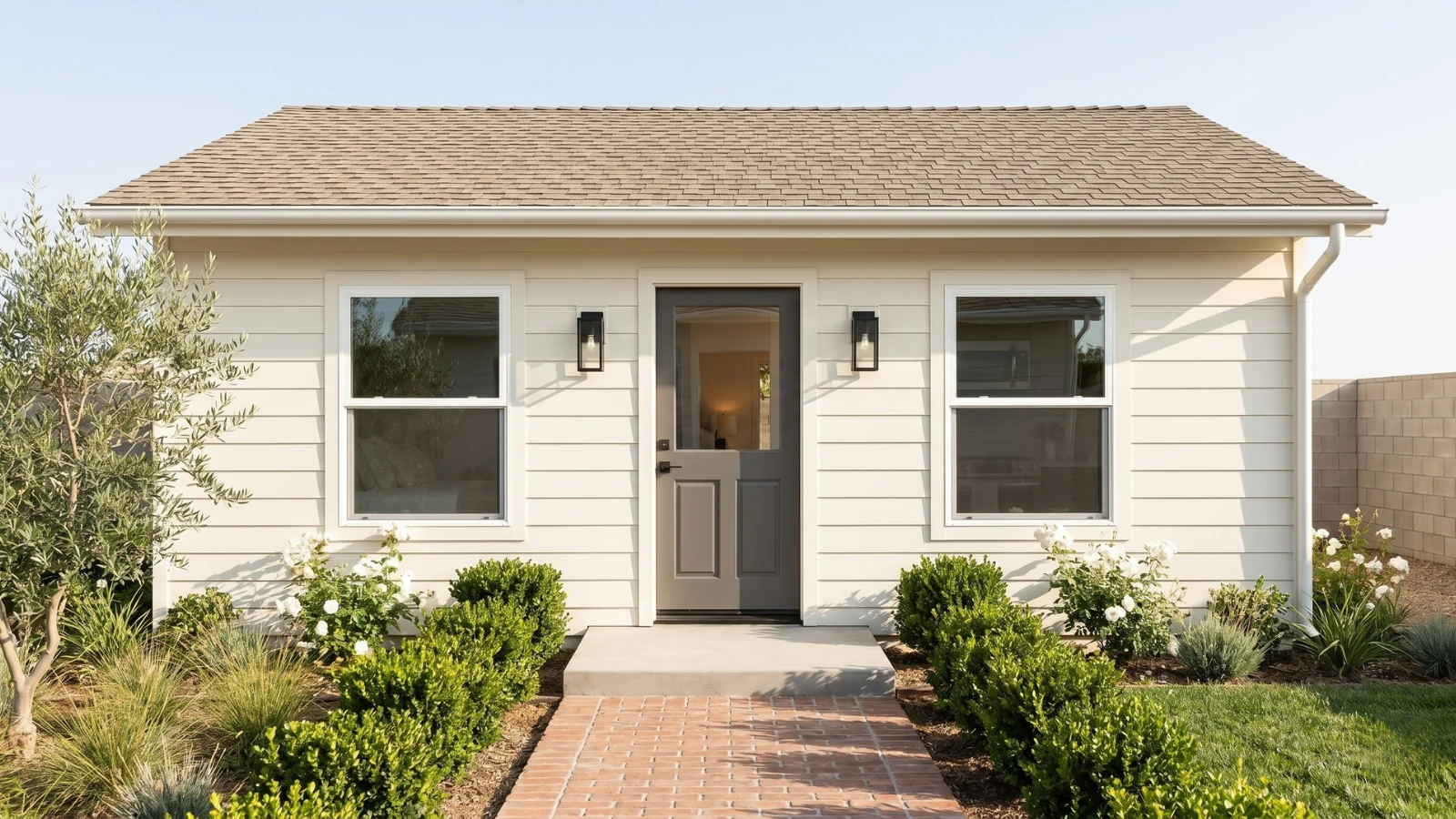
What can you build in Downey?
Which ADU type fits your property?
Start from what your lot already has, and from which of the cases below you are in.
| If your lot is… | Look at | Why |
|---|---|---|
| A typical flat lot with a deep back yard | Detached new build | Up to 1,000 sqft with two or more bedrooms, at 16 ft, or 18 ft if you are near transit. |
| Tight, or you want design freedom | Detached at 800 sqft | Floor area ratio, lot coverage, design standards and open space all fall away at that size. |
| Holding a sound detached garage | Conversion | Exempt from the size caps entirely, may keep the existing setback, and adds 150 sqft for ingress and egress. |
| With space inside the house | Junior ADU | Up to 500 sqft of interior livable space. Owner-occupancy only applies if it shares a bathroom with the house. |
| Already carrying one ADU | A second one | Downey allows two: one new build and one conversion. Worth checking before you assume you are finished. |
| Holding a unit built before 2020 without permits | Legalization | A streamlined state route with no impact fees or connection charges in most cases. |
The Signature Home lineup for Downey
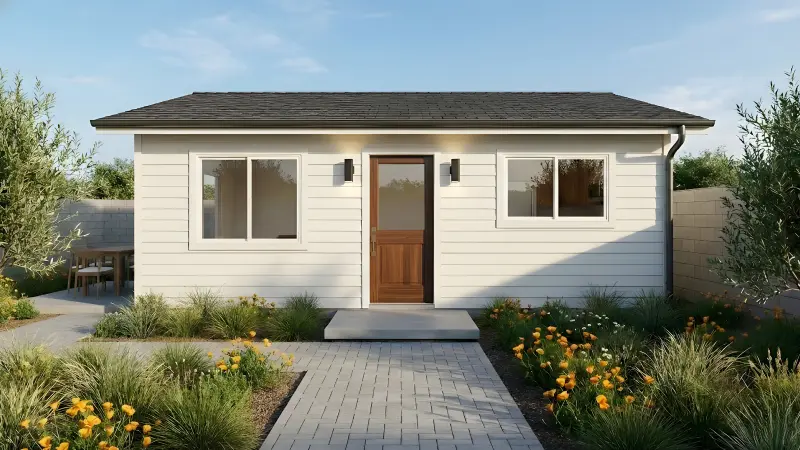
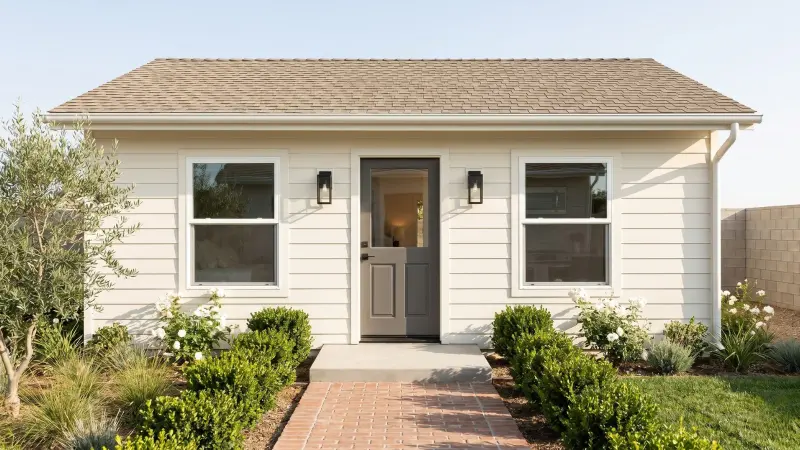
These three bracket the sizes that matter here: below the 750 square foot impact-fee line, at the 800 square foot exemption, and up at the 1,000 square foot ceiling for a unit with two or more bedrooms. All three are single-story, which sidesteps the second-story glazing and balcony restrictions entirely.
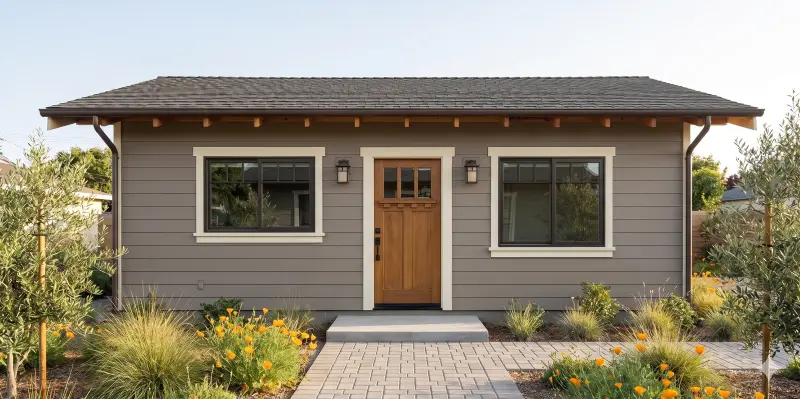
What an ADU costs in Downey (2026)
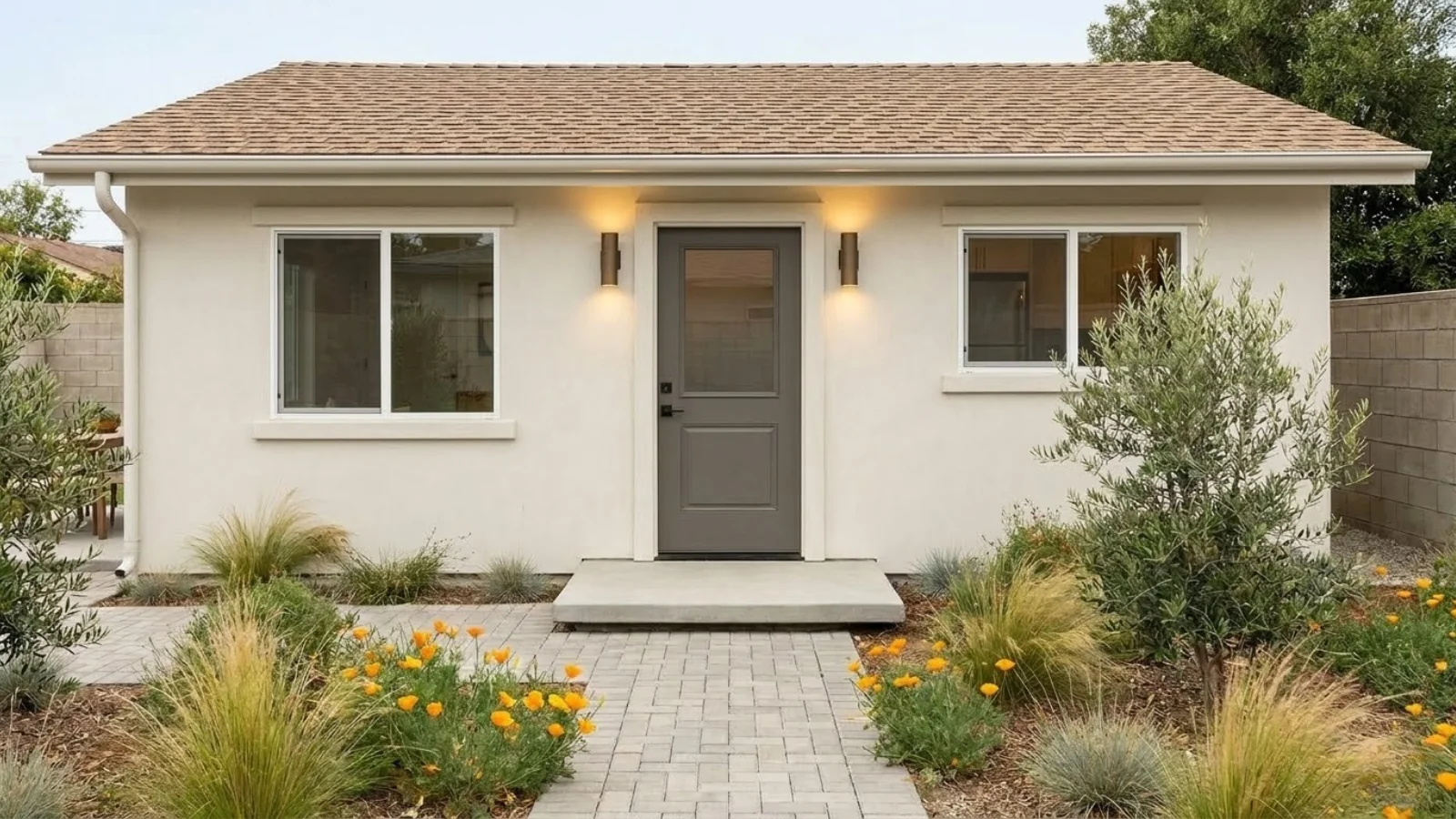
What the lineup costs to build
Plan fees are fixed. Construction is estimated, and varies with your site, access and finish level. Downey’s flat, regular lots make this more predictable than in the hillside cities we work in.
| Plan | Size | Bed / bath | Est. build cost |
|---|---|---|---|
| The Wilshire | 400 sqft | Studio / 1 BA | $180K–$200K |
| The Westwood | 550 sqft | 1 BR / 1 BA | $215K–$235K |
| The Laurel Canyon | 660 sqft | 2 BR / 1 BA | $240K–$265K |
| The Melrose | 800 sqft | 2 BR / 2 BA | $275K–$295K |
| The Lincoln | 1,000 sqft | 3 BR / 2 BA | $325K–$350K |
Custom work is priced per project rather than from a plan fee, and runs $9,990–$19,990 for design and permit processing.
City fees, and what the law takes away
Building permit and plan check fees are valuation-based, so they scale with the value of the work and should be quoted against real drawings rather than guessed from a table.
The impact-fee exemption is where the money is, and Downey has it written correctly. Section 9414.18(a)(1) says no impact fee is required for an ADU that “has 750 square feet of interior livable space or less,” or a junior ADU at 500 square feet or less. Above 750, any impact fee must be charged proportionately, comparing the ADU’s square footage to the primary dwelling’s.
One carve-out sits inside § 9414.18 itself: “impact fee” there does not include a connection fee or capacity charge for water or sewer. Read the next subsection before you budget for one, though. Under § 9414.18(b)(2) a converted ADU, a junior ADU, or an ADU allowed under Gov. Code § 66323 is not required to have a new or separate utility connection “nor is a connection fee or capacity charge required.” Where a connection fee is chargeable — a new detached ADU, or an ADU built alongside a new house — § 9414.18(b)(4) requires it to be proportionate to the burden the unit actually creates, measured by floor area or by drainage-fixture units, and it “may not exceed the reasonable cost of providing this service.”
A second charge comes from outside § 9414.18 entirely. School facilities fees are set by the school district under Education Code § 17620(a)(1)(C), which lets a district levy them only where the increase in assessable space exceeds 500 square feet. That is a third way of measuring a building, defined at Gov. Code § 65995(b)(1), and it is not the same as interior livable space. A unit at exactly 500 square feet is outside the fee; a 660 square foot unit can pay no impact fees at all and still receive a school fee bill.
What it returns
Downey spans three ZIP codes, and the spread between them is about 15 percent on home values but close to 30 percent on rents. In June 2026 the Zillow home value index was roughly $952,000 in 90240, $932,000 in 90241 and $828,000 in 90242. The rent indices were about $2,900, $2,300 and $2,250 — and that is the gap that moves your numbers. Check which ZIP your address carries before taking a blended Downey figure seriously.
Where to get a real number
We are not going to publish a bedroom-level asking rent, because the sources we trust are either blended across all unit sizes or are voucher standards rather than market rents. Start from HUD’s Small Area Fair Market Rents for your own ZIP code, then check live listings nearby.
How long it takes, start to finish
| Stage | Typical duration | What drives it |
|---|---|---|
| Settle the size question | Up front | 800 sqft or under, or above it? That decides whether the design standards apply, and it is easier to answer before drawing than after. |
| Design and permit set | 6–10 weeks | Fixed plan fee, and the schedule is largely yours to control. |
| Completeness determination | 15 business days | Statutory. If the city misses it, the application is deemed complete. |
| Plan check | 60 days statutory | Ministerial, no hearing. Miss it without acting and the application is deemed approved. Tolled by a delay you request, or where the ADU is filed with a permit application for a new primary dwelling |
| Corrections | 2–6 weeks | Sits inside the 60 days rather than after them. A complete first submittal is the biggest lever you have. |
| Construction | 4–8 months | Downey’s flat, regular lots make this more predictable than most of our service area. |
Gov. Code § 66317 sets the 60-day clock and it binds the permitting agency as a whole rather than one department, so an internal referral sits inside the 60 days rather than in front of them. If the city misses the deadline without acting, the application is deemed approved.
Two things stop that clock, and both are written into § 9414.16(b) as well as Gov. Code § 66317(a)(3). One is a delay you request, which tolls the 60 days for as long as the delay runs. The other catches a case worth planning around: if you file the ADU application together with a permit application for a new primary dwelling on the same lot, the city may hold the ADU until it acts on the house. The ADU is still decided ministerially — it just does not get its own 60-day clock.
The completeness step is bounded too, and both halves work for you. Gov. Code § 66317(a)(2)(A) gives the city 15 business days to determine completeness in writing — miss that deadline and § 66317(a)(2)(F) deems the application complete. Section 66317(a)(2)(B) requires that notice to list every incomplete item and describe how to fix it, and (a)(2)(D) then bars the city from requiring anything it left off its own list.
The Downey rules, in detail
Check the date on what you are reading
One practical warning before the standards. In August 2026, Downey’s online code viewer was still serving § 9414 with a history line reading “Added Ord. 25-1523, 4/8/2025” and no sign of the 2026 amendment — so anyone reading Downey’s code online was getting the superseded text. Whatever it shows on the day you look, check that history line for Ordinance 26-1544 before you rely on anything you read there.
The differences are not cosmetic. Under the 2025 version a junior ADU required owner-occupancy in all cases; under the current one it applies only where the junior ADU shares a bathroom with the house. Every standard below is taken from the adopting ordinance itself.
| Standard | What Downey requires |
|---|---|
| Units per single-family lot | Two ADUs — one attached or detached new build, plus one conversion — and one junior ADU. See the note below on the junior ADU use table |
| Units on a multifamily lot | Up to 8 detached ADUs on a lot with an existing multifamily building, capped at the number of existing units; 2 on a lot with a proposed one. Plus conversions of non-livable space up to 25% of existing units, minimum 1 (§ 9414.10) |
| Zones | R-1, R-2, R-3, R-3-O, M-U, and anywhere single-family or multifamily residential is allowed. Junior ADUs not on multifamily-zoned property |
| Maximum size | 850 sqft studio or one-bedroom; 1,000 sqft with two or more bedrooms. Attached also limited to 800 sqft or 50% of the primary dwelling, whichever is more, capped at 1,000. Downey writes these as floor area; Gov. Code § 66321(b)(2) writes its floor as interior livable space, which is the smaller measure — see the note below the table |
| Junior ADU | 500 sqft of interior livable space, converted from existing space, with its own exterior entrance and an efficiency kitchen |
| Conversions | Exempt from the maximum sizes. May expand up to 150 sqft beyond the existing structure for ingress and egress |
| At 800 sqft or under | Exempt from floor area ratio, lot coverage, design standards and open space |
| Side and rear setbacks | 4 ft, including for an ADU above an existing or proposed structure. Exterior staircases must meet the same 4 ft |
| Front setback | Does not apply to a § 66323 unit (§ 9414.12) or to an 800 sqft ADU (§ 9414.08(b)(4)). For the larger ordinance ADU: not permitted, unless it is physically infeasible to fit an 800 sqft ADU elsewhere on the lot, in which case an 800 sqft unit may encroach — but never into the driveway |
| Existing setbacks | A conversion, or a rebuild in the same location and dimensions, may keep the existing setback. Unpermitted accessory structures may keep nonconforming setbacks |
| Height | 16 ft detached; 18 ft within a half-mile walk of a major transit stop or high-quality transit corridor, plus 2 ft for a matching roof pitch; 25 ft attached or the zone limit if lower. Never more than two stories |
| Second floor | No balconies or decks. All windows and exterior glass doors must be obscured or frosted. Entrance oriented away from the rear property line |
| Parking | One uncovered space per ADU, permitted on the existing legal driveway including in setback areas, or as tandem. Six exemptions, the broadest being any ADU that is part of the existing or proposed primary residence or an accessory structure — that is, any conversion. No replacement parking for a converted garage (Gov. Code § 66314(d)(11)) |
| Fire sprinklers | Required in the ADU only if required in the primary dwelling |
| Rental term | No ADU may be rented for less than 30 days, regardless of when it was built |
| Septic lots | A percolation test within the last 5 years, or 10 if recertified |
Two footnotes to that table
Which square feet. Downey writes its size caps as floor area — measured to the outside of the walls. Gov. Code § 66321(b)(2) writes the state floor as interior livable space — measured inside them. For the same building, interior livable space is the smaller number, so the two are not interchangeable, and the error runs one way: a plan drawn to 1,000 square feet of living area will measure more than 1,000 square feet of floor area. That matters at the 800 square foot line especially, where a few inches of wall thickness decide whether the design standards apply to you. The plan sizes we publish are floor area. Confirm the measure with Building and Safety before you commit to a design that sits on a threshold, and know that § 66321(b)(2) guarantees you at least 850 square feet of interior livable space, or 1,000 with more than one bedroom, whatever the local cap is measured in.
The junior ADU use table. Ordinance 26-1543, adopted the same evening as the ADU amendment, rewrote the residential use table at § 9312.06. In that table junior ADUs are marked “NP” in R-1, R-2, R-3 and R-3-O. That cannot be squared with § 9414.08(a)(2), which permits one junior ADU per single-family lot, or with § 9414.06, which lists JADUs as a permitted use in those same zones. It also cannot be squared with state law: Gov. Code §§ 66323 and 66333 require a city to approve a qualifying junior ADU ministerially, and § 9414.06 itself opens “unless otherwise provided by preemptive state law.” We read it as a drafting slip in the use table rather than a policy, and the ADU chapter and the statute both control. But if you are planning a junior ADU, raise it at the counter early rather than at plan check.
The front-setback exception, and how to use it
This is the most unusual provision in the Downey ordinance and it is worth knowing about before you conclude your lot is too small.
Start by checking whether the prohibition reaches your unit at all. Section 9414.12 says ADUs and JADUs created under Gov. Code § 66323 — a conversion, a junior ADU, or the by-right detached unit — are “not subject to lot coverage, front setbacks, and design standards.” And § 9414.08(b)(4) permits an 800 square foot ADU without the underlying zone’s development standards, front setbacks expressly among them. If you are on either of those routes, none of what follows applies to you.
For everything else — the larger ordinance ADU — the rule at § 9414.08(c)(2) is that a new ADU or junior ADU cannot sit in the front setback. Then comes the exception at (c)(2)(i). If it is physically infeasible to fit an 800 square foot ADU anywhere else on the lot, an 800 square foot unit that meets all other development standards may encroach into the front setback. It still may not encroach into the driveway serving on-site parking or garage access.
What makes it usable rather than theoretical is that the ordinance defines the test. Infeasible means the lot area, minus the existing structures, the front, side and rear setbacks, easements, a pool and the required driveway, does not leave room for a continuous 800 square foot area. You submit architectural plans and exhibits demonstrating it, plus a letter from the utility provider where utility standards further restrict the lot, and the city inspects to verify.
Junior ADUs and owner-occupancy
This is where the 2026 amendment matters most. A junior ADU in Downey must be converted from existing space inside a single-family dwelling, capped at 500 square feet of interior livable space, with an independent exterior entrance and an efficiency kitchen.
Owner-occupancy applies “if and when the JADU shares sanitation facilities with the primary dwelling.” If the junior ADU has its own bathroom, the requirement falls away — and it also falls away where the owner is a government agency, land trust or housing organization. Where it does apply, a deed restriction is recorded with the Los Angeles County Recorder before final inspection. Under the 2025 version of the ordinance, owner-occupancy was required in every case.
How the permit process works
Ministerial means a reviewer applies the numbers to your drawings. That is worth stating clearly in Downey, because the city does have design standards — but they are written as objective requirements to be checked, not as matters of opinion to be argued. Routing runs through the Community Development Department, with Building and Safety handling plan check.
What you submit
A complete application is the biggest single factor in how long this takes. Expect a site plan, floor plans, elevations, structural drawings and Title 24 energy documentation. If you are relying on the front-setback exception, add the architectural plans and exhibits the ordinance calls for. If your lot is on septic, add the percolation test.
One piece of sequencing worth knowing if you are replacing a detached garage. Section 9414.16(d) requires the city to review the demolition permit concurrently with the ADU application and to issue the demolition and construction permits at the same time. You do not have to tear the garage down and then wait, and you should not be asked to.
Pre-approved plans
Downey’s Building and Safety Division publishes a pre-approved detached ADU program, with minimum submittal requirements and a submittal checklist among its handouts. We have not seen the current plan set, so we are not going to tell you what is in it or how it compares on cost — ask Building and Safety what is on the shelf. Worth noting that the city’s own handouts page warns that not all of its handouts reflect current codes, which is another reason to check the date on anything you download.
If you already have an unpermitted unit
Gov. Code § 66311.7 gives you a streamlined route. Where the unit was built before January 1, 2020, a city may not deny a permit to legalize it over building-code violations — unless correcting them is necessary for health and safety. It also may not charge impact fees or connection charges, except where utility infrastructure has to be brought up to Health and Safety Code § 17920.3 standards.
Downey’s own § 9414.20 addresses nonconforming zoning conditions, building code violations and unpermitted structures directly, and the setback provisions above let an unpermitted accessory structure keep its nonconforming setbacks through a conversion. On Downey’s postwar housing stock, where garages and rear structures of uncertain permit history are common, that is a more useful pair of provisions than it first appears.
If you are refused
You are not finished. Gov. Code § 66317(d) requires a city to provide a process to appeal a denial or an incompleteness determination, and to issue a final written determination within 60 business days of your written appeal.
Questions we get asked
The questions Downey homeowners actually ask — answered against Municipal Code § 9414 as amended in June 2026, and current California law.
Can I build an ADU in Downey?
Yes, and Downey is one of the easier cities in Los Angeles County to do it in. The city issued 244 ADU building permits in 2025, up from 202 the year before, and more than every city in the county except Los Angeles, Glendale, Long Beach and Lakewood. It rewrote its ADU rules twice in fourteen months to keep them current with state law — most recently in Ordinance 26-1544, adopted June 9, 2026. ADUs are allowed in the R-1, R-2, R-3, R-3-O and M-U zones, and more broadly anywhere single-family or multifamily residential use is allowed. Junior ADUs are the one exception: they are not allowed on multifamily-zoned property.
How many ADUs can I have on my lot?
Two ADUs and a junior ADU, and this is written into the Downey code rather than being something you have to argue for from the statute. Section 9414.08(a)(1) says "a maximum of two ADUs can be permitted on a single-family lot," made up of one attached or detached new-construction ADU plus one ADU converted from existing space. On top of that, subsection (a)(2) allows one junior ADU, which must be converted from existing space inside the house and is capped at 500 square feet of interior livable space. So a Downey single-family lot can carry the house plus three additional units. Multifamily lots run on a separate section, § 9414.10, and it is more generous still: on a lot with an existing multifamily building you may add up to eight detached ADUs, capped at the number of units already there, and separately convert non-livable space — storage rooms, boiler rooms, attics, basements, common areas, garages — into ADUs up to 25 percent of the existing unit count, with at least one always allowed. A lot with a proposed multifamily building gets two. Junior ADUs are the exception in the other direction: they are not permitted on multifamily-zoned property. Most cities we cover write "one" and leave you to cite state law for more.
How big can the ADU be?
For a detached or attached ADU, 850 square feet for a studio or one-bedroom and 1,000 square feet for a unit with two or more bedrooms. An attached ADU carries one more test: it is limited to 800 square feet or 50 percent of the floor area of the existing primary dwelling, whichever is more, capped at 1,000. Read that "whichever is more" carefully, because it works in your favor — on a small house the 800 square feet applies rather than the percentage. Conversions are treated differently again: an ADU converted from existing permitted space is exempt from the maximum sizes altogether, and may expand by up to 150 square feet beyond the existing structure for ingress and egress.
Is there a floor-area or lot-coverage limit that could shrink my ADU?
Not at 800 square feet or under. Downey Municipal Code § 9414.08(b)(3) exempts a new ADU of 800 square feet or less from floor area ratio, lot coverage, design standards and open space requirements, and (b)(4) says an ADU of 800 square feet is permitted "without the applicability of development standards of the underlying zone, such as FAR, lot coverage, front setbacks, design standards, and open-space requirements." Note front setbacks in that list. Above 800 square feet those standards come back into play, which is the real decision point on a tight Downey lot: an 850 square foot unit is subject to rules an 800 square foot unit is not. Two details that catch people out: patio covers and similar covered structures do not count toward the ADU size but do count toward your lot coverage, and an attic or loft over five feet in height counts as livable area.
What are the setbacks?
Four feet to the rear and side property lines for any new attached or detached ADU, including one built above an existing or proposed structure. Front setbacks are the interesting part in Downey and are covered in the next answer. Two provisions work in your favor on an older lot. A conversion of a permitted structure, or a new structure built in the same location and to the same dimensions as an existing one, may keep the existing setback as long as building code requirements are met. And an unpermitted accessory structure may keep its legal nonconforming setbacks as part of a conversion or addition, provided it does not present a health and safety threat and does not violate a recorded easement.
Can I build in the front yard setback?
Sometimes, and Downey is the only city we cover that writes this down. First check whether the rule reaches you at all: § 9414.12 exempts ADUs and JADUs created under Gov. Code § 66323 from front setbacks, and § 9414.08(b)(4) permits an 800 square foot ADU without the underlying zone's development standards, front setbacks expressly among them. If you are on either route you do not need any of what follows. For the larger ordinance ADU the general rule is no — § 9414.08(c)(2) says a new ADU or JADU cannot sit in the front setback area of the underlying zone. But there is an exception at (c)(2)(i): if it is physically infeasible to build an 800 square foot ADU anywhere else on the lot, an 800 square foot ADU that complies with all other development standards is allowed to encroach into the front yard setback. It may not encroach into the driveway for on-site parking or garage access. The ordinance defines "infeasible" precisely, which is what makes it usable: the lot area, minus existing structures, the front, side and rear setbacks, easements, a pool and the required driveway, must not leave enough room for a continuous 800 square foot area. You submit architectural plans and exhibits demonstrating it, a utility provider letter if utility standards further restrict the lot, and the city inspects to verify.
How tall can it be?
A detached ADU on a lot with an existing or proposed single-family dwelling gets 16 feet. That rises to 18 feet if the lot is within a half-mile walking distance of a major transit stop or a high-quality transit corridor, and you may add two more feet — 20 feet total — to carry a roof pitch that matches the main house. An ADU attached to the house gets 25 feet, or the underlying zone's height limit if that is lower. Nothing under this section may exceed two stories. One design restriction that surprises people: balconies and decks are not permitted on the second floor of an ADU, and all windows and exterior glass doors in a second-story ADU must be obscured or frosted glass.
What will my ADU have to look like?
This is the most Downey-specific thing on the page, and it is worth reading before you pick a design. Section 9414.12 sets objective design standards to preserve the property's existing architectural features. The ordinance reads: "The architectural design features of an ADU including but not limited to finish materials, colors, roof forms, windows and doors shall match those of the primary dwelling." The roof slope must match the dominant roof slope of the main house — with one exception worth knowing, at § 9414.12(f)(1): a unit converted from existing space that has not been demolished and replaced in the same location does not have to match. The primary entrance must have a covered front entrance whose roof form and slope match both the ADU and the primary dwelling, and it must be oriented toward the street. The three exceptions are narrower than they sound: the unit is at the rear of the property and attached to the house in a way that makes a street-facing entrance physically infeasible; the unit is on the second floor of an existing primary dwelling; or the unit is not visible from the public right of way. No dwelling may have its front entrance facing the rear of the property or a public alley. ADUs larger than 500 square feet need washer and dryer connections. Only one kitchen is allowed per dwelling. Front entries need downward porch lighting, and staircases must be within enclosed interior space. Where you do have an exterior staircase, it keeps the four-foot side and rear setback, may never sit in a front setback, and may not turn most of its face toward the front yard.
Is there a way around the design standards?
Yes, and the city wrote it into the same section. Section 9414.12 ends by saying that ADUs and JADUs created pursuant to Government Code § 66323 "are not subject to lot coverage, front setbacks, and design standards but must comply with building code and health and safety requirements for dwellings." A § 66323 unit means a conversion ADU inside existing space, a junior ADU, or the by-right detached unit. So the matching materials, the matching roof slope and the street-facing entrance are constraints on the larger ordinance ADU and simply do not reach the state route. Separately, a new ADU of 800 square feet or less is exempt from design standards under § 9414.08(b)(3). That is a real design decision rather than a technicality: if you want a contemporary ADU behind a 1950s Downey ranch house, the size you choose determines whether you may have it.
Do I need parking for an ADU in Downey?
One uncovered off-street space per ADU, and the way Downey lets you provide it is unusually practical: the space may sit on the existing legal driveway, including in setback areas, or as tandem parking. So on most Downey lots the driveway you already have satisfies it. Six exemptions remove the requirement entirely, and one of them swallows most projects: § 9414.14(a)(1)(iii) exempts an ADU that is "part of the proposed or existing primary residence or an accessory structure" — which is every conversion, including a garage conversion. The others are a half-mile walking distance to public transit, an architecturally and historically significant historic district, on-street parking permits that are required but not offered to the ADU's occupant, a car share vehicle stop within one block, and an ADU applied for alongside a new primary dwelling that meets one of the other criteria. A junior ADU converted from an existing attached garage requires no additional parking. And if you are converting a garage, state law is on your side twice over: Gov. Code § 66314(d)(11) bars the city from making you replace the parking the garage was providing. Note that a proposed new primary dwelling is not exempt and must meet its own parking requirement.
Do I need fire sprinklers?
Only if the main house has them. Downey Municipal Code § 9414.14(b) requires fire sprinklers in an ADU if sprinklers are required in the primary dwelling, which tracks state law. On Downey's housing stock, much of it built before residential sprinkler requirements, that usually means no. And building the ADU cannot create the requirement: § 9414.14(b)(2) says "the construction of an ADU does not trigger a requirement for fire sprinklers to be installed in the existing primary dwelling." Subsection (b)(3) adds that a JADU is not treated as a separate dwelling for fire or life-safety purposes. So a whole-house retrofit is not something you need to budget against.
What does an ADU cost to permit in Downey?
Building permit and plan check fees are valuation-based, so they scale with the value of the work and are better quoted against real drawings than guessed from a table. What state and local law take away is worth knowing precisely. No impact fee may be charged for an ADU with 750 square feet of interior livable space or less, or a junior ADU with 500 square feet or less — Downey's § 9414.18(a)(1) uses exactly that wording, matching Gov. Code § 66311.5(c)(1). Above 750 square feet, any impact fee must be charged proportionately, comparing the ADU's square footage to the primary dwelling's. Note the carve-out in the same subsection: "impact fee" there does not include a connection fee or capacity charge for water or sewer service. But read § 9414.18(b) before you budget for one. Subsection (b)(2) says a converted ADU, a junior ADU, or an ADU allowed under Gov. Code § 66323 is not required to have a new or separate utility connection "nor is a connection fee or capacity charge required." Where a connection fee is chargeable — a new detached ADU, or an ADU built alongside a new house — (b)(4) requires it to be proportionate to the burden the unit creates, measured by floor area or drainage-fixture units, and it may not exceed the reasonable cost of providing the service. School facilities fees are a separate regime from outside the ordinance: Education Code § 17620(a)(1)(C) lets a district levy them only where the increase in assessable space exceeds 500 square feet.
How long does it take?
Budget six to twelve months from first drawing to permit in hand, then construction on top. The statutory review is 60 days from a complete application and it is ministerial — a checklist, not a judgment call, with no hearing and no neighbors to win over. Gov. Code § 66317 sets that clock and it binds the permitting agency as a whole, so any internal referral sits inside the 60 days rather than in front of them. If the city misses the deadline without acting, the application is deemed approved. Two things stop that clock, both at § 9414.16(b) and mirrored in Gov. Code § 66317(a)(3): a delay you request, and an ADU filed together with a permit application for a new primary dwelling, in which case the city may hold the ADU until it acts on the house. Before the clock starts, the city has 15 business days to determine completeness in writing (§ 66317(a)(2)(A)), the notice must list every incomplete item and say how to cure it ((a)(2)(B)), and the city may not later require anything it left off that list ((a)(2)(D)). Miss the 15-day deadline entirely and the application is deemed complete ((a)(2)(F)).
Does Downey have pre-approved ADU plans?
Yes. The Building and Safety Division publishes a pre-approved detached ADU program, with minimum submittal requirements and a submittal checklist among its handouts, implementing the state requirement that cities make pre-approved plans available. We have not seen the current plan set, so we are not going to tell you what is in it or how it compares on cost — ask Building and Safety what is on the shelf. Worth knowing that the city's own handouts page carries a warning that not all of its handouts reflect current codes, which is a good reason to confirm anything you download against the ordinance date.
What will an ADU rent for in Downey?
Downey runs across three ZIP codes and the spread is real but modest, about 15 percent. In June 2026 the Zillow home value index was roughly $952,000 in 90240, $932,000 in 90241 and $828,000 in 90242, with rent indices of about $2,900, $2,300 and $2,250 respectively. Check which ZIP your own address carries before taking a blended Downey figure seriously. We are not going to publish a bedroom-level asking rent, because the sources we trust are either blended across all unit sizes or are voucher standards rather than market rents. Start from HUD's Small Area Fair Market Rents for your ZIP, then check live listings nearby.
Official sources
City of Downey
- Ordinance No. 26-1544 — the current ADU ordinance, amending Downey Municipal Code § 9414. Introduced May 26, 2026 and adopted June 9, 2026, written to conform to AB 1154 and SB 543. This is the source for every local standard on this page. Ordinance 26-1544 (PDF)
- Ordinance No. 25-1523 — the previous ADU ordinance, adopted April 8, 2025. Useful for seeing what the 2026 amendment changed. Ordinance 25-1523 (PDF)
- Downey Municipal Code § 9414 — the codified chapter. Check the ordinance history line before relying on it; when we wrote this page the viewer had not picked up the June 2026 amendment. DMC § 9414 (eCode360)
- Building and Safety handouts and forms — including the pre-approved detached ADU submittal requirements. City of Downey handouts
State law
- Gov. Code §§ 66310–66342 — California ADU law, including the unit combinations at § 66323, the 60-day clock and appeal right at § 66317, the impact-fee exemption at § 66311.5(c)(1), the legalization route at § 66311.7, and the junior ADU owner-occupancy rule at § 66333(b). Gov. Code § 66323 (leginfo)
- HCD ADU Handbook (March 2026) — the Department of Housing and Community Development’s interpretation of the statute. HCD ADU Handbook (PDF)
- Housing Element Annual Progress Report, Table A2 — the row-level dataset every California city files with the State. The Downey permit counts on this page are summed from it, not estimated. APR Table A2 (California Open Data)
A note on the numbers
The permit counts on this page — 244 ADU building permits in 2025 and 202 in 2024 — are Downey’s own figures, from the housing element annual progress report the city files with the State, as published in HCD’s Table A2 dataset. They count permits issued, not units finished; Downey finished 144 ADUs in 2025 and 159 in 2024, and mixing the two measures is an easy mistake to make. Home value and rent figures are Zillow indices by ZIP code for June 2026, reported separately for 90240, 90241 and 90242 rather than blended.
What we have deliberately not published: a per-lot floor-area analysis of the kind we run for our Los Angeles neighborhood pages, because Downey exempts an 800 square foot ADU from floor area ratio and lot coverage altogether and there is no equivalent constraint to model. We have also not published a median built ADU size, a price per square foot, or a bedroom-level asking rent, because we could not source any of them to a standard we would want to be held to.
Rules change. Downey has amended this chapter twice in fourteen months, and the state laws underneath it changed on January 1. If you are reading this later, check the ordinance history on § 9414 — or call us and we will confirm it for you.
Not sure what your lot
can actually support?
Get clarity before you spend anything on plans. In 15 minutes we will pull up your property, work through the 800 square foot decision, check whether the front-setback exception could help you, and give you an honest read on your options and a realistic budget — including whether an ADU is the right move at all.
15-minute video call · No obligation