
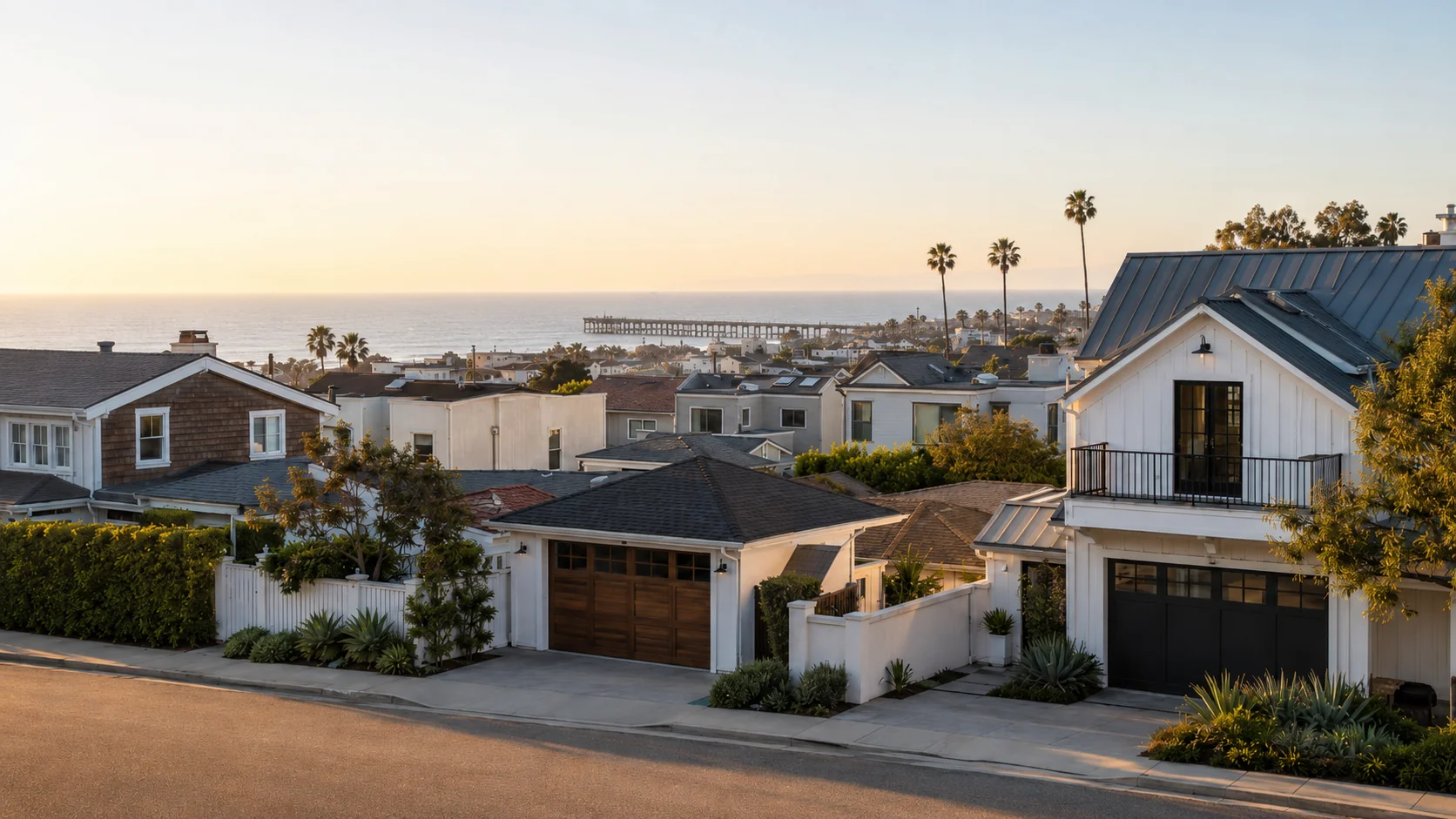
Building an ADU in Hermosa Beach. Rules, costs, timeline.
What HBMC Chapter 17.21 actually allows after its 2026 rewrite, how the Coastal Zone changes your permit, and what an all-in build costs on a Hermosa Beach lot in 2026.
What you can build — at a glance
Reviewed by CALI ADU’s ADU specialists · August 2026
- Max ADU size
- 850–1,000 sqft 850 sqft of interior livable space for a studio or one-bedroom and 1,000 sqft with two or more bedrooms on the local track (HBMC § 17.21.070(A)(1)). On the statutory track a new detached unit is capped at 800 sqft of livable space and a conversion of existing space has no cap at all (§ 17.21.050(A); Gov. Code § 66323).
- Detached height
- 16 ft, one story 18 ft within half a mile of a major transit stop, plus 2 ft to match your roof pitch (20 ft at most), and 18 ft on a lot with a multistory multifamily building (HBMC § 17.21.060(B)). Matches the state floors at Gov. Code § 66321(b)(4)(A)–(C). No above-garage exception, and on the local track no more than one story unless the unit is attached (§ 17.21.070(K)).
- Attached height
- 25 ft or your zone limit Whichever is lower, and never more than two stories (HBMC § 17.21.060(B)(4)). Gov. Code § 66321(b)(4)(D) reads the same way — it defers to the zone rather than guaranteeing 25 ft, so the operative number is your base-zone limit whenever that is under 25 ft.
- Side & rear setbacks
- 4 ft Both tracks (HBMC §§ 17.21.050(A)(2)(a), 17.21.070(C)(1); Gov. Code § 66314(d)(7)). 25 ft in front on the local track, subject to the 800 sqft guarantee. No setback at all for a unit rebuilt in the same location and to the same dimensions as an existing structure.
- Units per SFR lot
- 3, possibly 4 A conversion ADU, a junior ADU and a new detached ADU of 800 sqft or smaller, on top of the house you already have — HBMC § 17.21.050(A) codifies the Gov. Code § 66323 stack in full and says (A)(1) may be combined with (A)(2). There is no "1 ADU + 1 JADU" cap here to preempt. HCD reads a local-track § 66314 unit as additive on top of that stack (ADU Handbook, March 2026, p. 18), which would make four; Chapter 17.21 does not say the two tracks combine, so confirm with Planning.
- Parking required
- None on most lots One space is the local-track default (HBMC § 17.21.070(G)(1)) but six exceptions waive it (G)(2), and most of a 1.4-square-mile city sits inside the half-mile transit catchment. Statutory-track ADUs and all junior ADUs are outside the rule entirely. No replacement parking for a converted garage (Gov. Code § 66314(d)(11)).
- Permit timeline
- 60 days Ministerial review, no hearing (HBMC § 17.21.040(C)(2)–(3); Gov. Code § 66317), deemed approved if the City misses it. 15 business days for the completeness notice, and deemed complete if that is missed (Gov. Code § 66317(a)(2)(A)).
- Coastal Zone CDP
- Required — 60 days Much of the city is in the Coastal Zone. Since AB 462 rewrote Gov. Code § 66329 on October 10, 2025 the coastal permit runs concurrently with the ADU permit on its own 60-day clock, with no public hearing. HBMC § 17.21.040(C)(6) carries the same 60 days — but your CDP application must be complete before your ADU application counts as complete.
- Detached 800 sqft statutory track · up to 1,000 sqft local track · 16 ft, one story
- Attached 25 ft or your zone limit, whichever is lower · two stories at most
- Garage conversion Same footprint, no setback required · no replacement parking
- Interior conversion Carved out of the existing house · no square-foot cap
- Junior ADU Up to 500 sqft inside the single-family house
Per HBMC Chapter 17.21 (§§ 17.21.010–17.21.100, as adopted by Ord. No. 26-1498, effective April 23, 2026) and Gov. Code §§ 66310–66342. Cross-checked against the HCD ADU Handbook (March 2026) and HCD's May 8, 2026 letter of substantial compliance to the City. Full citations in the sections below.
On this page
Can I build an ADU in Hermosa Beach?
Five things to know before you start
If you read nothing else here, read these. They are the five points that change the most Hermosa Beach projects.
| What to know | Why it matters for your project |
|---|---|
| 1. The ordinance was rewritten in 2026 — and the State signed off | Ord. No. 26-1498 repealed and replaced Chapter 17.21 in full, effective April 23, 2026. HCD reviewed it and wrote to the City on May 8, 2026 that it is substantially compliant with State ADU Law, and that the compliance matter is closed. Advice written before spring 2026 describes a chapter that no longer exists. |
| 2. There are two tracks, and the smaller one skips the local rules | HBMC § 17.21.050 splits ADUs into Class 1 (statutory, under Gov. Code § 66323) and Class 2 (local). Class 1 units skip § 17.21.070 completely — the size caps, the matching-materials rule, the landscape screening, the FAR limit. It is the single biggest lever on a Hermosa Beach project. |
| 3. Detached means one story | § 17.21.060(B)(1) caps a detached ADU at 16 feet, which forecloses a second story on its own. On the local track § 17.21.070(K) says so outright, barring more than one story unless the unit is attached. There is no above-garage exception here. Two stories in Hermosa Beach means attached. |
| 4. Much of the city is in the Coastal Zone | A Coastal Development Permit runs alongside your ADU permit on its own 60-day clock, with no public hearing (Gov. Code § 66329, as rewritten by AB 462 effective October 10, 2025). The catch is at the front: your CDP application has to be complete before your ADU application counts as complete (HBMC § 17.21.040(C)(6)(a)). |
| 5. The City’s own web page has been wrong about owner-occupancy | When we last checked it in August 2026, the City’s ADU page listed owner-occupancy as required in single-family zones from January 1, 2025. The City’s ordinance says the opposite at § 17.21.060(G)(1), and Gov. Code § 66315 forbids the requirement outright. Where a web page and the code disagree, the code governs. |
How many units your lot allows
HBMC § 17.21.050(A) writes the Gov. Code § 66323 stack into local law and then does the thing most ordinances leave ambiguous: it states outright that a unit approved under (A)(1) may be combined with one approved under (A)(2). On a single-family lot that means:
| Unit | How many | Conditions |
|---|---|---|
| Conversion ADU | 1 | Inside the existing or proposed house, or inside an existing accessory structure plus up to 150 sqft for ingress and egress. No square-foot cap. Independent exterior access (§ 17.21.050(A)(1)) |
| Junior ADU | 1 | Up to 500 sqft, entirely inside the single-family structure, on a single-family-zoned lot only (§§ 17.21.030, 17.21.060(A)(3); Gov. Code §§ 66333–66339) |
| Detached, new construction | 1 | 800 sqft of livable space or smaller, at least 4-ft side and rear setbacks, within the height limit (§ 17.21.050(A)(2)) |
Three accessory units, then, on top of the house already standing. Nothing in the chapter caps you at “one ADU plus one junior ADU,” which is what most homeowners have been told.
There may be a fourth. HCD’s ADU Handbook (March 2026, p. 18) closes its table of allowable combinations with this: in addition to the units described in Gov. Code § 66323, a local agency must allow at least one unit described in § 66314, and may impose objective standards on it. That is the local track. HCD made the same point to Hermosa Beach directly in its December 2025 findings letter, telling the City that § 66314 units had to be reflected in the ordinance “to enable maximum unit allowances.” The City answered by adding the Class 2 track — but Chapter 17.21 does not say in terms that the two tracks stack. We would treat four as the state floor under Gov. Code § 66316 and confirm the as-applied answer with Planning before designing to it.
On a multifamily lot the numbers are larger. § 17.21.050(A)(3) allows at least one conversion ADU in non-livable space such as a storage room, boiler room, attic, basement or garage, up to 25 percent of the existing unit count. § 17.21.050(A)(4) allows up to eight detached ADUs on a lot with an existing multifamily building, capped at the number of existing units (Gov. Code § 66323(a)(4)(A)(ii)), or two on a lot with a proposed one. Those two may be combined as well, and the chapter says so expressly (§ 17.21.050(A); Gov. Code § 66323(a)).
Owner-occupancy
You do not have to live on the property. HBMC § 17.21.060(G)(1) says ADUs are not subject to an owner-occupancy requirement, which is the local expression of Gov. Code § 66315. A junior ADU is treated differently, but narrowly. Owner-occupancy applies in general under § 17.21.060(G)(2)(a), and is waived under (G)(2)(b) in two situations: where the junior ADU has its own separate sanitation facilities, and where the property is entirely owned by a governmental agency, land trust or housing organization.
The sanitation carve-out is AB 1154, effective January 1, 2026, which narrowed Gov. Code § 66333(b) to shared-sanitation cases only. Most cities in the region have not amended their text to match. Hermosa Beach wrote it in. Give the junior ADU its own bathroom and the requirement does not reach you. A junior ADU still records a deed restriction before its certificate of occupancy (§ 17.21.060(H)); an ADU records nothing.
What you can build
Which ADU type fits your property?
Hermosa Beach permits five types, and the right one is usually decided by your lot and your goal rather than by preference. Start here, then read the standards below against the type you land on.
| If this sounds like you | Start with | What that means |
|---|---|---|
| You have usable yard and want the cleanest possible approval | Detached ADU on the statutory track | 800 sqft of livable space or smaller, 16 ft, 4-ft side and rear setbacks. It sits outside § 17.21.070 entirely, so the matching-materials rule, the landscape screening and the FAR limit do not apply (Gov. Code § 66323(b)) |
| You want three bedrooms, or the largest unit the code allows | Detached ADU on the local track | Up to 1,000 sqft of interior livable space with two or more bedrooms — and the full § 17.21.070 rulebook comes with it: matching materials and roof slope, evergreen screening, a 50% lot FAR ceiling and a 25-ft front setback |
| You want two stories | Attached ADU | The only two-story path in this city. Capped at 25 ft or your zone’s height limit for the main house, whichever is lower, and never more than two stories (§ 17.21.060(B)(4)) |
| You have a garage you rarely use | Garage conversion | No setback required if you keep the same location and dimensions (§ 17.21.070(C)(2)), and no replacement parking (§ 17.21.070(G)(3)). If you are demolishing a detached garage and replacing it rather than converting it, the demolition permit is issued at the same time as the ADU permit (§ 17.21.040(C)(7)) |
| You are housing family and want the lowest-cost path | Junior ADU | Up to 500 sqft carved out of the house, including an attached garage. No parking may be required at all (Gov. Code § 66334(a)). Owner-occupancy applies only if it shares a bathroom with the main house |
| You own a small apartment building | Detached ADUs on the multifamily track | Up to eight detached units on a lot with an existing multifamily building, capped at the number of existing units, and combinable with conversion ADUs in non-livable space (§ 17.21.050(A)(3)–(4)) |
The two tracks, and why the choice matters
Class 1 is the statutory track at § 17.21.050(A). Class 2 is the local track at § 17.21.050(B), approved under Gov. Code §§ 66314–66322. Both are ministerial, both need an ADU permit and a building permit, and both answer to the general standards at § 17.21.060. The difference is § 17.21.070, whose opening line says it applies only to Class 2 — so the size caps, the design rules and the FAR ceiling in that section reach a Class 2 unit and no other. The two tracks are not mutually exclusive, either: as the unit count above explains, HCD reads a Class 2 unit as additive to the statutory stack.
That is not a local courtesy. Gov. Code § 66323(b) bars a city from imposing any objective development or design standard on a unit that meets the statutory description, beyond what § 66323 itself authorizes. Hermosa Beach has simply written the consequence into its own chapter, and repeated it in the savings clauses at §§ 17.21.070(H)(8) and (I)(5).
Maximum size
| Standard | Limit |
|---|---|
| Conversion ADU, statutory track | No square-foot cap. Existing space, plus up to 150 sqft on an accessory structure for ingress and egress only (§ 17.21.050(A)(1)(a)) |
| Detached ADU, statutory track | 800 sqft of livable space or smaller (§ 17.21.050(A)(2)(b); Gov. Code § 66323(a)(2)) |
| Studio or 1-bedroom, local track | 850 sqft of interior livable space (§ 17.21.070(A)(1); state floor Gov. Code § 66321(b)(2)) |
| Two bedrooms or more, local track | 1,000 sqft of interior livable space (§ 17.21.070(A)(1)) |
| Attached, local track | Also limited to 50% of the existing main house’s floor area (§ 17.21.070(A)(2)) |
| Junior ADU | 500 sqft of interior livable space (§ 17.21.030; Gov. Code § 66313(d)) |
| The guaranteed floor | 800 sqft of interior livable space, which no percent-based limit, FAR, front setback, minimum lot size, lot coverage limit or open-space requirement may take away (§ 17.21.070(A)(3); Gov. Code § 66321(b)(3)) |
The guaranteed floor is the number to hold on to. Hermosa Beach lots are small, and the base-zone FAR, coverage and open-space rules would otherwise squeeze a buildable unit out of existence on a lot that already carries a house. That clause is also the one HCD told the City to fix in December 2025: the earlier text named only the percent-based limit, front setback, lot coverage and open space. The 2026 chapter adds FAR and minimum lot size, which is what Gov. Code § 66321(b)(3) actually requires.
Maximum height
| Situation | Limit |
|---|---|
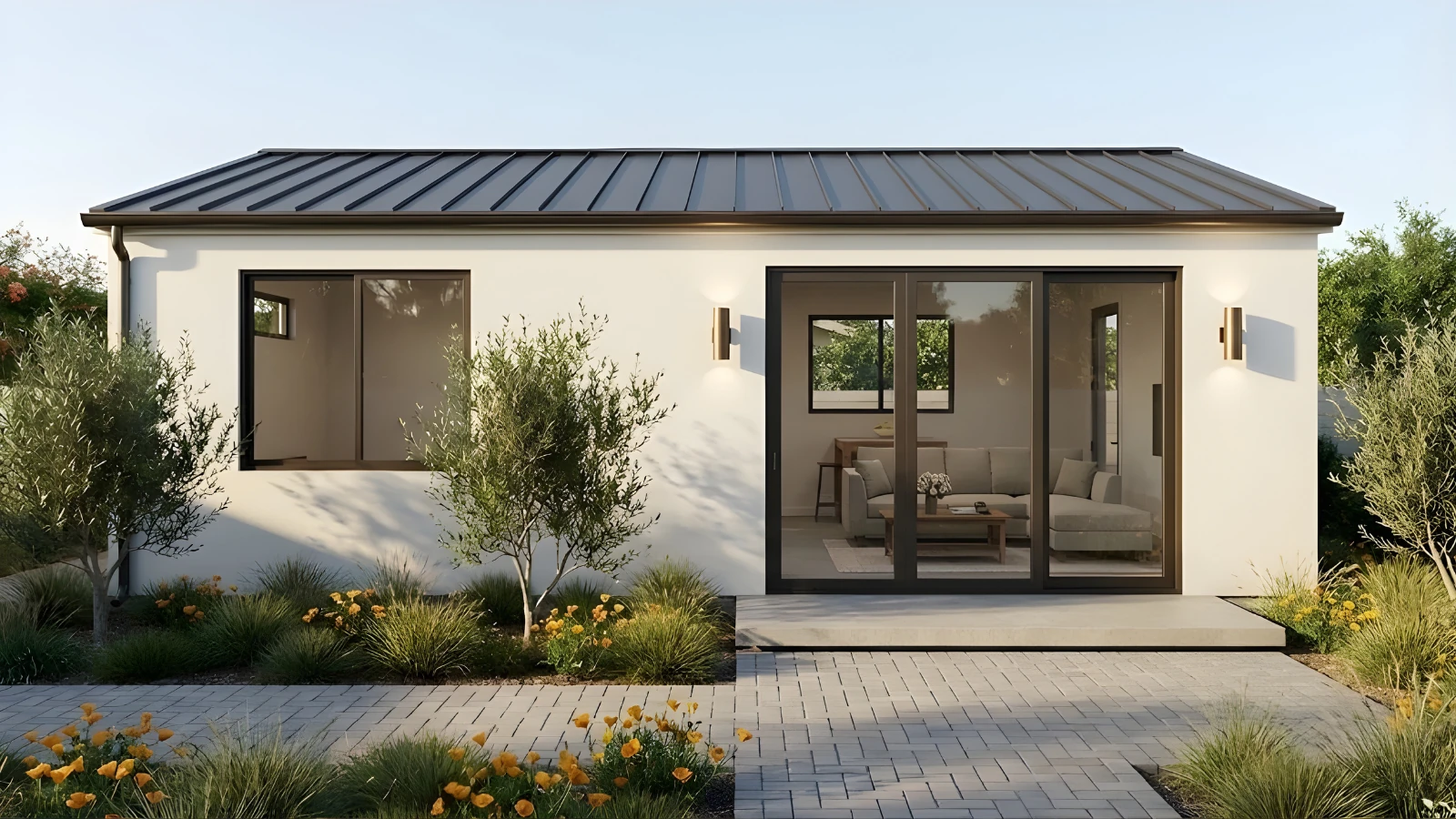
| Detached, standard lot | 16 ft (§ 17.21.060(B)(1); state floor Gov. Code § 66321(b)(4)(A)) |
| Detached, within ½ mile of transit | 18 ft, plus up to 2 more feet to align the ADU roof pitch with the main house — 20 ft at most (§ 17.21.060(B)(2); Gov. Code § 66321(b)(4)(B). “Transit” here means a major transit stop or high-quality transit corridor as defined in Pub. Resources Code § 21155) |
| Detached, lot with a multistory multifamily building | 18 ft (§ 17.21.060(B)(3); Gov. Code § 66321(b)(4)(C)) |
| Attached | 25 ft or the height limit your zone imposes on the main house, whichever is lower, and never more than two stories (§ 17.21.060(B)(4); Gov. Code § 66321(b)(4)(D)) |
| Stories, local track | One story, unless the unit is attached to the main house (§ 17.21.070(K)) |
| How height is measured | From existing legal grade or the level of the lowest floor, whichever is lower, to the peak of the structure (§ 17.21.060(B)(5)) |
Setbacks
| Standard | Rule |
|---|---|
| Side and rear | 4 ft on both tracks (§§ 17.21.050(A)(2)(a), 17.21.070(C)(1); Gov. Code § 66314(d)(7)) |
| Front, local track | 25 ft — but subject to the 800 sqft guarantee at § 17.21.070(A)(3), which the front setback may not defeat |
| Conversions and same-footprint rebuilds | No setback required where the ADU is built in the same location and to the same dimensions as an existing structure (§ 17.21.070(C)(2)) |
| Existing multifamily building closer than 4 ft | The City may not require you to modify the multifamily building as a condition of approving the ADU (§ 17.21.050(A)(4)(a)) |
| Statutory-track conversions | Side and rear setbacks only as the building and fire codes require for fire and safety (§ 17.21.050(A)(1)(c)) |
Parking
On most Hermosa Beach lots the answer is no space at all, and the reason is structural rather than lucky. The parking rule lives at § 17.21.070(G), inside the local-track section, so statutory-track ADUs and every junior ADU sit outside it before the exceptions are even reached. For a local-track unit the default is one off-street space per ADU or per bedroom, whichever is less, and it may sit in a setback area or be tandem.
Then § 17.21.070(G)(2) waives even that in six situations:
- Within half a mile walking distance of public transit
- Inside an architecturally and historically significant historic district
- Where the ADU is part of the proposed or existing main residence, or of an accessory structure
- Where on-street parking permits are required but not offered to the ADU occupant
- Where a car-share stop sits within one block
- Where the ADU permit is filed with an application for a new house or apartment building, and one of the three conditions above is also met
Hermosa Beach covers 1.4 square miles. The half-mile transit catchment alone reaches most addresses.
Converting a garage is the cleanest case. HBMC § 17.21.070(G)(3) bars the City from requiring replacement parking when a garage, carport, covered parking structure or uncovered space is demolished in conjunction with, or converted to, an ADU. That matches Gov. Code § 66314(d)(11), and it is absolute rather than discretionary.
Signature Homes that fit the 16-foot envelope
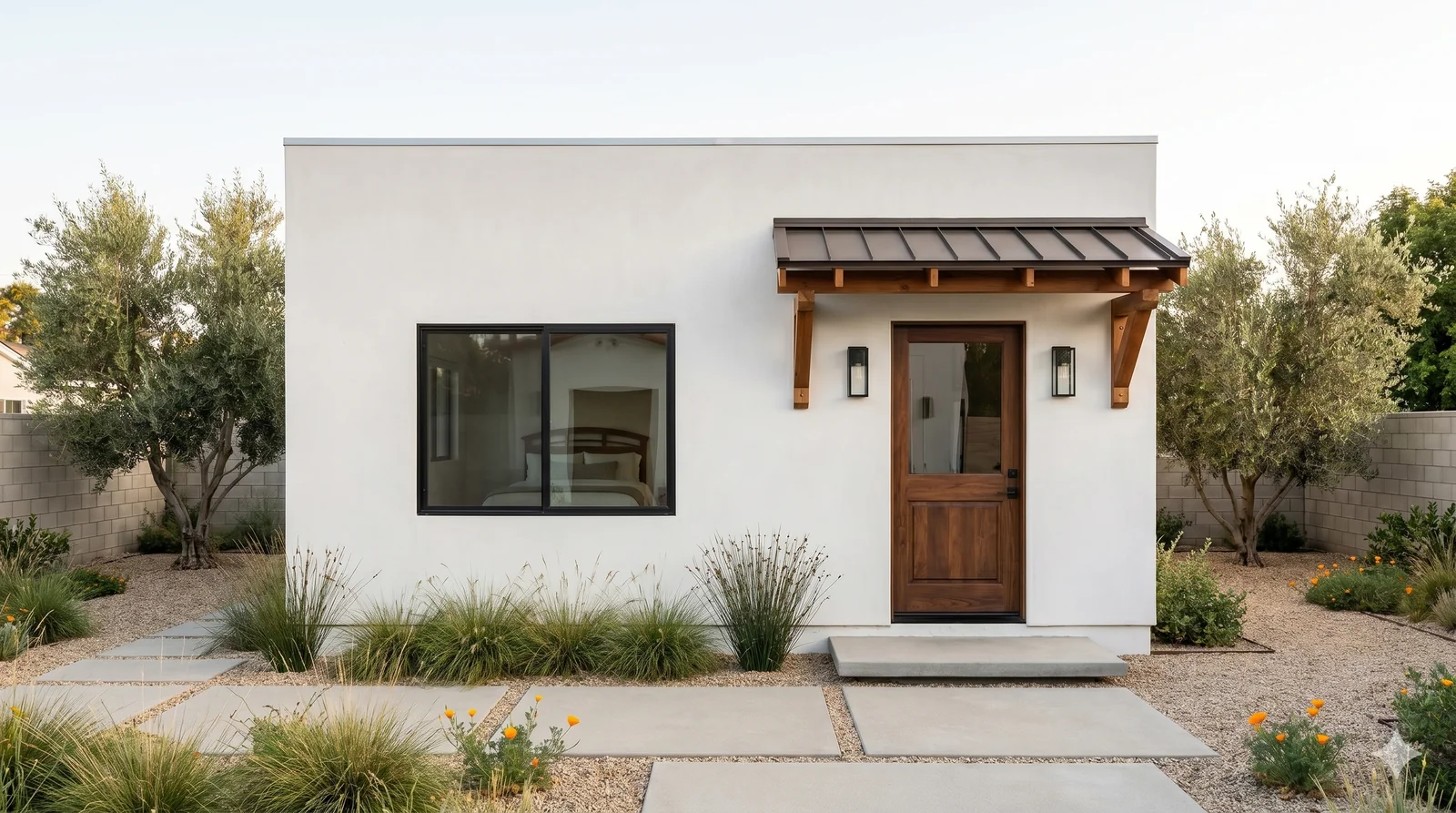
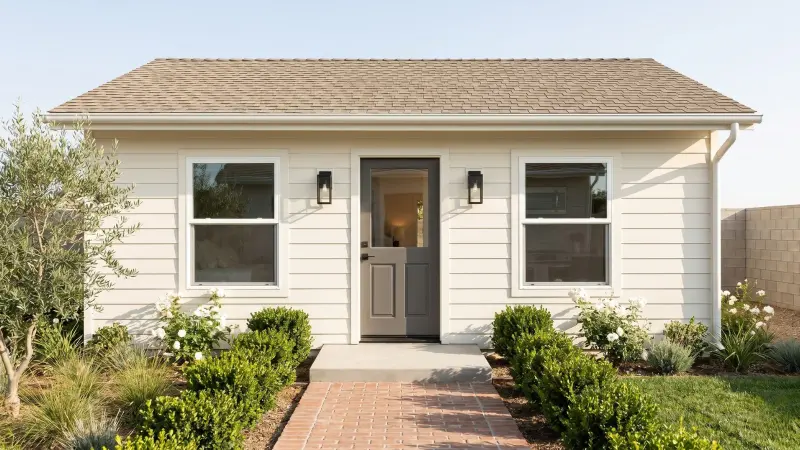
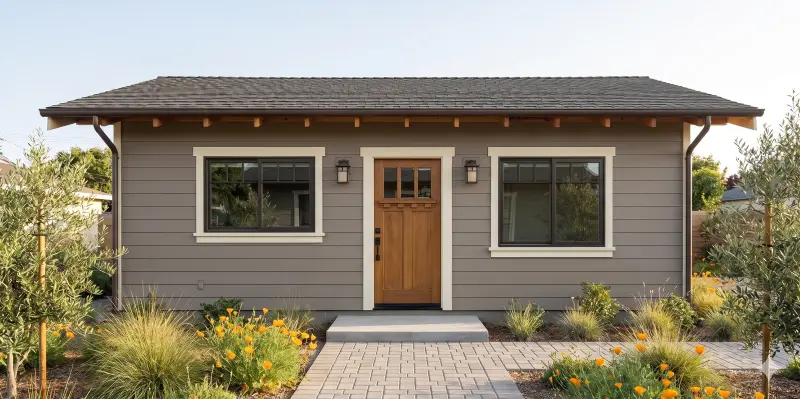
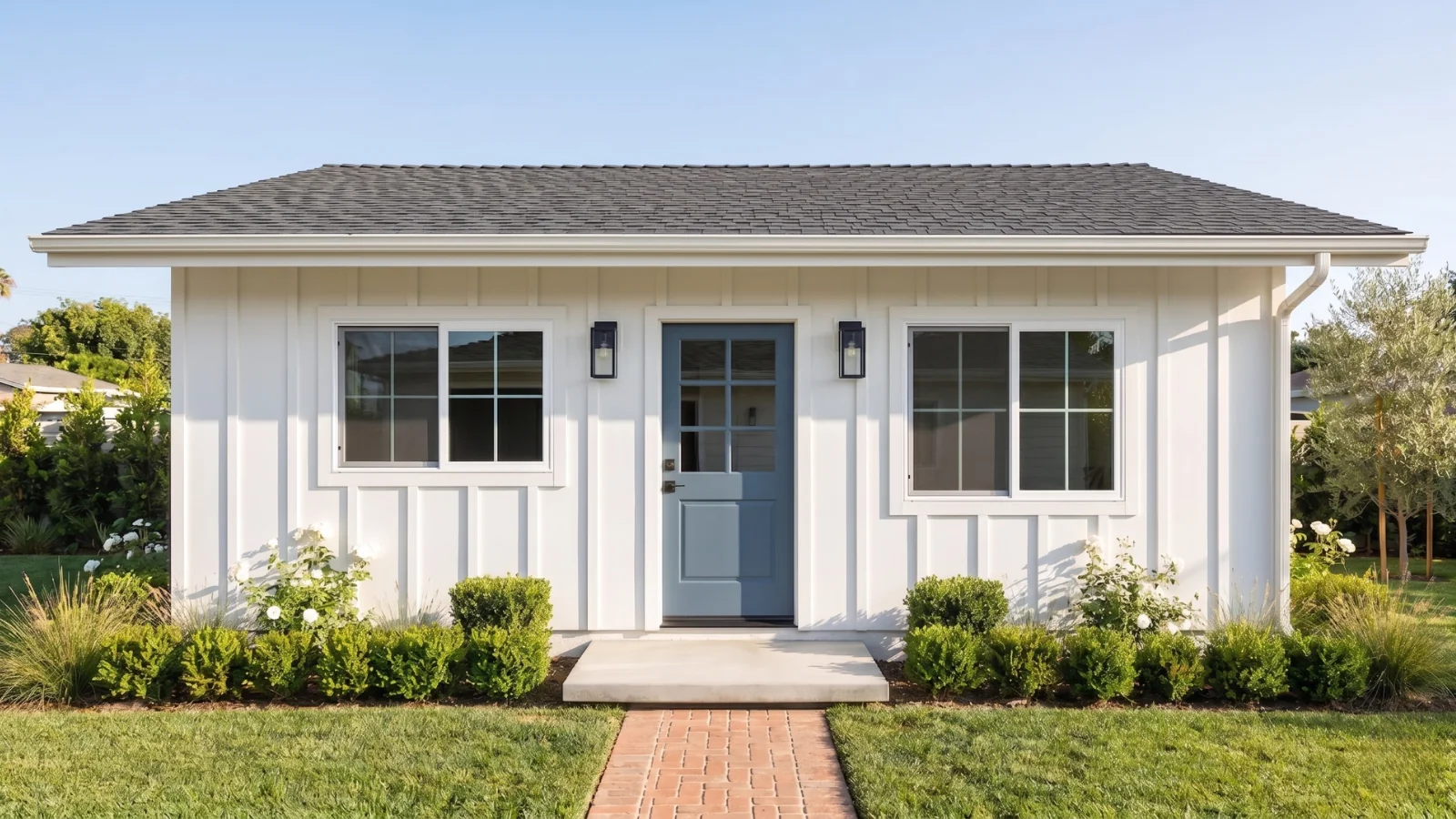
Three single-story plans, chosen against the 16-foot detached cap at HBMC § 17.21.060(B)(1) — reinforced on the local track by the one-story limit at § 17.21.070(K). Fixed plan pricing, permit processing included.
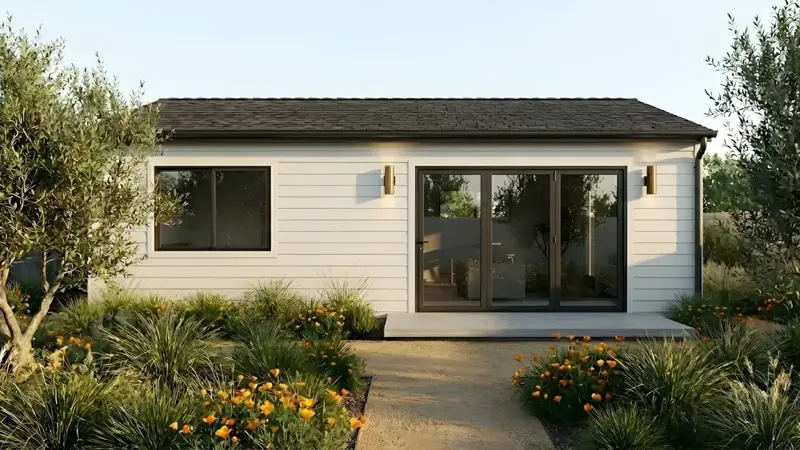
The Sunset
The Melrose
The Lincoln
The three sit at three different lines in the code, which is why they are the picks. The Sunset at 480 sqft is below 750, so impact fees fall away entirely. The Melrose at 800 sqft lands exactly on the statutory-track ceiling — § 17.21.050(A)(2)(b) reads “800 square feet of livable space or smaller” — so it still skips the local design rules. The Lincoln at 1,000 sqft is the local-track ceiling for a two-bedroom-plus unit, and it brings the § 17.21.070 rulebook with it.
Our two-story plans — the Fairfax, the Venice and the Culver — stand about 25 feet and are drawn as detached buildings, so they cannot be permitted in Hermosa Beach as drawn. The 16-foot detached cap is what stops them, and on the local track the one-story rule stops them again. There are two ways around it. A two-story plan can be modified to fit a lower envelope, or we design a custom ADU from scratch for $9,990–$19,990 for design and permit processing, bid per project. The single-story plans permit as drawn, which is why they lead. If two stories is the point, the attached path at § 17.21.060(B)(4) is real and it is custom-design work, not a stock plan.
What an ADU costs in Hermosa Beach (2026)
Our Signature plans are fixed-price — architectural design, structural engineering, Title 24 compliance and full permit processing included, the same number in Hermosa Beach as in every other city we serve. Construction is separate: once your plans are permitted, you build with our construction partner or your own licensed contractor. The figures below are the estimated cost to build each model.
| Model | Configuration | Size | Collection | Est. cost to build |
|---|---|---|---|---|
| The Wilshire | Studio / 1BA | 400 sqft | Single-story | $180K–$200K |
| The Sunset | 1BR / 1BA | 480 sqft | Single-story | $200K–$215K |
| The Westwood | 1BR / 1BA | 550 sqft | Single-story | $215K–$235K |
| The Laurel Canyon | 2BR / 1BA | 660 sqft | Single-story | $240K–$265K |
| The Melrose | 2BR / 2BA | 800 sqft | Single-story | $275K–$295K |
| The Fairfax | 2BR / 1.5BA | 840 sqft | Two-story | $280K–$310K |
| The Lincoln | 3BR / 2BA | 1,000 sqft | Single-story | $325K–$350K |
| The Venice | 2BR / 2.5BA | 1,080 sqft | Two-story | $335K–$365K |
| The Culver | 3BR / 2.5BA | 1,200 sqft | Two-story | $385K–$420K |
Development fees
Impact fees are the big exemption, and Hermosa Beach has written the state rule into § 17.21.080(A). No impact fee applies to a junior ADU, or to an ADU at or below the statutory 750-square-foot line. Above that, the fee is charged in proportion to the main house rather than at the full rate a new dwelling would pay, and § 17.21.080(A)(3) sets out the arithmetic: the floor area of the ADU, divided by the floor area of the main house, times the fee a new dwelling would be charged. A unit below 500 square feet is also outside school impact fees under Education Code § 17620 (§ 17.21.080(A)(2); Gov. Code § 66311.5(c)(3)).
What is not exempt: building-permit and plan-check fees, which are based on project valuation rather than on the fact that you are building an ADU, and utility connection fees and capacity charges, which § 17.21.080(A)(1) expressly carves out of the definition of an impact fee. Junior ADUs and statutory-track conversion ADUs on a single-family lot need no new or separate utility connection and no connection fee at all, unless they are built with a new house (§ 17.21.080(B)(2)). Other ADUs do, at a charge proportionate to the burden they place on the system (§ 17.21.080(B)(3)).
We have deliberately not published a dollar figure for Hermosa Beach permit and plan-check fees on this page. The City publishes its own schedule and it is valuation-based; your Backyard Review includes a line-item estimate of the pass-through costs for your specific lot, priced against the current schedule rather than a number we made up.
What it returns: renting the unit
Hermosa Beach is a 30-day-minimum city, so the asset you are building is a long-term tenancy rather than a nightly one. The benchmark we anchor on is HUD’s Fair Market Rent for the Los Angeles–Long Beach–Glendale metro area, FY 2026 as revised. It is a metro-wide floor across all housing stock and all ages, which is exactly why it is the right anchor: a new, fully permitted detached unit in a beach city rents at or above it, not below.
| Unit type | ADU size band | HUD FMR (FY 2026, LA metro) |
|---|---|---|
| Studio | ~400 sqft | $2,079 |
| 1 bedroom | 480–550 sqft | $2,328 |
| 2 bedroom | 660–800 sqft | $2,903 |
| 3 bedroom | 1,000 sqft | $3,681 |
HUD FMR figures: FY 2026 Fair Market Rents, Los Angeles–Long Beach–Glendale HUD Metro FMR Area, as revised effective May 21, 2026 (Federal Register, 91 FR 21301, published April 21, 2026). These are metro-wide figures across all housing stock and ages, and they are presented as a floor rather than a forecast. We have not published Hermosa Beach-specific rent bands here because we do not have a citable source for them; for payback math keyed to your lot, your model and your financing assumptions, use the ADU ROI calculator.
Why the Hermosa Beach market rewards the build
The city covers 1.4 square miles and has effectively no buildable greenfield left, which is the whole argument. New supply arrives one accessory unit at a time, and the rules now allow three of them on a single-family lot. The 30-day floor removes nightly-rental supply from the market, which tightens the long-term rental pool that a permitted ADU competes in.
The South Bay employment base — aerospace and engineering in El Segundo and Hawthorne, and the office corridor along Rosecrans — keeps long-term tenant demand steady rather than seasonal. And a fully permitted unit adds recorded, comp-able square footage to a parcel in a market where turnover is low and comparables are scarce.
The regulatory picture helps too, and it is unusual enough to say plainly: this is a city whose ADU chapter the State has reviewed and signed off on. That is not true of most of the region. It means the text you are designing against is the text that will be applied, rather than a chapter waiting to be corrected under Gov. Code § 66326.
When an ADU isn’t the right move
Not every Hermosa Beach property is a good ADU candidate, and it is cheaper to learn that now than after you have paid for plans. Five situations where we would tell you to wait, choose a different unit type, or not build:
- Your numbers depend on nightly rental income. They will not work. HBMC § 17.21.060(D) bars renting an ADU or junior ADU for a term shorter than 30 days, whenever the unit was created, and Gov. Code § 66323(e) requires a term longer than 30 days on the statutory track. Run the math on a month-to-month tenancy or stop here.
- You want a two-story detached backyard house. It does not exist in this city. Sixteen feet, one story, no above-garage exception. If the second story is the point, the honest options are an attached unit built into the main house, or a different city.
- Your lot has almost nothing usable after setbacks. Hermosa Beach parcels are small. After 4-ft side and rear setbacks and a 25-ft front setback on the local track, some lots simply cannot take a free-standing building worth building. A garage conversion or a junior ADU usually returns more on those lots.
- You need a firm date and you are in the Coastal Zone. The coastal permit now carries a 60-day clock, which is a real improvement — but your ADU application is not complete until the coastal application is complete (§ 17.21.040(C)(6)(a)). Assembling that submittal properly takes time no builder can compress.
- You want to sell the unit on its own one day. Hermosa Beach has not opted in under AB 1033, so the condominium route at Gov. Code § 66342 is not available here. § 17.21.060(E) bars separate conveyance except under Gov. Code § 66341, which is a qualified-nonprofit route, not a homeowner exit.
How long an ADU takes
Here is what the schedule actually looks like on a Signature plan.
| Phase | Duration | Notes |
|---|---|---|
| Signature plan preparation | ~2 weeks | A pre-engineered plan customized to your lot — and on the local track, to the main house’s materials and roof slope under § 17.21.070(H) |
| City completeness check | 15 business days | Written notice, with a list of anything missing and how to cure it. Resubmittals get another 15 business days, and the City may not add an item that was not in the original notice. Miss the clock and the application is deemed complete (§ 17.21.040(C)(1); Gov. Code § 66317(a)(2)(A), added by SB 543) |
| Ministerial decision | 60 days | Deemed approved if the City does not act (§ 17.21.040(C)(3); Gov. Code § 66317(a)). Tolled only if you request a delay, or if the ADU is filed with a permit application for a new primary dwelling. A denial has to list every defective item and how to remedy it, inside the same 60 days |
| Construction | 4–6 months | By model size — the schedule is guaranteed in writing, with a daily delay penalty if the contracted finish date is missed |
| Total, start to finish | 6–9 months | Signature plans. A custom design runs longer, because the City is reading the drawings for the first time. Coastal Zone parcels run the coastal permit in parallel rather than afterwards |
Plan check on a Signature plan is a conformance review of drawings that are already engineered, not a from-scratch evaluation, which is why the permit step is measured in weeks rather than months here. If the City calls the application incomplete or denies it, you may appeal in writing to the City Clerk, and the Planning Commission issues a final written determination within 60 business days (§ 17.21.040(C)(1)(f), (C)(5)).
If your parcel is in the Coastal Zone
The coastal review runs alongside the ADU permit, not after it, and since October 2025 that is a statutory requirement rather than a local habit. AB 462 rewrote Gov. Code § 66329 effective October 10, 2025, and the terms are better than most homeowners expect.
Note also what the ordinance does not do. The deemed-approval remedy at § 17.21.040(C)(3) runs to the ADU permit only. No deemed approval attaches to a coastal permit the City itself issues, which is correct: under Gov. Code § 66329(b)(5) that remedy exists only on the Coastal Commission track. Anyone telling you Hermosa Beach offers a deemed-approved coastal permit is reading the wrong subsection.
The rules that make Hermosa Beach different
The Coastal Zone
Much of the city sits inside the California Coastal Zone established by the Coastal Act of 1976 (Pub. Resources Code § 30000 et seq.). The boundary runs inland from the beach and does not cover the whole city, so whether a given property is inside depends on the address. We confirm it against the City’s boundary map before anyone commits to a schedule.
HBMC § 17.21.040(C)(6) says that nothing in state ADU law or the local code lessens the effect of the Coastal Act. It then attaches three qualifications. A complete coastal application is required before the ADU application counts as complete. The coastal permit must be approved or denied within 60 days. And where the City has no certified local coastal plan or program, it must notify the Coastal Commission at once.
Layered on top is Gov. Code § 66329 as rewritten by AB 462: concurrent review, no public hearing, and no Coastal Commission appeal of a local decision. The timeline consequences are worked through in the timeline section.
Design rules on the local track — and how to avoid them
Hermosa Beach has some of the most specific architectural requirements in the South Bay, and every one of them lives in § 17.21.070, which applies only to local-track units. The exterior wall, roof, window and door materials and colors must match the main house. The roof slope must match its dominant slope. Exterior lighting is limited to down-lights. The unit needs an independent exterior entrance, interior dimensions of at least 10 feet in every direction, and a minimum interior wall height of 7 feet.
Two privacy rules go further than most cities. No window or door may have a direct line of sight to an adjoining residential property — each one must either be placed where no such line exists or be screened with fencing, landscaping or privacy glass. And any window or door within 30 feet of a property line that is not a public right-of-way must be clerestory, with the bottom of the glass at least six feet above the finished floor, or use frosted or obscure glass (§ 17.21.070(H)(6)–(7)). Section 17.21.070(I) then requires drought-tolerant evergreen screening between the ADU and adjacent parcels, from the City’s approved plant list.
All of it falls away on the statutory track. Both subsections carry an express savings clause — §§ 17.21.070(H)(8) and (I)(5) state that the requirements “shall not preclude any unit subject to Government Code section 66323” — and Gov. Code § 66323(b) independently bars a city from imposing objective design standards on a statutory unit. That is why the size decision and the design decision are really one decision here.
What the State said about this ordinance
Most city ADU chapters in the region have never been through a state compliance review. This one has, twice, and the second letter closed the file. HCD wrote to the City on December 29, 2025 with written findings under Gov. Code § 66326(a) against the prior Ordinance No. 1484, giving the City 30 days to respond. Ord. No. 26-1498 is the answer. Here is what changed:
| HCD finding, December 29, 2025 | What the 2026 chapter does |
|---|---|
| Unit allowances capped ADU and junior ADU development at two units on a single-family lot, contrary to Gov. Code § 66323(a); units created under § 66314 were not reflected at all | § 17.21.050(A) codifies the full § 66323 stack and says (A)(1) may be combined with (A)(2); § 17.21.050(B) adds the §§ 66314–66322 units HCD asked for. HCD treats those as additional to the § 66323 stack (ADU Handbook, March 2026, p. 18); the chapter does not say the two tracks stack, which is the one open question left in it |
| Junior ADU owner-occupancy required in all cases, though AB 1154 narrowed Gov. Code § 66333(b) to shared-sanitation cases from January 1, 2026 | § 17.21.060(G)(2)(b)(I) waives it where the junior ADU has its own separate sanitation facilities |
| A deed restriction was imposed on ADUs; Gov. Code § 66315 bars additional standards on an ADU, and deed restrictions belong to junior ADUs only | § 17.21.060(H) now applies the deed restriction to junior ADUs only |
| The 800-square-foot savings clause was an incomplete recreation of Gov. Code § 66321(b)(3) — floor area ratio and minimum lot size were missing | § 17.21.070(A)(3) now names FAR and minimum lot size alongside the percent-based limit, front setback, lot coverage and open space |
| Architectural requirements carried no exception for units subject to Gov. Code § 66323 | §§ 17.21.070(H)(8) and (I)(5) both state the requirements shall not preclude any § 66323 unit |
| Recent legislation — AB 130, AB 462, AB 1154, SB 9 and SB 543 — needed to be incorporated | The 15-business-day completeness rule (SB 543), the AB 1154 sanitation carve-out and the 60-day coastal clock (AB 462) all appear in the adopted text |
HCD reviewed the adopted ordinance on April 14, 2026 and wrote to the City on May 8, 2026 that it “is substantially compliant with State ADU Law,” and that the Department “considers the matter of compliance with Government Code sections 66310-66342 closed.” Both letters are linked in the sources section.
What that means for you is practical rather than ceremonial. When a local chapter is out of step with the statute, a homeowner has to argue preemption at the counter, and Gov. Code § 66316 makes a noncompliant ordinance null and void until it is fixed. Here there is almost nothing to argue about. We found exactly one place where the local text reads narrower than the statute — the impact-fee cutoff at exactly 750 square feet, covered in the costs section — and it affects one square foot of one threshold.
Short-term rentals and separate sale
Two rules close doors, and both are worth knowing before you model returns. HBMC § 17.21.060(D) bars renting an ADU or junior ADU for a term shorter than 30 days, and applies that regardless of when the unit was created — there is no legacy carve-out. State law agrees rather than preempting: Gov. Code § 66323(e) requires a term longer than 30 days on the statutory track, and § 66333(g) says the same for a junior ADU, so a month-to-month tenancy is the safe floor.
On separate sale, Hermosa Beach has not opted in under AB 1033, so the condominium route at Gov. Code § 66342 is closed here. § 17.21.060(E) bars conveying an ADU or junior ADU separately from the lot and the main dwelling, with one carve-out: “as otherwise provided in Government Code section 66341.” That is the AB 587 route, under which a qualified nonprofit that built the unit may convey it to a qualified low- or moderate-income buyer under a recorded tenancy-in-common agreement. It is mandatory statewide and needs no opt-in — and it is not a homeowner exit. The two statutes are different things, and pages that write “§§ 66341–66342” as one citation get this wrong.
How the permit process works
Applications go to the Community Development Department at 1315 Valley Drive, through the Planning and Building divisions. There is no design review board, no neighbor notice and no council vote. The City may charge a processing fee for the ADU permit, set by council resolution (§ 17.21.040(B)).
The completeness stage has more structure than most cities give it, and it works in your favor. The City has 15 business days to determine in writing whether the application is complete. If it is not, the notice has to list the incomplete items and describe how to cure them. When you resubmit, the City has another 15 business days — and it may not require an item that was not in the original notice. Miss any of those clocks and the application is deemed complete (§ 17.21.040(C)(1)).
A denial is similarly constrained. The City has to provide comments listing all defective or deficient items and describing how the application may be remedied, and it has to do that inside the same 60-day window (§ 17.21.040(C)(4)). Both an incompleteness determination and a denial are appealable in writing to the City Clerk, with a final written Planning Commission determination within 60 business days.
Two building-code points are worth knowing at submittal. Building an ADU does not by itself constitute a Group R occupancy change unless the Building Official makes a written finding, on substantial evidence, of a specific adverse impact on public health and safety (§ 17.21.060(I)(2)). And a certificate of occupancy for the ADU normally cannot be issued before the main house has one — with one narrow exception at § 17.21.060(J)(2), for a detached, permitted and inspected ADU where the main house was substantially damaged or destroyed in an event covered by a Governor’s emergency proclamation made on or after February 1, 2025.
Pre-approved plans, and where we sit
AB 1332 requires every California city to run a pre-approved ADU plan program, in place since January 1, 2025 (Gov. Code § 65852.27). Ask Community Development what is currently on the Hermosa Beach list. A pre-approved plan moves faster across the counter, and the trade is that it cannot be modified.
CALI ADU does not put plans into city pre-approval catalogs. Our Signature Homes are individually permitted on your lot — engineered from the start to clear the objective standards in Chapter 17.21, and adapted to your setback geometry, grade, utilities and existing structures. If you want the fastest possible counter time on a standard lot and will build a plan exactly as the City holds it, a pre-approved plan is a real option. If you want a design and permit partner with a fixed fee in writing, that is us.
Hermosa Beach ADU questions, answered
The questions Hermosa Beach homeowners actually ask before they start — each answered from HBMC Chapter 17.21 (Ord. No. 26-1498) and Gov. Code §§ 66310–66342.
Does Hermosa Beach have its own ADU ordinance?
Yes. HBMC Chapter 17.21 governs ADUs and junior ADUs, and it is one of the newest chapters in the South Bay. Ord. No. 26-1498 repealed and replaced the whole chapter, adopted March 24, 2026 and effective April 23, 2026. HCD reviewed the new chapter on April 14, 2026 and wrote to the City on May 8, 2026 that it is substantially compliant with State ADU Law and that the compliance matter is closed. Anything you read about Hermosa Beach ADUs written before spring 2026 describes a chapter that no longer exists.
How big can an ADU be in Hermosa Beach?
It depends which track you build on. On the statutory track at HBMC § 17.21.050(A), a new detached ADU is capped at 800 square feet of livable space, and a conversion of existing space carries no square-foot cap at all — you may add up to 150 square feet to an accessory structure for ingress and egress. On the local track at § 17.21.070(A)(1), the cap is 850 square feet of interior livable space for a studio or one-bedroom and 1,000 square feet for two bedrooms or more; an attached unit on a lot with an existing house is limited on top of that to 50 percent of the house's floor area. A junior ADU is capped at 500 square feet. Whichever track you use, § 17.21.070(A)(3) guarantees that no FAR, minimum lot size, front setback, lot coverage or open-space rule may push the unit below 800 square feet of interior livable space (Gov. Code § 66321(b)(3)).
How tall can an ADU be in Hermosa Beach?
A detached ADU is capped at 16 feet under HBMC § 17.21.060(B)(1). Two exceptions raise it. If your lot is within one-half mile walking distance of a major transit stop or a high-quality transit corridor as defined in Public Resources Code § 21155, the cap is 18 feet, plus up to two more feet — 20 feet at most — where that is needed to align the ADU roof pitch with the main house (§ 17.21.060(B)(2)). On a lot with an existing or proposed multifamily building of more than one story, the cap is 18 feet (§ 17.21.060(B)(3)). Height is measured from existing legal grade or the level of the lowest floor, whichever is lower, to the peak of the structure. All three figures match the state floors at Gov. Code § 66321(b)(4)(A) through (C).
Can I build a two-story ADU in Hermosa Beach?
Only as an attached unit. The 16-foot detached cap at § 17.21.060(B)(1) forecloses a second story on its own, and on the local track § 17.21.070(K) says it outright, barring any ADU from having more than one story unless it is attached to the main house. There is no above-garage exception in this chapter. An attached ADU may go to two stories, but read the height rule carefully — § 17.21.060(B)(4) allows 25 feet or the height limit your zone imposes on the main house, whichever is lower, and never more than two stories. That mirrors Gov. Code § 66321(b)(4)(D), which defers to the zone rather than guaranteeing 25 feet. Confirm your base-zone height limit before you design to a number.
How many ADUs can I put on a Hermosa Beach single-family lot?
Three, and possibly four. HBMC § 17.21.050(A) codifies the Gov. Code § 66323 stack in full and says expressly that a unit approved under (A)(1) may be combined with one approved under (A)(2). That means one ADU converted from existing space, plus one junior ADU, plus one newly built detached ADU of 800 square feet or smaller — on top of the house already standing. There is no "one ADU plus one junior ADU" cap anywhere in the chapter. The possible fourth is the local track: HCD's ADU Handbook (March 2026, p. 18) says a local agency must allow at least one unit described in Gov. Code § 66314 in addition to the § 66323 units, and HCD told Hermosa Beach the same thing in its December 2025 findings letter. Chapter 17.21 does not say in terms that the two tracks stack, so confirm the as-applied answer with Planning. On a multifamily lot, (A)(3) allows at least one conversion ADU in non-livable space and up to 25 percent of the existing unit count, and (A)(4) allows up to eight detached ADUs on a lot with an existing multifamily building, capped at the number of existing units (Gov. Code § 66323(a)(4)(A)(ii)), or two on a lot with a proposed one. Those two may be combined as well, and § 17.21.050(A) says so expressly.
Do I need to add a parking space for an ADU in Hermosa Beach?
Usually not. The local parking rule reaches only the local track: § 17.21.070(G)(1) requires one off-street space per ADU or per bedroom, whichever is less, and the space may sit in a setback area or be tandem. Six exceptions waive it at § 17.21.070(G)(2): within one-half mile walking distance of public transit, inside an architecturally and historically significant historic district, where the ADU is part of the existing or proposed main residence or an accessory structure, where on-street parking permits are required but not offered to the ADU occupant, where a car-share stop sits within one block, or where the ADU application is filed with a new single-family or multifamily dwelling and one of the previous three conditions is also met. Statutory-track ADUs and all junior ADUs sit outside § 17.21.070 entirely and carry no parking requirement; Gov. Code § 66334(a) independently bars a parking requirement for a junior ADU. And § 17.21.070(G)(3) means no replacement parking when a garage, carport or uncovered space is demolished or converted (Gov. Code § 66314(d)(11)).
Do I have to live on the property to build an ADU in Hermosa Beach?
No. HBMC § 17.21.060(G)(1) states that ADUs are not subject to an owner-occupancy requirement, which matches Gov. Code § 66315. Note that when we last checked it in August 2026, the City's own ADU web page listed, under Key Features, that owner-occupancy is required in single-family zones starting January 1, 2025. That is contradicted by the City's own ordinance and preempted by state law; where a web page and the code disagree, the code governs. A junior ADU is the one exception, and a narrow one: § 17.21.060(G)(2)(a) applies owner-occupancy generally, but (G)(2)(b) waives it where the junior ADU has its own separate sanitation facilities, or where the property is entirely owned by a governmental agency, land trust or housing organization. The sanitation carve-out is the AB 1154 narrowing at Gov. Code § 66333(b), effective January 1, 2026, and Hermosa Beach wrote it straight into the ordinance.
What happens if my Hermosa Beach property is in the Coastal Zone?
You need a Coastal Development Permit alongside your ADU permit, and the two now run together. HBMC § 17.21.040(C)(6) preserves the California Coastal Act with three qualifications: a complete CDP application must be included for the ADU application to be complete, the CDP must be approved or denied within 60 days of a complete application, and if the City has no certified local coastal plan or program it must immediately notify the California Coastal Commission. AB 462 rewrote Gov. Code § 66329 effective October 10, 2025 and added the rest: the coastal review runs concurrently with the ADU permit under § 66317 rather than after it, no public hearing may be required, and a local decision is not appealable to the Coastal Commission under Public Resources Code § 30603. Where the Commission holds the 60 days instead, a missed deadline deems the coastal permit approved (§ 66329(b)(5)). The ordinance attaches no deemed approval to the CDP on the local track, which is correct.
Do I pay impact fees on a Hermosa Beach ADU?
Not if the unit is 750 square feet of interior livable space or less. Gov. Code § 66311.5(c)(1) exempts those ADUs outright, and exempts every junior ADU of 500 square feet or less. Above 750 square feet the fee must be charged in proportion to the main house rather than at the full rate a new dwelling would pay, and HBMC § 17.21.080(A)(3) writes out the arithmetic: the floor area of the ADU, divided by the floor area of the main house, times the fee a new dwelling would be charged. A unit below 500 square feet is also outside school impact fees under Education Code § 17620 (§ 17.21.080(A)(2)). One boundary detail is worth knowing: the local text exempts a unit of "less than 750 square feet" and charges proportionally at "750 square feet or more," which is narrower than the statute at exactly 750. State law controls there under Gov. Code § 66316. Water and sewer connection fees and capacity charges are separate from impact fees and are not exempted.
Can I rent a Hermosa Beach ADU on Airbnb?
No. HBMC § 17.21.060(D) bars renting any ADU or junior ADU for a term shorter than 30 days, and says so regardless of when the unit was created. There is no separate short-term rental permit path for ADUs. State law pushes in the same direction rather than against it: Gov. Code § 66323(e) requires a term longer than 30 days for a statutory-track ADU and § 66333(g) does the same for a junior ADU, so a month-to-month tenancy is the safe floor. Long-term tenancy is the operative business case in Hermosa Beach, and any pro forma built on nightly income will not survive contact with the ordinance.
Can I sell a Hermosa Beach ADU separately from the main house?
Generally no. AB 1033 lets a city opt in to separate condominium sale of an ADU under Gov. Code § 66342, and Hermosa Beach has not adopted an opt-in. HBMC § 17.21.060(E) bars selling or conveying an ADU or junior ADU separately from the lot and the main dwelling, with one express exception: "as otherwise provided in Government Code section 66341." That is the AB 587 route, under which a qualified nonprofit that built the unit may convey it to a qualified low- or moderate-income buyer under a recorded tenancy-in-common agreement. It is mandatory statewide and needs no city opt-in, but it is not a route for a homeowner planning an exit.
What design rules apply to a Hermosa Beach ADU?
On the local track, some of the most specific in the South Bay — and on the statutory track, none of them. HBMC § 17.21.070(H) requires the exterior wall, roof, window and door materials and colors to match the main house, the roof slope to match its dominant slope, exterior lighting limited to down-lights, an independent exterior entrance, interior dimensions of at least 10 feet in every direction with a 7-foot minimum wall height, and no direct line of sight from any window or door to an adjoining residential property. Windows and doors within 30 feet of a property line that is not a public right-of-way must be clerestory with the glass starting at least six feet above the floor, or use frosted or obscure glass. Section 17.21.070(I) then requires drought-tolerant evergreen screening from the City's approved plant list. Both subsections carry an express exception at (H)(8) and (I)(5): they "shall not preclude any unit subject to Government Code section 66323." Gov. Code § 66323(b) says the same thing from the state side.
How long does a Hermosa Beach ADU permit take?
The City has 15 business days to tell you in writing whether your application is complete, and if it misses that deadline the application is deemed complete (HBMC § 17.21.040(C)(1); Gov. Code § 66317(a)(2)(A), added by SB 543). Once the application is complete, the City has 60 days to approve or deny it or the application is deemed approved, tolled only if you request a delay or if the ADU is filed with a permit application for a new primary dwelling (§ 17.21.040(C)(3); Gov. Code § 66317(a)). Review is ministerial, so there is no hearing and no design review board. For a pre-engineered Signature plan the permit step runs in weeks rather than months, because plan check is a conformance review of drawings that are already engineered. A custom design takes longer, since the City is reading the drawings for the first time. In the Coastal Zone the coastal permit runs on its own concurrent 60-day clock.
Can I legalize an unpermitted ADU in Hermosa Beach?
Usually yes, if it was built before January 1, 2020. HBMC § 17.21.090(B)(1) bars the City from denying a permit to legalize an existing but unpermitted ADU or junior ADU built before that date on the grounds that it violates building standards or does not comply with state ADU law or Chapter 17.21. The exception is narrow: the City may still deny where it finds that correcting a violation is necessary to comply with Health and Safety Code § 17920.3, the substandard-building standard. Separately, § 17.21.090(A) bars the City from denying any ADU application because of a nonconforming zoning condition, building-code violation or unpermitted structure elsewhere on the lot, as long as it does not threaten public health and safety and is not affected by the ADU. Two more protections sit in the statute rather than the ordinance, and they are worth knowing: Gov. Code § 66311.7(e) says you may not be charged impact fees or connection or capacity charges to permit a pre-2020 unit, except where utility infrastructure is needed for Health and Safety Code § 17920.3 compliance, and § 66311.7(f) bars the City from penalizing you for having had the unpermitted unit. The state authority is § 66311.7 (AB 2533), which SB 543 renumbered effective January 1, 2026.
Official sources
Where a local rule and state law differ, Gov. Code § 66316 makes state law the operative rule and renders a noncompliant local ordinance null and void until the city fixes it. That question is unusually quiet in Hermosa Beach: HCD has reviewed this chapter and closed its file, and on most standards the City meets the state floor exactly rather than falling short of it.
| Source | What it governs |
|---|---|
| Hermosa Beach Municipal Code, Chapter 17.21 (opens in a new tab) encodePlus, the City’s official code publisher · Title 17 Zoning, §§ 17.21.010–17.21.100 · repealed and replaced by Ord. No. 26-1498 § 2, adopted March 24, 2026, effective April 23, 2026 | The binding local ordinance: the Class 1 and Class 2 tracks, unit counts, size, height, setbacks, parking, architectural and landscape standards, the historic-resources rule, fees, the coastal filing rule, and legalization of pre-2020 unpermitted units. |
| California Government Code §§ 66310–66342 (opens in a new tab) California Legislative Information · renumbered from former § 65852.2 et seq. by SB 477, effective March 25, 2024 | State ADU law — the floor every city must meet. Source for the 60-day ministerial clock, the owner-occupancy and parking preemptions, the 800 sqft entitlement, the unit stack, the impact-fee exemption at § 66311.5(c)(1), and the coastal permit rules as rewritten by AB 462. |
| HCD letter of substantial compliance to the City of Hermosa Beach (opens in a new tab) California Department of Housing and Community Development · May 8, 2026 (PDF) | HCD’s determination, after reviewing Ord. No. 26-1498 on April 14, 2026, that the ordinance is substantially compliant with State ADU Law, and that the compliance matter under Gov. Code §§ 66310–66342 is closed. |
| HCD ADU ordinance review findings to the City of Hermosa Beach (opens in a new tab) California Department of Housing and Community Development · December 29, 2025 (PDF) | The six written findings under Gov. Code § 66326(a) against the prior Ordinance No. 1484 — unit allowances, junior ADU owner-occupancy, the ADU deed restriction, the incomplete 800 sqft savings clause, architectural requirements without a § 66323 exception, and recent legislation. Ord. No. 26-1498 is the City’s answer to it. |
| HCD ADU Handbook (opens in a new tab) California Department of Housing and Community Development · updated March 2026 | The State’s official interpretation of ADU law, and the position that controls when a local rule reads more narrowly. Every regulatory claim on this page was cross-checked against it. |
| City of Hermosa Beach — Accessory Dwelling Units (opens in a new tab) Community Development Department · 1315 Valley Drive | Submittal information, handouts and staff contacts. One caution: when we last checked it in August 2026, this page listed owner-occupancy as required in single-family zones, which the City’s own § 17.21.060(G)(1) and Gov. Code § 66315 both contradict. Where the web page and the code disagree, the code governs. |
Last verified against primary sources on August 25, 2026; the ordinance and both HCD letters were re-read on August 28, 2026. California amends ADU law nearly every January 1. If you are reading this well after that date, confirm the current version before you commit to a design — or call us and we will confirm it for you.
Not sure what your lot
can actually support?
In 15 minutes we will pull up your property, confirm whether you are inside the Coastal Zone, run the Chapter 17.21 numbers against your lot, and give you an honest read on your options and a realistic budget — including whether an ADU is the right move at all.
15-minute video call · No obligation