
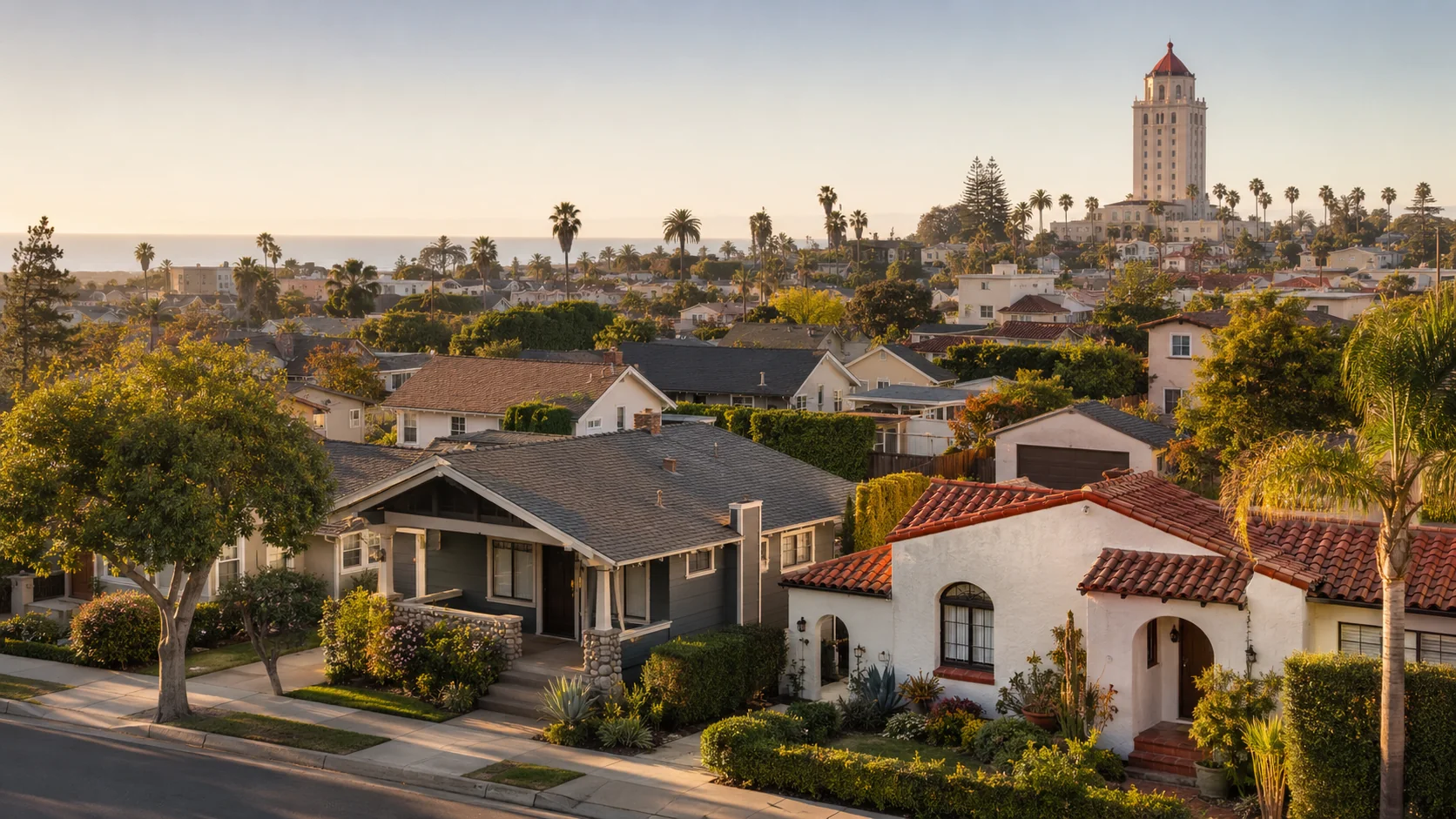
Building an ADU in Long Beach. Rules, costs, timeline.
Long Beach is the rare California city with no ADU ordinance it will apply. Your project is governed by the state statute alone — which is mostly good news, and occasionally expensive if you don't know it.
What you can build — at a glance
Reviewed by CALI ADU’s ADU specialists · August 2026
- Governing law
- State law only Long Beach confirms its own ADU ordinance no longer applies, and administers the state statutes directly. Every rule below comes from state law rather than a city code.
- Units per SFR lot
- 3, likely 4 A conversion ADU, a Junior ADU and a detached ADU of up to 800 sqft — all three in combination, not as alternatives. HCD’s position is that a city must allow at least one more on top.
- Apartment lots
- Up to 8 Convert up to 25 percent of your existing units, plus up to eight detached units, capped at the number of units already on the lot.
- Max ADU size
- 800–1,200 sqft A conversion has no cap at all. A detached unit is 800 sqft by right, and because Long Beach has no ordinance HCD reads the default ceiling as 1,200 sqft. Attached is half your house or 800 sqft, whichever is larger.
- Detached height
- 16–18 ft floors 16 ft, or 18 ft near transit with 2 more to match your roof pitch. Read those as minimums a city has to allow, not as caps — state law contains no height limit, and a city only gets one by adopting a compliant ordinance. Long Beach has none, so anything taller is an argument to make in writing rather than a given.
- Attached height
- Up to 25 ft 25 ft, or your zone limit if that is lower. HCD reads this as requiring at least two stories where the height and the building code allow it, though a city is never required to go beyond two.
- Parking required
- Usually none Transit proximity, historic districts, conversions, car-share and the City’s mapped Parking Exempt Area between them cover most of Long Beach.
- Impact fees
- None under 750 sqft No impact fees at all on an ADU of 750 sqft or less, park fees included. The City’s published fee schedule does not say so, so raise it yourself.
- Detached 800 sqft by right · 16–18 ft
- Attached 50% of the primary or 800 sqft · up to 25 ft and 2 stories
- Conversion No size cap · no added setback · no replacement parking
- Junior ADU Up to 500 sqft inside the primary dwelling · single-family lots only
- Coastal Zone Administrative Local CDP · 60-day clock · no hearing · no Coastal Commission appeal
Per California Gov. Code §§ 66310–66342, as administered by the City of Long Beach under Planning Information Bulletin IB-PZ-001. LBMC § 21.51.276 remains in the codified text (current through ORD-26-0013, enacted May 25, 2026) but the City has confirmed it no longer applies. Cross-checked against the HCD ADU Handbook (March 2026). Full citations in the sections below.
On this page
Can I build an ADU in Long Beach?
The City says Long Beach ranks as the highest per-capita producer of ADUs in California — more than 400 a year, up from close to zero a decade ago. The reason is partly this: there is very little local rulebook to argue with.
Five things to know before you start
These five decide most Long Beach projects. Everything further down the page is detail underneath them.
| What to know | Why it matters for your project |
|---|---|
| State law is the whole rulebook | The City applies Gov. Code §§ 66310–66342 directly. There is no local overlay to satisfy and no local discretion to lose. |
| Three units, and HCD reads it as four | A conversion ADU, a Junior ADU and a new detached ADU combine under § 66323, and HCD adds at least one more under § 66314 on top. |
| You may be owed a fee refund | The published impact fee schedule charges ADUs with no small-unit exemption. State law bars those fees below 750 sqft. |
| Coastal appeals are gone | Since October 2025 a coastal ADU decision is not appealable to the Coastal Commission under Public Resources Code § 30603. That removes the biggest historic risk. |
| Submittal is in person | The Permit Center does not accept online submissions for construction documents. Plan for a trip downtown with plans on a USB drive. |
What can you build on your lot?
Because there is no local ordinance, the state categories are the menu. That makes Long Beach unusually easy to plan for: what the statute says you may build is what you may build.
Which ADU type fits your property?
Start from what your lot already has rather than from a floor plan. The cheapest square footage in Long Beach is almost always space that is already standing.
| If your lot has… | The type that usually fits | Why |
|---|---|---|
| A detached garage on an alley | Garage conversion | No size cap, no added setback, and no replacement parking may be required. The rear setback is measured to the alley centerline. |
| Open rear yard | Detached new build | 800 sqft by right with four-foot side and rear setbacks. No local floor-area or lot-coverage rule applies. |
| An oversized house | Attached ADU | 50 percent of the primary or 800 sqft, whichever is more — and the attached envelope reaches 25 ft and two stories. |
| Spare space inside the house | Junior ADU | Up to 500 sqft, and it stacks with both of the above on the same lot. |
| An apartment building | Conversion plus detached | 25 percent of existing units converted, plus up to eight detached. The two allowances stack. |
| An unpermitted unit from before 2020 | Legalization | Gov. Code § 66311.7 and the City’s own amnesty program at LBMC Chapter 21.66 both offer a route. |
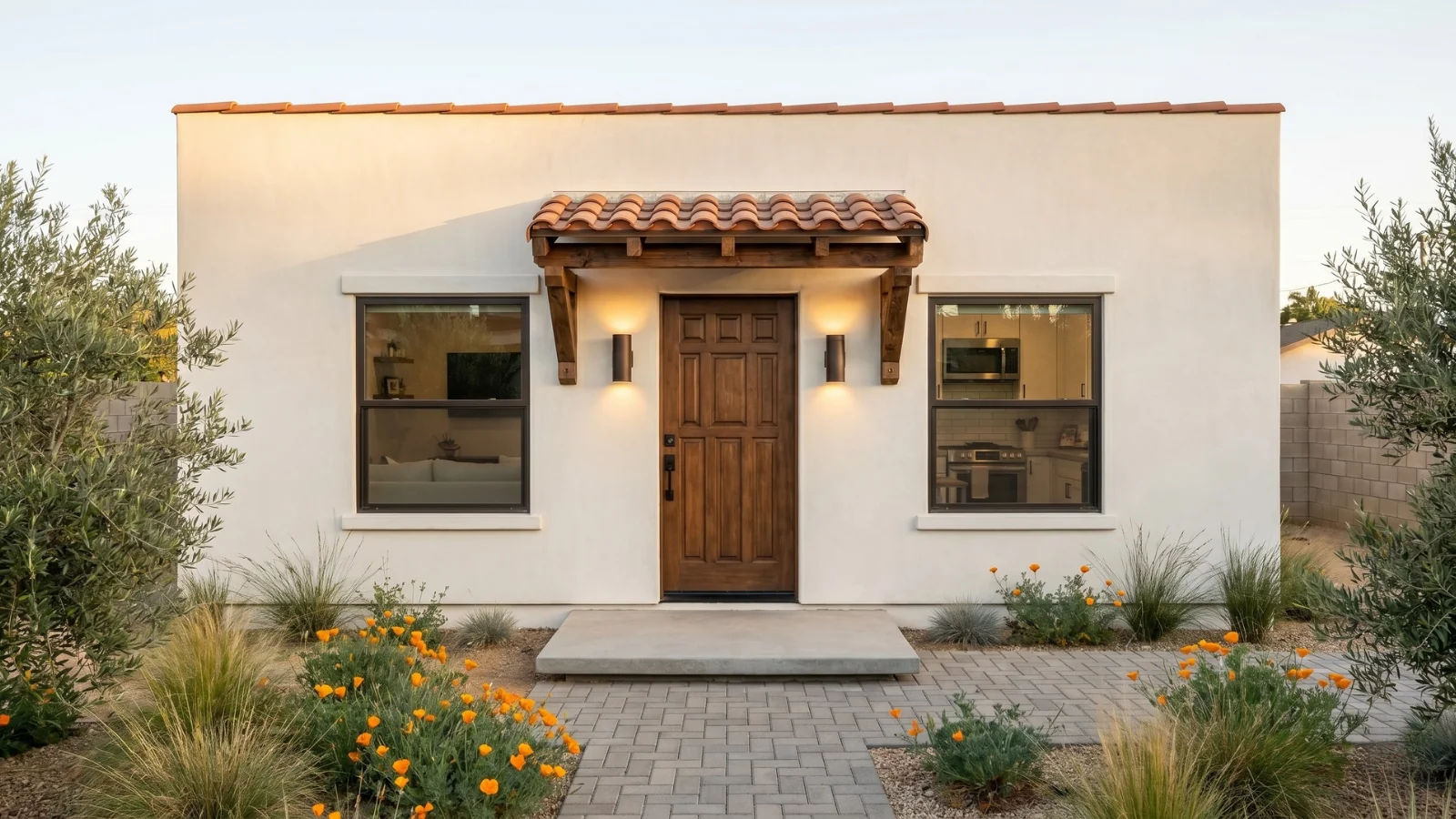
How tall can it actually be?
Two answers, depending on which unit you build.
The by-right 800 square foot unit is quoted at 16 feet, or 18 feet within a half-mile walking distance of a major transit stop or high-quality transit corridor, plus two more feet to match your roof pitch. Read § 66323(a)(2) carefully, though. It says a local agency “may impose” a floor-area limitation of 800 square feet and “a height limitation as provided in” § 66321(b)(4). Those are conditions a city elects to apply, not caps the statute applies by itself — and HCD’s position is that a city imposes a height limit “by adopting a compliant ADU ordinance.” In practice the City’s bulletin applies both numbers on day one.
Any other detached ADU has no height limit. HCD is explicit: “There is no height limit contained in State ADU Law,” and a city imposes one “by adopting a compliant ADU ordinance.” Long Beach has not adopted one. The 16 feet you will be quoted at the counter comes from the City’s bulletin, which is administrative guidance rather than an ordinance.
An attached ADU avoids the argument entirely. Gov. Code § 66321(b)(4)(D) guarantees 25 feet or the zoning limit, whichever is lower, and HCD reads it as requiring at least two stories where the height and the building code allow. If a second story is what you want, attaching the unit to the house is the route that delivers it without a debate — and our two-story plans can be modified to work that way, or we can design a custom ADU from scratch.
Fire sprinklers
Worth knowing before anyone tells you otherwise. Gov. Code § 66314(d)(12) provides that an ADU need not have fire sprinklers if they are not required for the primary residence, and that building an ADU cannot trigger a sprinkler requirement in the main house. Gov. Code § 66323(d) says the same for the by-right units. If your house has no sprinklers, your ADU does not need them.
If you own an apartment building
This is where Long Beach gets genuinely interesting, because two separate allowances stack and most owners only know about one.
| Existing units | Interior conversions | Detached ADUs | Total new units |
|---|---|---|---|
| 4 units | 1 | 4 | 5 |
| 8 units | 2 | 8 | 10 |
| 12 units | 3 | 8 | 11 |
| 24 units | 6 | 8 | 14 |
The detached allowance is capped at eight, and separately capped at the number of units you already have — so a four-unit building gets four detached, not eight. Conversions come from non-livable space such as storage, boiler rooms or unused common area, at one unit or 25 percent of your existing count, whichever is more.
If you are in the Coastal Zone
Long Beach has a certified Local Coastal Program, which means the City issues coastal permits itself rather than sending you to the Coastal Commission. An ADU in the Coastal Zone needs an Administrative Local Coastal Development Permit, filed concurrently with the building permit. No public hearing is required.
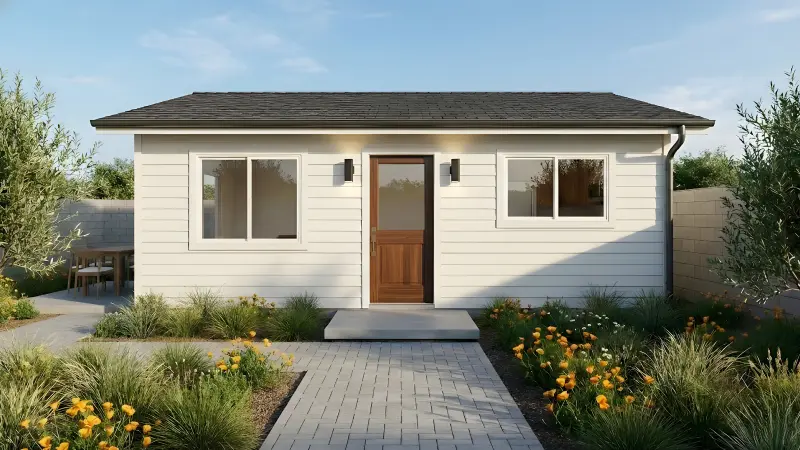
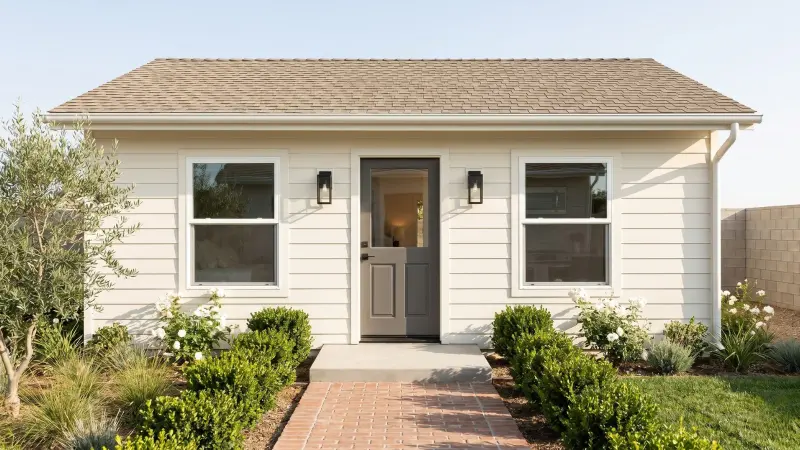
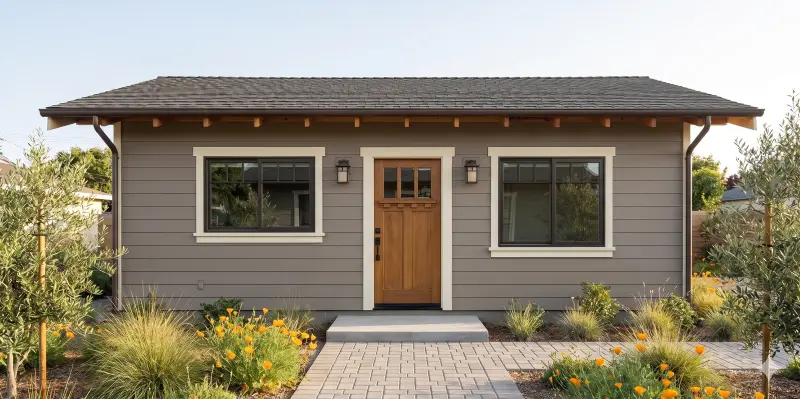
The single-story Signature ADU
Three architect-designed plans that permit as drawn inside the 16-foot envelope the City’s bulletin currently applies, at fixed design and permit pricing. That 16 feet is administrative practice rather than a state ceiling — see the height section above. If none suits your lot, a two-story plan can be attached to the house, or we can design a custom ADU from scratch.
What an ADU costs in Long Beach (2026)
Our plan fees are the same number on any lot, in Long Beach or anywhere else we work. Construction is separate. Once your plans are permitted you can build it yourself, bring your own licensed contractor, or use one of our vetted partners.
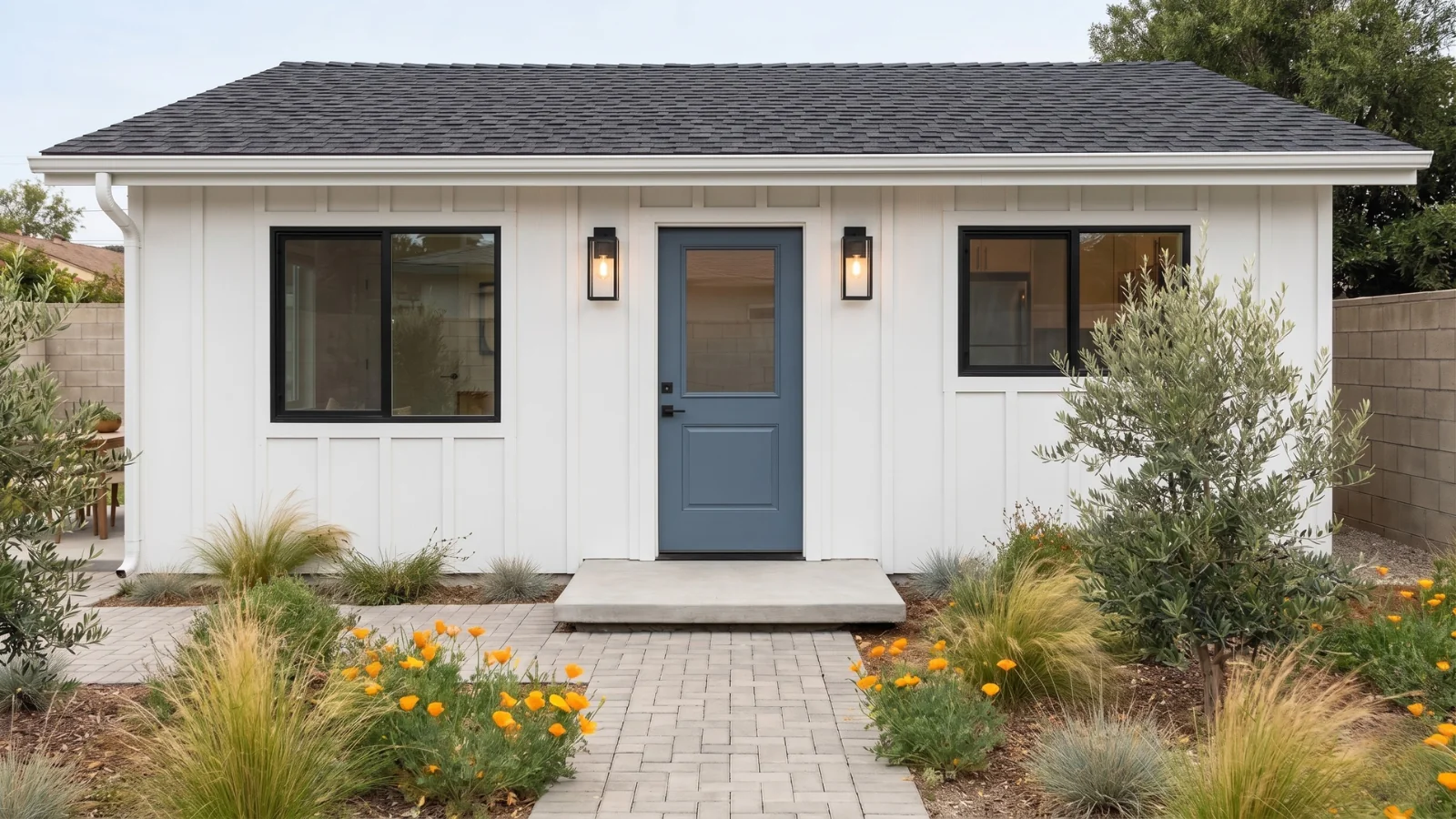
What the lineup costs to build
Plan fees are fixed. Construction is estimated, and varies with your site, access, and the finish level you choose.
| Plan | Size | Bed / bath | Est. build cost |
|---|---|---|---|
| The Wilshire | 400 sqft | Studio | $180K–$200K |
| The Sunset | 480 sqft | 1 BR / 1 BA | $200K–$215K |
| The Westwood | 550 sqft | 1 BR / 1 BA | $215K–$235K |
| The Laurel Canyon | 660 sqft | 2 BR / 1 BA | $240K–$265K |
| The Melrose | 800 sqft | 2 BR / 2 BA | $275K–$295K |
| The Lincoln | 1,000 sqft | 3 BR / 2 BA | $325K–$350K |
If none of the plans suits your lot, we also design custom ADUs from scratch — which runs $9,990–$19,990 for design and permit processing, bid per project.
City fees, and the ones that should not apply
This is the part of Long Beach worth reading carefully, because the City’s published schedule and the state statute do not agree.
| Fee | Published rate | On an ADU of 750 sqft or less |
|---|---|---|
| Parks & Recreation impact fee | $1,781.39 | Barred. § 66311.5(c)(2) brings § 66477 park fees inside the impact-fee definition. |
| Police facilities impact fee | $342.86 | Barred by Gov. Code § 66311.5(c)(1). |
| Fire facilities impact fee | $241.74 | Barred by Gov. Code § 66311.5(c)(1). |
| Transportation improvement fee | $236.25–$663.75 | Barred by Gov. Code § 66311.5(c)(1). |
| Sewer capacity fee | $144.34 | Depends on the unit type. Barred outright on a conversion ADU or a Junior ADU (§ 66311.5(d)). On a new detached unit it may be charged, but only proportionately to actual burden (§ 66311.5(e)). |
| School fee (Long Beach Unified) | $5.38 per sqft | Chargeable above 500 sqft. LBUSD applies it to ADUs over 500 square feet. |
The four barred fees add up to roughly $2,600 to $3,000 on a small ADU. Gov. Code § 66311.5(c)(1) is unambiguous: a local agency “shall not impose any impact fee upon the development of an accessory dwelling unit that has 750 square feet of interior livable space or less.” Above 750 square feet the fees return, but they must be charged proportionately to the size of your main house rather than as a flat per-unit amount.
Raise it in writing at the fee-estimate stage rather than after you have paid. This is a statutory entitlement, not a negotiation.
Building permit and plan check are separate again and valuation-based. A combination building permit for a house-type project runs at 150 percent of the building permit fee, plan check at 85 percent, and the City adds a 6 percent technology surcharge, a 6 percent general plan surcharge and a $115 processing fee on top. The City’s own rule of thumb is that permits and agency fees come to about 2 percent of building costs.
What it returns
Long Beach ADUs are long-term rentals, and the City bars them from short-term letting outright. For current rents, use the HUD Fair Market Rent schedule for the Los Angeles–Long Beach–Glendale area, published annually and a defensible baseline, then check local listings for what comparable units in your own neighborhood are asking.
How long an ADU takes
Both clocks have teeth, and they bite in different ways. If the City misses the 15 business days, your application is deemed complete. If it does send a completeness notice in time, that notice has to list every missing item and how to cure it — and when you resubmit, the City may not demand an item it left off its own list. If it misses the 60 days, the application is deemed approved (Gov. Code § 66317(a)).
One trap is specific to Long Beach. The dead ordinance recites a 120-day decision period, and that number still appears in the codified text anyone can look up. It does not apply. If a 120-day timeline is quoted to you, § 66317 is the answer.
| Stage | Typical duration | What governs it |
|---|---|---|
| Design and construction documents | 6–10 weeks | Your decisions, mostly. This is the stage you control. |
| Completeness determination | 15 business days | Statutory. Written notice of what is missing and how to cure it, or the application is deemed complete. |
| Plan review | Within 60 days | Statutory. A planner and an engineer review concurrently. |
| Coastal permit, if applicable | Within 60 days, concurrent | Gov. Code § 66329(a). No public hearing, and no Coastal Commission appeal. |
| Corrections and resubmittal | 2–6 weeks | Depends on how complete the first submittal was. This is where most schedules slip. |
| Construction | 4–8 months | Site access, weather, and your contractor’s schedule. |
There is a genuine shortcut here. Long Beach’s Pre-Approved ADU Program lets qualifying plans be approved over the counter, and the City states that a building permit can then be issued the same day. It is available for new construction only, not for conversions of existing space.
Over-the-counter review is also unavailable for anything in a historic district, anything in the Coastal Zone, or any project involving major structural engineering.
The city with no ADU ordinance
Two things are true at once here, and holding both is the key to reading anything you find online about Long Beach ADUs.
The ordinance exists. It runs to some fifteen thousand words with its own tables, it was last amended in 2021, and it appears in the code as codified through Ordinance ORD-26-0013 enacted on May 25, 2026. It was never repealed and it never expired.
And it does not govern you. The City’s Planning Information Bulletin IB-PZ-001 states that “the City of Long Beach does not currently have an adopted local ADU ordinance as of the date of this Bulletin,” and that ADU projects “are reviewed strictly in accordance with State ADU law.” The City’s ADU page puts it more bluntly still: LBMC 21.51.276 “no longer applies.”
Why the old ordinance became unusable
Reading it against current law explains the decision. Gov. Code § 66316 makes a local ADU ordinance null and void where it fails to meet the requirements of state ADU law, and requires the City to apply the state standards in its place until it adopts a compliant one.
| What LBMC § 21.51.276 says | What state law requires |
|---|---|
| ADUs only on a lot with one detached single-family dwelling | ADUs are required on multifamily lots too (Gov. Code § 66323(a)(3), (a)(4)). |
| 120 days to approve or deny | 60 days, then the application is deemed approved (§ 66317). |
| “The owner of the property shall reside either in the primary dwelling or the accessory dwelling unit” | Owner-occupancy may not be required for an ADU at all (§ 66315). |
| Minimum lot size of 4,800 square feet | No minimum lot size may bar an ADU (§ 66314(b)(1)). |
| Minimum unit sizes of 300, 450 and 750 square feet by bedroom count | A city may not bar an efficiency unit; the floor is 150 square feet. |
| ADU floor area counts against lot coverage, floor-area ratio and open space | Those standards may not be applied so as to block a qualifying ADU (§ 66321(b)(3)). |
| One ADU per lot, single-family only | A conversion ADU, a Junior ADU and a detached ADU in combination (§ 66323(a)). |
The City’s bulletin closes the loop on the development standards too, stating that no lot coverage, open space or floor-area-ratio standards apply to the ADU project types it covers. That is a direct repudiation of the old table.
What we could not find
One thing worth saying plainly, because other sites speculate about it. We found no HCD findings letter, notice of violation, technical assistance letter or memorandum of understanding directed at Long Beach on ADUs. There is no evidence the State forced this. On the available record it reads as the City’s own decision to stop applying a rulebook it knew was unenforceable while it writes a new one.
How the permit process works
The Community Development Department handles ADUs, with the Planning Bureau covering zoning and the Building & Safety Bureau covering construction. They review at the same time rather than in sequence.
What you submit, and where
Start with Planning Information Bulletin IB-PZ-001 — it is the document the City reviews against, and reading it first will save you a correction cycle.
Then note an unusual constraint. The City states that all construction documents and related permit applications must be submitted in person, that plan check fees are due the same day, and that online submissions are not available. Bring your application and a complete set of plans as a PDF on a USB drive to the Permit Center at 411 W. Ocean Boulevard.
Permits are issued in person as well, and inspections must be scheduled online — the City does not accept phone requests for building inspections.
Two things that change the path
A historic district location requires a Certificate of Appropriateness. There is no hearing and it is filed concurrently, but it removes you from over-the-counter eligibility. The consolation is real: a historic district is an automatic parking exemption.
A Coastal Zone location requires the Administrative Local Coastal Development Permit described earlier, and removes over-the-counter eligibility. One thing to watch: the City’s ADU webpage still tells you to obtain the coastal permit before submitting the building permit application. Both Bulletin IB-PZ-001 and Gov. Code § 66329(a) say otherwise — the coastal permit is filed concurrently and the two reviews run together. If you are asked to run them in sequence, § 66329(a) is the answer.
Legalizing an unpermitted unit
Long Beach has two routes and it is worth checking both. Gov. Code § 66311.7 bars the City from denying a permit for an unpermitted ADU or Junior ADU built before January 1, 2020 on the grounds that it violates building standards or does not comply with ADU law, and bars impact fees and connection charges on the legalized unit. The City separately runs an Unpermitted Dwelling Unit Amnesty Program at LBMC Chapter 21.66.
The state protections fall away entirely in two cases: where the City finds that correcting the violation is necessary to protect health and safety, and where the building is deemed substandard under Health and Safety Code § 17920.3.
If you are refused
You are not finished. Gov. Code § 66317(d) requires the City to give you a written appeal — on a denial or on an incompleteness determination — running to the City Council or the Planning Commission, with a final written determination within 60 business days.
Long Beach ADU questions, answered
The questions Long Beach homeowners and property owners actually ask — answered against California state ADU law and the City’s own Planning Information Bulletin.
Does Long Beach have an ADU ordinance?
Not one it applies. LBMC § 21.51.276 is still printed in the municipal code, but the City has stopped using it and says so publicly: "Long Beach Municipal Code 21.51.276 no longer applies, and the City is administering state ADU law directly until a new local ordinance is adopted." The City's Planning Information Bulletin IB-PZ-001 is the operative document, and it opens by confirming that "the City of Long Beach does not currently have an adopted local ADU ordinance." So your project is governed by Gov. Code §§ 66310–66342 — the state statute — and nothing else. A replacement ordinance went out for public comment in late 2025 but had not been adopted when this page was last verified.
Why did Long Beach stop using its own ADU ordinance?
Because it became legally unenforceable. LBMC § 21.51.276 was last amended in 2021 and conflicts with current state law on nearly every point: it allows ADUs only on lots with one detached single-family dwelling, gives the City 120 days to decide rather than 60, requires the owner to live on the property, sets a 4,800 square foot minimum lot size, and counts the ADU against lot coverage and floor-area ratio. Gov. Code § 66316 makes a local ADU ordinance null and void where it fails to meet the requirements of state law, and requires the agency to apply the state standards instead. Rather than enforce something unenforceable, the City switched to administering the statute directly.
How many ADUs can I build on a Long Beach single-family lot?
Three under § 66323, and HCD reads state law as requiring a fourth. Because the City applies state law directly you get the full Gov. Code § 66323(a) stack: one ADU converted from existing space in the house or an accessory structure, one Junior ADU of up to 500 square feet, and one newly built detached ADU of up to 800 square feet. The City's own bulletin confirms that combination. HCD's March 2026 Handbook (p. 18) adds that "in addition to the units described in Government Code section 66323, a local agency must allow at least one unit described in Section 66314" — the unit that carries the 1,200 square foot default discussed below. There is no local rule cutting any of it down, because there is no local rule.
How many ADUs can I add to a Long Beach apartment building?
Substantially more than most people expect. State law allows interior conversions of non-livable space at one unit or 25 percent of your existing units, whichever is more, and separately allows up to eight detached ADUs on a lot with an existing multifamily dwelling, capped at the number of units you already have (Gov. Code § 66323(a)(3), (a)(4)(A)(ii)). Those two allowances stack. On a twelve-unit building that is three conversions plus eight detached units. Junior ADUs are single-family only and are not available on a multifamily lot.
Is Long Beach charging impact fees it is not allowed to charge?
The published schedule reads that way, and it is worth knowing before you pay. Long Beach's Development Impact Fee schedule effective October 1, 2025 lists ADU rates — $1,781.39 for parks and recreation, $342.86 for police, $241.74 for fire, and a transportation fee — with no stated exemption for small units. Gov. Code § 66311.5(c)(1) prohibits any impact fee on an ADU of 750 square feet or less of interior livable space, and § 66311.5(c)(2) expressly brings park fees under § 66477 inside that definition. For a sub-750 square foot ADU that is roughly $2,600 to $3,000 of fees state law bars. Raise the statute in writing before you pay. Above 750 square feet, fees must be charged proportionately to the size of your main house rather than as a flat per-unit amount.
Which fees can Long Beach still charge on a small ADU?
The sewer capacity fee, currently $144.34, along with the valuation-based building permit and plan check fees. Gov. Code § 66311.5(c)(2) takes connection fees and capacity charges outside the impact-fee exemption, so the 750-square-foot rule does not bar them. But they are not automatically owed either. If your ADU is a conversion within the house or an accessory structure, or a Junior ADU — the units at § 66323(a)(1) — § 66311.5(d) bars a separate connection and any related charge, unless the unit is built with a new house or separately conveyed. Note that a multifamily conversion under § 66323(a)(3) is outside that subdivision. If it is new detached construction, § 66311.5(e) allows it — but it must be proportionate to the unit's burden, measured by square footage or drainage fixture units, not charged as a flat per-unit figure. Ask which basis the $144.34 was calculated on. School fees are separate again: Long Beach Unified charges $5.38 per square foot effective June 15, 2026, and applies it to ADUs over 500 square feet.
How tall can an ADU be in Long Beach?
Worth understanding what the 16-foot figure actually is. HCD states that "there is no height limit contained in State ADU Law," and that a local agency may impose one "by adopting a compliant ADU ordinance" — which Long Beach has not done. The 16 and 18 foot figures are floors a city must allow, not statewide caps. In practice the City's bulletin applies 16 feet, rising to 18 feet within a half-mile walking distance of a major transit stop or high-quality transit corridor, plus two more feet to match your roof pitch, and 18 feet where the lot already carries a multistory apartment building. If you want taller, HCD's Handbook is the document to raise in writing at pre-application. An attached ADU is different and more generous: Gov. Code § 66321(b)(4)(D) guarantees 25 feet or the zoning limit, whichever is lower, and two stories. Conversions simply maintain the existing height.
How big can a Long Beach ADU be?
A conversion of existing space inside the house has no square-foot limit at all. A newly built attached ADU may be 50 percent of the primary dwelling or 800 square feet, whichever is more. A newly built detached ADU is capped at 800 square feet under the by-right route at Gov. Code § 66323(a)(2) — the unit the City cannot refuse. That is not the ceiling, though. For a city without a compliant ADU ordinance, HCD reads the default maximum as 1,200 square feet for a new detached ADU (HCD ADU Handbook, March 2026, p. 38; the Handbook cites Gov. Code § 66314(d)(4), which in the current codified text is numbered (d)(5)). The City's bulletin says 800, so treat 1,200 as an argument to raise in writing rather than a given. A Junior ADU is capped at 500 square feet, and the minimum for any unit is 150 square feet.
Do I need a Coastal Development Permit for an ADU in Long Beach?
If your property is in the Coastal Zone, yes — an Administrative Local Coastal Development Permit, filed concurrently with the building permit. But the process improved sharply in October 2025. Under Gov. Code § 66329(a) as amended by AB 462, the City must approve or deny the coastal permit within 60 days, running concurrently with the ADU permit, and no public hearing is required. More importantly, § 66329(c) provides that a local decision under subdivision (a) "is not subject to appeal under Section 30603 of the Public Resources Code" — so the Coastal Commission appeal that used to be the scariest part of a coastal ADU is gone. Coastal projects are not eligible for over-the-counter review, so plan for a longer path.
Does Long Beach require parking for an ADU?
Usually not, and the exemptions are broad enough that most of the city qualifies. No parking is required within a half-mile walking distance of any transit stop, in a historic district, for a conversion of existing space, where on-street permits are required but not offered to the ADU occupant, within a half-mile of a car share — the City's bulletin sets that radius, which is more generous than the one-block floor at Gov. Code § 66322(a)(5) — for any Junior ADU, or anywhere inside the City's mapped Parking Exempt Area under LBMC § 21.41.175. And replacement parking is never required when a garage is converted or demolished (Gov. Code § 66314(d)(11)).
How long does an ADU permit take in Long Beach?
Two statutory clocks apply, and they are the only ones — the City publishes no local timeline commitment. Under Gov. Code § 66317 it has 15 business days to determine in writing whether your application is complete, then 60 days from completeness to approve or deny, after which the application is deemed approved. Note that the ordinance the City no longer applies still recites a 120-day decision period; if anyone at the counter quotes 120 days, § 66317 is the answer. Budget six to twelve months from first drawing to permit in hand, then construction on top.
Does Long Beach have pre-approved ADU plans?
Yes, and it is one of the better programs in the region. The Pre-Approved Accessory Dwelling Unit Program, or PAADU, lets qualifying plans and permit applications be approved over the counter at the Permit Center, and the City states that "upon approval, a building permit can be issued the same day." One important limitation: PAADU is available for new construction only, not for conversions of existing space. Every California city has been required to run a pre-approval program since January 1, 2025 under AB 1332.
Can I rent a Long Beach ADU on Airbnb?
No, and the City is unusually explicit about it. LBMC § 5.77.050(B) states that accessory dwelling units and junior accessory dwelling units "are approved for residential use but are prohibited from use as a STR," and § 5.77.030(B)(1) separately excludes them from short-term rental registration. State law points the same way: Gov. Code § 66323(e) requires a rental term longer than 30 days for these units, and it is mandatory rather than optional. A Long Beach ADU is a long-term rental asset.
Do I have to live on the property to build an ADU in Long Beach?
No. Owner-occupancy may not be required for an ADU under Gov. Code § 66315. The ordinance the City no longer applies says otherwise — LBMC § 21.51.276.E.1.a states that "the owner of the property shall reside either in the primary dwelling or the accessory dwelling unit" — and that provision is one of the clearest reasons the City set it aside. Junior ADUs are different, but the rule narrowed on January 1, 2026: under Gov. Code § 66333(b) as amended by AB 1154, owner-occupancy applies only where the Junior ADU shares sanitation facilities with the main house.
Can I legalize an unpermitted unit in Long Beach?
There are two routes, and it is worth checking both. Gov. Code § 66311.7 bars the City from denying a permit for an unpermitted ADU or Junior ADU built before January 1, 2020 because it violates building standards or does not comply with ADU law, and bars impact fees and connection charges on the legalized unit. Long Beach also runs its own Unpermitted Dwelling Unit Amnesty Program at LBMC Chapter 21.66. The state protections drop away where correcting the violation is necessary to protect health and safety, or where the building is deemed substandard under Health and Safety Code § 17920.3.
Official sources
Long Beach
- Planning Information Bulletin IB-PZ-001 — the operative ADU document. Confirms the City has no adopted local ordinance and sets out the standards it applies. longbeach.gov
- City of Long Beach ADU page — where the City confirms LBMC § 21.51.276 no longer applies and a replacement is in development. longbeach.gov/lbcd/adus
- Pre-Approved ADU Program (PAADU) — over-the-counter approval and same-day permit issuance for qualifying new-construction plans. longbeach.gov
- Development Impact Fees, effective October 1, 2025 — the schedule to read against Gov. Code § 66311.5(c)(1) before you pay anything. Fee schedules
California
- Gov. Code §§ 66310–66342 — state ADU law, renumbered by SB 477 effective March 25, 2024. In Long Beach this is the whole rulebook. leginfo.legislature.ca.gov
- Gov. Code § 66316 — the section under which a noncompliant local ADU ordinance becomes null and void. leginfo.legislature.ca.gov
- Gov. Code § 66329 — coastal development permits for ADUs, as amended by AB 462 effective October 10, 2025. leginfo.legislature.ca.gov
- HCD ADU Handbook — the state’s official interpretive guidance, March 2026. hcd.ca.gov
Rules change, and Long Beach is mid-rewrite. The replacement ADU ordinance had not been adopted when this page was last verified. If you are reading this later, confirm whether Council has acted — or call us and we will confirm it for you.
Not sure what your lot
can actually support?
Get clarity before you spend anything on plans. In 15 minutes we will pull up your property, run the state numbers against your lot, tell you whether you are in the Coastal Zone and which fees you should not be paying, and give you an honest read on your options and a realistic budget — including whether an ADU is the right move at all.
15 minutes · No obligation