
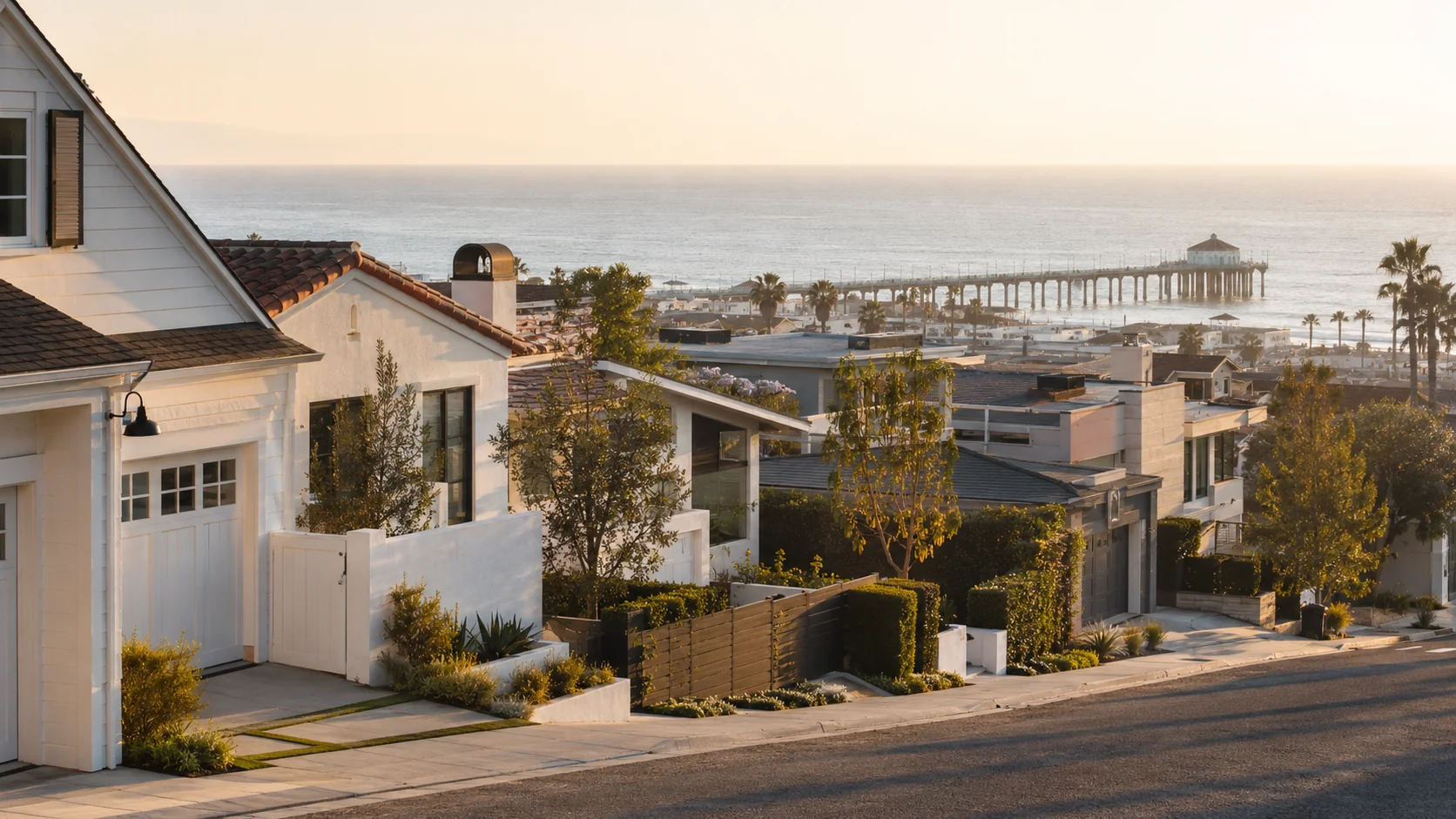
Building an ADU in Manhattan Beach. Rules, costs, timeline.
What MBMC Chapter 10.74 actually allows after Ord. 25-0004, why the code posted on the City's own website is out of date, and what an all-in build costs on a Manhattan Beach lot in 2026.
What you can build — at a glance
Reviewed by CALI ADU’s ADU specialists · August 2026
- Max ADU size
- 850 sqft studio/1BR · 1,000 sqft 2BR+ Measured on interior livable space. An attached unit is also capped at 50% of the house. A junior ADU is capped at 500 sqft.
- Detached height
- 16 ft · 18 ft near transit Plus 18 ft on a multistory multifamily lot and 2 ft more to match the roof pitch of the house. About 20 ft at the very top.
- Above a detached garage
- 26 ft A detached ADU stacked directly above or below a detached garage may reach 26 ft in total. Rare in the South Bay.
- Side & rear setbacks
- 4 ft None for a conversion or a same-footprint rebuild. Detached units also need 5 ft of separation from other buildings.
- Units per SFR lot
- Up to 3 Two ADUs plus a junior ADU, only one of them detached. The local code already matches the state stack.
- Parking required
- None on most lots One space is the written default, but five exemptions remove it and the City states none is required. The house keeps its own spaces in the Coastal Zone.
- Permit timeline
- 60 days · ministerial, no hearing Plus 15 business days for the written completeness notice. Deemed approved if the City misses the 60 days.
- Coastal Zone permit
- State law only · concurrent 60 days Local standards drop away and only state ADU law applies. Since October 2025 the coastal permit runs alongside the ADU permit, not after it.
- Detached Up to 1,000 sqft · 16–20 ft at grade, 26 ft over a detached garage
- Attached Up to 1,000 sqft · 25 ft, and no more than 50% of the house
- Garage conversion Within the existing footprint · no setback, no replacement parking
- Interior conversion Carved out of existing dwelling space · +150 sqft for ingress and egress
- Junior ADU Up to 500 sqft inside the primary dwelling
Per MBMC Chapter 10.74 as amended by Ord. 25-0004 (adopted 1 April 2025, eff. 1 May 2025), the City’s Planning Division ADU Handout of February 2026, and Gov. Code §§ 66310–66342. All three re-read on 24 August 2026 and cross-checked against the HCD ADU Handbook (March 2026 update). Full citations in the sections below.
On this page
Can I build an ADU in Manhattan Beach?
Five things to know before you start
If you read nothing else on this page, read these. They are the five points that change the most projects here.
| What to know | Why it matters for your project |
|---|---|
| 1. The code posted online is out of date | Ord. 25-0004 replaced Chapter 10.74 on 1 May 2025. The City says its own code website has not caught up, and links the ordinance excerpt instead. The old chapter’s 1,200 sqft cap and 220 sqft minimum were repealed. |
| 2. A detached unit is one story — unless it sits on a garage | Sixteen feet is the base and about 20 feet is the ceiling at grade. But MBMC § 10.74.050(A)(1)(b) allows 26 feet for a detached ADU directly above or below a detached garage. Very few South Bay cities do. |
| 3. Your lot allows three units, not two | Two ADUs plus one junior ADU, with only one of the ADUs detached (MBMC § 10.74.050(B)(1)(a)). That already matches Gov. Code § 66323, so there is nothing to argue about. |
| 4. In the Coastal Zone the local rulebook drops away | The City states that coastal ADUs are subject only to state ADU law, because its Local Coastal Program ADU chapter is still awaiting Coastal Commission certification. You still need a coastal permit — but it now runs on a concurrent 60-day clock. |
| 5. A § 66323 unit is free of your floor-area budget | The City’s Handout states that § 66323 ADUs are not counted toward the maximum buildable floor area for the site. On a tight Manhattan Beach lot that is often the whole decision. |
How many units a lot allows
MBMC § 10.74.050(B)(1)(a) allows a maximum of two ADUs on a lot with a proposed or existing single-family dwelling, of which only one may be detached. A junior ADU sits on top of that under § 10.74.060. Three separate things can therefore exist on one single-family lot.
- An ADU carved out of existing space. Inside the house or an accessory building, with up to 150 extra square feet for ingress and egress.
- A junior ADU. Up to 500 square feet, entirely within the single-family home (Gov. Code § 66313(d)).
- A new detached ADU. Up to 800 square feet on the streamlined track, with 4-foot side and rear setbacks.
That matches what Gov. Code § 66323(a)(1)–(2) requires and what the HCD ADU Handbook confirms. Most South Bay ordinances still read as one ADU plus one junior ADU and have to be corrected against the statute. Manhattan Beach fixed its own text in 2025, which is a genuine advantage when you file.
Multifamily lots
MBMC § 10.74.050(B)(1)(b) adopts Gov. Code § 66323(a)(3) and (4) directly rather than writing a narrower local number. On a lot with an existing multifamily building that means conversions of non-livable space — storage, boiler rooms, passageways, attics, basements, garages — equal to 25 percent of the existing units with a minimum of one, plus up to eight detached ADUs or the number of existing units, whichever is less (Gov. Code § 66323(a)(4)(A)(ii), as raised by SB 1211 effective 1 January 2025). A proposed multifamily building gets up to two detached units. Junior ADUs are a single-family product only.
Owner-occupancy
You do not have to live on the property to build an ADU here. The covenant Manhattan Beach requires under MBMC § 10.74.050(A)(3)(a) covers a rental term of 30 days or longer, no separate conveyance unless state law requires it, ongoing maintenance, and penalties for violation. Owner-occupancy is not on that list, and Gov. Code § 66315 would bar it if it were.
Junior ADUs are the exception, and the local text is now behind the statute. MBMC § 10.74.060(F)(i) requires the owner to occupy either the house or the junior ADU unless the owner is a government agency, land trust or housing organization, and Table 1 of the City’s Handout repeats it. Ord. 25-0004 took effect eight months before AB 1154 changed the rule.
What you can build
Which ADU type fits your property?
Five configurations are available here. The right one usually falls out of what is already on your lot.
| If this sounds like you | Start with | What that means |
|---|---|---|
| You have open backyard and want the most rentable unit | Detached, new construction | Up to 1,000 sqft with two or more bedrooms, 4-ft side and rear setbacks, 5 ft of separation from the house. One story at grade — or two if it sits over a detached garage. |
| Your lot is narrow and the house is already two stories tall | Attached ADU | Up to 25 ft, or the zone height limit for the house if that is lower, over no more than two stories. Separately capped at 50 percent of the buildable floor area of the house. |
| You have a garage you do not use | Garage conversion | No setback required, no replacement parking, and the unit stays inside the existing footprint. |
| You have space inside the house you never use | Interior conversion | Carved out of existing dwelling space, with up to 150 sqft of expansion for ingress and egress. No separate setback applies. |
| You have spare rooms and a modest budget | Junior ADU | Up to 500 sqft inside the house, with an efficiency kitchen and a separate exterior entry. Cheapest route in. Give it its own bathroom and owner-occupancy no longer reaches it. |
Size
The operative caps are 850 square feet for a studio or one-bedroom unit and 1,000 square feet for a unit with two or more bedrooms. Those are the figures the City publishes in Tables 1 and 2 of its February 2026 ADU Handout, and they sit exactly on the floor Gov. Code § 66321(b)(2) sets. An attached ADU carries a second, separate limit: no more than 50 percent of the buildable floor area of the existing house. A junior ADU is capped at 500 square feet.
Since SB 543 those limits are measured on interior livable space rather than gross floor area, which is a real difference on a plan with thick walls or a covered porch. Whatever else the standards say, no floor area ratio, lot coverage, front setback, minimum lot size or open space rule may prevent an 800 square foot ADU at 16 feet with 4-foot side and rear setbacks (MBMC § 10.74.050(B)(2)(d)(ii); Gov. Code § 66321(b)(3)).
Height
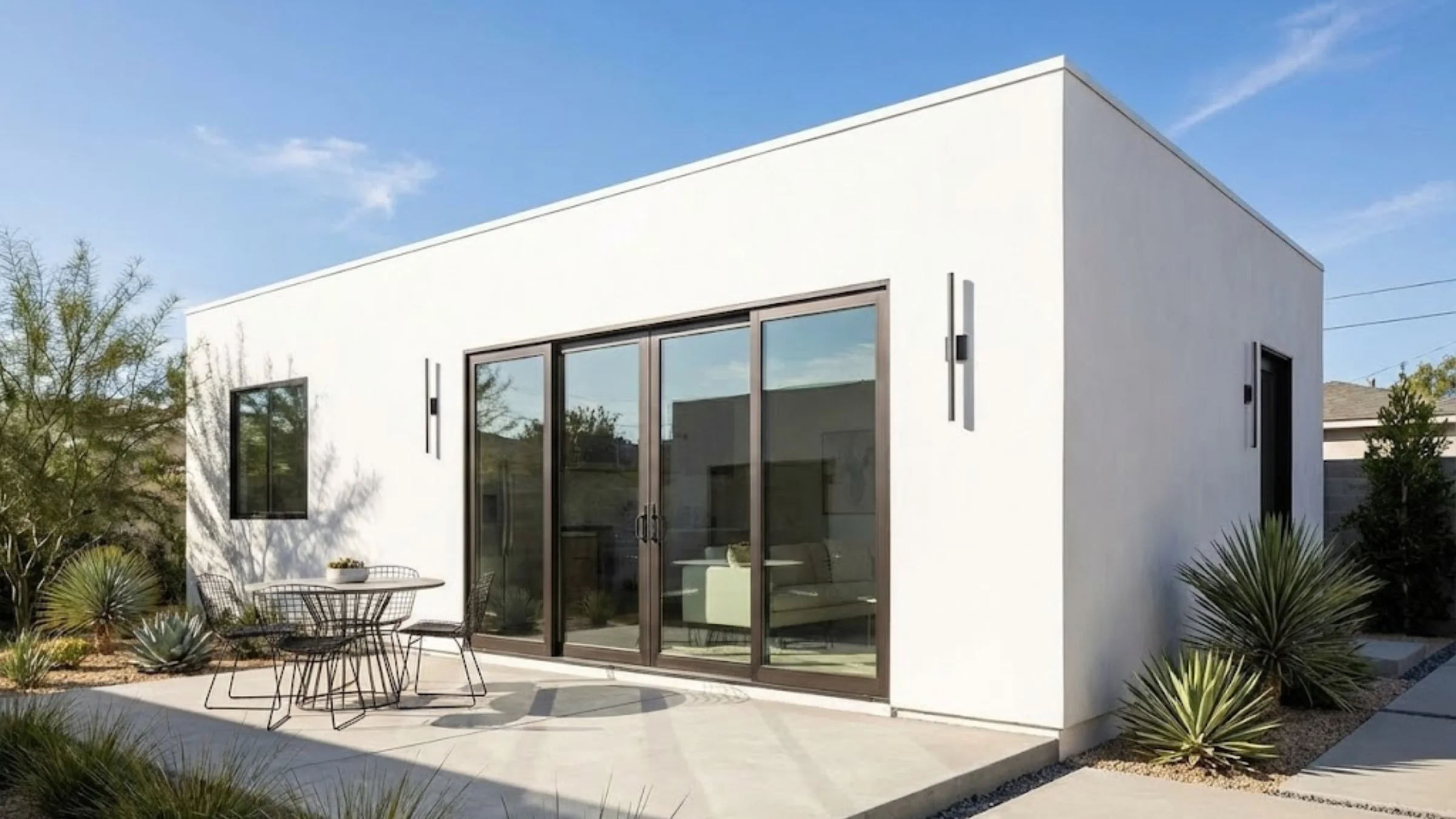
MBMC § 10.74.050(A)(1) does not set a local height number. It adopts the limits in Gov. Code § 66321, which guarantee four things for a detached unit: 16 feet as the base, 18 feet within half a mile walking distance of a major transit stop or a high-quality transit corridor, 18 feet on a lot with an existing or proposed multistory multifamily dwelling, and 2 additional feet to match the roof pitch of the house. Twenty feet is the practical ceiling at grade. An attached ADU may reach 25 feet, or the zone height limit for the house if that is lower, over no more than two stories.
Then there is the provision that makes Manhattan Beach different. MBMC § 10.74.050(A)(1)(b) allows a detached ADU located directly above or directly below a detached garage to reach a total height of 26 feet, provided the lower level does not qualify as a basement. Height is measured from the weighted average of the local grades around the perimeter of the structure, which matters on the sloping blocks above the Strand. The ordinance takes the configuration seriously enough to write privacy rules for it: second-story detached ADUs on non-alley lots within 12 feet of a rear property line or 10 feet of an interior side line need translucent glazing that is either inoperable or set at least 5 feet above the finished floor (§ 10.74.050(D)(4)).
Setbacks and separation
Four feet from the side and rear lot lines, which is the maximum a city may require (MBMC § 10.74.050(B)(2)(b); Gov. Code § 66314(d)(7)). The front setback matches whatever the primary structure has to meet. No setback at all is required for an ADU created inside an existing structure, or rebuilt in the same location and dimensions as an existing structure.
One local rule catches people out on narrow lots: MBMC § 10.74.050(B)(2)(c) requires a detached ADU to sit at least 5 feet from every other building on the lot. A unit tucked hard against the back of the house does not work here even where the lot line setback is satisfied. Utility and recorded easements survive all of it.
Parking
MBMC § 10.74.050(E)(1) writes one off-street space per ADU as the default, then lists the five exemptions that remove it: within half a mile walking distance of public transit, inside an architecturally and historically significant historic district, where the unit is part of the existing house or an existing accessory structure, where on-street parking permits are required but not offered to the ADU occupant, and within one block of a city-approved car share space. Table 3 of the City’s Handout goes further and states flatly that no additional or replacement parking is required.
Three guarantees sit underneath that. A city may never require more than one space per unit or per bedroom, whichever is less, and guest parking may never be required for an ADU (Gov. Code § 66314(d)(10)). No parking at all may be imposed on a § 66323 unit. And a junior ADU needs none in any case (MBMC § 10.74.060(G); Gov. Code § 66334(a)).
Signature Homes that permit here
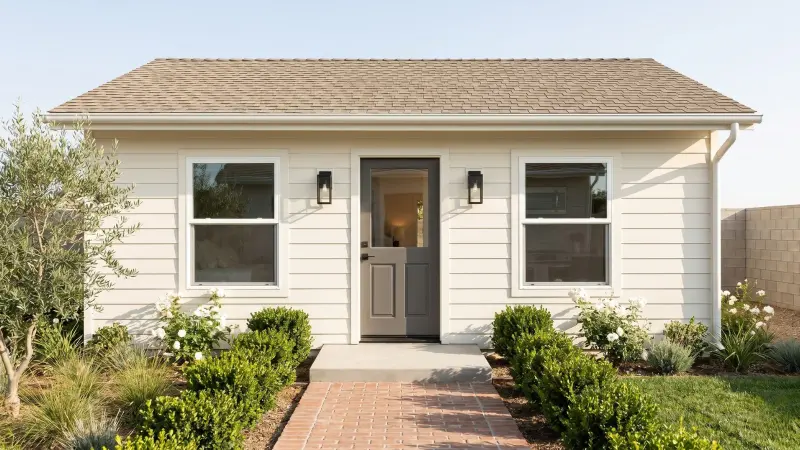
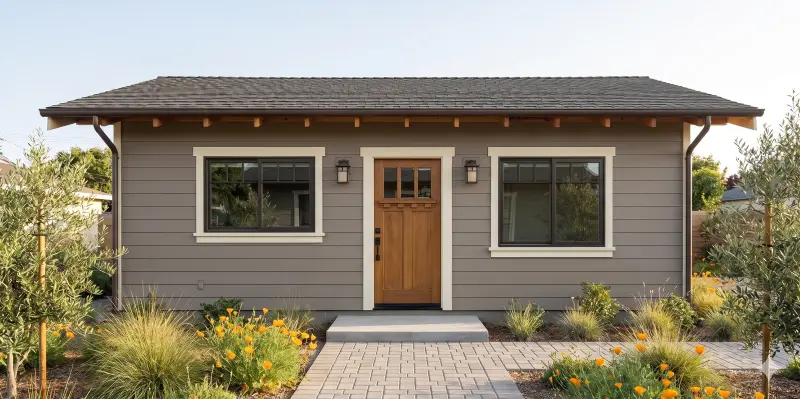
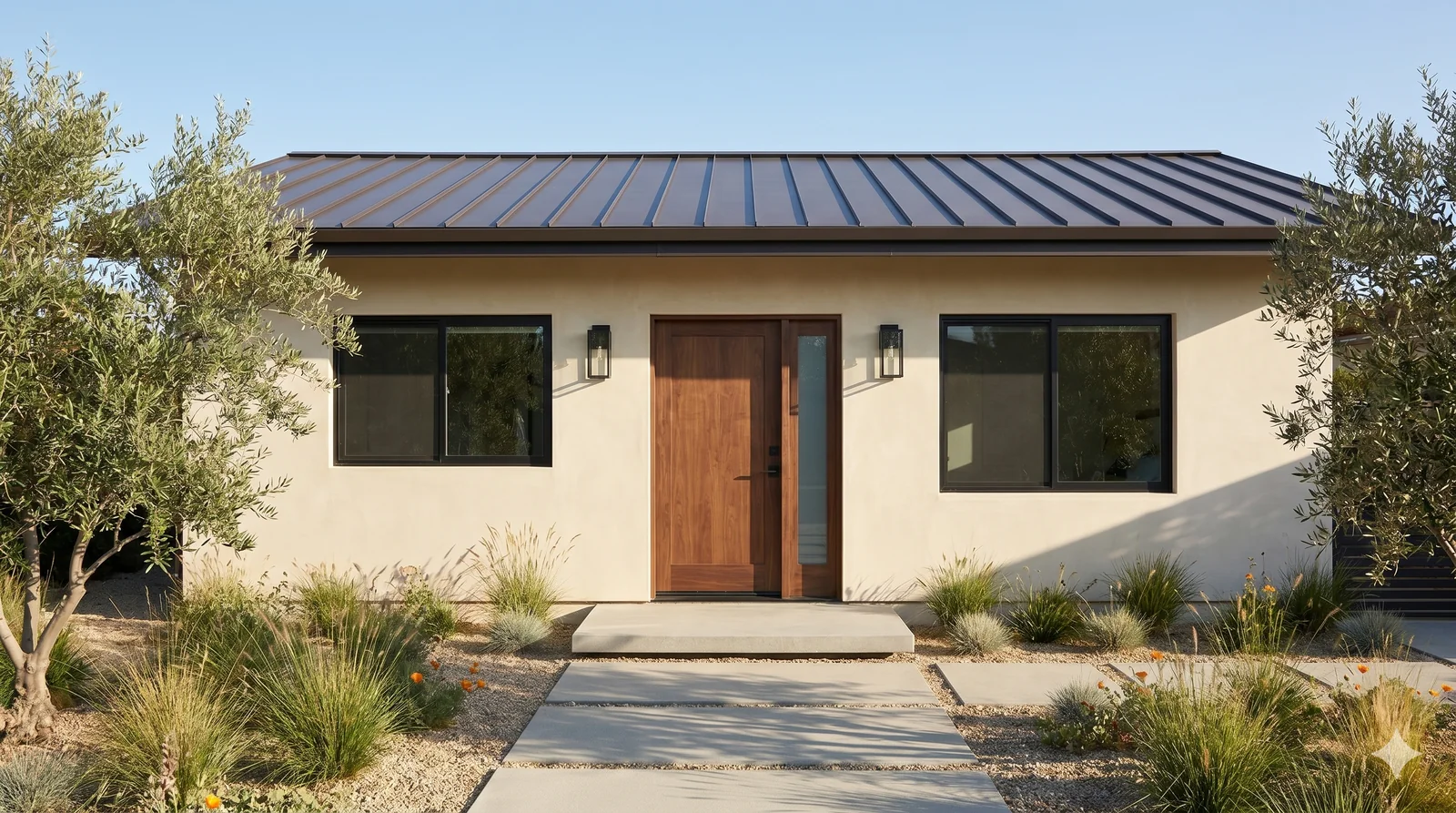
Three picks for a city with a 1,000-square-foot ceiling and a single-story envelope at grade.
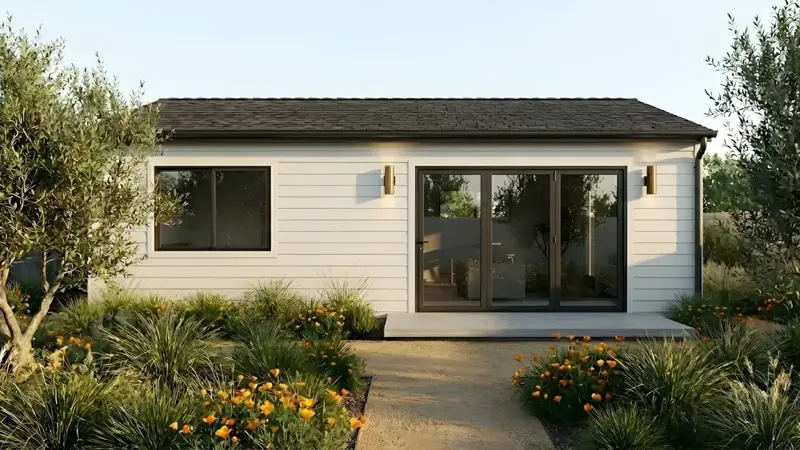
The Sunset
The Melrose
The Lincoln
A note on what is not shown. Our two-story plans — the Fairfax, the Venice and the Culver — stand roughly 25 feet and are sold as detached units, so they cannot be permitted in Manhattan Beach as drawn. The reason is the height rule above: a standalone detached ADU at grade tops out around 20 feet once every state allowance is counted. The 26-foot envelope here belongs to a unit stacked on a detached garage, and the 25-foot envelope belongs to attached units. Neither is how those three plans are drawn.
Neither is a dead end, and Manhattan Beach is a better place than most to say so. A two-story plan can be modified to fit the garage-stacked envelope the code already allows, or we design a custom ADU from scratch at $9,990–$19,990 for design and permitting, bid per project. The cards above are the plans that permit as drawn, which is why they lead.
What an ADU costs in Manhattan Beach (2026)
Plan pricing does not vary by neighborhood, and it does not vary by whether the lot is inside the Coastal Zone. The fee covers architectural design, structural engineering, Title 24 energy compliance, and every piece of permit processing and plan check correspondence through to an issued permit. Once the plans are permitted, build with our construction partner or your own licensed contractor.
The build estimate covers labor and materials, interior finishes, cabinetry, countertops, flooring, fixtures, appliances and utility connections. What sits outside it: City permit, plan check, water and sewer fees, any coastal permit fee where one applies, and site-specific work such as grading on the sloping blocks of the Hill Section, retaining walls, shoring on a walk-street lot, long utility runs or drainage. We identify and price all of that in the proposal before you commit.
City fees
Impact fees are the good news. An ADU with 750 square feet or less of interior livable space is exempt outright under Gov. Code § 66311.5(c)(1), and above that threshold impact fees must be charged in proportion to the size of the ADU relative to the house rather than at the full rate a new home would pay. A unit under 500 square feet is also outside school impact fees and does not increase assessable space (Gov. Code § 66311.5(c)(3)). MBMC § 10.74.070(A) still cross-references the old Gov. Code § 66324, which SB 543 renumbered to § 66311.5 effective 1 January 2026.
Building permit and plan check fees are separate, apply at any size, and are valuation-based rather than a flat ADU rate. Two local steps carry their own costs and are easy to miss: MBMC § 10.74.070(B) requires letters of service availability for water and sewer to go to the Building Official, and the Handout’s own disclaimer states that a Change of Address application and its associated fees are required as part of the ADU plan check process.
What it earns
Use a government benchmark rather than a listing site. For the Los Angeles–Long Beach–Glendale HUD Metro FMR Area, the FY 2026 Fair Market Rents as revised are $2,079 for a studio, $2,328 for a one-bedroom, $2,903 for a two-bedroom, $3,681 for a three-bedroom and $4,098 for a four-bedroom, published at 91 FR 21301 and effective 21 May 2026. Those figures cover the whole metro across all housing stock and ages, most of it older than anything you would build. A new, well-finished detached ADU typically rents above them, and a beach-adjacent Manhattan Beach address with the El Segundo employment corridor immediately north supports that. Run your own numbers on our ADU ROI calculator.
When an ADU isn’t the right move
A guide that never says “not you” is a brochure. Four situations where an ADU here is the wrong call, or the wrong call right now.
- Your plan depends on nightly rental income. The 30-day minimum is written into the recorded covenant and into state law, and it is not waivable. If short-term rental is the business case, there is no version of this that works in Manhattan Beach.
- You are counting on selling the unit separately. Manhattan Beach has not adopted an AB 1033 condominium opt-in, so an ADU here cannot be sold apart from the house. If your exit depends on that, you are planning around a policy change that may not come.
- You wanted a two-story detached unit in the open yard. The envelope at grade is about 20 feet. The 26-foot allowance requires the unit to sit directly above or below a detached garage, which is a different building and a different site plan.
- You need it finished in under six months. Design through move-in runs roughly six to nine months on a Signature plan and longer on a custom one. A family situation that needs housing sooner is better served another way.
How long an ADU takes
It helps to separate the permit from the project. The permit step is short because the plan is pre-engineered: the City is running a conformance review against Chapter 10.74 and the Building Code, not evaluating a drawing set for the first time. The long pole is construction, and that is the phase we put a date on.
| Phase | How long | What governs it |
|---|---|---|
| Signature plan preparation | About 2 weeks | A pre-engineered plan customized to your lot, its grades and its easements. |
| Completeness check | 15 business days | The City must determine completeness and notify you in writing (Gov. Code § 66317(a)(2)(A), added by SB 543 effective 1 January 2026). |
| Ministerial approval | 60 days, usually less | Approve or deny a complete application, or it is deemed approved (Gov. Code § 66317(a)). No hearing (MBMC § 10.74.040(B)(2)). |
| Coastal permit, if the lot is in the zone | 60 days, concurrent | Runs alongside the ADU permit rather than after it (Gov. Code § 66329). See the section below. |
| Construction | 4–6 months | By model size: under 600 sqft about 4 months, 600 to 800 sqft about 5, above 800 sqft about 6. This is the guaranteed phase. |
| Total, start to finish | About 6–9 months | Signature plans only. A custom design adds bespoke design time and a longer plan check. |
The rules that make Manhattan Beach different
The Coastal Zone
Manhattan Beach has a certified Local Coastal Program, but it does not yet contain ADU provisions. Ord. 25-0004 added a new Chapter A.74 to the Local Coastal Program alongside amendments to Chapters A.12, A.16, A.84, A.94 and A.96, and the City states that it is still awaiting California Coastal Commission certification of those amendments. Until certification, the City’s published position is that ADUs and JADUs proposed in the Coastal Zone are subject only to applicable state law.
That has a real upside. The local development standards in MBMC § 10.74.050 — the 50 percent attached cap, the guest house rule, the deck and glazing rules — do not apply on a coastal lot. What applies is Gov. Code §§ 66314 to 66332 for ADUs and §§ 66333 to 66339 for junior ADUs, which is the same floor every city in California must meet. You still need a coastal development permit alongside the building permit, and the City’s own Interactive Map is the tool it points homeowners to for checking whether a specific parcel is inside the zone.
Two caveats belong with the good news. Gov. Code § 66329 does not alter or lessen the effect of Coastal Act resource protection policies, so habitat, public access, public view corridor and coastal hazard requirements still apply on their own terms. And the City states that inside the Coastal Zone the required on-site parking for the primary dwelling must be maintained at all times — the one place its published parking position differs from the rest of the city.
Parking, and the one place the local text is narrower
Table 3 of the City’s Handout is unambiguous outside the Coastal Zone: no additional or replacement parking is required. The ordinance text is drafted more tightly. MBMC § 10.74.050(E)(4) says that where a garage, carport, covered parking structure or uncovered space is demolished or converted for an ADU, those spaces need not be replaced if the project meets any of the criteria in Gov. Code § 66322(a). State law does not attach that condition.
Floor area, and the § 66323 carve-out
Manhattan Beach lots are small and buildable floor area is the binding constraint on most of them. An ADU built on the local ADU Permit track counts toward the maximum buildable floor area for the lot. An ADU built as a § 66323 unit does not: Table 3 of the Handout states that 66323 ADUs are not counted toward the maximum total buildable floor area applicable to the project site, and MBMC § 10.74.050(B)(2)(e) carries the same carve-out. That single line decides which pathway a lot of projects here should take.
The guest house rule
This one is specific to Manhattan Beach and it catches Hill Section properties in particular. MBMC § 10.74.050(C) provides that where an ADU is proposed on a lot that already has a guest house, either the guest house or the ADU — but not both — must be attached to the primary dwelling, unless the project complies with all the requirements of Gov. Code § 66323(a). A guest house, or accessory living quarters as MBMC § 10.04.030 defines it, is not an ADU and never has been. If you have one, the § 66323 pathway is worth looking at first.
Design rules that shape the drawing
- Decks. No outdoor deck may sit more than 30 inches above local grade inside the primary dwelling’s required yards. Landings sized for required ingress and egress are excepted.
- Alley access. Where the lot abuts an alley, any new driveway access for the ADU must come off the alley.
- Second-story glazing. On a non-alley lot, exterior openings within 12 feet of a rear line or 10 feet of an interior side line need translucent glazing, either inoperable or set at least 5 feet above the finished floor.
- Kitchen, foundation and access. Every ADU needs at least one permanently installed stovetop appliance, a permanent foundation and a separate exterior entrance.
All four sit in MBMC § 10.74.050(D) and all four apply on the ADU Permit track. None of them applies to a § 66323 unit, and none of them applies in the Coastal Zone while the Local Coastal Program amendment is uncertified.
How the permit process works
MBMC § 10.74.040 sets out three routes, and the City’s Handout puts them in a flowchart on its second page. The review process is the same for all three. What differs is which development standards attach.
- Coastal Zone. If the parcel is inside the zone, only state ADU law applies, and the project runs through a building permit plus a coastal development permit.
- Building Permit Only. If the project satisfies Gov. Code § 66323, no ADU permit is required and the local standards in MBMC § 10.74.050 do not apply at all (§ 10.74.040(A)). This is the pathway with the floor-area carve-out.
- ADU Permit. Everything else. The Director of Community Development or a designee reviews and approves the application ministerially, with no public hearing, provided it is complete and complies (§ 10.74.040(B)(2)).
Junior ADUs run through the building permit route under MBMC § 10.74.060 and Gov. Code § 66333. Where an ADU permit application arrives alongside an application for a primary dwelling that is subject to discretionary review, the ADU is considered separately, without discretionary review or a hearing, once the discretionary portion has been acted on (§ 10.74.040(B)(3)).
The clocks
MBMC § 10.74.040(C) processes all three pathways within the timelines in Gov. Code §§ 66317 and 66335. In practice that means the City has 15 business days to determine completeness and tell you in writing (§ 66317(a)(2)(A)), and 60 days from a complete application to approve or deny it, failing which the application is deemed approved (§ 66317(a)). If an application is found incomplete or denied, the City must provide an appeal process and a final written determination within 60 business days (§ 66317(d)(1)–(2)).
Unpermitted units built before 2020
MBMC § 10.74.080 provides that an unpermitted ADU or JADU built before 2020 shall be permitted, and that the City may not deny a permit to legalize it on the grounds that it violates building standards or does not comply with ADU law. The exceptions are narrow: the City may deny where correcting a violation is necessary to comply with Health and Safety Code § 17920.3, or where the building is deemed substandard under that section. The operative state statute is Gov. Code § 66311.7, which AB 2533 created and SB 543 renumbered effective 1 January 2026; the local section still cross-references Gov. Code § 66331, which is the separate provision requiring a five-year delay in enforcement against a qualifying substandard ADU. Both are worth knowing if you inherited a unit with the house.
Pre-approved plans
AB 1332 requires every California city to run a pre-approved ADU plan program, with the program in place by 1 January 2025 (Gov. Code § 65852.27). Ask the Planning Division whether Manhattan Beach publishes a set and what it covers — where a city does, a pre-approved plan can shorten plan check further.
Manhattan Beach ADU questions, answered
The questions homeowners here actually ask before they start — each answered from MBMC Chapter 10.74 as amended by Ord. 25-0004, the City’s February 2026 ADU Handout, and Gov. Code §§ 66310–66342.
Does Manhattan Beach have its own ADU ordinance?
Yes — MBMC Chapter 10.74, and the version you find on the City's code website is not the current one. The City Council adopted Ordinance No. 25-0004 on 1 April 2025 and it took effect on 1 May 2025. The City states on its own ADU page that its Municipal Code website has not been updated to reflect the revised regulations, and it links the ordinance excerpt directly instead. Read the excerpt and the Planning Division's February 2026 ADU Handout together. Where either is narrower than California Government Code sections 66310 to 66342, state law is the operative rule (Gov. Code section 66316).
How big can an ADU be in Manhattan Beach?
Up to 850 square feet for a studio or one-bedroom unit, and up to 1,000 square feet for a unit with two or more bedrooms. Those are the caps the City publishes in Tables 1 and 2 of its February 2026 ADU Handout, and they match the floor California sets at Gov. Code section 66321(b)(2). An attached ADU is separately capped at 50 percent of the buildable floor area of the house (MBMC section 10.74.050(B)(2)(a)(i)). A junior ADU is capped at 500 square feet (MBMC section 10.74.060(A); Gov. Code section 66313(d)). Since SB 543 those limits are measured on interior livable space, not gross floor area.
Is the 1,200 square foot cap I read about still accurate?
No. The pre-2025 version of MBMC section 10.74.050 capped studio and one-bedroom ADUs at 850 square feet and larger units at 1,200 square feet, with a 220 square foot minimum. Ordinance 25-0004 repealed those numbers. The replacement text at section 10.74.050(B)(2)(a) simply says an ADU shall comply with the minimum and maximum square footage prescribed in Gov. Code section 66321, and the City's February 2026 Handout publishes the operative maximums as 850 and 1,000 square feet. If you are designing to 1,200 square feet on the strength of the old chapter, you are designing to a repealed provision.
How tall can a detached ADU be in Manhattan Beach?
Sixteen feet as the base, and up to about 20 feet in the right conditions. MBMC section 10.74.050(A)(1) adopts the height limits in Gov. Code section 66321 rather than setting its own. That statute guarantees 16 feet on a standard lot, 18 feet within half a mile walking distance of a major transit stop or a high-quality transit corridor, 18 feet on a lot with an existing or proposed multistory multifamily dwelling, and 2 more feet to match the roof pitch of the house. Height is measured from the weighted average of the local grades around the perimeter of the structure (MBMC section 10.74.050(A)(1)(a)). Note that Table 3 of the City's Handout summarizes this as a flat 16 feet; the statute it cites says more than that.
Can I build a two-story detached ADU in Manhattan Beach?
Yes, in one specific configuration — and this is unusual for the South Bay. MBMC section 10.74.050(A)(1)(b) allows a detached ADU located directly above or directly below a detached garage to reach a total height of 26 feet, provided the lower level does not qualify as a basement. The ordinance takes that seriously enough to write privacy rules for it: section 10.74.050(D)(4) requires translucent, inoperable or high-set glazing on second-story detached ADUs on non-alley lots within 12 feet of a rear property line or 10 feet of an interior side line. A standalone detached ADU sitting on the ground is a different question and stays inside the roughly 20 foot envelope above.
How many units can I add on a Manhattan Beach single-family lot?
Up to two ADUs plus one junior ADU, and only one of the ADUs may be detached (MBMC section 10.74.050(B)(1)(a); Handout Table 2). This is one of the places Manhattan Beach is ahead of its neighbors. Gov. Code section 66323(a)(1) to (2) requires a city to allow a conversion ADU made from existing space, a junior ADU, and a newly built detached ADU of up to 800 square feet to be combined on one single-family lot, and the HCD ADU Handbook confirms the stack. Ordinance 25-0004 already writes that into the local code, so there is nothing to argue about here.
What happens if my Manhattan Beach property is in the Coastal Zone?
Two things change. First, the local development standards drop away: the City states that ADUs and JADUs proposed in the Coastal Zone are subject only to state ADU law, because the Local Coastal Program amendments that would create local coastal ADU rules are still awaiting Coastal Commission certification. Second, you need a Coastal Development Permit alongside the building permit. AB 462 rewrote Gov. Code section 66329 effective 10 October 2025, and the headline is that the coastal permit now runs on a 60-day clock concurrently with the ADU permit under Gov. Code section 66317, rather than sequentially after it. Use the City's Interactive Map to check whether your specific parcel is inside the zone.
Who decides the coastal permit, the City or the Coastal Commission?
Confirm this one with Planning before you file, because Manhattan Beach is in a transitional posture. Gov. Code section 66329(a) applies where a certified Local Coastal Program contains ADU provisions: the local agency decides in 60 days, concurrently, with no hearing required. Gov. Code section 66329(b)(3) applies where a certified program does not contain ADU provisions, and there the Coastal Commission's review is the one that runs concurrently with the section 66317 process. Manhattan Beach has a certified Local Coastal Program, but the chapter that would put ADU provisions into it is not certified yet. Either way the decision is a 60-day concurrent one. Ask the Planning Division which counter your application goes to, and expect that to change once the Commission certifies the amendment.
Is a coastal permit deemed approved if nobody acts within 60 days?
Only on the Coastal Commission track, and it is worth being precise about that. Gov. Code section 66329(b)(5) provides that where the Commission has not approved or denied a completed coastal development permit application for an ADU within the period, the permit is deemed approved. There is no equivalent deemed-approval remedy written into Gov. Code section 66329(a) for a city deciding under its own certified program. The ADU permit itself is different and simpler: under Gov. Code section 66317(a) a complete application the city does not act on within 60 days is deemed approved.
Does Manhattan Beach require owner-occupancy for an ADU?
No, and the ordinance is compliant on this point. The covenant Manhattan Beach requires for an ADU under MBMC section 10.74.050(A)(3)(a) covers four things — a rental term of 30 days or longer, no separate conveyance unless state law requires it, ongoing maintenance, and penalties for violation — and owner-occupancy is not one of them. Gov. Code section 66315 bars a local agency from imposing an owner-occupancy requirement on an ADU in any event. The only occupancy term a city may impose is a rental term longer than 30 days.
Does the rule change for a junior ADU?
Yes, and the local text has not caught up. MBMC section 10.74.060(F)(i) requires the owner to occupy either the house or the junior ADU, with a carve-out only where the owner is a government agency, land trust or housing organization, and Table 1 of the City's Handout repeats it. Ordinance 25-0004 took effect in May 2025, eight months before AB 1154. Under Gov. Code section 66333(b) as amended by AB 1154, effective 1 January 2026, owner-occupancy reaches a junior ADU only where the unit shares sanitation facilities with the primary dwelling. Give the junior ADU its own bathroom and the requirement falls away under state law.
Do I need to add a parking space for an ADU in Manhattan Beach?
Usually not. One space per ADU is the written default at MBMC section 10.74.050(E)(1), but the five exemptions in Gov. Code section 66322(a) remove it in the situations that cover most lots here, and Table 3 of the City's own Handout states flatly that no additional or replacement parking is required. No parking may be imposed on a section 66323 unit at all, and a junior ADU needs none in any case (MBMC section 10.74.060(G); Gov. Code section 66334(a)). One local wrinkle to plan around: the City notes that inside the Coastal Zone the required on-site parking for the primary dwelling must be maintained at all times, so a coastal project cannot quietly consume the house's spaces.
Will an ADU eat into my buildable floor area?
Not if it is a section 66323 unit. Table 3 of the City's February 2026 Handout states that 66323 ADUs are not counted toward the maximum total buildable floor area applicable to the project site, and MBMC section 10.74.050(B)(2)(e) puts the same carve-out in the ordinance. On a small, floor-area-constrained Manhattan Beach lot that is frequently the difference between a project that works and one that does not. Separately, no buildable floor area, front setback, minimum lot size or open space rule may be applied so as to block an 800 square foot ADU at 16 feet with 4 foot side and rear setbacks (MBMC section 10.74.050(B)(2)(d)(ii); Gov. Code section 66321(b)(3)).
Do I pay impact fees on a Manhattan Beach ADU?
Not if the unit has 750 square feet of interior livable space or less. Gov. Code section 66311.5(c)(1) makes that exemption mandatory statewide, and above 750 square feet impact fees must be charged in proportion to the size of the ADU relative to the house rather than at the full rate a new home would pay. A unit under 500 square feet is also outside school impact fees and does not increase assessable space (Gov. Code section 66311.5(c)(3)). MBMC section 10.74.070(A) still cross-references the old section 66324, which SB 543 renumbered to section 66311.5 effective 1 January 2026. Building permit, plan check, water and sewer fees are separate and apply at any size.
Can I rent a Manhattan Beach ADU on Airbnb, or sell it separately?
No to both. Table 3 of the City's Handout states that short-term rental is prohibited and rental terms must be 30 days or longer, and the recorded covenant at MBMC section 10.74.050(A)(3)(a)(i) says the same thing. State law sets the same floor at Gov. Code section 66323(e) for an ADU and section 66333(g) for a junior ADU. On separate sale, the covenant bars conveying the ADU apart from the house unless state law otherwise requires, and Manhattan Beach has not adopted an AB 1033 condominium opt-in. Until the City opts in under Gov. Code section 66342, an ADU here cannot be sold as a separate condominium.
Official sources
Where the local text and state law differ, Gov. Code § 66316 resolves it: a noncompliant local provision is null and void, and the city applies state standards until it is fixed. On this page that rule does real work twice — on junior ADU owner-occupancy, and on replacement parking. Everywhere else Ord. 25-0004 already tracks the statute, which is more than most South Bay ordinances can say.
| Source | What it governs |
|---|---|
| Ordinance No. 25-0004, ADU and JADU provisions (opens in a new tab) City of Manhattan Beach · adopted 1 April 2025, effective 1 May 2025 (PDF) | The binding local text: permit pathways, unit counts, height, setbacks, separation, parking, covenants, design features, fees and legalization. This is the operative chapter, not the version on the code website. |
| Planning Division ADU Handout, February 2026 (opens in a new tab) City of Manhattan Beach Community Development, Planning Division (PDF) | The City’s own guidance, with the permit pathway flowchart and three regulatory tables. Source for the operative 850 and 1,000 square foot maximums, the 26-foot garage-stacked height exception, and the floor-area carve-out for § 66323 units. |
| City of Manhattan Beach ADU and JADU page (opens in a new tab) Community Development · Planning and Zoning · re-read 24 August 2026 | Where the City states that its Municipal Code website is not yet updated, and that Coastal Zone ADUs are subject only to state law until the Coastal Commission certifies the Local Coastal Program amendment. |
| MBMC Chapter 10.74 on Municode (opens in a new tab) Municode Library, the City’s code publisher · read with the caveat above | The codified chapter. Useful for structure and section numbering, but the City states it does not yet reflect Ord. 25-0004 — so its size caps and minimums are superseded. |
| California Government Code §§ 66314–66332 (opens in a new tab) California Legislative Information · Article 2, Chapter 13 · renumbered from former § 65852.2 by SB 477 | State ADU law for ADUs — the 60-day ministerial clock, the owner-occupancy and parking preemptions, the 800 sqft entitlement, the unit stack, the impact-fee exemption and the coastal permit rules as rewritten by AB 462. |
| California Government Code §§ 66333–66339 (opens in a new tab) California Legislative Information · Article 3, Chapter 13 | State law for junior ADUs, including the owner-occupancy rule as narrowed by AB 1154 and the 30-day rental floor. The City links both articles from its own ADU page. |
| HCD ADU Handbook, March 2026 update (opens in a new tab) California Department of Housing and Community Development (PDF) | HCD’s official interpretation of state ADU law, including the worked unit stack for a single-family lot, the height table, and the coastal question-and-answer that explains how § 66329 now operates on each track. |
| Manhattan Beach Coastal Zone Regulations (opens in a new tab) Community Development · coastal development permit procedures and Local Coastal Program | The City’s coastal permit procedures and Local Coastal Program standards. Read alongside Gov. Code § 66329 for how an ADU coastal permit is handled while Chapter A.74 awaits certification. |
| City of Manhattan Beach Interactive Map (opens in a new tab) Information Technology · GIS and Maps · the tool the City points homeowners to | Parcel-level check for whether a property sits inside the Coastal Zone. Use it rather than a neighborhood rule of thumb — the boundary does not follow street lines. |
| Manhattan Beach Development Impact Fees (opens in a new tab) Finance Department | The City’s published impact fee information. Read against the statutory exemption at Gov. Code § 66311.5(c)(1) for an ADU with 750 sqft or less of interior livable space. |
Manhattan Beach has roughly 35,506 residents (2020 census) on a built-out 3.9-square-mile coastal footprint, which is why almost every new home here arrives as an ADU rather than as a subdivision. One live item to watch: the Local Coastal Program amendment that Ord. 25-0004 created, including new MBLCP Chapter A.74, is still pending Coastal Commission certification. When it is certified, the coastal treatment described on this page changes. Re-check this page against the sources above if you are reading it well after August 2026 — California amends ADU law nearly every January.
Not sure what your lot
can actually support?
In 15 minutes we will pull up your property, confirm whether the parcel is inside the Coastal Zone, run the Chapter 10.74 numbers against your lot and its grades, and give you an honest read on your options and a realistic budget — including whether an ADU is the right move at all.
15-minute video call · No obligation