
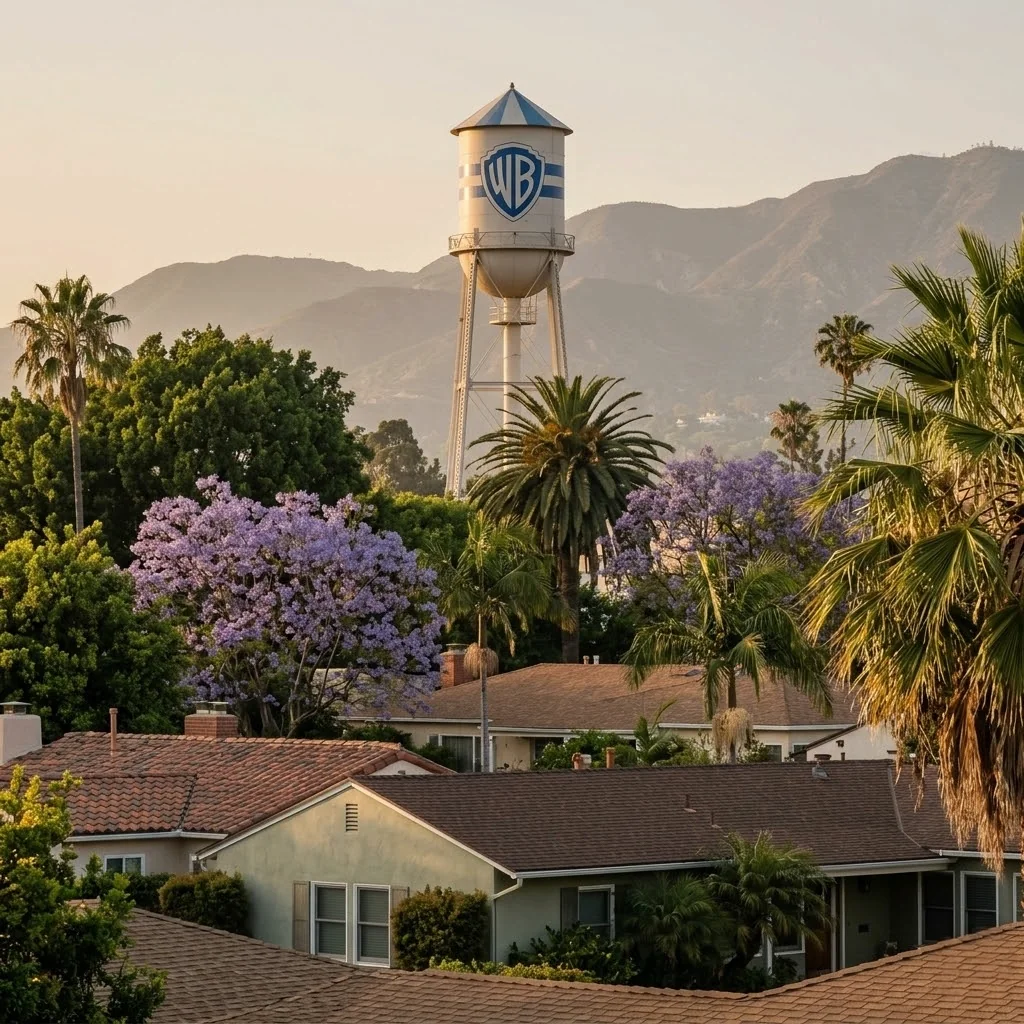
Building an ADU in Burbank. Rules, costs, timeline.
Burbank lets you build higher than almost any city around it — 23 feet over a detached garage, 30 feet attached if the roof slopes 30 degrees. The catch is an ordinance still written against a statute that no longer exists.
What you can build — at a glance
Reviewed by CALI ADU’s ADU specialists · August 2026
- Above a garage
- 23 ft tall A true two-story unit that costs you no yard — the best move on a tight lot. 20 ft to the top of plate, 23 ft to any architectural feature. The stair has to come from outside: no interior door may connect the ADU to the garage below, and ground-floor access is capped at 150 sqft.
- Attached to the house
- 30 ft, or 23 ft flat The tallest envelope Burbank offers, but only with a steeply pitched roof — 30 degrees or more, roughly a 7:12 pitch. A flat roof drops you to 23 ft. “Attached” has a technical meaning too: a shared wall, or walls touching along at least half the ADU wall. A breezeway does not count.
- Detached, freestanding
- 17 ft tall Rises to 18 ft if your lot is within a half-mile walk of major transit, plus 2 more feet there to match your home’s roof pitch. A lot with a multistory apartment building also gets 18 ft, but without the extra 2 ft.
- Max ADU size
- 850–1,000 sqft 850 sqft for a studio or one-bedroom, 1,000 sqft with two or more bedrooms. Converting existing space has no size limit at all under state law. Adding parking beyond what is required buys another 120 sqft — 120 in total, not per space — in exchange for a deed restriction.
- Side & rear setbacks
- 4 ft Four feet from the side and rear lines, and that holds at the second story above a garage. Buildings need 5 ft between faces and 4 ft eave to eave. Rebuilding in the same spot and the same size as an existing structure needs no setback at all, even if you have already torn it down.
- Units per SFR lot
- Burbank 2 · State 4 The city code allows one ADU plus one Junior ADU. State law requires at least four: a conversion ADU, a Junior ADU, a new detached ADU, and one more on top of those. The local number is the one to push back on.
- Apartment lots
- Burbank 2 · State 8 The code caps you at two detached units. State law requires up to eight on a lot that already has an apartment building, limited to the number of units already there. Burbank’s savings clause does not reach this subsection, so expect to argue it.
- Parking required
- Usually none Six exemptions cover most lots, including one Burbank wrote itself: if you can show on dimensioned plans that there is nowhere feasible to put a space, none is required. Junior ADUs never require parking. Converting or demolishing a garage never requires you to replace the spaces.
- Above a garage Up to 23 ft · 4 ft setbacks still apply at the second story
- Attached 30 ft with a 30° pitch · 23 ft flat · 850/1,000 sqft
- Detached 17 ft, or 18–20 ft near transit · the code sets a height, not a story count
- Conversion No size cap — keeps the greater of 850/1,000 or the existing footprint (F.7) · keeps existing setbacks (BMC § 10-1-620.3(H)(3))
- Junior ADU Up to 500 sqft inside the house · one per lot
Per Burbank Municipal Code §§ 10-1-620.1–620.7 (added by Ordinance 18-3,901 effective April 13, 2018; last amended by Ordinance 23-4,002 effective December 8, 2023) and Table 10-1-603(A), as published by Code Publishing current through Ordinance 26-4,038 passed February 24, 2026 — which did not amend the ADU section. Read together with Gov. Code §§ 66310–66342 and cross-checked against the HCD ADU Handbook (March 2026). Full citations in the sections below.
On this page
Can I build an ADU in Burbank?
Burbank is a working ADU market with a functioning ministerial process, and the height allowances are a large part of why. No other city we work in lets you put 23 feet over an existing detached garage.
Five things to know before you start
These five decide most Burbank projects. Everything further down the page is detail underneath them.
| What to know | Why it matters for your project |
|---|---|
| Height depends on how you attach it | 23 ft above a garage and 30 ft attached, against 17 ft for a freestanding detached unit. The same house can support very different buildings. |
| The 30 ft needs a steep roof | Table 10-1-603(A) footnote 3 requires a 30-degree slope. A flat-roofed attached ADU caps at 23 ft — and that is below the state floor. |
| Extra parking buys square footage | Stalls beyond the minimum add up to 120 sqft in total — not per stall — to one ADU, in exchange for a recorded deed restriction. |
| The fire overlay is a local line | Burbank’s Mountain Fire Zone is drawn by the Fire Department, not by CalFire, and it cannot be applied to the units state law guarantees. |
| The code cites a dead statute | Six provisions cross-reference Gov. Code § 65852.2, which no longer exists. Check any rule quoted to you against the live sections. |
What can you build on your lot?
The three heights, and why they matter
This is the decision that shapes the whole project, and it is worth making before anyone draws anything.
| How it sits on the lot | Height you get | What that buys |
|---|---|---|
| Freestanding detached § 10-1-620.3(G)(3) | 17 ft to any architectural feature. 18 ft within a half-mile walking distance of a major transit stop or high-quality transit corridor, plus 2 ft there to match your roof pitch. Separately, 18 ft on a lot with an existing or proposed multistory multifamily dwelling — the +2 ft sits in the transit exception only and does not attach to this one (§ 620.3(G)(3)(b); Gov. Code § 66321(b)(4)(C)). | Single-story on most plans, though the code sets a height rather than a story count. Simplest to permit, and it keeps the whole footprint in the rear yard. |
| On top of a garage § 10-1-620.3(G)(2) | 20 ft to top of plate, 23 ft to any architectural feature. | A genuine two-story envelope that uses no extra yard. The best move on a tight lot with an existing garage — with four conditions in § 620.3(G)(4), set out below the table. |
| Attached to the house Table 10-1-603(A) | 20 ft to plate, 30 ft to the top of a pitched roof at 30 degrees or steeper. A flat roof caps at 23 ft. “Attached” is a defined term: § 620.3(G)(1) requires a shared wall, or abutting walls adjoined with no gap along at least 50% of the length of the ADU wall or 5 feet, whichever is greater. | The largest envelope available, but both the roof pitch and the definition of “attached” are real design constraints. A breezeway or corner connection is detached, and detached means 17 ft — a 13-foot swing. |
One clarification that saves arguments. Table 10-1-603(A) footnote 4 states that accessory dwelling units, attached or detached, “are not considered accessory structures.” That is why the 10 and 14 foot caps elsewhere in the same table do not apply to your ADU.
Four conditions come with the above-garage route, and they shape the plan rather than the permit. Under § 10-1-620.3(G)(4) the ADU may not touch grade except through support posts or stair access, and its finished floor must sit above the garage’s top plate. The ground-floor stair and landing are capped at 150 square feet, and there can be no interior door between the ADU and the garage below. The two are separate buildings that happen to share a footprint, and the stair has to come from outside.
Two more rules turn height into square footage, and they catch people designing to the 23 and 30 foot envelopes. Any interior space over 12 feet tall, including above a staircase, counts against your cap as though a second story were inside it (§ 620.3(F)(3)). An attic or loft over 5 feet in a one-story ADU does the same (§ 620.3(G)(5)). A double-height living room is not a free upgrade in Burbank.
What your ADU does not have to comply with
Section 10-1-620.3(F)(1) exempts an ADU from floor area ratio, lot coverage, open space and minimum lot size. On a built-out lot with a house and a garage already on it, that exemption is usually what makes the project possible at all.
Read § 10-1-620.3(A) with care, though, because it separately recites compliance with floor area ratio standards and lot coverage. F.1 is the specific provision and controls. State law backs it up independently: HCD states that limits on lot coverage or floor area ratio cannot preclude an ADU of at least 800 square feet of interior livable space maintaining four-foot rear and side setbacks (Gov. Code §§ 66321(b)(3), 66311). The units § 66323 guarantees are not subject to local open space or landscaping requirements at all (§ 66323(b)). If a coverage or FAR correction comes back on your ADU, that is the citation to send back.
Which ADU type fits your property?
Start from what your lot already has rather than from a floor plan. In Burbank the existing garage is usually the most valuable thing on the property.
| If your lot has… | The type that usually fits | Why |
|---|---|---|
| A detached garage in reasonable condition | ADU above the garage | 23 ft of height, four-foot setbacks at the second story, and no yard given up — subject to G.4: no touching grade, a 150 sqft cap on the ground-floor stair, and no interior door to the garage. |
| A garage you would rather convert | Garage conversion | Keeps the existing setbacks, has no size cap under Gov. Code § 66323(a)(1), and no replacement parking may be required. Two conditions: under § 620.3(C)(4), if you convert a front- or street-facing attached garage and the driveway cannot hold an 18′ by 8′6″ stall, the driveway and curb cut must be removed; and under § 620.3(J)(1) the garage door must come out and be replaced with windows or a residential entry door. |
| An unpermitted shed or structure | Conversion under BMC § 10-1-620.3(H)(3) | An unpermitted accessory structure can keep its legal nonconforming setbacks in a conversion. |
| Room alongside the house | Attached ADU | The tallest envelope available at 30 ft, if the roof slopes at least 30 degrees. |
| Open rear yard, near transit | Detached new build | 18 ft plus 2 ft for a matching roof pitch is a materially better single-story envelope than 17. |
| An apartment building | Conversion plus detached | 25 percent of existing units converted, plus up to eight detached under state law. |
| An unpermitted unit built before 2020 | Legalization under Gov. Code § 66311.7 | A unit built before January 1, 2020 without permits gets a streamlined path, and the City may not deny it over building-code violations unless correcting them is necessary for health and safety. |
Buying square footage with parking
This provision is unusual and most people miss it. Under § 10-1-620.3(F)(9), each additional on-site parking stall you provide beyond the minimum required adds up to 120 square feet to the maximum size of one ADU on the lot.
The cap is 120 square feet in total however many stalls you add, and it applies to a single ADU. So the practical ceiling becomes 970 square feet for a studio or one-bedroom, and 1,120 with more bedrooms. In exchange, a deed restriction is recorded against the property barring removal of that parking for as long as the ADU exceeds the normal cap, and it is enforceable against whoever buys the house from you.
If you own an apartment building
The local cap and the statute disagree here, and the gap is large. BMC § 10-1-620.3(O)(1) states that “no more than two (2) ADUs can be constructed on a lot with an existing or proposed multifamily dwelling structure(s).”
Gov. Code § 66323(a)(4)(A)(ii) requires ministerial approval of up to eight detached ADUs on a lot with an existing multifamily dwelling, capped at the number of units already there. Separately you may convert non-livable space at one unit or 25 percent of your existing units, whichever is more, and those two allowances stack.
Burbank’s conversion rule at § 10-1-620.3(O)(2) does track state law. It is the two-unit detached cap that does not, and the ordinance’s “unless otherwise preempted” savings clause sits in subsection B, not subsection O.
The Signature ADU lineup
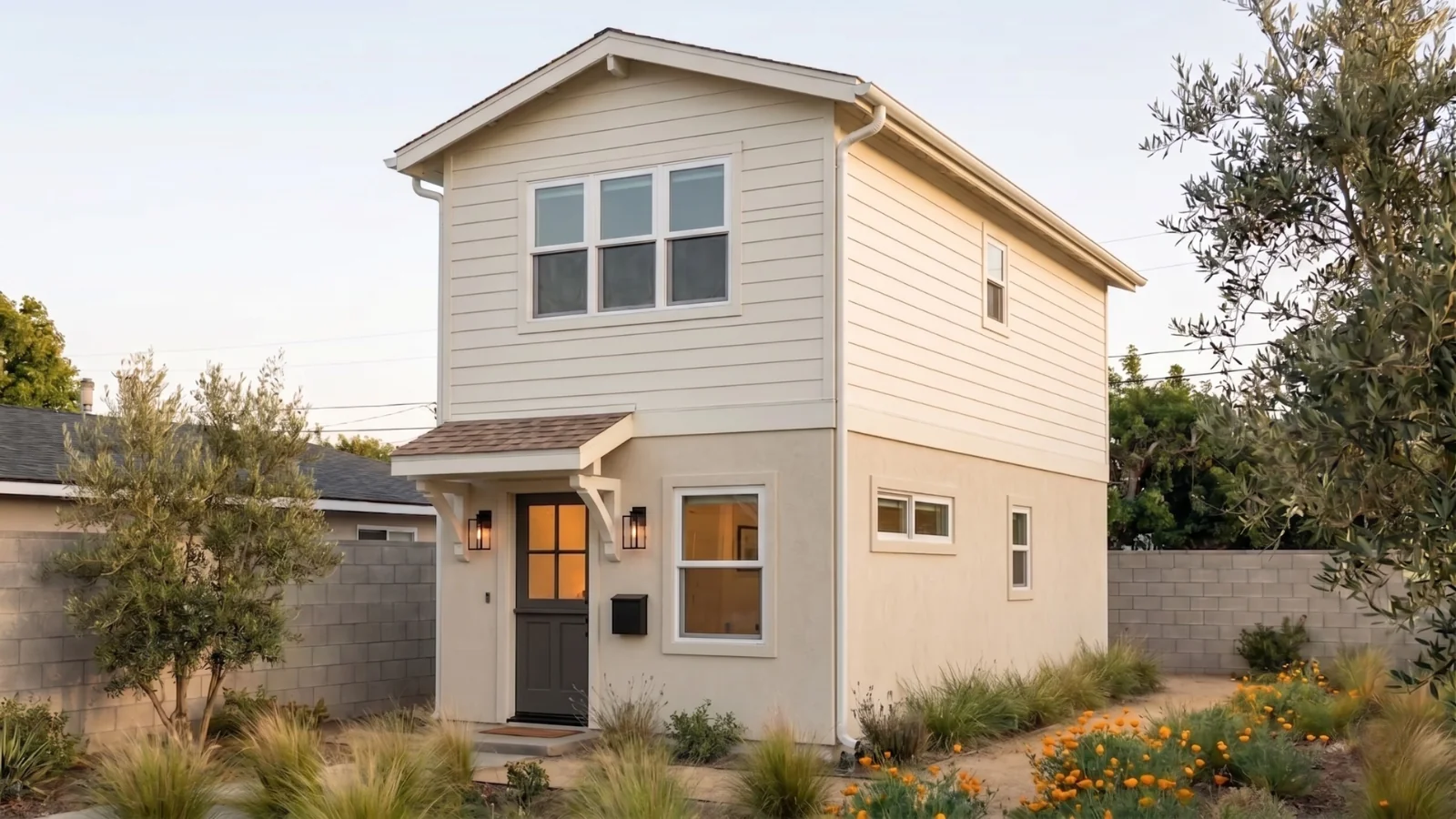
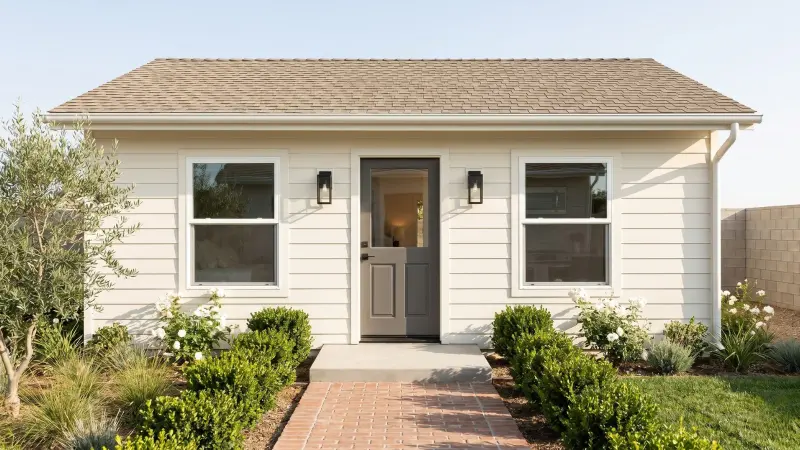
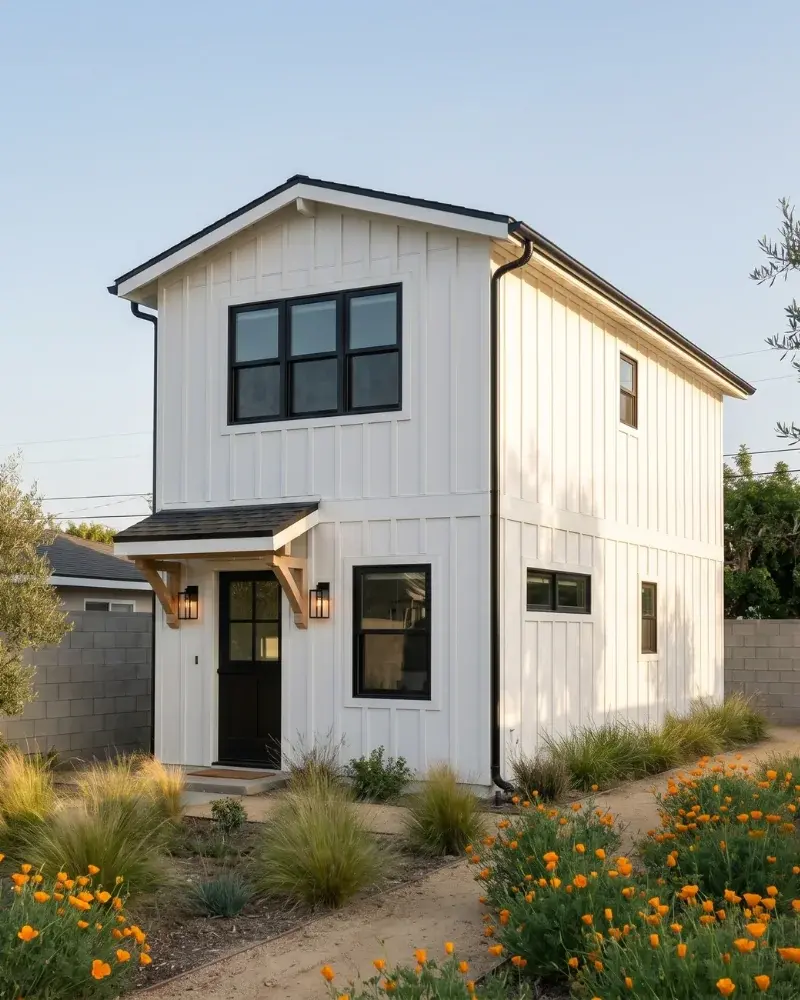
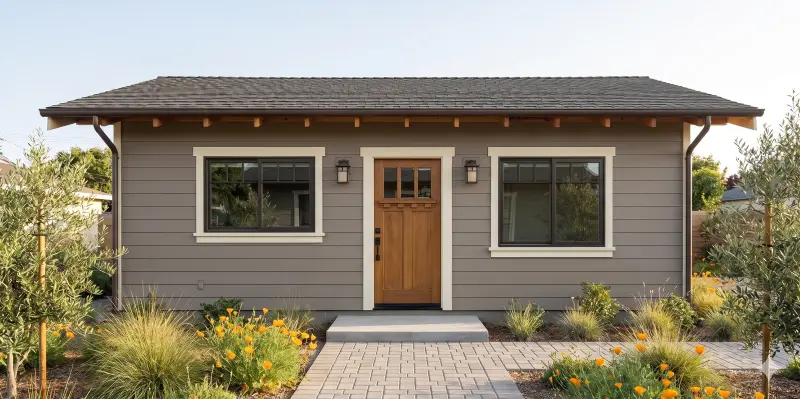
Architect-designed plans at fixed design and permit pricing. The two-story plans permit as drawn in Burbank when the unit sits above a garage or attaches to the house — a route most cities near here do not offer.
What an ADU costs in Burbank (2026)
Our plan fees are the same number on any lot, in Burbank or anywhere else we work. Construction is separate. Once your plans are permitted you can build with our construction partner or your own licensed contractor.
What the lineup costs to build
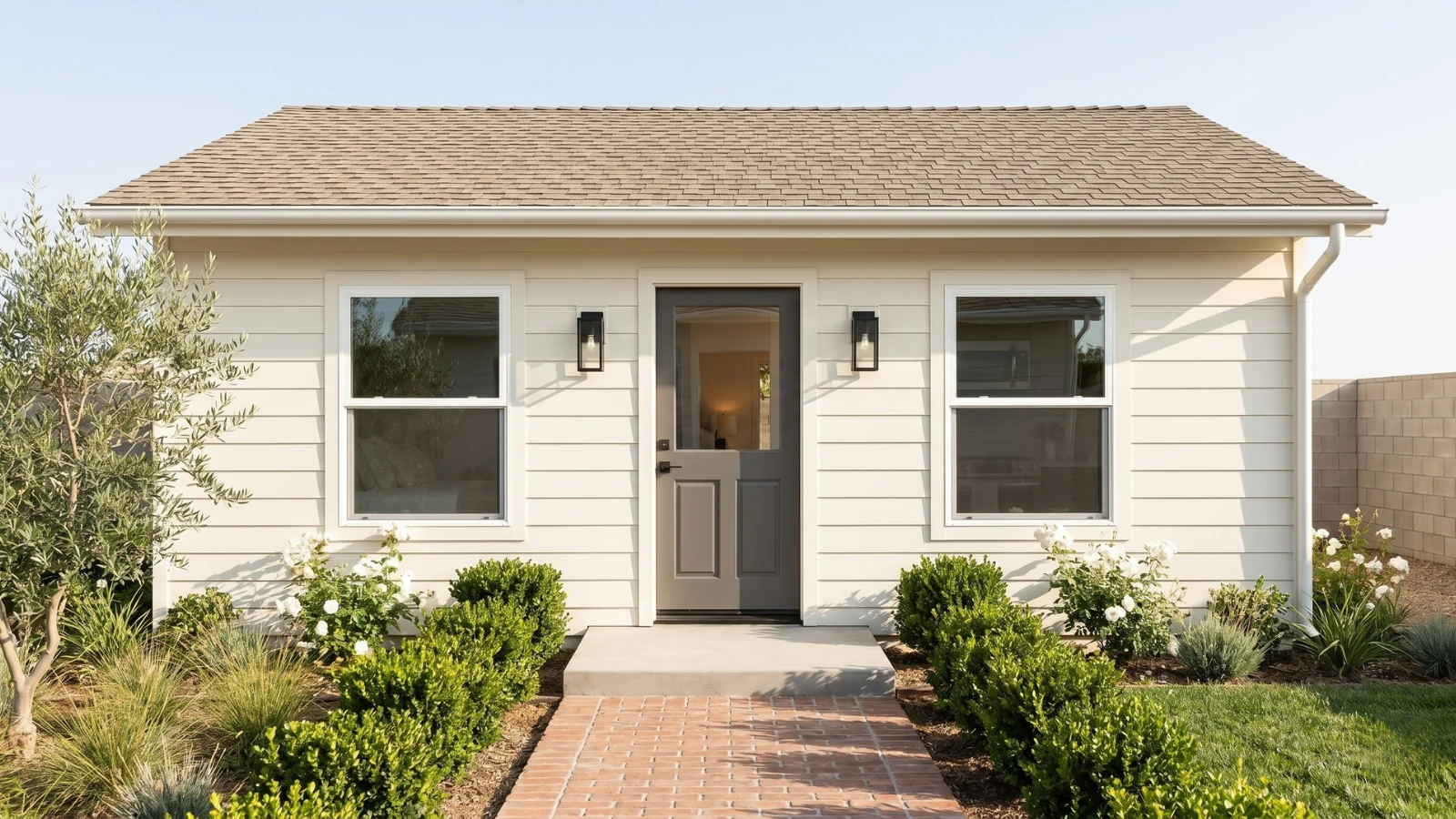
Plan fees are fixed. Construction is estimated, and varies with your site, access, and the finish level you choose.
| Plan | Size | Bed / bath | Est. build cost |
|---|---|---|---|
| The Wilshire | 400 sqft | Studio | $180K–$200K |
| The Sunset | 480 sqft | 1 BR / 1 BA | $200K–$215K |
| The Westwood | 550 sqft | 1 BR / 1 BA | $215K–$235K |
| The Laurel Canyon | 660 sqft | 2 BR / 1 BA | $240K–$265K |
| The Melrose | 800 sqft | 2 BR / 2 BA | $275K–$295K |
| The Fairfax | 840 sqft | 2 BR / 1.5 BA | $280K–$310K |
| The Lincoln | 1,000 sqft | 3 BR / 2 BA | $325K–$350K |
| The Venice | 1,080 sqft | 3 BR / 2.5 BA | $335K–$365K |
One Burbank-specific note on that table. The Lincoln at 1,000 square feet sits exactly on the multi-bedroom cap. The Venice at 1,080 exceeds it — which is precisely the case the § 10-1-620.3(F)(9) parking trade exists for, since one extra stall lifts the ceiling to 1,120. If none of the plans suits your lot, we also design custom ADUs from scratch, which runs $9,990–$19,990 for design and permit processing, bid per project.
City fees, and what Burbank does not publish
The planning application for an ADU is $1,728.42 on Burbank’s adopted Fiscal Year 2026–27 planning fee schedule, effective July 1, 2026, plus a general plan maintenance fee of 20 percent of the application fee. Council resets these every July 1, so that figure holds through June 30, 2027.
Building permit and plan check are valuation-based, and Burbank does not publish them in a form you can compute from. Get them quoted rather than working from a figure you find online.
Two things are close to certain, with one measurement trap. BMC § 10-1-620.3(K)(2) provides that “an ADU under 750 square feet shall not be charged development impact fees” and that fees above that are proportional to the main dwelling, which tracks Gov. Code § 66311.5(c)(1). The state version is better than Burbank’s wording in two ways: it exempts an ADU of 750 square feet “or less,” not “under” 750, and it measures interior livable space, while Burbank measures ADU square footage exterior wall to exterior wall (§ 620.3(F)(2)). On a 2x6 wall assembly an 800 square foot Burbank ADU can be at or under 750 square feet of interior livable space. If you are near the line, put the interior-livable-space figure on the plans and cite § 66311.5(c)(1). A Junior ADU of 500 square feet of interior livable space or less is exempt on the same basis.
Utility connections and capacity charges
BMC § 10-1-620.3(K)(3) says a unit not built within existing space may need a new or separate connection and may be charged a connection fee or capacity charge. Read that against Gov. Code § 66311.5(d), which HCD states as a flat rule: a local agency, special district or water corporation may not treat an ADU or Junior ADU as a new residential use when calculating connection fees or capacity charges for utilities including water and sewer, the sole exception being an ADU built at the same time as a new single-family home. Subdivision (b) states the same rule specifically for conversions and Junior ADUs, and § 66311.5(e) requires any charge that is levied to be proportionate to the burden of the unit. If Burbank Water and Power quotes you a new-connection charge computed as though the ADU were a new house, that is the citation to put in writing.
What it returns
Burbank ADUs are long-term rentals. For current rents, use the HUD Fair Market Rent schedule for the Los Angeles–Long Beach–Glendale area, published annually and a defensible baseline, then check local listings for what comparable units in your own neighborhood are asking.
How long an ADU takes
Both clocks have teeth, and they bite in different ways. If the City misses the 15 business days, your application is deemed complete. If it does send a completeness notice in time, that notice has to list every missing item and how to cure it — and when you resubmit, the City may not demand an item it left off its own list. If it misses the 60 days, the application is deemed approved (Gov. Code § 66317(a)(3)).
The 60-day window covers the whole permitting agency. Gov. Code § 66313(k) defines that term to include planning departments, building departments, utilities and special districts — which in Burbank means Burbank Water and Power sits inside the clock, not after it.
| Stage | Typical duration | What governs it |
|---|---|---|
| Design and construction documents | 6–10 weeks | Your decisions, mostly. This is the stage you control. |
| Completeness determination | 15 business days | Statutory. Written notice of what is missing and how to cure it, or the application is deemed complete. |
| Plan check and approval | Within 60 days | Statutory, and it covers Burbank Water and Power and Public Works too, not Planning alone. |
| Corrections and resubmittal | 2–6 weeks | Depends on how complete the first submittal was. This is where most schedules slip. |
| Construction | 4–8 months | Site access, weather, and your contractor’s schedule. Above-garage builds run longer. |
Burbank runs a pre-approved plan program under AB 1332 and states a goal of issuing permits within 30 days using it. Be realistic about the inventory: the library holds one design, and the City separately accepts one City of Los Angeles plan. It is a genuine shortcut only if one of those two happens to suit your lot.
The Burbank rules, and the three overlays
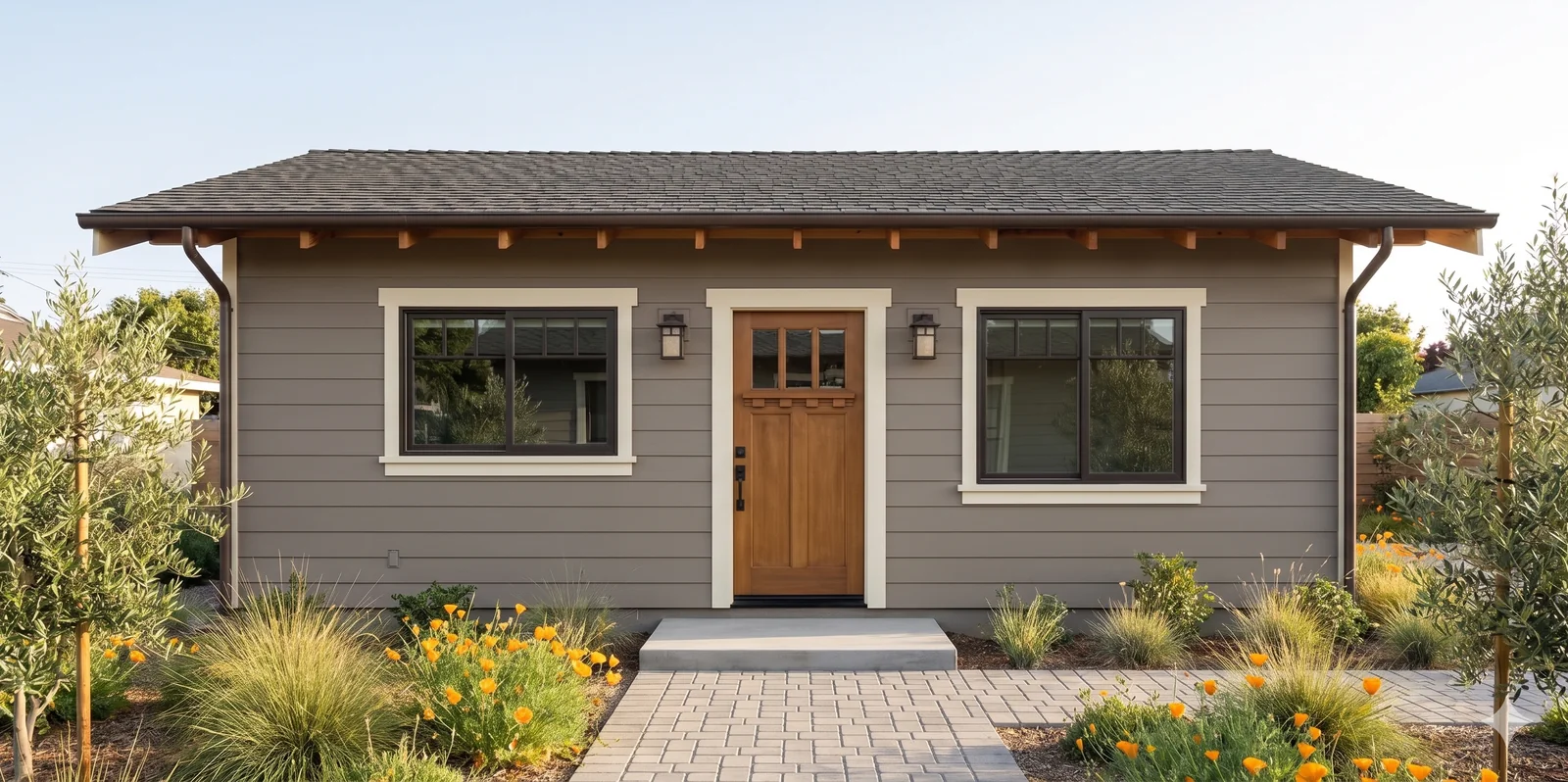
Start with something structural, because it colors everything else. The ordinance is written against a statute that no longer exists.
Six provisions — §§ 10-1-620.2(B), 620.3(B)(2), (B)(3), (E), (I) and (J)(2) — cross-reference “Government Code Section 65852.2.” State ADU law was recodified into Gov. Code §§ 66310 and following, and § 65852.2 is gone. Burbank’s own development standards still stand. But every state-law reference inside the ordinance now points at nothing, so if a rule is explained to you by reference to § 65852.2, the live provision may not say what the old one did.
The Mountain Fire Zone
BMC § 10-1-620.3(M)(1) bars an ADU on R-1 or R-1-H land inside the City’s Mountain Fire Zones unless it is a single ADU of no more than 800 square feet or a single Junior ADU of no more than 500 square feet, and brush clearance requirements are met.
Two things about that rule are worth knowing before you accept it.
| What people assume | What the sources actually say |
|---|---|
| The Mountain Fire Zone is a state fire hazard zone | It is not. Burbank’s General Plan Safety Element says the two zones “are designated by the Burbank Fire Department,” and never mentions CalFire or the state Fire Hazard Severity Zone system. |
| The 800 sqft cap applies to every ADU in the zone | Gov. Code § 66323(b) bars a city from imposing standards on the by-right units that the statute does not itself authorize. So the 800 sqft cap and the either/or reach none of the three: not a § 66323(a)(1) conversion ADU, which has no size cap at all; not the Junior ADU the same subdivision delivers alongside it; and not the § 66323(a)(2) detached 800-footer. The either/or fails in particular, because state law requires the conversion ADU and the Junior ADU together, not as alternatives. |
| The City’s own pages are consistent about it | They are not. The Pre-Approved ADU Program page describes the cap as applying in a “Very High Fire Zone” — the state term for something the code defines locally. |
The R-1-H horse-keeping zone
If you are in R-1-H, the local rule is narrow, and most summaries of it are narrower still. Section 10-1-620.3(N)(1) caps the zone at one ADU or one Junior ADU — not both — and bars new construction of ADUs except for four routes: converting an existing permitted garage, converting an existing permitted guest dwelling unit, converting existing square footage within the main dwelling, and, the one most people miss, an addition to the main dwelling, which subparagraph (d) permits so long as it sits outside the rear 35 feet reserved for horse keeping.
Then § 10-1-620.3(N)(2) closes the obvious workaround. It bars converting any other existing accessory structure, naming storage buildings, sheds, pool houses, recreation rooms, barns, stables, corrals and tack rooms. Openings within the horse-keeping area must sit at least 10 feet from the rear and side property lines.
Both bars sit badly against state law, and N(2) is the weaker of the two. Gov. Code § 66323(a)(1) guarantees one ADU per lot within the converted space of an existing single-family dwelling or accessory structure, and § 66323(b) bars a city from applying any standard to that unit the statute does not itself list — which is close to the whole of N(2). The bar on new detached construction runs into § 66323(a)(2) the same way.
None of this has been tested in court, so treat it as an argument rather than a settled answer. Burbank’s own subsection N opens “unless otherwise stated in the following or otherwise required by state law,” which is the hook. Submit the application, cite § 66323(a)(1) and (b) on the plans, and make the City put any denial in writing — Gov. Code § 66317(b) requires it to give you a full written list of deficiencies rather than a verbal no.
The hillside area
If your lot sits inside the hillside area — bounded by the City limits with Glendale and Los Angeles and by Sunset Canyon Drive, Walnut Avenue, Bel Aire Drive, Cambridge Drive, Kenneth Road and Scott Road (§ 10-1-606(A)(2)) — a separate set of development standards exists, and the code never says how it interacts with the ADU section. Neither section mentions the other: § 10-1-606 does not mention ADUs or accessory structures anywhere, and §§ 10-1-620.1–620.7 never mention the hillside area.
On height, we read the code as leaving the ADU numbers alone. Table 10-1-603(A) marks with an “(H)” the rows that hillside standards displace: floor area ratio, yard setbacks, fence heights and parking. The maximum height row is not one of them.
Two other hillside provisions are written broadly enough to reach an ADU on their face. Section 10-1-606(H) requires a Hillside Development Permit before a building permit issues for “the main dwelling structure or any other structure” where height to the top of the roof exceeds 16 feet. Every ADU configuration on this page does. And § 10-1-606(D) bars “any structure” within 100 vertical feet of a major ridge centerline, or 50 vertical feet of a minor ridge.
Why the hillside permit matters
A Hillside Development Permit is discretionary. It requires a view study, is noticed to owners and occupants within 300 feet, is appealable to the Planning Commission, and costs $9,421.36 on the Fiscal Year 2026–27 schedule. Applying it to an ADU would collide with the ministerial 60-day review that Gov. Code § 66317 requires.
We do not think a city can lawfully require a discretionary hillside permit for an ADU, and Burbank’s ADU section does not require one. But the hillside section is written broadly enough that it can be raised. If you are in the hillside area, get a written determination from Planning on whether an HDP will be required before you spend money on drawings.
What the State has and has not said
Worth stating plainly, because it is easy to overclaim in both directions. We found no HCD findings letter, notice of violation, technical assistance letter or memorandum of understanding directed at Burbank’s ADU ordinance.
Burbank does have an active State enforcement history on housing more generally, including a Notice of Violation in May 2022 over a denied housing project and a technical assistance letter in September 2025 about SB 9 and fire mitigation. Neither is about ADUs, and we are not going to stretch them into something they are not.
How the permit process works
Ministerial means a reviewer applies the numbers to your drawings. Design taste, neighborhood opinion and discretion are not part of it. Routing runs through Planning, Public Works, Burbank Water and Power for both electric and water, and the Fire Department, with school fees coordinated separately through Burbank Unified.
One local wrinkle sits inside that, and it is narrower than it first looks. BMC § 10-1-620.3(A) lists among the standards an ADU must meet “architectural design review, including compatibility with existing structures located on the same property and in the surrounding neighborhood that are listed in the California Register of Historic Places.” That closing clause is the whole ballgame. Read naturally, the compatibility test is keyed to Register-listed structures — so for the large majority of Burbank lots, with no listed building on the property or nearby, there is nothing for it to attach to and no design judgment to make.
If you do have a listed structure on your lot or on your block, the clause bites, and it is worth knowing that a compatibility test is a judgment call sitting inside a process Gov. Code § 66317 requires to run on objective written standards. Ask the reviewer in writing which listed structure the comment is keyed to and what objective standard it rests on. That is a fair question, and it is usually the end of the conversation.
What you submit
A complete application is the single biggest factor in how long this takes. Expect a site plan, floor plans, elevations, structural drawings and Title 24 energy documentation.
Two Burbank-specific items catch people out. Height is measured from the lower of existing or finished grade, taken at one-foot intervals along the face of the structure — so on a sloped lot the measurement is unforgiving and worth surveying early. And any grading beyond six inches, or twelve in a hillside area, triggers a stamped pre-demolition topographic survey.
The completeness step
It is bounded. Gov. Code § 66317(a)(2)(B) gives the City 15 business days to decide in writing, and requires the notice to list every incomplete item and describe how the application can be made complete.
If you already have an unpermitted unit
Gov. Code § 66311.7 gives you a streamlined route. Where the unit was built before January 1, 2020, the City may not deny a permit to legalize it over building-code violations unless correcting them is necessary for health and safety. That route is worth more in Burbank than in most cities, because § 10-1-620.6 makes a willfully false permit statement a misdemeanor and sets violation penalties running from $100 to $1,000 a day. Legalizing is cheaper than being found.
Fire sprinklers
Burbank’s own rule matches the statute and is worth knowing. Section 10-1-620.3(M)(2) provides that sprinklers are not required in an ADU if they are not required for the primary dwelling, and that building an ADU will not by itself trigger a sprinkler requirement in the existing house. Gov. Code § 66314(d)(12) says the same.
If you are refused
You are not finished. Gov. Code § 66317(d) requires the City to provide a process to appeal a denial or an incompleteness determination, and to issue a final written determination within 60 business days of your written appeal. Burbank does not name the appeal body anywhere in § 10-1-620, so ask Planning in writing which body hears it, and on what form, before the clock starts.
Burbank ADU questions, answered
The questions Burbank homeowners and property owners actually ask — answered against BMC § 10-1-620, the City’s own handout, and current state law.
How tall can an ADU be in Burbank?
Taller than in most cities near it, and the number depends on how you attach it. A freestanding detached ADU is capped at 17 feet to any architectural feature, rising to 18 feet within a half-mile walking distance of a major transit stop or high-quality transit corridor — plus two more feet there to match your home's roof pitch. Build the ADU on top of a detached garage or accessory structure and BMC § 10-1-620.3(G)(2) allows 20 feet to the top of plate and 23 feet to any architectural feature. Attach it to the house and the R-1 table applies: 20 feet to plate and 30 feet to the top of a pitched roof, though a flat roof is capped at 23 feet.
Can I build a two-story ADU in Burbank?
Yes, by two routes, and this is the most useful thing on the page. Above a garage you have 23 feet to work with, which comfortably carries a two-story unit. Attached to the house you have 30 feet if the roof slopes at least 30 degrees — Table 10-1-603(A) footnote 3 sets that condition, and the City's own ADU handout omits it. A freestanding detached ADU at 17 feet is single-story on most plans, though note that the code sets a height, not a story count: the word "one-story" appears in § 10-1-620.3(G) only in the attic rule at G.5. State ADU law contains no story limit either, and HCD's March 2026 Handbook (p. 24) states that where a detached two-story ADU fits within the applicable height allowance and complies with the building code, a city cannot deny it on story count alone. Read that as HCD guidance rather than statutory text — Gov. Code § 66321(b)(4)(D) governs attached ADUs and expressly "shall not require a local agency to allow an accessory dwelling unit to exceed two stories." If a plan checker treats 17 feet as a one-story rule, ask which provision says so.
How big can a Burbank ADU be?
For new construction, 850 square feet for a studio or one-bedroom and 1,000 square feet with more than one bedroom (BMC § 10-1-620.3(F)(2)). Those are the state-mandated minimums a city may set, not a Burbank concession. A conversion is a different and much better answer. An ADU created inside your existing house or inside an existing accessory structure is a Gov. Code § 66323(a)(1) unit, and HCD is explicit that it "is not subject to unit size requirements" — no square-foot cap at all. Burbank agrees in its own text: § 10-1-620.3(F)(7) lets an accessory-structure conversion keep the greater of 850/1,000 or the existing structure's footprint, and F.8 allows another 150 square feet for ingress and egress. If you have a 1,200 square foot garage or workshop, do not shrink it to 1,000. There is also a local bonus on new construction: under § 10-1-620.3(F)(9), providing on-site parking stalls beyond the minimum required buys up to 120 more square feet in total — not per stall — on one ADU on the lot, a practical ceiling of 970 or 1,120 square feet. The trade is a recorded deed restriction running with the land that bars removing that parking for as long as the ADU exceeds the normal cap.
How many ADUs can I build on a Burbank single-family lot?
The code says one ADU plus one Junior ADU — § 10-1-620.3(B)(2) permits "no more than one ADU" on a single-family lot, and § 10-1-620.3(P)(2) allows one Junior ADU. State law is more generous. Gov. Code § 66323(a) requires the City to allow a conversion ADU, a Junior ADU and a newly built detached ADU of up to 800 square feet in combination, and HCD's March 2026 Handbook (p. 18) adds that a local agency must allow at least one further unit under Gov. Code § 66314 on top of those. Do the arithmetic and the state floor on a Burbank single-family lot is four units, not two. That fourth unit is HCD guidance rather than express statutory text, so put it in writing at pre-application rather than assuming it at the counter. Burbank's own text concedes the underlying point by opening § 10-1-620.3(A) with "unless otherwise preempted by state law."
How many ADUs can I add to a Burbank apartment building?
The code caps you at two detached, and that cap is preempted. BMC § 10-1-620.3(O)(1) states that "no more than two (2) ADUs can be constructed on a lot with an existing or proposed multifamily dwelling structure(s)." Gov. Code § 66323(a)(4)(A)(ii) requires ministerial approval of up to eight detached ADUs on a lot with an existing multifamily dwelling, capped at the number of units already there. Separately, § 10-1-620.3(O)(2) allows conversions of non-livable space at 25 percent of existing units with at least one permitted, which does track state law. Note that Burbank's "unless otherwise preempted" savings clause sits in subsection B and does not reach subsection O.
What are the setback rules for a Burbank ADU?
Four feet from the rear and side property lines, and § 10-1-620.3(H)(1) is explicit that this applies "including ADUs constructed on top of a garage or accessory structure" — so the four feet holds at the second story too. Two provisions are worth more than they look. Under H.6, no setback is required where the ADU is built in the same location and to the same dimensions as an existing legal structure, "even when that structure has been demolished." And under § 10-1-620.3(H)(3), an unpermitted accessory structure can keep its legal nonconforming setbacks as part of a conversion, subject to the Building Official's health and safety review. Two more numbers matter as much on a normal lot: § 10-1-620.3(H)(4) requires 5 feet between building faces and 4 feet eave to eave, and stairs, landings and any balcony or patio more than 7 inches above grade take the full 4-foot setback (H.7, H.8). The front setback is the prevailing setback on your blockface rather than a fixed number — but it can never be the reason you get no ADU. Gov. Code § 66321(b)(3) provides that a front setback cannot preclude an ADU of at least 800 square feet, even if that ADU would sit partly or wholly inside the front setback, and Burbank codifies the same thing at § 10-1-620.3(H)(2)(b): show with dimensioned exhibits that an 800 square foot ADU will not fit elsewhere on the lot at 2-foot side and rear setbacks — the City will test that against a two-story option first — and an ADU of up to 800 square feet is allowed to encroach into the front yard. Note the trade in that subsection: anywhere you end up under 3 feet from a side or rear line, no openings are allowed on that elevation.
Does Burbank require parking for an ADU?
Usually not, and two categories are exempt absolutely rather than usually. A Junior ADU may never be required to provide parking at all — Gov. Code § 66334(a), and HCD is explicit that this holds even when the Junior ADU is converted from an attached garage. And no parking standard of any kind may be applied to a § 66323 unit: a conversion ADU, a Junior ADU, or the by-right detached 800 square foot unit. For everything else the baseline is at most one space per ADU or per bedroom, whichever is less, and six exemptions remove it: within a half-mile walking distance of public transit, in a historic district, part of the existing primary dwelling or an accessory structure, where on-street permits are required but not offered to your tenant, where a car share sits within one block — and, uniquely, § 10-1-620.3(E)(6), which waives parking outright if you can produce dimensioned plans proving there is no feasible location for it. Replacement parking is never required when a garage is converted or demolished in conjunction with the ADU (Gov. Code § 66314(d)(11)), though note Burbank narrows "in conjunction" to footprint overlap or a structure that impedes access to the ADU, a narrowing the statute does not contain.
What are the Mountain Fire Zone rules, and do they really apply to me?
Read this carefully before you accept a "no." BMC § 10-1-620.3(M)(1) bars an ADU on R-1 or R-1-H land inside the City's Mountain Fire Zones unless it is one ADU of no more than 800 square feet or one Junior ADU of no more than 500 square feet. But the Mountain Fire Zone is a Burbank Fire Department line drawn in the General Plan Safety Element — the Safety Element says the zones "are designated by the Burbank Fire Department" and never mentions CalFire or the state Fire Hazard Severity Zone system. It is not the same thing as a state Very High Fire Hazard Severity Zone, even though the City's own pre-approved plan page calls it a "Very High Fire Zone." Separately, Gov. Code § 66323(b) bars a city from imposing standards on the by-right units that the statute does not itself authorize, so neither the 800 square foot cap nor the either/or reaches any of the three: not a § 66323(a)(1) conversion ADU, which has no size cap at all; not the Junior ADU that the same subdivision delivers alongside it; and not the § 66323(a)(2) detached 800-footer. The either/or fails in particular, because state law requires the conversion ADU and the Junior ADU together rather than as alternatives. If you are in the foothills, ask for a written zoning determination.
I am in the R-1-H horse-keeping zone. Can I build anything?
More than the summaries suggest, and the local rule is on shaky ground anyway. BMC § 10-1-620.3(N)(1) caps R-1-H at one ADU or one Junior ADU — not both — and bars new construction of ADUs except for four routes: converting an existing permitted garage, converting an existing permitted guest dwelling unit, converting existing square footage within the main dwelling, and, the one most people miss, an addition to the main dwelling under N(1)(d), which is permitted so long as it sits outside the rear 35 feet reserved for horse keeping. Subsection N(2) separately says converting a storage building, shed, pool house, recreation room, barn, stable, corral or tack room "shall not be permitted." That is the most clearly preempted rule in the ordinance: Gov. Code § 66323(a)(1) guarantees one ADU per lot "within the converted space of a proposed or existing single-family dwelling or accessory structure," and § 66323(b) bars a city from applying any standard to that unit the statute does not list. The categorical bar on new detached construction runs into § 66323(a)(2) the same way. None of this has been decided in court, and Burbank's own subsection N opens "unless otherwise stated in the following or otherwise required by state law" — so submit the application, cite § 66323(a)(1) and (b) on the plans, and make the City put any denial in writing, which Gov. Code § 66317(b) requires it to do.
Why does the Burbank ordinance cite a law that no longer exists?
Because it has not been updated. BMC § 10-1-620 repeatedly cites "Government Code Section 65852.2" — at §§ 10-1-620.2(B), 620.3(B)(2), (B)(3), (E), (I) and (J)(2). State ADU law was recodified into Gov. Code §§ 66310 and following, and § 65852.2 no longer exists. That does not void Burbank's own development standards, but it does mean every state-law cross-reference inside the ordinance points at a dead section. If a rule is being applied to you by reference to § 65852.2, the live provision is somewhere in §§ 66310–66342 and it may not say what the old one did.
What does an ADU permit cost in Burbank?
The planning application for an ADU is $1,728.42 on Burbank's adopted Fiscal Year 2026–27 planning fee schedule, effective July 1, 2026, plus a general plan maintenance fee of 20 percent of the application fee. Council resets these every July 1, so that figure holds through June 30, 2027. Building permit and plan check are valuation-based and Burbank does not publish them in a form you can compute from — get them quoted. On impact fees, BMC § 10-1-620.3(K)(2) bars development impact fees on an ADU under 750 square feet and requires proportional fees above that, tracking Gov. Code § 66311.5(c)(1) — but the state version is better than Burbank's wording in two ways worth knowing. State law exempts an ADU of 750 square feet "or less," not "under" 750, and it measures interior livable space, while Burbank measures ADU square footage exterior wall to exterior wall (§ 620.3(F)(2)). On a 2x6 wall assembly an 800 square foot Burbank ADU can be at or under 750 square feet of interior livable space. If you are near the line, put the interior-livable-space figure on the plans and cite § 66311.5(c)(1).
Do I pay school fees on a Burbank ADU?
Only above 500 square feet — and both the City and the school district blur this. The 750 square foot line is the local impact-fee exemption. School fees are different: under Gov. Code § 66311.5(c)(3) an ADU or Junior ADU with less than 500 square feet of interior livable space is not subject to school impact fees at all. Burbank Unified's developer fee page states that fees are charged on the entire ADU if it exceeds 750 square feet, which is the wrong threshold in your favor below 750 and worth confirming in writing. The district does not publish its adopted per-square-foot rate; contact them directly.
Can I rent a Burbank ADU short-term, or to a production for 60 days?
Not under the local rule, and the local rule goes further than state law does. BMC § 10-1-620.3(Q) provides that ADUs and Junior ADUs "shall be rented for terms longer than 90 days." The state floor is 30 days under Gov. Code §§ 66323(e) and 66333(g), so Burbank has added 60 days of its own. That extra 60 days is a local standard, and § 66323(b) bars local standards on the units state law guarantees — so on a conversion ADU, a Junior ADU or the by-right detached 800 square foot unit, 30 days is the number to raise in writing. On any other ADU the 90 days stands. Either way a vacation rental is out: the 30-day floor is mandatory statewide, not optional. If your numbers depend on 30-to-89-day tenancies, which is a live market in Burbank given the studios, get the City's position in writing before you build.
Do I have to live on the property to build an ADU in Burbank?
No. Owner-occupancy may not be required for an ADU under Gov. Code § 66315. Junior ADUs are different, but the rule narrowed on January 1, 2026: under Gov. Code § 66333(b) as amended by AB 1154, owner-occupancy applies only where the Junior ADU shares sanitation facilities with the main house. Give it its own bathroom and the requirement does not apply. A deed restriction is still recorded under § 66333(c) covering separate sale and unit size. Note separately that if you use the +120 square foot parking bonus, that carries its own recorded deed restriction on the parking.
Can I sell a Burbank ADU separately from the house?
No. BMC § 10-1-620.3(R) states that any ADU "may be rented separate from the primary residence, but may not be sold or otherwise conveyed separate from the primary residence," and Burbank has not opted into AB 1033, the law at Gov. Code § 66342 that lets a city allow ADUs to be conveyed separately as condominiums. A handful of California cities have opted in; Burbank is not among them. The narrow qualified-nonprofit route at Gov. Code § 66341 remains available in principle but does not apply to an ordinary homeowner. A Junior ADU may never be sold separately in any city.
Official sources
Burbank
- BMC §§ 10-1-620.1–620.7 — the ADU ordinance. Added by Ordinance 18-3,901 effective April 13, 2018, and last amended — as to the development standards at § 620.3 and the application section at § 620.7 — by Ordinance 23-4,002 effective December 8, 2023. Code Publishing is current through Ordinance 26-4,038 (February 24, 2026), which did not amend the ADU sections. View on Code Publishing
- City of Burbank ADU page — including the ADU FAQ handout, which is useful but omits the 30-degree roof pitch condition on the 30-foot attached height. burbankca.gov
- Burbank Pre-Approved ADU Program — the current plan library and the accepted City of Los Angeles design. burbankca.gov
- General Plan Safety Element — where the Mountain Fire Zones are defined, and where you can confirm they are a Burbank Fire Department designation. Read the chapter (PDF)
California
- Gov. Code §§ 66310–66342 — state ADU law, renumbered by SB 477 effective March 25, 2024. The sections Burbank’s ordinance should be citing. leginfo.legislature.ca.gov
- Gov. Code § 66323 — the unit combinations a city must allow, and the bar on adding standards to them. leginfo.legislature.ca.gov
- HCD ADU Handbook — the state’s official interpretive guidance, March 2026. hcd.ca.gov
Rules change. Burbank’s ADU section has been stable since December 2023, though the City is under State pressure on housing capacity and that could change. Its planning fees reset every July, and its pre-approved plan library changes. If you are reading this later, confirm the fee and the plan list — or call us and we will confirm them for you.
Not sure what your lot
can actually support?
Get clarity before you spend anything on plans. In 15 minutes we will pull up your property, work out whether the garage route, the attached route or a freestanding unit gives you the most building, check whether the fire overlay touches you at all, and give you an honest read on your options and a realistic budget — including whether an ADU is the right move at all.
15-minute video call · No obligation