
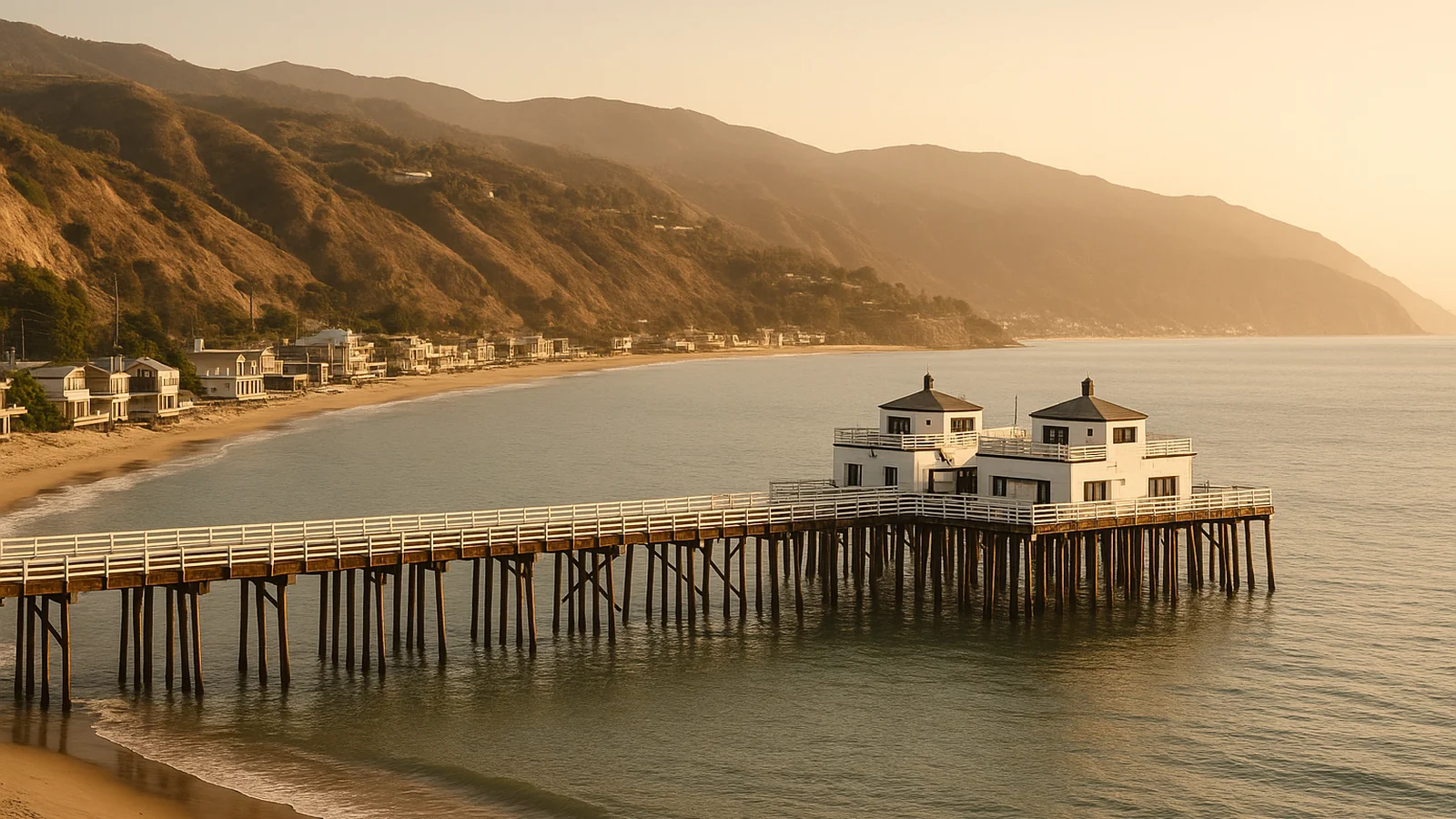
Building an ADU in Malibu. Rules, costs, timeline.
What Malibu's brand-new ADU ordinance (MMC Ch. 17.44, adopted June 2026) actually allows, how the Coastal Zone and citywide fire-hazard designation shape your permit, and what an all-in build costs on a Malibu lot in 2026.
What you can build — at a glance
Reviewed by CALI ADU’s ADU specialists · August 2026
- Max ADU size
- Up to 1,000 sqft Detached or attached, under the locally regulated track (MMC § 17.44.090(A)). The statutory by-right detached track caps at 800 sqft (§ 17.44.060(A)(2); Gov. Code § 66323); JADUs at 500 sqft. No FAR, front-setback, lot-coverage, or open-space rule may force an ADU below 800 sqft.
- Detached height
- 16 ft, single story MMC § 17.44.080(K); the state 18-ft bonus requires a major transit stop or high-quality transit corridor within ½ mile (Gov. Code § 66321(b)(4)(B)) — which effectively no Malibu parcel has.
- Attached height
- 25 ft or zone limit Whichever is lower, and never more than 2 stories (MMC § 17.44.080(K)(d); Gov. Code § 66321(b)(4)(D)).
- Side & rear setbacks
- 4 ft MMC § 17.44.090(B); none for a rebuild in the same location and dimensions, and beachfront fire-rebuild ADUs may keep the replacement structure’s setback (§ 17.44.090(B)(3)–(4)).
- Units per SFR lot
- Up to 3 accessory units One converted ADU + one JADU + one detached new-construction ADU ≤800 sqft, in combination (MMC § 17.44.060(A)(1)–(2); Gov. Code § 66323; HCD ADU Handbook, “66323 Units”). Existing multifamily lots: conversions up to 25% of units plus up to 8 detached ADUs (SB 1211).
- Parking required
- 1 space or fewer One space per ADU or per bedroom, whichever is less — tandem and setback parking count, and broad exemptions apply, including within ½ mile of public transit (MMC § 17.44.090(F); Gov. Code § 66322). No replacement parking when a garage is converted or demolished.
- Permit timeline
- 60 days Ministerial review by the Community Development Director — no hearing, deemed approved if the City misses the window (MMC § 17.44.070; Gov. Code § 66317). Completeness check: 15 business days (SB 543).
- Coastal Zone
- Entire city Every Malibu parcel is in the California Coastal Zone under a certified Local Coastal Program. Where a Coastal Development Permit applies, it now runs concurrently on its own 60-day, no-hearing clock (MMC § 17.44.060; Gov. Code § 66329, AB 462).
- Detached Up to 1,000 sqft · 16 ft, single story
- Attached Up to 1,000 sqft · ≤50% of primary · 25 ft / 2 stories
- Garage conversion Within existing structure footprint + 150 sqft for access
- Interior conversion Carved out of existing primary dwelling space
- Junior ADU Up to 500 sqft inside the primary dwelling (Gov. Code § 66313(d))
Per MMC Chapter 17.44 as rewritten by Ordinance No. 535 (adopted June 22, 2026; effective July 22, 2026) and Gov. Code §§ 66310–66342. Cross-checked against the HCD ADU Handbook (March 2026). Full citations in the sections below.
On this page
Can I build an ADU in Malibu?
Five things to know before you start
If you read nothing else on this page, read these. They are the five points that change the most Malibu projects.
| What to know | Why it matters for your project |
|---|---|
| 1. The rules changed in June 2026 | Ordinance No. 535 (adopted June 22, 2026, effective July 22) replaced MMC Chapter 17.44 in its entirety. It was rewritten after a state HCD findings letter, so it now tracks current state law closely. Almost everything published about Malibu ADUs before mid-2026 — including the code text still shown on some code-hosting sites — describes superseded rules. |
| 2. The whole city is in the Coastal Zone | Every parcel. Where your project needs a Coastal Development Permit, it is no longer a sequential slog. Since October 2025, Gov. Code § 66329 puts an ADU CDP on its own 60-day clock, run concurrently with the ADU permit, with no public hearing. Conversions inside existing structures may skip the CDP entirely under the Coastal Act’s existing-structures exemption (Pub. Resources Code § 30610) — and then only the ADU chapter governs (MMC § 17.44.060). |
| 3. Detached means single-story here | Detached ADUs are capped at 16 feet above grade (MMC § 17.44.080(K)). The state 18-ft exception requires a major transit stop or high-quality transit corridor within a half-mile (Gov. Code § 66321(b)(4)(B)) — effectively nowhere in Malibu. Plan the square footage in one story, or attach the ADU to the house, where 25 ft and two stories are available. |
| 4. Septic drives feasibility | Most Malibu lots run on on-site wastewater treatment. If the ADU connects to one, your application must include a percolation test from the last five years (ten if recertified) (MMC § 17.44.080(E)) — and the City’s environmental-health review is a real line item. Check septic capacity before you fall in love with a floor plan. |
| 5. Short-term rental is off the table | An ADU or JADU may not be rented for less than 30 days, no matter when it was built (MMC § 17.44.080(B)). Malibu also requires owners to report the actual rent charged each year (§ 17.44.080(C)). If your numbers depend on nightly income, they will not work here. |
How many units your lot supports
The June 2026 ordinance organizes ADUs into two tracks. Class 1 “statutorily regulated” units follow Gov. Code § 66323 and can be combined on one single-family lot (MMC § 17.44.060(A)):
| Unit | How many | Conditions |
|---|---|---|
| Converted ADU | 1 | Within the space of the home or an existing accessory structure, plus up to 150 sqft for entry/exit access (§ 17.44.060(A)(1)). |
| JADU | 1 | ≤ 500 sqft, inside the single-family structure, deed restricted (§§ 17.44.060(A)(1), 17.44.080(H)). |
| Detached new-construction ADU | 1 | ≤ 800 sqft, 4-ft side/rear setbacks, 16-ft height (§ 17.44.060(A)(2)). |
That is up to three accessory units alongside the house you already have — the state-law stack confirmed by the HCD ADU Handbook’s “66323 Units” guidance. Want a single larger unit instead? The Class 2 locally regulated track allows one detached or attached ADU up to 1,000 sqft (§ 17.44.090(A)). On multifamily lots, conversion ADUs are allowed up to 25% of existing units, plus up to eight detached ADUs on a lot with an existing multifamily dwelling — the SB 1211 floor, now written directly into the Malibu code (§ 17.44.060(A)(3)–(4); Gov. Code § 66323).
Owner-occupancy
You do not have to live on the property to build or rent an ADU. The ordinance says it in one line: “ADUs are not subject to an owner-occupancy requirement” (MMC § 17.44.080(G)(c)), matching the state bar in Gov. Code § 66315. A JADU is the narrow exception — and narrower than it used to be. After AB 1154 (effective January 1, 2026, amending Gov. Code § 66333), owner-occupancy applies only when the JADU shares a bathroom with the main house, or unless the property is owned by a government agency, land trust, or housing organization. Give the JADU its own sanitation and the requirement falls away — Malibu’s new ordinance codifies exactly that (§ 17.44.080(G)(b)).
What can you build?
Everything in this section is grounded in MMC Chapter 17.44 as rewritten by Ordinance No. 535 (effective July 22, 2026), with state-law citations called out where they set the floor. We won’t re-cite the local chapter on every line. Assume it under each subsection unless we tell you otherwise.
Which ADU type fits your property?
Malibu permits five types. On this coastline the right one is usually decided by your lot — septic capacity, fire access, and the coastal overlay — rather than by preference. Start here, then read the standards below against the type you land on.
| If this sounds like you | Start with | What that means |
|---|---|---|
| You want the most space and rental value your lot allows. | Class 2 detached ADU | Up to 1,000 sqft single-story at 16 ft, 4-ft setbacks, subject to the 38% FAR and lot-coverage standards — which can never push you below 800 sqft. |
| You want the fastest, cleanest approval path. | By-right detached ADU (≤800 sqft) | The statutory track: 800 sqft, 4-ft setbacks, 16 ft — the unit every city must approve, and it can stack with a conversion ADU and a JADU. |
| You need two stories, or the yard cannot take a separate structure. | Attached ADU | Up to 25 ft / 2 stories (or the zone limit if lower), capped at 50% of the primary’s floor area and 1,000 sqft — the only two-story ADU path in Malibu. |
| You have a garage or accessory structure you rarely use. | Conversion ADU | Reuses the existing footprint plus up to 150 sqft for access, no setback required for a same-location rebuild, and no replacement parking — often CDP-exempt (Pub. Resources Code § 30610; confirmed parcel-by-parcel), which removes the coastal step entirely. |
| You are housing family and want the simplest, lowest-cost path. | Junior ADU (JADU) | Up to 500 sqft carved out of the house, deed restricted. Owner-occupancy applies only if it shares a bathroom with the main home (AB 1154). |
| You are rebuilding after a fire. | Rebuild-paired ADU | Beachfront fire-rebuild ADUs may keep the replacement structure’s setback, and a finished detached ADU can be occupied before the rebuilt main house (§§ 17.44.090(B)(4), 17.44.080(J)). |
Maximum size
| Standard | Limit |
|---|---|
| Detached or attached ADU (Class 2) | Up to 1,000 sqft (§ 17.44.090(A)(1)). |
| Attached ADU, additional cap | 50% of the existing primary dwelling’s floor area (§ 17.44.090(A)(2)). |
| By-right detached ADU (Class 1) | 800 sqft or smaller (§ 17.44.060(A)(2); Gov. Code § 66323(a)(2)). |
| Conversion ADU | The existing space of the home or accessory structure, plus up to 150 sqft for ingress/egress (§ 17.44.060(A)(1)). |
| JADU | Up to 500 sqft of interior livable space (§ 17.44.090(A)(4); Gov. Code § 66313(d)). |
| The 800-sqft floor | No percent-based limit, FAR, front-setback, lot-coverage, or open-space rule may force the ADU below 800 sqft of interior livable space (§ 17.44.090(A)(3); Gov. Code § 66321(b)(3)). |
The 800-sqft floor is the number to remember on Malibu’s FAR- and coverage-constrained lots. Development standards can trim a 1,000-sqft plan, but they can never trim it below 800 sqft. The attached-ADU percentage cap has its own state-law floors on top of that. A percent-based limit cannot cut a one-bedroom ADU below 850 sqft or a two-plus-bedroom ADU below 1,000 sqft (Gov. Code § 66321(b)(2); HCD ADU Handbook). So on a small primary dwelling, the 50% rule bends before your floor plan does.
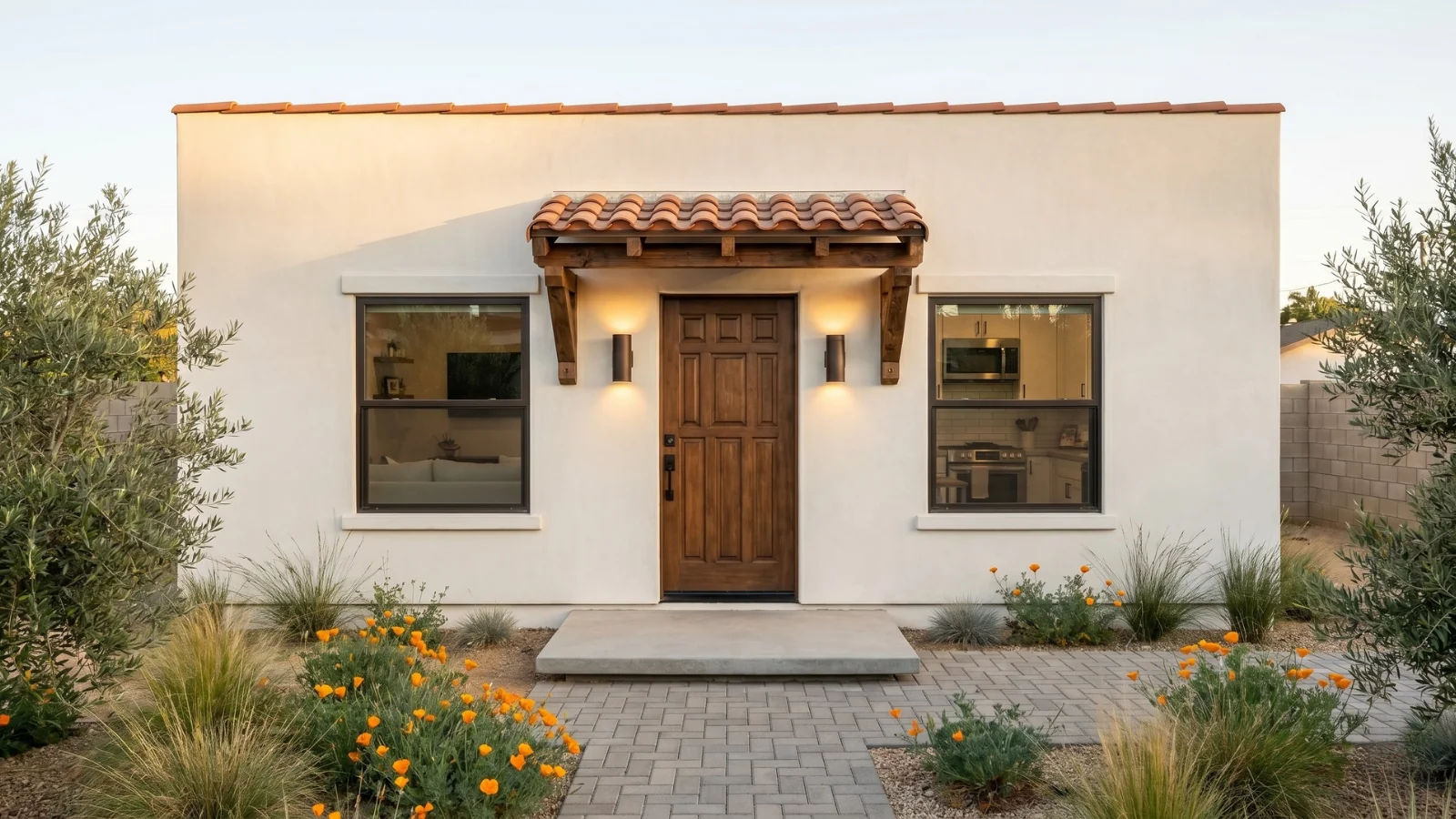
Height: 16 feet detached, 25 feet attached
| ADU type | Height limit |
|---|---|
| Detached ADU | 16 ft above grade (§ 17.44.080(K)(a)). |
| Detached, near a major transit stop | 18 ft, +2 ft to match the primary’s roof pitch (max 20 ft). § 17.44.080(K)(b) keys this to a major transit stop within ½-mile. State law also reaches high-quality transit corridors (Gov. Code § 66321(b)(4)(B)) and controls — but effectively no Malibu parcel qualifies either way. |
| Detached, on a multistory multifamily lot | 18 ft (§ 17.44.080(K)(c)) |
| Attached ADU | 25 ft or the underlying zone’s limit, whichever is lower — never more than 2 stories (§ 17.44.080(K)(d); Gov. Code § 66321(b)(4)(D)). |
The design consequence: a detached Malibu ADU is a single-story building, full stop. If your program needs two stories — a view deck, bedrooms over living space — the path is an attached ADU under the 25-ft envelope. Our two-story Signature plans stand roughly 25 ft as detached homes, so they cannot be permitted in Malibu as drawn. A two-story plan can be modified to fit the attached envelope, or we design a custom ADU from scratch for the lot. The single-story plans below permit as-is, which is why they lead.
Setbacks
| Standard | Rule |
|---|---|
| Side and rear | 4 feet (§ 17.44.090(B)(2)) — the state-law floor in Gov. Code § 66314(d)(7). |
| Front, non-beachfront lot | At least 20% of the total lot depth, or 65 ft, whichever is less (§ 17.44.090(B)(1)) — but a front setback may never be applied to preclude the 800-sqft ADU (§ 17.44.090(A)(3)). |
| Front, beachfront lot | 20 ft maximum, or the average of the two immediate neighbors, whichever is less (§ 17.44.090(B)(1)). |
| Same-footprint rebuilds | No setback required for an ADU built in the same location and dimensions as an existing structure (§ 17.44.090(B)(3)). |
| Beachfront fire rebuilds | An ADU attached to a legally authorized fire-rebuild replacement structure may keep the replacement structure’s setback, with LA County Fire and Building Official sign-off (§ 17.44.090(B)(4)) — new in Ord. 535. |
Parking
| Requirement | Malibu rule |
|---|---|
| On-site parking | One space per ADU or per bedroom, whichever is less — unenclosed, tandem, and setback-area parking all count (§ 17.44.090(F)(1)). |
| Exemptions (any one removes parking entirely) | Within ½-mile walking distance of public transit · in a historic district · the ADU is part of the existing home or an accessory structure · on-street permits exist but are not offered to the ADU occupant · a car-share stop is within one block · the ADU is filed with a new primary dwelling (§ 17.44.090(F)(2); Gov. Code § 66322). |
| Replacement parking | Never required. When a garage, carport, or even an uncovered space is demolished or converted for the ADU, those spaces do not have to be replaced (§ 17.44.090(F)(3); Gov. Code § 66314(d)(11)). |
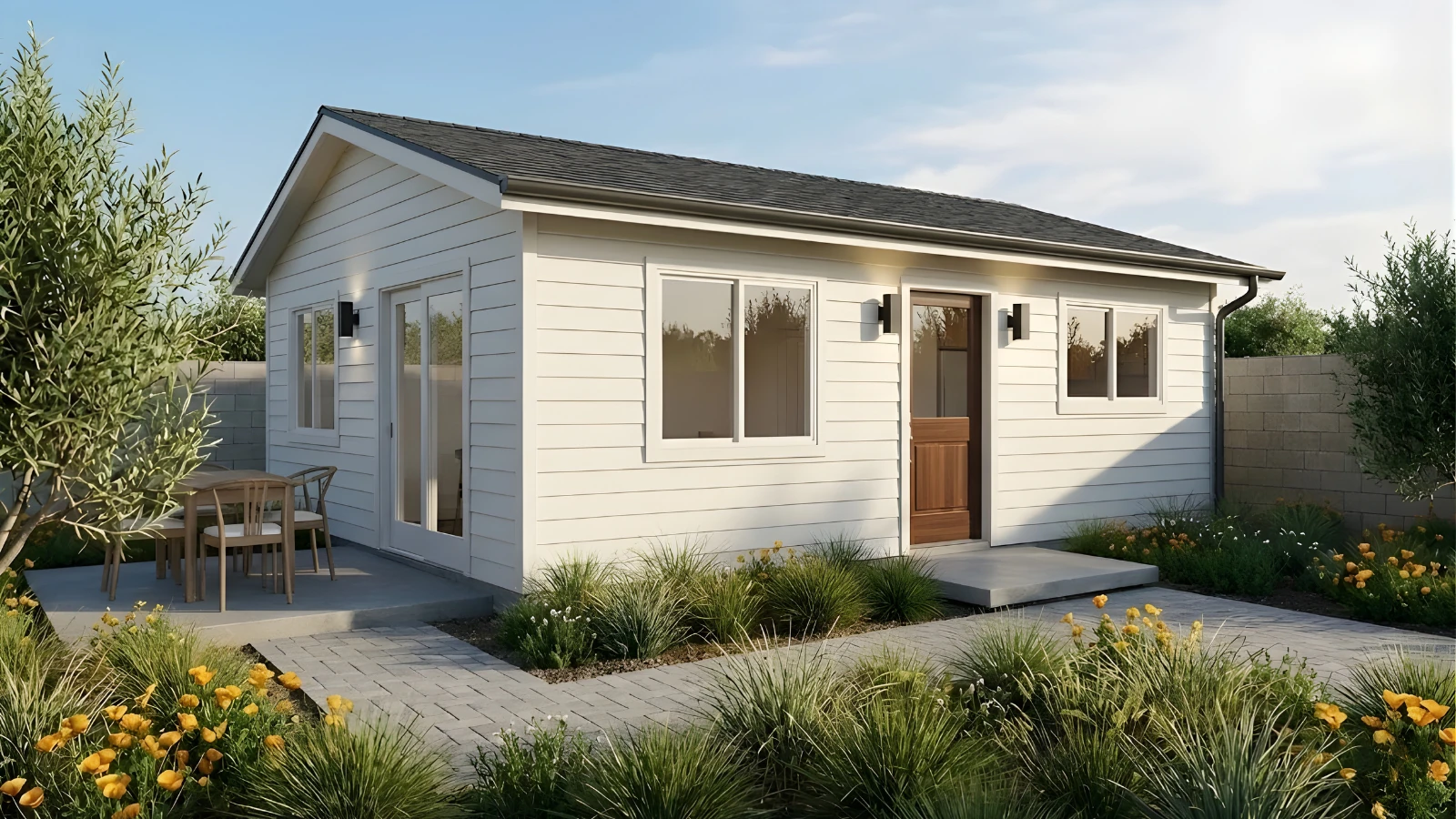
The single-story Signature ADU
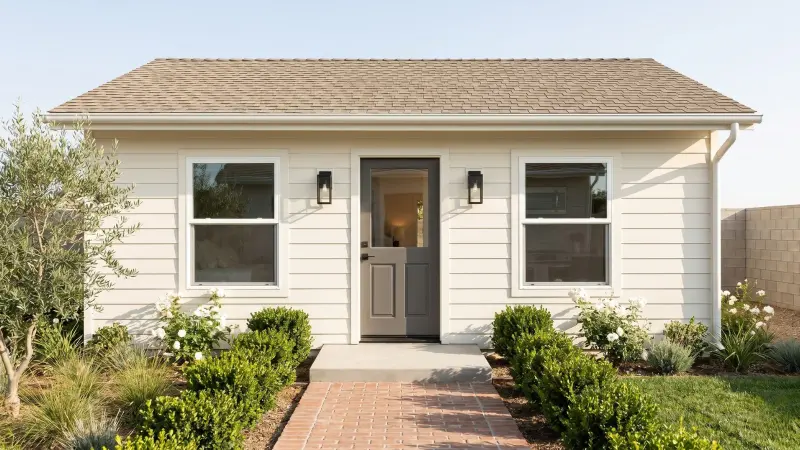
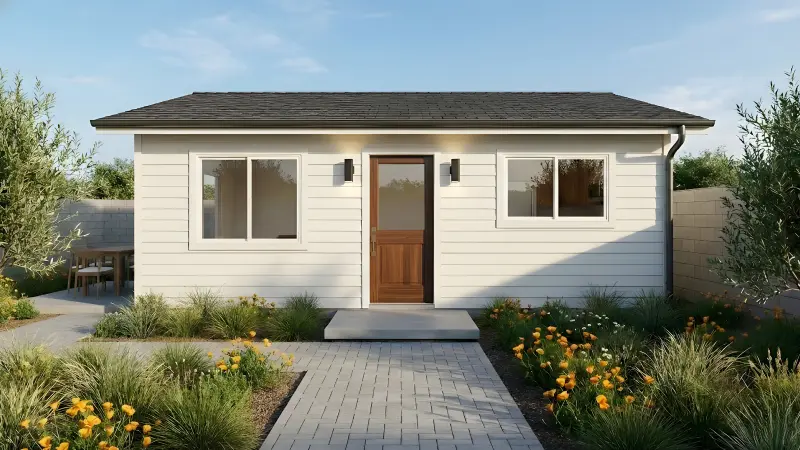
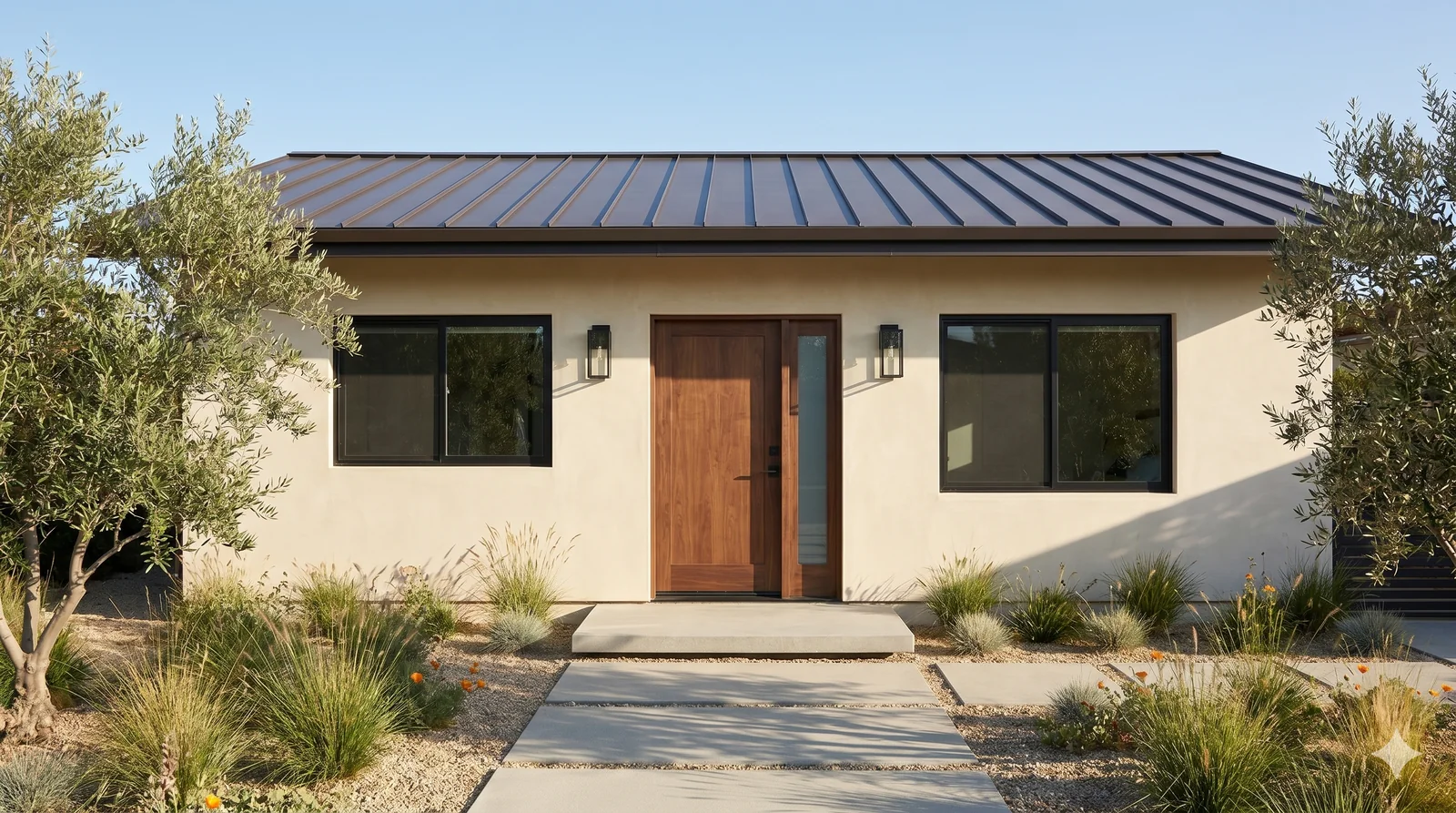
Malibu’s 16-ft detached envelope is exactly what our single-story lineup was engineered for. Three picks for this market — the Lincoln sits precisely at the 1,000-sqft Class 2 ceiling, the Melrose at the 800-sqft by-right cap.
Signature Homes for Malibu lots
Single-story plans engineered to clear MMC § 17.44.080(K)’s 16-ft detached envelope as drawn. Fixed plan pricing, design and permit processing included.
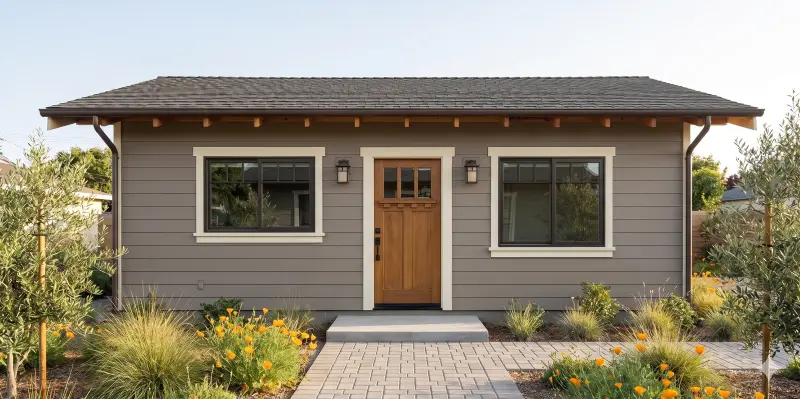
The Lincoln
The Melrose
The Westwood
See the full nine-model Signature lineup. For lots and programs the stock plans don’t fit — a two-story attached unit, a bluff lot, a rebuild pairing — we design custom ADUs from scratch; $9,990–$19,990 for design and permit processing, bid per project.
What an ADU costs in Malibu (2026)
Our Signature plans are fixed-price — architectural design and full permit processing included, the same number whether the lot is in Malibu, Santa Monica, or the Valley. Construction is separate: once your plans are permitted, you build with our construction partner or your own licensed contractor. The figures below are the estimated cost to build each model.
| Model | Configuration | Size | Collection | Est. cost to build |
|---|---|---|---|---|
| The Wilshire | Studio / 1BA | 400 sqft | Single-story | $180K–$200K |
| The Sunset | 1BR/1BA | 480 sqft | Single-story | $200K–$215K |
| The Westwood | 1BR/1BA | 550 sqft | Single-story | $215K–$235K |
| The Laurel Canyon | 2BR/1BA | 660 sqft | Single-story | $240K–$265K |
| The Melrose | 2BR/2BA | 800 sqft | Single-story | $275K–$295K |
| The Fairfax | 2BR/1.5BA | 840 sqft | Two-story | $280K–$310K |
| The Lincoln | 3BR/2BA | 1,000 sqft | Single-story | $325K–$350K |
| The Venice | 2BR/2.5BA | 1,080 sqft | Two-story | $335K–$365K |
| The Culver | 3BR/2.5BA | 1,200 sqft | Two-story | $385K–$420K |
In Malibu the two-story models and the 1,080–1,200 sqft plans are shown for reference — the detached envelope here is single-story and 1,000 sqft, so the Lincoln is the ceiling as drawn. Custom work is priced per project, $9,990–$19,990 for design and permit processing.
Malibu’s pass-through fees — the honest picture
Not in either number above: the City’s own fees. Malibu is the most fee-intensive jurisdiction we work in, because most lots add specialist reviews — geology, on-site wastewater, coastal — that inland cities never see. From the FY 2026-27 Schedule of Fees (effective July 1, 2026).
| City fee | FY 2026-27 amount | When it applies |
|---|---|---|
| Building plan check + permit | $2.48 + $2.51 per sqft | All new residential construction — roughly $4,000 combined on an 800-sqft ADU. |
| Geology review — second units | $4,113 | Standard geotechnical review for guest houses and second units; most Malibu lots. |
| Environmental health / OWTS review | $1,175–$3,085 planning + $402–$2,203 building | Simple non-OWTS review at the low end; complex on-site wastewater review at the high end. |
| Coastal Development Permit — Level 3 | $13,244 | Accessory structures and second units, where a CDP is required and not exempt. |
| Coastal engineering review | $870–$3,753 | Beachfront and wave-exposed lots — $870 minor, $1,876 standard, $3,753 complex project review. |
| Surcharges | 5.12% of building permit + 0.18% of valuation | Technology enhancement and general-plan maintenance, on every permit. |
Which of these your lot actually pays depends on its coastal status, soils, and wastewater situation. A garage conversion on a sewered Civic Center-area lot sees a fraction of what a beachfront new-build does. Your Backyard Review includes a line-item estimate of the pass-through costs for your specific parcel. For sizing and payback math: the ADU calculator and the ROI calculator.
Development fees
State law is the anchor here: no impact fees at all for an ADU of 750 sqft or less of interior livable space. Above 750 sqft, impact fees are proportional — scaled to the ADU’s share of the primary home’s floor area (Gov. Code § 66311.5, as amended by SB 543). One boundary-case flag: MMC § 17.44.100(A) writes the exemption as “less than 750” — narrower than the state floor for an ADU of exactly 750 sqft, and state law controls (Gov. Code § 66316). No school fees under 500 sqft.
“Impact fee” includes Mitigation Fee Act and Quimby Act fees. So the City’s $5,636 parkland development fee for a single-family dwelling is off the table for a sub-750-sqft ADU. Utility connections are separate: a converted ADU needs no new connection, while new construction pays a connection fee proportionate to its actual burden (§ 17.44.100(B)).
What it returns: renting your ADU
Malibu blocks short-term rentals of ADUs outright — a 30-day minimum term is written into the ordinance and into the JADU deed restriction (MMC § 17.44.080(B), (H)). What is left is one of the strongest long-term rental markets in California: coastal supply is scarce, legal permitted units are scarcer, and Pepperdine, entertainment-industry, and rebuild-era demand is persistent.
The trusted public benchmark is HUD’s Fair Market Rent for the Los Angeles–Long Beach–Glendale metro area (FY 2026, revised effective May 21, 2026). Malibu sits at the far top of that metro distribution. A new, fully permitted detached ADU here typically rents well above the metro FMR, and coastal-proximate units command the largest premiums.
| Unit type | Typical ADU size | HUD FMR (FY 2026, LA metro) |
|---|---|---|
| Studio | ~400 sqft | $2,079 |
| 1 bedroom | 480–550 sqft | $2,328 |
| 2 bedroom | 660–800 sqft | $2,903 |
| 3 bedroom | 1,000 sqft | $3,681 |
We deliberately publish the government benchmark rather than a made-up “Malibu rent range.” The honest statement: Malibu long-term rents for comparable units run a multiple of these figures, and the premium varies more by micro-location (beachfront, bluff, canyon) than in any other city we serve. For payback math keyed to your lot and your financing, use the ADU ROI calculator.
HUD FMR figures: FY 2026 Fair Market Rents, Los Angeles–Long Beach–Glendale HUD Metro FMR Area, as revised effective May 21, 2026 (huduser.gov; Federal Register, Apr. 21, 2026). FMR is a metro-wide benchmark, not a Malibu appraisal; your specific ADU’s performance depends on finish level, lot, access, and the rental market at the time you lease it.
Why the Malibu market rewards the investment
Between the coastal overlay, septic engineering, fire-zone building standards, and the county’s highest pass-through fees, Malibu is the hardest place on this site’s service map to build an ADU. Why build here anyway?
- Scarcity works for you. The same constraints that make permitting hard keep legal, fully permitted rental units extraordinarily scarce. A compliant ADU in Malibu competes in a market with almost no supply.
- The new ordinance removed the local guesswork. Ord. 535 was rewritten to satisfy HCD’s findings letter, so the standards are now objective and state-aligned — a conforming application is a ministerial approval, not a negotiation (MMC § 17.44.070(B)).
- The coastal step finally has a clock. Since October 2025, an ADU coastal permit must be decided in 60 days, concurrently, with no hearing (Gov. Code § 66329). The open-ended coastal timeline that scared owners off for years is gone on paper — and conversions often skip it entirely.
- Guest-house economics without guest-house rules. Malibu estates have always carried guest houses; an ADU is the version that may legally house family, staff, or a 30+ day tenant. It also adds permitted, insurable square footage on lots where every buildable foot is precious.
- Fire-rebuild flexibility is real. The ADU-first occupancy exception (§ 17.44.080(J)) means a rebuilt lot can house its owners in the ADU while the main house rises — a planning option that did not exist before 2026.
- State law backstops the city. The 60-day clock, the 800-sqft floor, the parking exemptions, and the owner-occupancy bar all run on Gov. Code §§ 66310–66342 regardless of local process.
When an ADU isn’t the right move
Not every Malibu property is a good ADU candidate, and it is cheaper to learn that now than after you have paid for plans. Five situations where we would tell you to wait, choose a different unit type, or not build at all:
- Your numbers depend on nightly rental income. They will not work. The 30-day minimum term is in the ordinance and in the deed restriction (MMC § 17.44.080(B), (H)), and state law backs it. Run the math on a 30+ day tenancy or reconsider.
- Your parcel lacks legal access to a 20-foot street. Fire-apparatus access under Fire Code § 503 is a real, enforceable building requirement on some canyon and private-road parcels. It cannot be used as a zoning veto (§ 17.44.050(C)) — but solving access can cost more than the ADU is worth. Check it first.
- Your septic system has no spare capacity. If the OWTS cannot absorb another dwelling and the lot cannot take an expanded system, the ADU stalls at environmental health. This is the most common Malibu feasibility killer, and it is knowable before you spend anything on design.
- You need a two-story detached unit. The 16-ft cap is not negotiable by variance for a ministerial ADU. If an attached two-story or a modified plan doesn’t serve the goal, Malibu is the wrong envelope for that program.
- You need a firm, short timeline and your lot needs a CDP plus specialist reviews. The 60-day clocks are real, but they start at completeness — and assembling geology, percolation, and coastal-engineering reports takes months on some lots. If a hard deadline drives the project, factor that in before you start.
How long an ADU takes
Here is what the timeline actually looks like on a Signature plan:
| Phase | Duration | Notes |
|---|---|---|
| Signature plan preparation | ~2 weeks | Pre-engineered plan customized to your lot. On Malibu parcels, site reports (geology, percolation, coastal where applicable) are ordered in parallel — they, not the drawings, usually set the critical path. |
| City completeness check | 15 business days | MMC § 17.44.070(A); SB 543 (eff. Jan. 1, 2026); Gov. Code § 66317(a)(2). If the City misses its own deadline, the application is deemed complete. |
| Ministerial approval | 60 days to a decision | The City must approve or deny a complete application within 60 days, with no hearing. The project is deemed approved if it misses the window (MMC § 17.44.070(C); Gov. Code § 66317(a)). Pre-engineered plans clear plan check in weeks, not months — it is a conformance review, not a from-scratch evaluation. |
| Construction | 4–6 months | By model size — the schedule is guaranteed in writing, with a daily delay penalty if the contracted finish date is missed. |
| Total, start to finish | ~6–9 months | Signature plans. Custom designs add bespoke design time and a longer plan check, because the City is reviewing the drawings for the first time. |
The coastal permit runs alongside, not after
Where your parcel needs a Coastal Development Permit, the old fear — an open-ended coastal review bolted onto the end of the schedule — no longer matches the law. AB 462 rewrote Gov. Code § 66329 effective October 10, 2025.
What genuinely extends Malibu schedules is the front end: completeness. A complete application on an OWTS lot includes the percolation test (§ 17.44.080(E)); hillside lots add the geology review; wave-exposed lots add coastal engineering. Those reports are procurable in parallel and early — which is exactly how we run them. But an owner who starts them late can add months before either 60-day clock ever starts.
The rules that make Malibu different
The Coastal Zone covers every parcel
Everything in this subsection is grounded in MMC § 17.44.060 (Ord. 535), the certified Malibu Local Coastal Program (LIP § 3.6), and Gov. Code § 66329. Unlike Santa Monica or Redondo Beach, there is no “east of the boundary” shortcut here — the whole city sits inside the California Coastal Zone, and every ADU application is screened for Coastal Act and LCP compliance before the ADU chapter does its work.
The screening has three outcomes. Some projects are CDP-exempt — most commonly conversions within existing structures, under the Coastal Act’s exemption for improvements to existing structures (Pub. Resources Code § 30610) as applied through the LCP, confirmed parcel-by-parcel — and the ordinance is explicit that for them “only this chapter governs.” Some qualify for a waiver-level review. New detached construction on visible or sensitive sites generally needs a full Coastal Development Permit, processed by the City under its certified LCP. That review runs on the 60-day, concurrent, no-hearing terms described in the timeline section, at the Level 3 fee of $13,244 (FY 2026-27 Schedule of Fees).
Fire: a citywide VHFHSZ — and what that does not mean
The ordinance opens by saying it: “The entire city of Malibu is located in a designated ‘Very High Fire Hazard Severity Zone’” (MMC § 17.44.020; Ord. 299; Gov. Code § 51177). Three practical consequences:
- Fire access is a building standard, not a veto. Emergency ingress and egress are evaluated under the 2025 California Fire Code — including the § 503 fire-apparatus access-road requirements, enforced by the LA County Fire Department. But § 17.44.050(C) states that these requirements shall not be used as a zoning-based basis to deny an ADU that state law requires to be approved ministerially.
- Sprinklers follow the primary. The ADU needs fire sprinklers only if the primary residence does, and building the ADU cannot trigger a sprinkler retrofit of the main house (§ 17.44.080(F); Gov. Code § 66314(d)(12)).
- Fire rebuilds get real accommodations. Two provisions are new in 2026. On beachfront lots, an ADU attached to a legally authorized fire-rebuild replacement structure (MMC § 17.60.020(C)) may keep the replacement structure’s setback (§ 17.44.090(B)(4)). And after a state-declared emergency proclaimed on or after February 1, 2025, a finished, inspected detached ADU may be occupied before the rebuilt primary home receives its certificate of occupancy (§ 17.44.080(J)). So the ADU can house you while you rebuild.
Septic: the OWTS gate
Most of Malibu runs on on-site wastewater treatment systems rather than sewer. If the ADU connects to one, the application must include a percolation test completed within the last five years — ten if recertified (§ 17.44.080(E)). The City’s environmental-health division then reviews the system’s capacity for the added dwelling. This is a feasibility question, not a paperwork question: it is the single most common reason a Malibu ADU concept changes size, changes type, or stops. We check it first on every Malibu parcel.
A brand-new ordinance — what actually changed
Malibu’s 2024 ordinance (Ord. 511) drew a formal findings letter from the state housing department in November 2024 identifying provisions inconsistent with state ADU law. The rewrite that followed became Ordinance No. 535 — adopted unanimously June 22, 2026, effective July 22, 2026 — replacing Chapter 17.44 in its entirety. The changes that matter to a homeowner:
| Rule | Old ordinance said | Ord. 535 says |
|---|---|---|
| Detached ADUs on existing multifamily lots | No more than two | Up to eight, capped at the number of primary units (§ 17.44.060(A)(4); SB 1211). |
| JADU owner-occupancy | Deed-restriction residency requirement in all cases | Only where the JADU shares sanitation with the primary (§ 17.44.080(G); AB 1154). |
| Unpermitted-unit legalization | Pre-2018 units only | Units built before January 1, 2020 (§ 17.44.110(B); AB 2533). |
| Completeness review | Not specified | 15 business days, with deemed-complete and appeal mechanics (§ 17.44.070(A); SB 543). |
| ADU deed restriction | Recorded deed restriction on every ADU and JADU | Deed restriction on JADUs only (§ 17.44.080(H)). |
| Fire-rebuild ADUs | — | Beachfront setback carry-over (§ 17.44.090(B)(4)) and ADU-first occupancy after state-declared emergencies (§ 17.44.080(J)). |
“Old ordinance” rows reflect the Ord. 511 (2024) text as published on the City’s code-hosting site, accessed August 2026.
The honest summary: Malibu’s ordinance now largely matches the state floor rather than fighting it. The local personality lives in the coastal screen, the fire and septic gates, the beachfront front-setback rule, and the 38%-FAR / lot-coverage standards. Each of these yields to the 800-sqft guarantee.
Renting and selling: the two hard limits
No short-term rental, ever. The 30-day minimum term applies to every ADU and JADU regardless of when it was created (§ 17.44.080(B)), and owners report actual rents to the City annually (§ 17.44.080(C)). No separate sale. Malibu has not adopted an AB 1033 condominium opt-in. An ADU may not be sold separately from the lot and primary dwelling except through the narrow qualified-nonprofit path in Gov. Code § 66341 — and a JADU may never be (§ 17.44.080(D)). Build for rental income, family housing, or property value — not for a condo exit.
How the permit process works
Everything here is grounded in MMC §§ 17.44.060 and 17.44.070 (Ord. 535) and Gov. Code § 66317. The ordinance sorts every project into one of two tracks, and knowing which one you are on tells you which standards apply:
| Track | What it covers | Which standards apply |
|---|---|---|
| Class 1 — Statutorily Regulated | The Gov. Code § 66323 units: conversions, the JADU, the ≤800-sqft detached ADU, and the multifamily combinations. | The general requirements only (§ 17.44.080) — the City cannot layer its FAR, coverage, or front-setback standards onto these units. |
| Class 2 — Locally Regulated | Everything else — typically the up-to-1,000-sqft detached or attached ADU. | General requirements plus the specific standards (§ 17.44.090): front setbacks, 38% FAR, lot coverage, parking. |
Both tracks take an ADU permit plus a building permit, decided by the Community Development Director. The completeness mechanics have teeth now. The City has 15 business days to issue a written completeness determination. It may not add new items after its first incompleteness notice. And a missed deadline means the application is deemed complete (§ 17.44.070(A)). Denials must arrive within the 60-day window, with a written list of every deficiency and how to fix it. Both incompleteness findings and denials are appealable to the Planning Commission on a 60-business-day clock (§ 17.44.070(D)–(E)). One mechanic worth knowing: a demolition permit for a detached garage being replaced by an ADU is reviewed and issued with the ADU application, not before it (§ 17.44.070(F)).
Preapproved plans and the Signature alternative
State law (AB 1332; Gov. Code § 65852.27) required every California city to operate a preapproved-ADU-plan program by January 1, 2025. Malibu’s ADU page does not currently publish a preapproved-plan catalog — ask the planning counter for the program’s current status if a build-exactly-as-filed plan appeals to you. Our approach is different by design: Signature plans are individually permitted on your lot — adapted to its setbacks, grade, septic layout, and coastal posture. On this coastline the lot, not the floor plan, is the hard part. That is also why the design fee includes full permit processing: design and permitting under one roof, with your choice of licensed builder.
Malibu ADU questions, answered
The questions Malibu homeowners actually ask before they start — with citations to MMC Chapter 17.44 (Ordinance 535) and state law.
How big an ADU can I build in Malibu?
Up to 1,000 square feet for a detached or attached ADU under Malibu’s locally regulated track (MMC § 17.44.090(A), Ord. 535, eff. July 22, 2026). A by-right detached ADU under the statutory track is capped at 800 sqft (§ 17.44.060(A)(2); Gov. Code § 66323), and a JADU at 500 sqft.
An attached ADU is also limited to 50% of the primary home’s floor area — but no FAR, front-setback, lot-coverage, or open-space rule may push any ADU below 800 sqft of interior livable space.
Do I need a Coastal Development Permit for a Malibu ADU?
Possibly — every Malibu parcel is in the California Coastal Zone, and MMC § 17.44.060 (Ord. 535) says ADU applications may be subject to the certified Local Coastal Program in addition to the ADU chapter. Some projects — notably conversions inside an existing structure — can qualify for a CDP exemption (Pub. Resources Code § 30610, confirmed parcel-by-parcel), in which case only the ADU chapter governs.
Where a CDP is required, Gov. Code § 66329 (AB 462, eff. Oct. 10, 2025) requires a decision within 60 days of a complete application, concurrent with the ADU permit, with no public hearing. Budget for the fee: the City’s FY 2026-27 Schedule of Fees prices a Level 3 CDP (accessory structures and second units) at $13,244.
Can I build a two-story ADU in Malibu?
Not as a detached structure. MMC § 17.44.080(K) (Ord. 535) caps detached ADUs at 16 feet above grade — the state 18-foot transit exception requires a major transit stop or high-quality transit corridor within a half-mile (Gov. Code § 66321(b)(4)(B)), which effectively does not apply in Malibu. An ADU attached to the primary dwelling may reach 25 feet or the underlying zone’s limit, whichever is lower, up to two stories.
Our two-story Signature plans stand ~25 ft, so they cannot be permitted in Malibu as drawn; a two-story plan can be modified to fit, or we design a custom ADU from scratch. The single-story plans permit as-is.
Did Malibu just change its ADU rules?
Yes. On June 22, 2026, the City Council adopted Ordinance No. 535, replacing MMC Chapter 17.44 in its entirety, effective July 22, 2026. It implements HCD’s November 2024 findings letter and the latest state legislation (SB 1211, SB 543, AB 1154, AB 462, AB 2533). It organizes ADUs into a statutory Class 1 and a locally regulated Class 2, adds a beachfront fire-rebuild setback provision, and extends pre-2020 unpermitted-unit legalization.
Summaries published before mid-2026 — including the code text still shown on some code-hosting sites — describe superseded law.
Can I rent a Malibu ADU on Airbnb?
No. MMC § 17.44.080(B) (Ord. 535) prohibits renting an ADU or JADU for any term shorter than 30 days, regardless of when the unit was created, and the deed restriction recorded on a JADU repeats the same rule. State law independently requires a rental term longer than 30 days for statutory-track units (Gov. Code § 66323(e)).
A Malibu ADU is a 30+ day tenancy asset, a guest house, or family housing — not a nightly rental.
Does Malibu require parking for an ADU?
For locally regulated (Class 2) ADUs, one off-street space per ADU or per bedroom, whichever is less — and it may be unenclosed, tandem, or in a setback area (MMC § 17.44.090(F), Ord. 535). No parking at all is required if the ADU is within a half-mile walk of public transit (the Metro corridor along PCH qualifies many parcels), within a historic district, or part of an existing structure. The same exemption applies where on-street permits exist but are not offered to the ADU occupant, or with a car-share stop within a block.
When a garage or carport is demolished or converted for the ADU, the lost spaces never have to be replaced.
Do I have to live on the property to build a Malibu ADU?
Not for an ADU — MMC § 17.44.080(G)(c) (Ord. 535) states plainly that ADUs are not subject to an owner-occupancy requirement, matching Gov. Code § 66315.
A JADU is the narrow exception: owner-occupancy applies only when the JADU shares sanitation facilities with the primary dwelling (or unless the property is owned by a government agency, land trust, or housing organization), reflecting AB 1154 (Gov. Code § 66333, eff. Jan. 1, 2026). Give the JADU its own bathroom and the requirement does not apply.
What if my Malibu property is on septic?
Most of Malibu is. If the ADU will connect to an on-site wastewater treatment system, MMC § 17.44.080(E) (Ord. 535) requires a percolation test completed within the last five years — or ten, if recertified — submitted with the application.
Budget for the City’s environmental-health review: the FY 2026-27 fee schedule prices a complex OWTS review at $3,085 (planning phase) plus $2,203 (building phase), and a simple non-OWTS review at $1,175 plus $402. Septic capacity is one of the first things we check on a Malibu feasibility review.
Can Malibu deny my ADU because of fire hazard?
Not categorically. The entire city is a designated Very High Fire Hazard Severity Zone, and MMC § 17.44.050(C) (Ord. 535) requires emergency ingress and egress to be evaluated under the 2025 California Fire Code, including the fire-apparatus access-road requirements of Fire Code § 503, as enforced by the LA County Fire Department.
But the ordinance itself states that these are fire-code requirements, not a zoning-based prohibition, and that they shall not be used as a zoning basis to deny an ADU that state law requires to be approved ministerially. Fire sprinklers are required in the ADU only if they are required in the primary residence (§ 17.44.080(F)).
Can an ADU be part of my fire rebuild in Malibu?
Yes — Ord. 535 added two rebuild-specific provisions. On a beachfront lot, an ADU attached to a legally authorized fire-rebuild replacement structure (MMC § 17.60.020(C)) may keep the replacement structure’s setback even where it sits outside the approved envelope. LA County Fire and the Building Official must confirm code compliance (§ 17.44.090(B)(4)).
And where the primary home was substantially damaged or destroyed in a state-declared emergency proclaimed on or after February 1, 2025, a detached ADU that has passed all inspections may receive its certificate of occupancy before the rebuilt primary home does (§ 17.44.080(J)). That means the ADU can house you during the rebuild.
How many ADUs can I have on my Malibu lot?
On a single-family lot, up to three accessory units in combination: one converted ADU (from existing space of the home or an accessory structure), one JADU up to 500 sqft, and one detached new-construction ADU up to 800 sqft (MMC § 17.44.060(A)(1)–(2), Ord. 535; Gov. Code § 66323; HCD ADU Handbook, “66323 Units”).
On a lot with an existing multifamily dwelling: conversion ADUs up to 25% of existing units plus up to eight detached ADUs, capped at the number of primary units (§ 17.44.060(A)(3)–(4); SB 1211).
What does an ADU cost in Malibu?
Signature plan fees are fixed at $7,490 to $12,990, including architectural design and full permit processing. Building is estimated at roughly $180K–$420K across the nine-model lineup.
Malibu’s pass-through fees run higher than inland cities: building plan check and permit near $5 per sqft combined, geology review for second units at $4,113, and OWTS environmental-health review up to $3,085 + $2,203. Where required, a Level 3 Coastal Development Permit adds $13,244 (FY 2026-27 Schedule of Fees). State law exempts ADUs of 750 sqft or less from impact fees, with proportional fees only above 750 sqft (Gov. Code § 66311.5, as amended by SB 543; MMC § 17.44.100(A)).
Can I sell my Malibu ADU separately from the house?
No. Malibu has not adopted an AB 1033 condominium opt-in. MMC § 17.44.080(D) (Ord. 535) bars selling or conveying an ADU separately from the lot and primary dwelling, except as provided in Gov. Code § 66341 (the qualified-nonprofit path). A JADU may never be sold separately.
If a separate-sale exit matters to your plans, that is a rule to weigh before you build.
How long does it take to build an ADU in Malibu?
Plan on roughly 6 to 9 months from design through move-in on a pre-engineered Signature plan, with Malibu-specific reviews as the wildcard. The City must confirm completeness within 15 business days (MMC § 17.44.070(A); SB 543) and approve or deny a complete application within 60 days — deemed approved if it misses the window (§ 17.44.070(C); Gov. Code § 66317). A Coastal Development Permit, where required, now runs concurrently on its own 60-day clock with no hearing (Gov. Code § 66329).
What stretches Malibu schedules is assembling the site package — geology, OWTS/percolation, and coastal-engineering reviews where applicable — before the application is complete. Construction is 4-6 months by model size and guaranteed in writing. Custom designs take longer.
Can I legalize an unpermitted ADU in Malibu?
If it was built before January 1, 2020, generally yes. MMC § 17.44.110(B) (Ord. 535) — implementing AB 2533 — bars the City from denying a permit to legalize a pre-2020 unpermitted ADU or JADU on the grounds that it violates building standards or ADU rules. The exception: where correcting a violation is necessary to meet the health-and-safety standards in Health & Safety Code § 17920.3, or where the building is substandard under that section.
Ord. 535 extended Malibu’s earlier ordinance, which had only reached pre-2018 units.
Official sources
One caution unique to this city right now: because the ordinance is weeks old, the usual code-hosting sites still publish the superseded 2024 text. Read the ordinance PDF itself, or the City’s ADU page, until the codified version catches up.
| Source | What it governs |
|---|---|
| Ordinance No. 535 — MMC Chapter 17.44 (opens in a new tab) City of Malibu · adopted June 22, 2026 · effective July 22, 2026 (PDF). | The binding local ADU ordinance: unit combinations, size and height caps, setbacks, parking, septic, fire, fees, and the fire-rebuild provisions. Nearly every local figure on this page traces here. |
| City of Malibu — Accessory Dwelling Units (opens in a new tab) malibucity.org · ordinance history, hearing records, and the LCP amendment timeline. | The City’s ADU landing page: the adoption record for Ord. 535, HCD and Coastal Commission correspondence, and planning-division contacts. Start here to confirm anything with staff. |
| California Government Code §§ 66310–66342 (opens in a new tab) California Legislative Information · renumbered from former § 65852.2 et seq. by SB 477, eff. March 25, 2024. | State ADU law — the floor every city must meet. Source for the 60-day clock, the owner-occupancy and parking preemptions, the 800-sqft entitlement, the unit stack, and the coastal-permit streamlining in § 66329. |
| HCD ADU Handbook (opens in a new tab) California Department of Housing and Community Development · March 2026 edition. | The state’s official interpretation of ADU law, and the position that controls when a local rule reads more narrowly. Every regulatory claim on this page was cross-checked against it. |
| FY 2026-27 Schedule of Fees (opens in a new tab) City of Malibu · effective July 1, 2026 (PDF). | Every City fee cited on this page: building plan-check and permit rates, geology and environmental-health review fees, CDP levels, and surcharges. |
| California Coastal Commission — SB 1077 ADU Guidance (opens in a new tab) coastal.ca.gov · final guidance on coastal ADU LCP amendments. | The Commission’s guidance for simplifying coastal ADU permitting — the document Malibu’s pending LCP amendment responds to. Watch this space; the coastal side of Malibu ADU permitting is actively being simplified. |
Last verified against primary sources on August 21, 2026. State ADU law changes every January 1, and Malibu’s LCP amendment is pending at the Coastal Commission. If you are reading this six months from now, confirm the current version before you commit to a design — or call us and we will confirm it for you.
Not sure what your lot
can actually support?
Get clarity before you spend anything on plans. In 15 minutes we will pull up your property, read its coastal and fire posture, and run the MMC Chapter 17.44 numbers against your lot — septic included. You get an honest read on your options and a realistic budget, including whether an ADU is the right move at all.
15-minute video call · No obligation