
Building an ADU in Monterey Park. Rules, costs, timeline.
What MPMC Chapter 21.50 actually allows — under a local chapter that hands every dimensional standard to state law and a City handout — and what a build costs on a Monterey Park lot in 2026.
What you can build — at a glance
Reviewed by CALI ADU’s ADU specialists · August 2026
- Max ADU size
- 1,200 sqft detached Detached up to 1,200 sqft. Attached up to 50% of the primary dwelling’s floor area or 800 sqft, whichever is greater. JADU 500 sqft. A conversion inside existing permitted space has no cap (City of Monterey Park ADU Development Standards, June 2026; Gov. Code §§ 66313(d), 66323(a)(1)).
- Detached height
- 16 ft · 18 ft near transit Sixteen feet is the state floor in Gov. Code § 66321(b)(4)(A) and Monterey Park adopts it as written. It rises to 18 ft within a half-mile walking distance of a major transit stop or high-quality transit corridor, plus 2 ft where the roof pitch must match the main house, or on a lot with an existing or proposed multifamily multistory dwelling (ADU Development Standards, June 2026; Gov. Code § 66321(b)(4)(B)–(C)).
- Attached height
- 25 ft An attached ADU may reach 25 ft as part of the primary structure (ADU Development Standards, June 2026), which matches the attached floor in Gov. Code § 66321(b)(4)(D).
- Side & rear setbacks
- 4 ft Four feet from the side and rear lines for a new attached or detached unit; a conversion keeps its existing setbacks when rebuilt in the same location (ADU Development Standards, June 2026; Gov. Code § 66314(d)(7)). Building separation runs 5 ft habitable-to-non-habitable and 10 ft habitable-to-habitable at the first floor.
- Units per SFR lot
- Up to 2 ADUs + 1 JADU The City’s Number of Permitted ADUs handout (June 2026) reads “1 ADU & 1 JADU” for an R-1 lot — state law preempts. Gov. Code § 66323(a)(1)–(2) requires a conversion ADU, a JADU, and a newly built detached ADU of up to 800 sqft to be allowed in combination, and § 66316 makes the state standard control.
- Parking required
- 1 space — often waived One space per attached or detached ADU, none for a JADU or a conversion. Waived within a half-mile walking distance of public transit, plus the other exemptions in Gov. Code § 66322(a). A demolished or converted garage never triggers replacement parking (ADU Development Standards, June 2026; Gov. Code § 66314(d)(11)).
- Permit timeline
- 60 days Ministerial review, no hearing, deemed approved if the City misses the window on a complete application (Gov. Code § 66317). A written completeness determination is due within 15 business days (§ 66317(a)(2)).
- Pre-approved plans
- 6 sets on the shelf The City runs a designer-owned Pre-Approved ADU Plan program and lists six approved plan sets available for purchase as of June 2026 — two each at 800, 1,000 and 1,200 sqft (montereypark.ca.gov; AB 1332, Gov. Code § 65852.27).
- Detached Up to 1,200 sqft · 16 ft, or 18 ft near transit · 4-ft side and rear setbacks · rear-yard location
- Attached 50% of the main house or 800 sqft, whichever is greater · 25 ft · 4-ft side and rear setbacks
- Garage conversion Within the existing footprint, plus up to 150 sqft for entry · no replacement parking
- Interior conversion Carved out of existing permitted space · keeps existing setbacks · no square-foot cap
- Junior ADU Up to 500 sqft inside the primary home, attached garage included (Gov. Code § 66313(d))
Per MPMC Ch. 21.50 (Ord. 2261, Apr. 16, 2025) and Gov. Code §§ 66310–66342, cross-checked against the City of Monterey Park ADU Development Standards (June 2026) and Number of Permitted ADUs (June 2026) handouts. Full citations in the sections below.
On this page
Can I build an ADU in Monterey Park?
Five things to know before you start
If you read nothing else on this page, read these. They are the five points that change the most Monterey Park projects.
| What to know | Why it matters for your project |
|---|---|
| 1. The local chapter sets no numbers | MPMC Ch. 21.50 has four sections — definitions, certificate of occupancy, address numbers and fees. Every size, height, setback and parking figure comes from state law and the City’s published ADU Development Standards handout instead. In practice, Monterey Park builds to the Government Code. |
| 2. Detached means single-story | Sixteen feet, the state floor in Gov. Code § 66321(b)(4)(A), rising to 18 ft near transit or on a multistory multifamily lot. A free-standing two-story unit does not fit. Design around one level and use the 1,200 sqft allowance instead. |
| 3. Your lot probably holds three accessory units | The City’s handout shows “1 ADU & 1 JADU” for an R-1 lot. Gov. Code § 66323(a)(1)–(2) requires a conversion ADU, a JADU and a new detached ADU of up to 800 sqft to be allowed together, and § 66316 makes that control. |
| 4. Eight hundred square feet is the dividing line | At 800 sqft or under, the City may not impose local planning requirements at all — no design-match criteria, no lot-coverage or floor-area limits (ADU Development Standards, June 2026; Gov. Code §§ 66321(b)(3), 66323(b)). Above it, local standards apply. |
| 5. Nightly rental is off the table | Short-term rental of an ADU or JADU is prohibited, and MPMC § 21.50.020(A) records a covenant fixing rentals at 30 days or longer before the certificate of occupancy issues. If your numbers depend on nightly income, they will not work here. |
How many ADUs your lot allows
The City publishes a one-page Number of Permitted ADUs handout, updated June 1, 2026, that sorts the answer by zone and by how many primary dwellings you already have. Here is what it shows, and where state law reaches further:
| Your property | What the City handout shows | What state law entitles you to |
|---|---|---|
| R-1, one single-family dwelling | 1 ADU & 1 JADU | A conversion ADU + a JADU + a new detached ADU up to 800 sqft, in combination (Gov. Code § 66323(a)(1)–(2)) |
| R-1, two or more single-family dwellings in separate buildings | 1 ADU | Gov. Code § 66323(a) keys the stack to a lot with a proposed or existing single-family dwelling. How it reads on a lot carrying two or more is worth raising with Planning before you design |
| R-2 / R-3, conversion from interior non-livable space | At least 1 ADU, up to 25% of existing units | Matches Gov. Code § 66323(a)(3) |
| R-2 / R-3, existing multifamily dwelling, newly built detached | Up to 8 ADUs, not exceeding the number of existing units | Matches the SB 1211 floor at Gov. Code § 66323(a)(4)(A)(ii) |
| R-2 / R-3, proposed multifamily dwelling, newly built detached | Up to 2 ADUs | Matches Gov. Code § 66323(a)(4) |
Owner-occupancy
You do not have to live on the property to build or rent an ADU in Monterey Park. Gov. Code § 66315 bars every California city from requiring it, and the City’s June 2026 ADU Development Standards say so outright. A junior ADU is the exception, and since January 1, 2026 a narrow one.
What can you build?
Everything below comes from the City’s June 2026 ADU Development Standards handout and the Government Code sections it defers to, with state-law citations called out where they supply or override the rule. Assume the handout under each heading unless we say otherwise.
Which ADU type fits your property?
Five types are available, and the right one is usually settled by your lot rather than by preference. Start here, then read the standards below against the type you land on.
| If this sounds like you | Start with | What that means |
|---|---|---|
| You have usable rear yard and want the most space, privacy and rental value | Detached ADU | Up to 1,200 sqft on one level, 16 ft (18 ft near transit), 4-ft side and rear setbacks, rear-yard location, 10 ft of separation from the house |
| You want to stay under every local standard and move fastest | Detached ADU at 800 sqft or less | The City may not apply local planning requirements at this size. No design-match criteria, no lot-coverage or floor-area limits (Gov. Code §§ 66321(b)(3), 66323(b)) |
| You have a garage or accessory structure you rarely use | Conversion ADU | No size cap inside the existing footprint, plus up to 150 sqft added for entry. Existing setbacks are kept, and no replacement parking is owed for the main house |
| The yard cannot take a separate building, or you want two levels | Attached ADU | Half the main house’s floor area or 800 sqft, whichever is greater, and up to 25 ft — the only route to a second story here |
| You are housing a family member and want the simplest, lowest-cost path | Junior ADU | Up to 500 sqft carved out of the existing house or its attached garage. No parking, never separately sellable. Owner-occupancy applies only if it shares a bathroom |
Size limits
- Detached: up to 1,200 sqft — a notably generous cap that holds a full three-bedroom single-story home with room to spare.
- Attached: up to 50% of the primary dwelling’s floor area or 800 sqft, whichever is greater.
- Statewide-exemption unit: an 800 sqft ADU at 16 ft with 4-ft side and rear setbacks must be permitted regardless of the zone’s lot coverage, floor-area ratio or open-space limits (Gov. Code § 66321(b)(3)).
- Conversion: no square-foot cap inside existing permitted space. A garage may be converted and expanded by up to 150 sqft for ingress and egress (Gov. Code § 66323(a)(1)(A)).
- Junior ADU: up to 500 sqft inside the primary dwelling, attached garage included (Gov. Code § 66313(d)).
Height, and what 16 feet means for the design
This is the constraint that shapes every Monterey Park project. A detached ADU is capped at 16 feet — exactly the floor Gov. Code § 66321(b)(4)(A) obliges the City to allow, with nothing added on top. Two situations raise it to 18 feet. The first is a lot within a half-mile walking distance of a major transit stop or high-quality transit corridor. The second is a lot carrying an existing or proposed multifamily, multistory dwelling. In the transit case you may add two more feet to match the main house’s roof pitch, so the real ceiling there is 20 feet.
An attached ADU is governed by a different rule and may reach 25 feet as part of the primary structure (Gov. Code § 66321(b)(4)(D)). Read plainly: a second story in Monterey Park is something you build into the house, not something you stand alone in the yard. The 1,200 sqft detached allowance is the compensation, and it is a real one — most neighboring cities that cap at 16 feet also cap size well below 1,200.
Setbacks and building separation
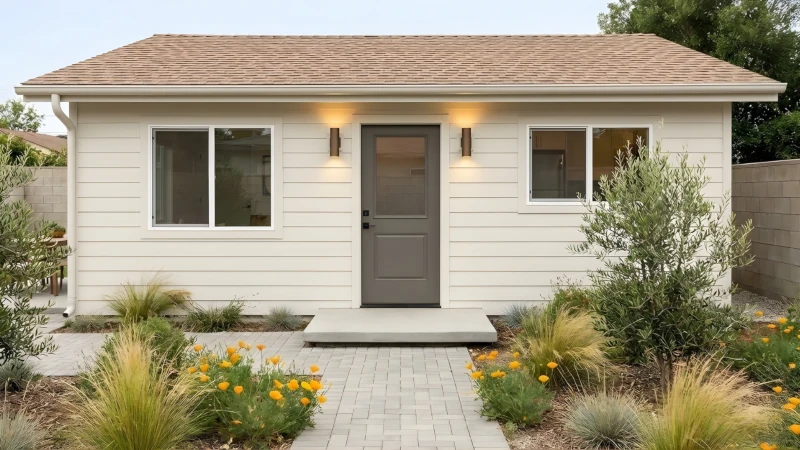
Four feet from the side and rear property lines for a new attached or detached ADU, which is the state floor in Gov. Code § 66314(d)(7). A conversion keeps its existing setbacks when it is built in the same location. New attached and detached units are located in the rear yard. The City adds building-separation standards, measured between the nearest sections of the buildings: 5 feet between a habitable and a non-habitable building, 10 feet between habitable buildings at the first floor, and 11 feet at the second.
Parking
One space per attached or detached ADU, and none at all for a junior ADU or a conversion. The requirement is waived when the ADU sits within one-half mile walking distance of public transit, and the City’s handout points to Gov. Code § 66322(a) for the rest of the exemptions:
- The ADU is within a half-mile walking distance of public transit.
- The parcel sits in an architecturally or historically significant historic district.
- The ADU is part of the proposed or existing primary residence, or an existing accessory structure.
- On-street parking permits are required, but not offered to the ADU occupant.
- A car-share vehicle is located within one block of the ADU.
Lot coverage, floor area and the design-match rule
Eight hundred square feet is the line that decides which rulebook you are under. An ADU of 800 sqft or smaller must comply with state requirements only — the City’s handout says outright that local agencies may not impose local planning requirements on it, which is Gov. Code § 66321(b)(3) and § 66323(b) restated. Above 800 sqft, both state and local requirements apply.
The main local requirement is the design criteria at MPMC § 21.08.080(J). An ADU has to be architecturally compatible with the primary building in color, materials, roof type and pitch, and scale. That is an objective standard, not a veto: review stays ministerial under Gov. Code § 66317. Our Signature Homes are drawn to sit naturally beside the San Gabriel Valley’s Spanish, ranch and mid-century housing stock either way.
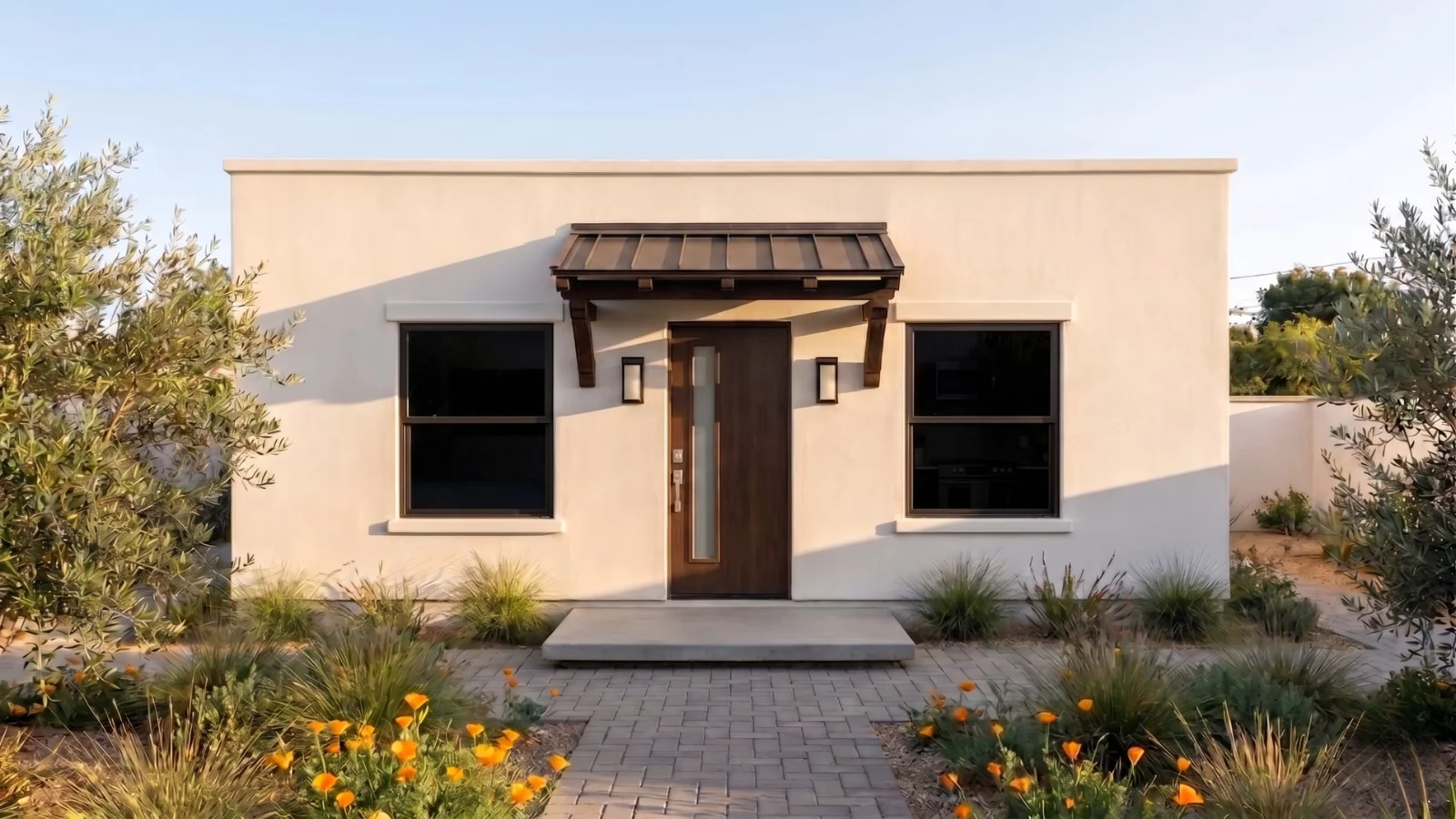
Signature Homes that fit a Monterey Park lot
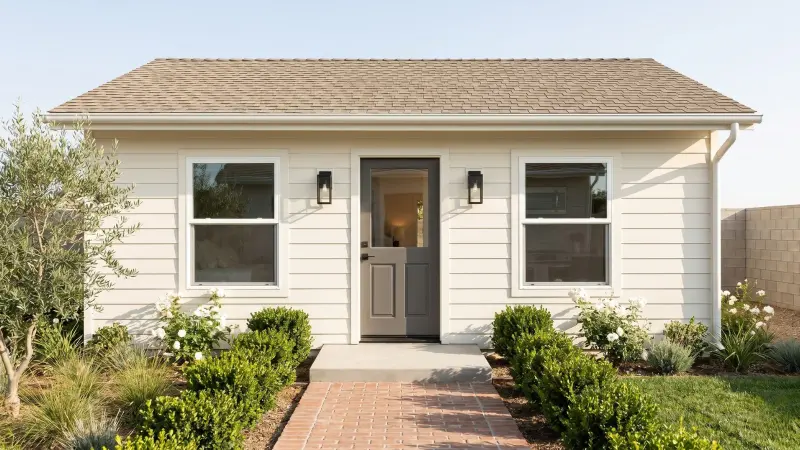
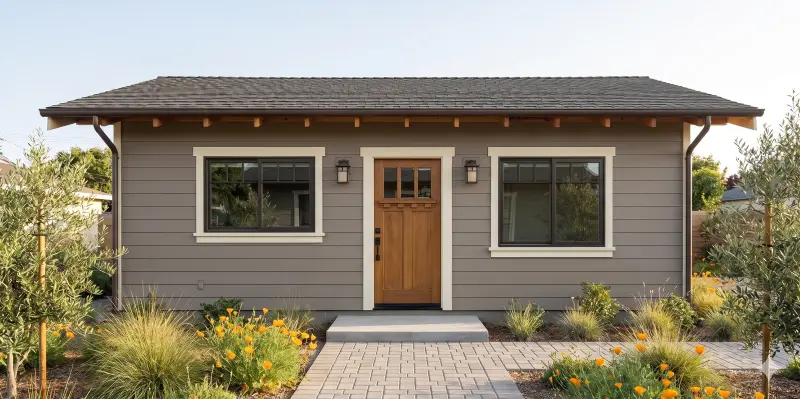
Single-story plans engineered for the detached envelope here — from a compact one-bedroom to a three-bedroom that still leaves 200 sqft under the City’s 1,200 sqft cap. Fixed plan pricing. Architect-designed.
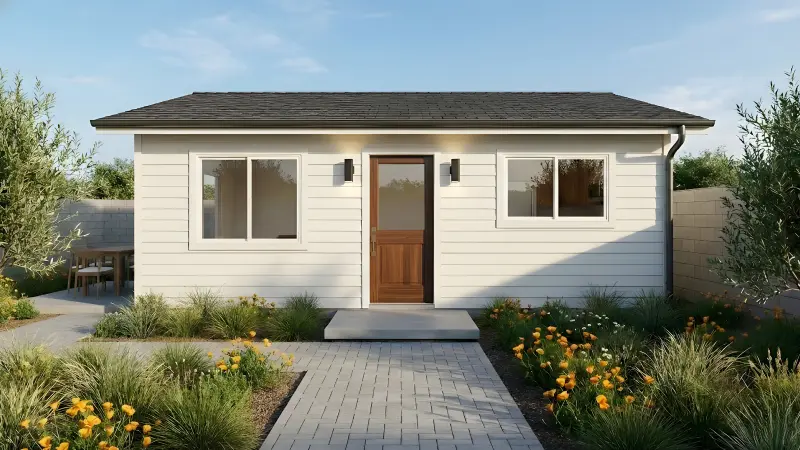
The Westwood
The Melrose
The Lincoln
Our two-story plans — Fairfax, Venice and Culver — stand roughly 22 to 25 feet and are sold as detached buildings, so they cannot be permitted in Monterey Park as drawn. The detached envelope is 16 feet, or 18 to 20 feet on a transit-proximate lot. That is a constraint on the stock plan, not on the project. A two-story plan can be redrawn to fit the local envelope, or we design a custom ADU from scratch ($9,990–$19,990 for design and permit processing, bid per project). The single-story plans permit as drawn, which is why they lead.
If your lot is inside the half-mile transit band, the redraw route is worth pricing: 18 feet plus a matched roof pitch reaches 20, which is within a couple of feet of the flat-roof two-story variant. Elsewhere in the city, at a flat 16 feet, the honest answer is a single-story plan or a custom design — and with 1,200 sqft available on one level, that is less of a compromise here than it sounds.
What an ADU costs in Monterey Park (2026)
Our Signature plans are fixed-price — architectural design and full permit processing included, the same number whether the lot is in Monterey Park, Alhambra or the Westside. Construction is separate: once your plans are permitted, you build with our construction partner or your own licensed contractor. The figures below are the estimated cost to build each model.
| Model | Configuration | Size | Collection | Est. cost to build |
|---|---|---|---|---|
| The Wilshire | Studio / 1BA | 400 sqft | Single-story | $180K–$200K |
| The Sunset | 1BR/1BA | 480 sqft | Single-story | $200K–$215K |
| The Westwood | 1BR/1BA | 550 sqft | Single-story | $215K–$235K |
| The Laurel Canyon | 2BR/1BA | 660 sqft | Single-story | $240K–$265K |
| The Melrose | 2BR/2BA | 800 sqft | Single-story | $275K–$295K |
| The Lincoln | 3BR/2BA | 1,000 sqft | Single-story | $325K–$350K |
| The Fairfax | 2BR/1.5BA | 840 sqft | Two-story — needs a taller envelope | $280K–$310K |
| The Venice | 2BR/2BA | 1,080 sqft | Two-story — needs a taller envelope | $335K–$365K |
| The Culver | 3BR/2.5BA | 1,200 sqft | Two-story — needs a taller envelope | $385K–$420K |
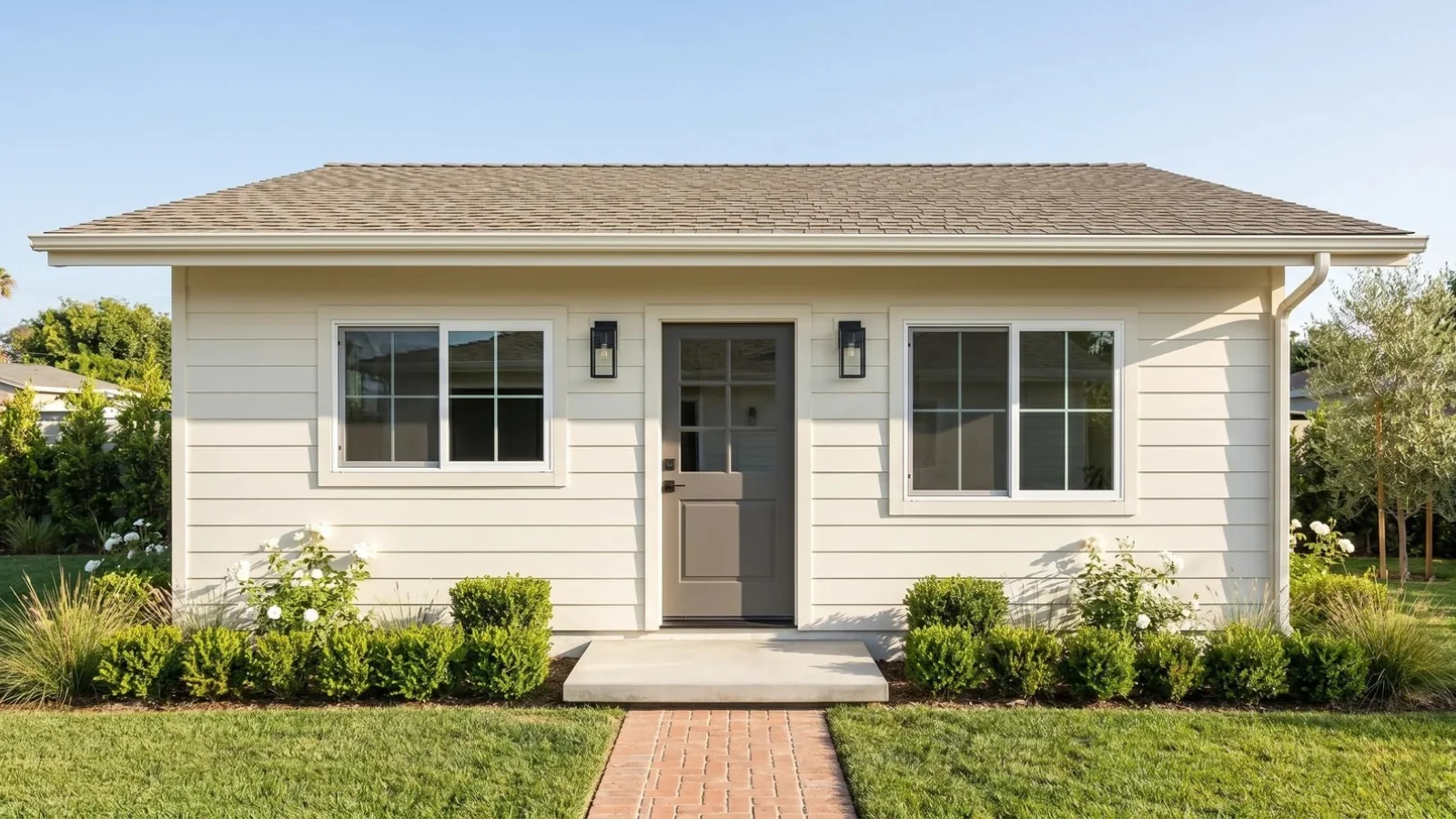
One caution on that 200 sqft of headroom, and on any figure like it. A plan’s stated size is gross floor area, measured to the outside of the walls, while the sizes state law works in — the 850 and 1,000 sqft floors a city may not cap below, and the 750 sqft fee threshold — are interior livable space, measured inside them (Gov. Code §§ 66321(b)(2), 66311.5(c)(1)). The interior figure is the smaller of the two for the same building. Headroom calculated from gross area is therefore a little optimistic against an interior-measured limit. On a 200 sqft margin it changes nothing; on a 20 sqft margin it decides the design.
City fees, and the ones you do not pay
Monterey Park charges ADU planning fees off its adopted schedule, and the numbers moved on July 1, 2026. From the Planning Fees 2026–2027 schedule:
| Fee | FY 2026–27 | What it covers |
|---|---|---|
| Accessory Dwelling Unit — administrative application | $822.95 | The planning review of the ADU itself |
| Planning plan check — residential additions / single-family homes | $416.25 | Planning’s read of the submitted drawings |
| Covenant — accessory dwelling unit | $162.47 | The covenant MPMC § 21.50.020 requires before the certificate of occupancy. County recording fee is separate |
Building permit and building plan check fees sit on top of those and are valuation-based, so they scale with the size and cost of the unit. Utility connection charges are proportional to the burden the unit places on the water or sewer system (MPMC § 21.50.040(B); Gov. Code § 66311.5(e)).
What it returns
Monterey Park sits in the Los Angeles–Long Beach–Glendale HUD Metro Fair Market Rent area. HUD’s revised FY 2026 figures, published at 91 FR 21301 and effective May 21, 2026, are the honest public benchmark:
| Unit | Studio | 1 BR | 2 BR | 3 BR |
|---|---|---|---|---|
| HUD Fair Market Rent | $2,079 | $2,328 | $2,903 | $3,681 |
Read those as a floor, not a forecast. Fair Market Rents average every kind of housing in the metro, including stock built decades ago. A newly built detached unit with its own entrance, in-unit laundry and no shared walls typically leases above the number. What Monterey Park adds is demand depth. Cal State LA and East Los Angeles College are a short hop away. Downtown Los Angeles is a straight run on the I-10 or the 60. And the San Gabriel Valley’s multigenerational housing culture keeps well-built backyard homes occupied, often by family rather than tenants at all. For payback math on your own lot, use the ROI calculator, or size the unit first with the ADU calculator.
Two rent rules worth knowing before you sign a lease. Newly constructed units first occupied after February 1, 1995 are generally outside California’s local rent-ceiling controls under the Costa-Hawkins Rental Housing Act (Civ. Code § 1954.50 et seq.). The statewide cap under AB 1482 (Civ. Code § 1947.12) may still reach an ADU depending on its structure and ownership. Confirm both for your situation.
When an ADU isn’t the right move
Not every Monterey Park property is a good candidate, and it is cheaper to learn that now than after you have paid for plans. Four situations where we would tell you to wait, pick a different unit type, or not build:
- Your numbers depend on nightly rental income. They will not work. Short-term rental of an ADU or JADU is prohibited, and MPMC § 21.50.020(A) records a covenant fixing rentals at 30 days or longer before the certificate of occupancy can issue. Run the math on a long-term or mid-term tenancy, or reconsider the project.
- You need a free-standing two-story building. The detached envelope is 16 feet, or 18 to 20 near transit. If a two-level unit is non-negotiable and your lot cannot take an attached one, this is a design problem the ordinance will not solve — and it is worth knowing before you commission drawings.
- You need to sell the unit separately. Monterey Park has not adopted an AB 1033 opt-in (Gov. Code §§ 66340–66342), so there is no condominium path for an ADU here, and the covenant at MPMC § 21.50.020(A)(2) bars separate sale of a JADU outright. As an exit strategy this is the wrong plan.
- Your rear yard is already mostly built out. New detached and attached units go in the rear yard. Subtract the 4-foot setbacks and 10 feet of separation from the house, and some parcels cannot hold a detached unit worth building. On those lots a garage conversion or a JADU usually returns more than forcing a new structure — though the 800 sqft state pathway is worth testing first.
How long an ADU takes
Here is what the calendar actually looks like on a pre-engineered Signature plan:
| Phase | Duration | Notes |
|---|---|---|
| Signature plan preparation | ~2 weeks | Pre-engineered plan customized to your lot — placement, setbacks, the building-separation dimensions the City checks, and utility routing |
| City completeness check | 15 business days | SB 543 (eff. Jan. 1, 2026); Gov. Code § 66317(a)(2). Written notice, with a list of missing items, before the 60-day clock starts |
| Ministerial approval | 60 days to a decision | Gov. Code § 66317 requires the City to approve or deny a complete application within 60 days, with no hearing, and the application is deemed approved if it misses that window. A pre-engineered plan clears review in weeks rather than months, because it is a conformance check and not a from-scratch evaluation |
| Construction | 4–6 months | By model size — under 600 sqft, four months; 600–800 sqft, five; over 800 sqft, six. The schedule is guaranteed in writing, with a daily delay penalty if the contracted finish date is missed |
| Total, start to finish | 6–9 months | Signature plans only. A custom design adds bespoke design time and a longer plan check, because the City is reading the drawings for the first time |
The rules that make Monterey Park different
A local chapter that hands the numbers to Sacramento
Most city ADU ordinances run to a dozen subdivisions of size, height, setback and parking standards. Monterey Park’s does not. MPMC Chapter 21.50, adopted by Ordinance 2261 on April 16, 2025, has four sections: definitions, certificate of occupancy, application for an address number, and fees. It was read in full on August 24, 2026 and it contains no size cap, no height limit, no setback and no parking standard.
The working numbers live in the City’s published ADU Development Standards handout instead, most recently updated June 1, 2026, and that handout is essentially California state law written out on two pages. Every figure on it meets or exceeds the floors in Gov. Code §§ 66321–66323. The practical consequence is worth understanding: in Monterey Park there is very little daylight between what the City asks for and what Sacramento guarantees, so there is very little to argue about at the counter.
What HCD said about the ordinance in December 2025
On December 5, 2025 the California Department of Housing and Community Development sent the City a Letter of Technical Assistance. Its opening finding is worth reading carefully: the most recent Monterey Park ADU ordinance on file with HCD is from 2020. Ordinance 2261 was adopted in April 2025. HCD asked the City to send in the current ordinance if the department’s records were wrong. The rest of the letter lists every change in state ADU law that a 2020 ordinance would not reflect.
The City’s pre-approved ADU plan program
Every California city has had to run a pre-approval program for ADU plans since January 1, 2025 (AB 1332, Gov. Code § 65852.27). Monterey Park’s is further along than most. Its Designer-Owned Pre-Approved ADU Program lists six approved plan sets available for purchase as of June 2026 — two at 800 sqft (2 bed / 2 bath), two at 1,000 sqft (3 bed / 2 bath) and two at 1,200 sqft (3 bed / 2 bath). The City describes the sets as roughly 70% complete for permitting, and is reviewing further submissions from designers.
Read that program for what it tells you: the City’s own Planning Division treats pre-engineered, repeatable plans as the fast lane. A plan the reviewer has seen before is a conformance check, not a from-scratch evaluation. That is the entire logic of pre-approval, and it is the same logic behind our Signature Homes.
The covenant, the address, and the certificate of occupancy
Three administrative requirements sit in Chapter 21.50, and they catch people out because they are not dimensional standards.
- Occupancy order. The Building Official will not issue a final certificate of occupancy for an ADU or JADU before the primary dwelling has one (MPMC § 21.50.020(A)).
- The recorded covenant. Before any certificate issues, the owner records a covenant running with the land, in a form the City Attorney approves. It fixes ADU rentals at 30 days or longer, and bars separate sale of a JADU (§ 21.50.020(A)(1)–(2), (B)).
- The address number. Any ADU or JADU with its own entrance or its own utility connection applies for an address number, posted where it is visible from the street (§ 21.50.030).
Short-term rental is prohibited
The City’s June 2026 ADU Development Standards state it in one line: short-term rental of an ADU or JADU is prohibited, and Planning requires the covenant as part of planning clearance. The 30-day floor in the recorded covenant is the operative mechanism.
State law lands in the same place from a different direction. Gov. Code § 66323(e) requires a city to impose a rental term longer than 30 days on a statewide-exemption ADU, and § 66333(g) does the same for junior ADUs. The compliant income model here is a 30-day-or-longer lease: a standard residential tenancy, or a furnished mid-term rental for corporate, traveling-medical or academic tenants, which often prices above an unfurnished twelve-month lease.
Separate sale is not available here
AB 1033, codified at Gov. Code §§ 66340–66342, lets a city opt in to allowing an ADU to be sold separately as a condominium. Monterey Park has not adopted that opt-in — Chapter 21.50 was read in full and contains no such provision — so the path does not exist in this city. A junior ADU is barred outright regardless: the recorded covenant at MPMC § 21.50.020(A)(2) states that the JADU may not be sold separately.
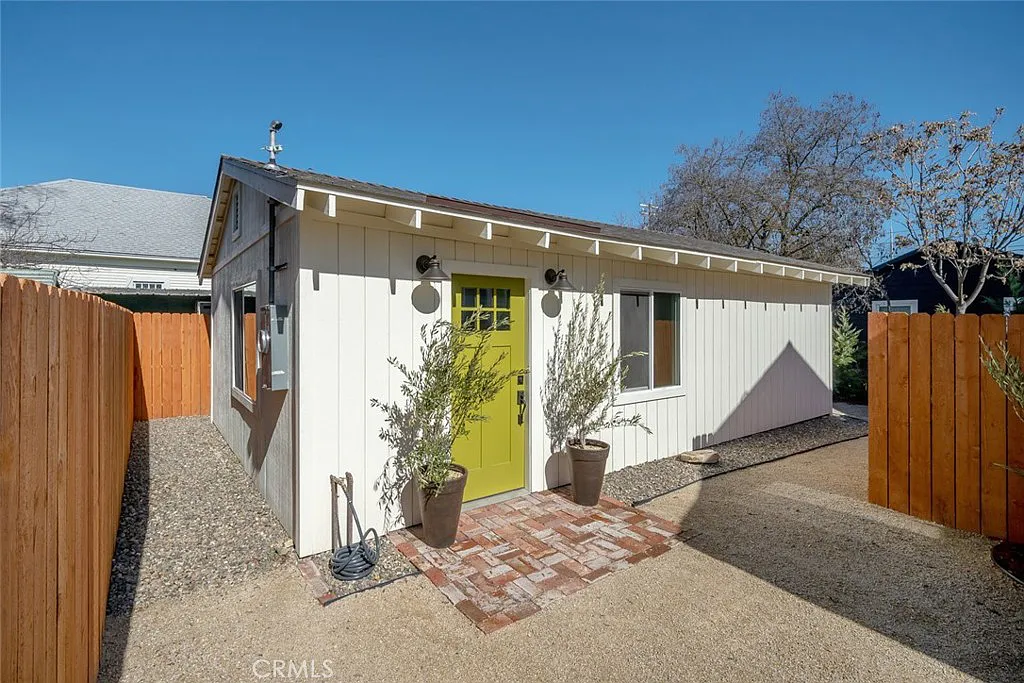
Recent CALI ADU work near Monterey Park
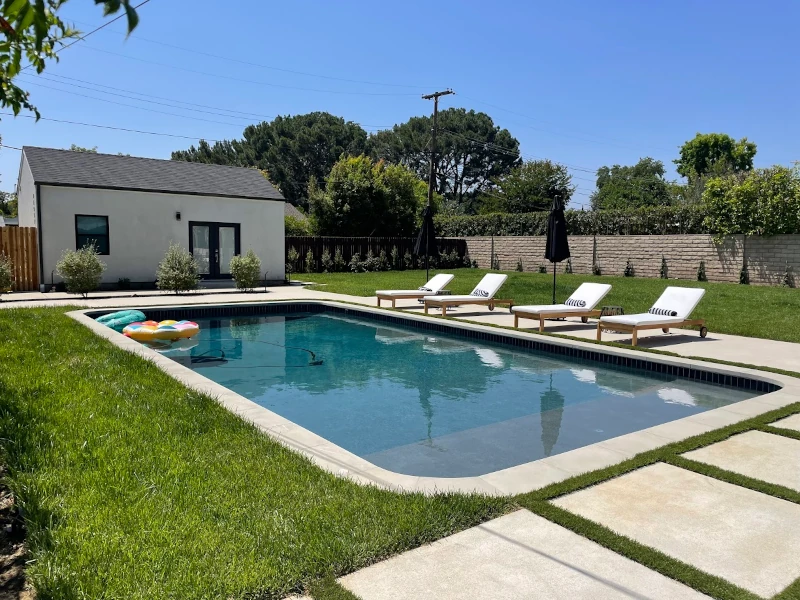
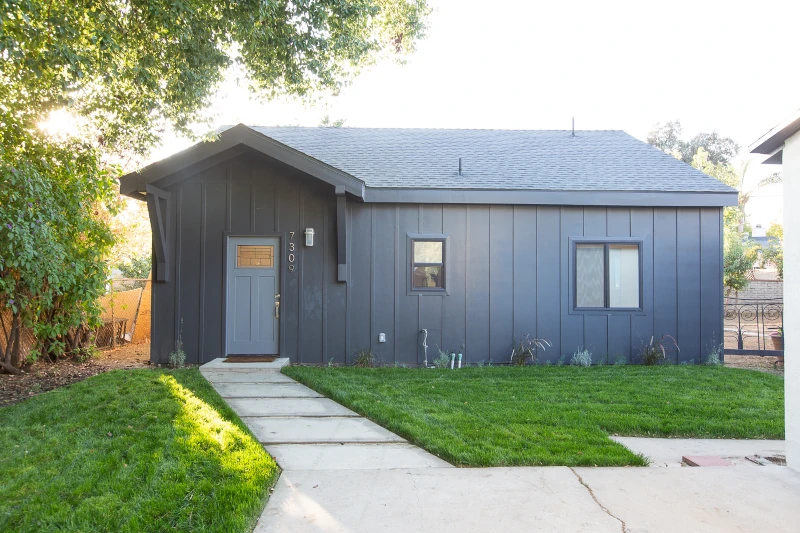
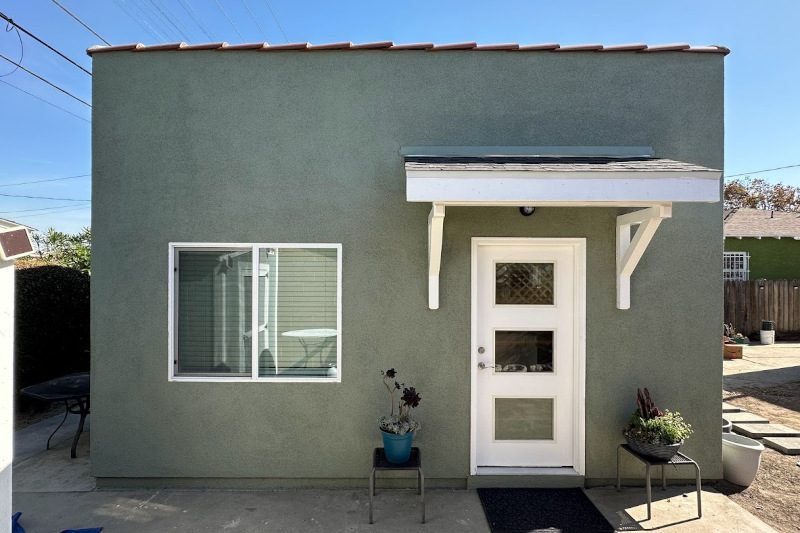
Single-story detached builds and garage conversions across the San Gabriel Valley and greater Los Angeles — the project types Monterey Park's 16-foot detached envelope calls for.
How the permit process works
The City’s published sequence is planning approval, then plan check, then building permit — the same three steps for every ADU type, including a conversion. Planning approval is where the objective standards are checked and where the covenant is prepared; plan check is where the drawings are read; the building permit is what you build against.
Ministerial means the City has no discretion in either direction. It cannot deny a compliant application because a neighbor objects. It cannot approve a non-compliant one because the design is attractive. There is no public hearing and no discretionary design review (Gov. Code § 66317). What the City can do is issue corrections, and correction cycles are where most schedules slip.
The pre-approved plan track (AB 1332)
Monterey Park’s Designer-Owned Pre-Approved ADU Program is a real alternative worth knowing about. Six plan sets are approved and available for purchase, roughly 70% complete for permitting. The trade-off is the same everywhere a city runs one: you hire the program’s designer to finalize and adapt the set, the layouts are fixed, and design, permitting and construction remain separate contracts you coordinate yourself.
Monterey Park ADU questions, answered
The questions Monterey Park homeowners actually ask before they start — each answered against MPMC Ch. 21.50, the City’s own ADU handouts, and California Gov. Code §§ 66310–66342.
How big an ADU can I build in Monterey Park?
A detached ADU may be up to 1,200 square feet, which is generous by San Gabriel Valley standards. An attached ADU may be up to 50% of the primary dwelling’s floor area or 800 square feet, whichever is greater. A junior ADU is capped at 500 square feet inside the home (Gov. Code § 66313(d)). Those figures come from the City of Monterey Park ADU Development Standards handout, updated June 1, 2026 — MPMC Chapter 21.50 itself sets no size limits. Separately, state law guarantees at least an 800-square-foot ADU at 16 feet with four-foot side and rear setbacks regardless of local lot-coverage, floor-area or open-space rules (Gov. Code § 66321(b)(3)), and a conversion ADU built inside existing permitted space has no square-foot cap at all (Gov. Code § 66323(a)(1)).
How tall can a detached ADU be in Monterey Park?
Sixteen feet on a standard lot. That is exactly the floor state law sets in Gov. Code § 66321(b)(4)(A), and Monterey Park adopts it as written rather than going above it. Two situations raise it to 18 feet: a lot within a half-mile walking distance of a major transit stop or a high-quality transit corridor, and a lot with an existing or proposed multifamily, multistory dwelling. In the transit case you may add two more feet to accommodate a roof pitch aligned with the primary dwelling where the pitch has to match, so the practical ceiling there is 20 feet. An attached ADU is a different rule and may reach 25 feet (Gov. Code § 66321(b)(4)(D)). Source: City of Monterey Park ADU Development Standards, June 2026.
Can I build a two-story ADU in Monterey Park?
Not as a free-standing building on a typical lot. The City caps a detached ADU at 16 feet, or 18 feet near transit or on a multistory multifamily lot, plus 2 feet for a matched roof pitch in the transit case (ADU Development Standards, June 2026; Gov. Code § 66321(b)(4)). None of those envelopes holds a two-story detached unit. An attached ADU may reach 25 feet as part of the primary structure (§ 66321(b)(4)(D)), so a two-story unit is possible when it is built into the house rather than standing on its own. Our two-story Signature Homes stand roughly 22 to 25 feet and are sold as detached buildings, so they cannot be permitted in Monterey Park as drawn. That is a limit on the stock plan, not on the project: a two-story plan can be redrawn to the local envelope — worth pricing on a transit-proximate lot at 18 to 20 feet — or we design a custom ADU from scratch. All six single-story Signature Homes clear 16 feet as drawn.
How many ADUs can I build on a Monterey Park single-family lot?
More than the City’s handout shows. The Number of Permitted ADUs handout, updated June 1, 2026, reads "1 ADU & 1 JADU" for an R-1 lot with one single-family dwelling. State law is broader: Gov. Code § 66323(a)(1)–(2) requires a local agency to allow a conversion ADU created from existing space, a junior ADU of up to 500 square feet inside the home, and a newly built detached ADU of up to 800 square feet — up to two ADUs plus a JADU, in combination. Where a local summary reads narrower than the statute, Gov. Code § 66316 makes the state standard control. Gov. Code § 66323(b) goes further and bars the City from imposing objective development standards on those units that the statute does not authorize.
Do I need parking for an ADU in Monterey Park?
Often not. The City asks for one space per attached or detached ADU and none for a junior ADU or a conversion (ADU Development Standards, June 2026). The requirement is waived when the ADU sits within one-half mile walking distance of public transit, and the other exemptions in Gov. Code § 66322(a) apply as well — a parcel in a historic district, an on-street permit area where the occupant is not offered a permit, or a car-share vehicle within one block. Monterey Park is a dense bus-served grid along Garvey, Atlantic and Garfield, so the transit exemption reaches a great deal of the city. Two rules never change: no city may require parking for a JADU at all (Gov. Code § 66334(a)), and when a garage, carport, covered structure or uncovered space is demolished in conjunction with an ADU, those spaces do not have to be replaced (Gov. Code § 66314(d)(11)).
Does Monterey Park require the owner to live on the property?
Not for an ADU. Gov. Code § 66315 bars every California city from requiring owner-occupancy for an accessory dwelling unit, and the City’s June 2026 ADU Development Standards state plainly that it is not required. A junior ADU is the exception, and since January 1, 2026 a narrow one. AB 1154 amended Gov. Code § 66333(b) so JADU owner-occupancy now applies only where the JADU shares sanitation facilities — a bathroom — with the main house. The City’s June 2026 handout already reflects that narrowing, which is rare among LA County cities. Worth knowing: the codified covenant at MPMC § 21.50.020(A)(2) still carries the older, unqualified wording requiring the owner to occupy either the single-family residence or the JADU, with an exception where the owner is a government agency, land trust or housing organization. Where the two disagree, the statute controls.
Can I rent a Monterey Park ADU on Airbnb?
No. The City’s June 2026 ADU Development Standards state that short-term rental of an ADU or JADU is prohibited, and MPMC § 21.50.020(A) requires a recorded covenant — approved as to form by the City Attorney and recorded before the final certificate of occupancy — stating that any rental of the ADU must be for a term of 30 days or longer, and that a JADU cannot be rented for any period less than 30 days. State law points the same way: Gov. Code § 66323(e) requires a city to impose a rental term longer than 30 days on a statewide-exemption ADU, and § 66333(g) does the same for junior ADUs. The compliant income model is a 30-day-or-longer tenancy — a standard residential lease, or a furnished mid-term rental for corporate, traveling-medical or academic tenants.
What does the City of Monterey Park charge in planning fees for an ADU?
Per the City’s Planning Fees 2026–2027 schedule, effective July 1, 2026: the Accessory Dwelling Unit administrative application is $822.95, the planning plan check fee for residential additions and single-family homes is $416.25, and the ADU covenant that MPMC § 21.50.020 requires carries its own $162.47 planning fee, with the County recording fee separate. Building permit and building plan check fees sit on top of those and are valuation-based, so they scale with the size and cost of the unit. Impact fees are a separate category and are exempt under 750 square feet — see the next question.
Do I have to pay impact fees on a Monterey Park ADU?
Not under 750 square feet. Gov. Code § 66311.5(c)(1) prohibits any local agency, special district or water corporation from imposing an impact fee on an ADU of 750 square feet or less of interior livable space, or on a JADU of 500 square feet or less. Above 750 square feet, impact fees must be charged proportionally in relation to the square footage of the primary dwelling unit rather than as a flat per-unit charge — which is exactly what MPMC § 21.50.040(A) says the City does. Six of our nine Signature Homes sit under 750 square feet. Separately, an ADU or JADU under 500 square feet does not increase assessable space for school-fee purposes (§ 66311.5(c)(3)).
Does my ADU have to match the main house in Monterey Park?
It depends on size, and 800 square feet is the dividing line. The City’s June 2026 ADU Development Standards apply the design criteria at MPMC § 21.08.080(J) to ADUs — architecturally compatible with the primary building in color, materials, roof type and pitch, and scale. But the same handout states that an ADU of 800 square feet or smaller must comply with state requirements only, and that local agencies may not impose local planning requirements on it. That tracks Gov. Code § 66321(b)(3) and § 66323(b). So at 800 square feet or under the design-match criteria do not reach your project; above it they do. Either way the review stays ministerial — this is an objective standard, not a design-review veto (Gov. Code § 66317).
How long does a Monterey Park ADU permit take?
The City must approve or deny a complete ADU or JADU application within 60 days, ministerially, with no public hearing and no discretionary design review (Gov. Code § 66317). If it misses that window the application is deemed approved. Before the clock starts, SB 543 requires a written completeness determination within 15 business days of receiving the application, with a list of what is missing if it is incomplete (Gov. Code § 66317(a)(2)). On a pre-engineered Signature plan, expect roughly six to nine months from start to move-in: about two weeks of plan preparation, the review above, then four to six months of construction. A custom design is slower, because the City is reading the drawings for the first time.
Can a Monterey Park ADU be sold separately from the main house?
No. Separate conveyance of an ADU as a condominium is available only where a city has opted in under AB 1033, codified at Gov. Code §§ 66340–66342. MPMC Chapter 21.50 was read in full on August 24, 2026 and contains no such opt-in — the chapter has four sections and none of them addresses separate sale. A junior ADU is barred outright: the covenant required by MPMC § 21.50.020(A)(2) states that the JADU may not be sold separately. If separate sale is central to your plan, Santa Monica and Culver City are the LA-area cities that have adopted the opt-in.
How many ADUs are allowed on a Monterey Park multifamily property?
Considerably more than most owners expect, and the City’s own June 2026 handout says so. On a lot with an existing multifamily dwelling you may build up to eight detached ADUs, capped at the number of existing dwelling units on the lot — the floor SB 1211 set in Gov. Code § 66323(a)(4)(A)(ii). On a lot with a proposed multifamily dwelling the number is up to two detached ADUs. Separately, ADUs converted from interior non-livable space — storage rooms, boiler rooms, passageways, attics, basements, garages — run from at least one up to 25% of the existing unit count (Gov. Code § 66323(a)(3)). Junior ADUs are a single-family unit type and are not available on a multifamily lot.
Do I need a separate utility connection for a Monterey Park ADU?
For a newly built unit, usually yes. MPMC § 21.50.040(B) requires each ADU to install a separate utility connection directly between the unit and the utility, "except as provided by California law," subject to a connection fee or capacity charge proportionate to the burden the unit places on the water or sewer system. The California-law carve-out matters: Gov. Code § 66311.5(d) bars a local agency from requiring a new or separate connection for a conversion ADU or JADU created inside existing space under § 66323(a)(1), unless it is built alongside a new single-family dwelling. Gov. Code § 66311.5(e) is what allows the requirement for everything else. Separate metering and billing is a different question, and that one is your choice — the City’s June 2026 handout describes it as something you request by permitting and installing a separate electrical panel, gas meter and water meter.
Official sources
Where a local rule and state law differ, state law sets a floor the City cannot drop below (Gov. Code § 66316). Monterey Park sits at that floor on nearly everything, above it on detached size, and below it on one point — the units-per-lot count in the handout, which is why that preemption is called out twice on this page.
| Source | What it governs |
|---|---|
| MPMC Chapter 21.50 — Accessory Dwelling Units (opens in a new tab) eCode360, the City’s official code publisher · Ord. 2261, adopted 4/16/2025 · prior history Ord. 2192 § 6, 2020 | The binding local chapter, and a short one: definitions, certificate-of-occupancy sequencing, the recorded covenant, address numbers and fees. No dimensional standards. |
| ADU Development Standards — June 2026 (opens in a new tab) City of Monterey Park, Community and Economic Development (PDF, updated 06/01/2026) | The City’s working numbers: size caps, detached and attached heights, setbacks, building separation, parking and its waivers, design criteria, the 800 sqft exemption line, owner-occupancy and the short-term-rental prohibition. |
| Number of Permitted ADUs — June 2026 (opens in a new tab) City of Monterey Park, Community and Economic Development (PDF, updated 6/1/2026) | How many units the City counts by zone and primary-dwelling type. The single-family row reads narrower than Gov. Code § 66323(a)(1)–(2). |
| City of Monterey Park — Accessory Dwelling Units (opens in a new tab) montereypark.ca.gov program page · Planning Division | The City’s ADU landing page: current handouts, the ADU/JADU application, and the staff contacts to confirm anything on this page directly. |
| Pre-Approved ADU Plans (opens in a new tab) City of Monterey Park · Designer-Owned Pre-Approved ADU Program (AB 1332) | The six approved plan sets, their sizes and configurations, and the designer contact details for buying one. |
| Planning Fees 2026–2027 (opens in a new tab) City of Monterey Park, adopted fee schedule (PDF) · effective July 1, 2026 | The ADU administrative application fee, the planning plan-check fee, and the ADU covenant fee quoted in the costs section above. |
| California Government Code §§ 66310–66342 (opens in a new tab) California Legislative Information · renumbered from former § 65852.2 et seq. by SB 477, eff. March 25, 2024 | State ADU law — the floor every city must meet, and in Monterey Park very nearly the whole rulebook. Source for the 60-day clock, the owner-occupancy and parking preemptions, the 800 sqft entitlement, the unit stack and the impact-fee exemption. |
| HCD Letter of Technical Assistance — December 5, 2025 (opens in a new tab) California Department of Housing and Community Development (PDF) | HCD’s letter to the City recording that the most recent ADU ordinance on file with the department is from 2020, and listing the state-law changes an older ordinance may not reflect. |
| HCD ADU Handbook (opens in a new tab) California Department of Housing and Community Development | The state’s official interpretation of that law, and the position that controls when a local rule reads more narrowly than the statute. |
Rent benchmarks are HUD Fair Market Rents for the Los Angeles–Long Beach–Glendale HUD Metro FMR Area, FY 2026 as revised, published at 91 FR 21301 and effective May 21, 2026.
Last verified against primary sources on August 24, 2026 — the municipal code chapter, both City handouts, the adopted fee schedule and the HCD letter were each read that day. State ADU law changes every January 1. If you are reading this six months from now, confirm the current version before you commit to a design — or call us and we will confirm it for you.
Not sure what your lot
can actually support?
Get clarity before you spend anything on plans. In 15 minutes we will pull up your property, run the City’s June 2026 ADU standards and Gov. Code §§ 66310–66342 against your parcel, and give you an honest read on your options and a realistic budget — including whether an ADU is the right move at all.
15-minute video call · No obligation