
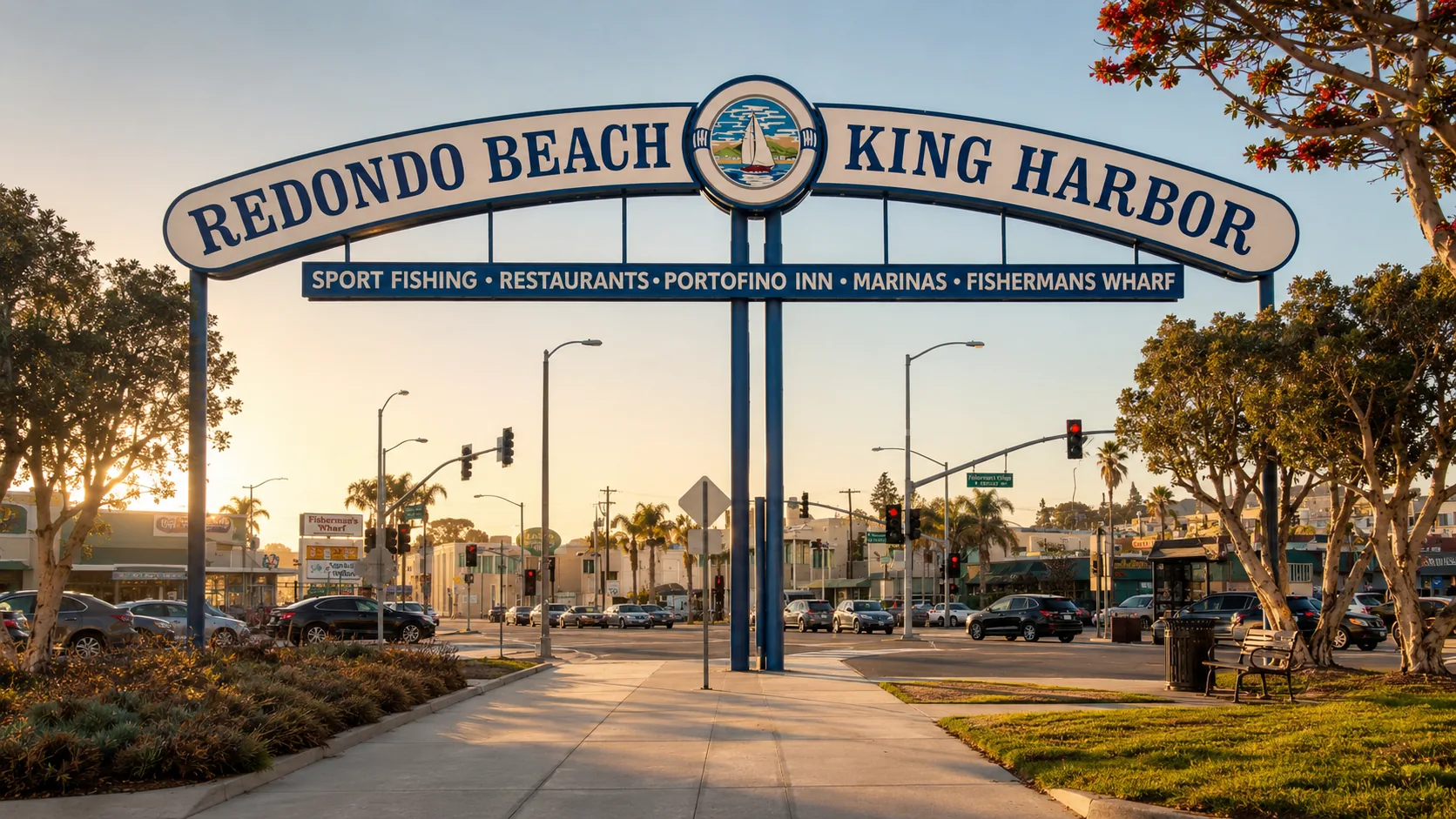
Building an ADU in Redondo Beach. Rules, costs, timeline.
What RBMC § 10-2.1506 actually allows, why the owner-occupancy rule the City still publishes is preempted by state law, and what an all-in build costs on a Redondo Beach lot in 2026.
What you can build — at a glance
Reviewed by CALI ADU’s ADU specialists · August 2026
- Max ADU size
- 850 sqft studio/1BR · 1,000 sqft 2BR+ A new detached unit of 800 sqft is guaranteed whatever else the standards say. A junior ADU is capped at 500 sqft.
- Detached height
- 16 ft · 18 ft near transit Plus 18 ft on a multistory multifamily lot, and 2 ft more to match the roof pitch of the house. About 20 ft at the very top — a single-story envelope.
- Attached height
- 25 ft · up to 2 stories Or the zone height limit for the primary dwelling, whichever is lower.
- Side & rear setbacks
- 4 ft None for a conversion or a same-footprint rebuild. Detached units also need 5 ft of separation from other structures.
- Units per SFR lot
- Up to 3 A conversion ADU, a junior ADU and a new detached ADU of 800 sqft or less. The local text reads narrower; state law governs.
- Parking required
- None on most lots One space is the default, but any one of five exemptions removes it. A parking overlay applies west of Catalina Avenue.
- Permit timeline
- 60 days · ministerial, no hearing Plus 15 business days for the written completeness notice. Deemed approved if the City misses the 60 days.
- Coastal Zone permit
- Concurrent 60-day clock Since October 2025 a coastal permit for an ADU runs alongside the building permit, not after it, and no hearing is required. Some infill lots are excluded from it entirely.
- Detached Up to 1,000 sqft · single-story envelope, 16–18 ft
- Attached Up to 1,000 sqft · 25 ft over two stories
- Garage conversion Within the existing footprint · no setback, no replacement parking
- Interior conversion Carved out of existing dwelling space · +150 sqft for ingress and egress
- Junior ADU Up to 500 sqft inside the primary dwelling
Per RBMC § 10-2.1506 (Ord. 3264 c.s., eff. 8 December 2023), the coastal parallel at RBMC § 10-5.1506, and Gov. Code §§ 66310–66342. Both ADU sections re-read at the City’s code publisher on 24 August 2026. Units-per-lot reflects the state-law stack confirmed by the HCD ADU Handbook. Full citations in the sections below.
On this page
Can I build an ADU in Redondo Beach?
Five things to know before you start
If you read nothing else on this page, read these. They are the five points that change the most Redondo Beach projects.
| What to know | Why it matters for your project |
|---|---|
| 1. You do not have to live here | RBMC § 10-2.1506(a)(10) says the owner must occupy the house or the ADU for units permitted after 1 January 2025, and the City’s own ADU page still says so. Gov. Code § 66315 bars that requirement outright. The local sentence is preempted. |
| 2. Your lot probably allows three units, not two | The local streamlined track reads as one ADU plus one junior ADU. Gov. Code § 66323(a)(1)–(2) requires a conversion ADU, a junior ADU and a new detached ADU of up to 800 sqft to be allowed together. Most homeowners assume the limit is one. |
| 3. Detached means single story | Sixteen feet is the base, 18 feet near a major transit stop, plus 2 feet to match the roof pitch of the house. That is a one-story envelope. An attached unit is the only route to 25 feet here. |
| 4. The coastal rulebook is older than the zoning one | RBMC § 10-5.1506 was last amended in October 2022 and predates SB 1211, AB 1154 and AB 462. Its flat 16-foot cap and one-story rule are below the state floor at Gov. Code § 66321(b)(4). On a coastal lot, know the statute before you go in. |
| 5. Short-term rental is off the table | An ADU here cannot be rented for less than 30 days. State law sets the same floor for § 66323 units and junior ADUs. If nightly income is the business case, it will not work. |
How many units a lot allows
Read on its own, RBMC § 10-2.1506 looks like a two-unit ceiling. The streamlined track at subsection (b)(4) covers one ADU plus one junior ADU on a single-family lot, and the standard track at subsection (c) is limited to one ADU per lot. State law is wider than both.
- An ADU carved out of existing space. Inside the house or an accessory building, with up to 150 extra square feet for ingress and egress, and no separate square-foot cap.
- A junior ADU. Up to 500 square feet, entirely within the single-family home (Gov. Code § 66313(d)).
- A new detached ADU. Up to 800 square feet, with 4-foot side and rear setbacks and 16 feet of height or more where Gov. Code § 66321 allows it.
Multifamily lots
RBMC § 10-2.1506(b)(5) allows conversion of non-livable space — storage, boiler rooms, passageways, attics, basements, garages — into ADUs equal to 25 percent of the existing units, with a minimum of one. It then allows two detached ADUs per lot. That last figure is where state law goes further: Gov. Code § 66323(a)(4)(A)(ii), as raised by SB 1211 effective 1 January 2025, requires up to eight detached ADUs on a lot with an existing multifamily building, capped at the number of existing units. A proposed multifamily building gets up to two. Junior ADUs are a single-family product only.
Owner-occupancy
This is the single most consequential thing on the page, so it is worth stating flatly. RBMC § 10-2.1506(a)(10) provides that for any ADU permitted after 1 January 2025 in a single-family residential zone, the primary unit or an ADU shall be occupied by the owner. The coastal parallel goes further and asks for a recorded covenant before the building permit issues. The City’s own ADU resource page still lists the requirement.
Gov. Code § 66315 does not allow it. A local agency may not require an owner to occupy the property as a condition of an ADU; the only occupancy term a city may impose is a rental term longer than 30 days. The local sentence tracks an allowance in the former Gov. Code § 65852.2(a)(6) that did not carry over when SB 477 renumbered ADU law in 2024. Junior ADUs are the exception, and a narrow one: under Gov. Code § 66333(b), as amended by AB 1154 effective 1 January 2026, owner-occupancy reaches a junior ADU only where it shares sanitation facilities with the house.
What you can build
Which ADU type fits your property?
Five configurations are available here. The right one usually falls out of what is already on your lot.
| If this sounds like you | Start with | What that means |
|---|---|---|
| You have open backyard and want the most rentable unit | Detached, new construction | Up to 1,000 sqft with two or more bedrooms, 4-ft side and rear setbacks, 5 ft of separation from the house. One story, 16 to 18 feet. |
| Your lot is tight and you want a second story | Attached ADU | The only route to 25 feet in Redondo Beach, over no more than two stories, and capped at the zone height limit for the house. |
| You have a garage you do not use | Garage conversion | No setback required, no replacement parking ever, and the unit stays inside the existing footprint. |
| You have spare rooms and a modest budget | Junior ADU | Up to 500 sqft inside the house. Cheapest route in. Give it its own bathroom and owner-occupancy no longer reaches it. |
| Your lot has an apartment building on it | Multifamily conversion or detached | Non-livable space equal to 25% of the existing units, plus detached units up to the state ceiling of eight on an existing building. |
Size limits
RBMC § 10-2.1506(c)(5) caps a studio or one-bedroom ADU at 850 square feet and a unit with two or more bedrooms at 1,000. A junior ADU is 500 square feet, inside the house. The streamlined detached track covers a new detached unit of up to 800 square feet, and the ordinance states that its own standards may not cut the allowance below 800 square feet.
State law sets the same hard minimum from the other direction. Gov. Code § 66321(b)(3) provides that no local floor area ratio, lot coverage, open space or setback rule may prevent an 800-square-foot ADU at 16 feet with 4-foot side and rear setbacks. On the narrow lots common in west and south Redondo Beach, that is the provision that does the work.
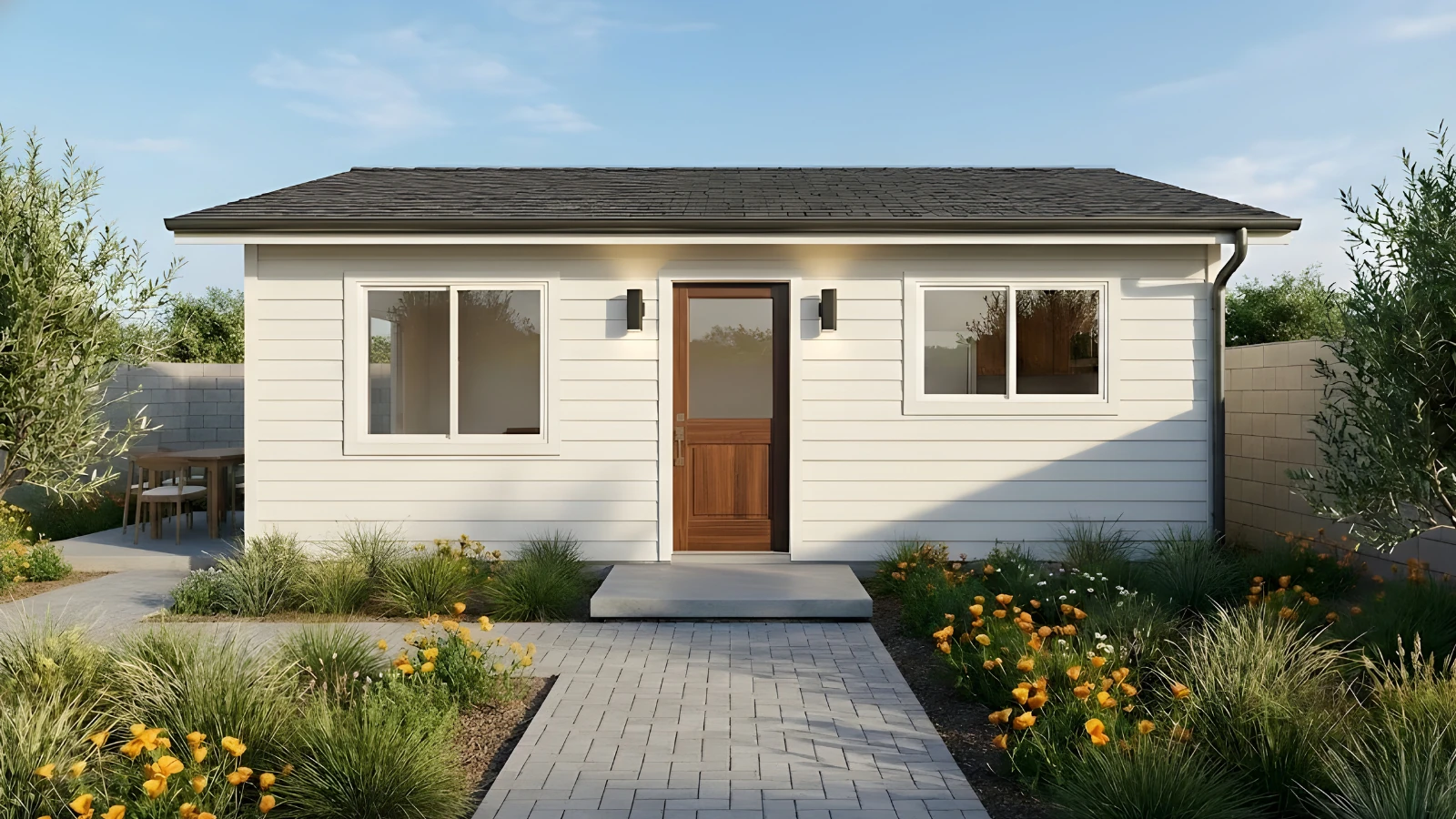
Maximum height, and the two-story question
A detached ADU is capped at 16 feet. Three increases sit on top of that under RBMC § 10-2.1506 and Gov. Code § 66321(b)(4): 18 feet within half a mile walking distance of a major transit stop or high-quality transit corridor, 18 feet for a detached unit on a lot with a multistory multifamily building, and 2 additional feet where they are needed to match the roof pitch of the house.
Add them up and roughly 20 feet is the ceiling. That is a single-story envelope. An attached ADU is the exception: it may reach 25 feet, or the zone’s height limit for the primary dwelling if that is lower, over no more than two stories (RBMC § 10-2.1506(c)(4)(d)(5); Gov. Code § 66321(b)(4)(D)).
Setbacks and separation
Side and rear setbacks are 4 feet, which is the maximum a city may require for a conforming ADU (RBMC § 10-2.1506(c)(4)(a); Gov. Code § 66314(d)(7)). No setback applies to a unit built inside an existing structure or rebuilt in the same location and dimensions. The local rule people miss is separation: RBMC § 10-2.1506(b)(3)(f) requires at least 5 feet between structures for fire and life safety, so a detached unit pushed hard against the house fails even when the lot-line setbacks are met.
Parking
One space per ADU is the default under RBMC § 10-2.1506(c)(8)(a). In practice most projects never add one, because any single exemption in Gov. Code § 66322 removes the requirement.
- Within half a mile walking distance of public transit;
- Inside an architecturally or historically significant historic district;
- Part of the proposed or existing primary dwelling, or of an accessory structure;
- Where on-street parking permits are required but not offered to the occupant; or
- Within one block of an established car-share vehicle.
Replacement parking is a separate guarantee: it can never be required when a garage or covered space is converted or demolished for an ADU (RBMC § 10-2.1506(c)(8)(c); Gov. Code § 66314(d)(11)). A junior ADU needs no parking under any circumstances (Gov. Code § 66334(a)). The one place to look twice is the coastal ADU Parking Overlay west of Catalina Avenue, where the code expects a space unless a state exemption applies.
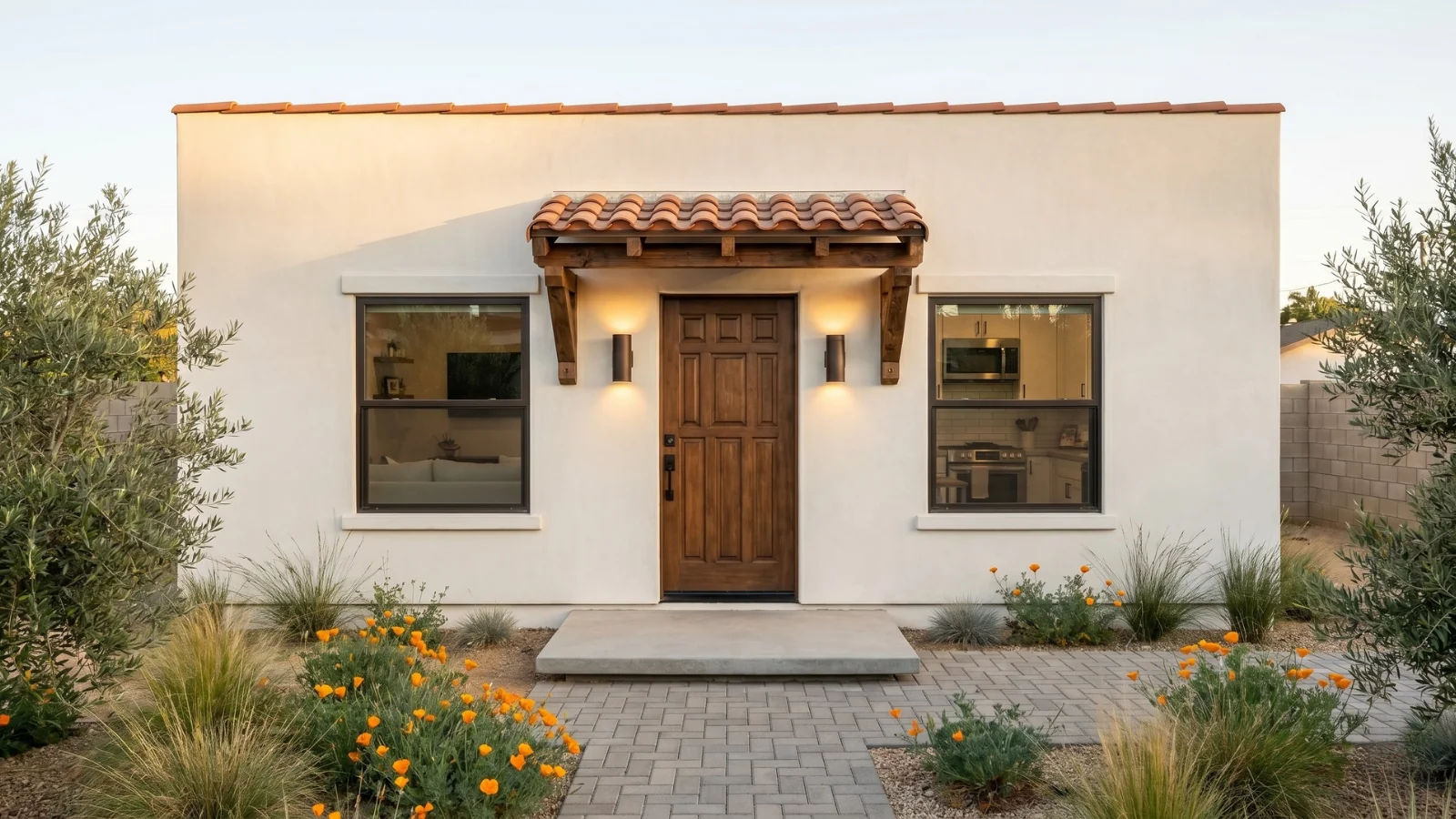
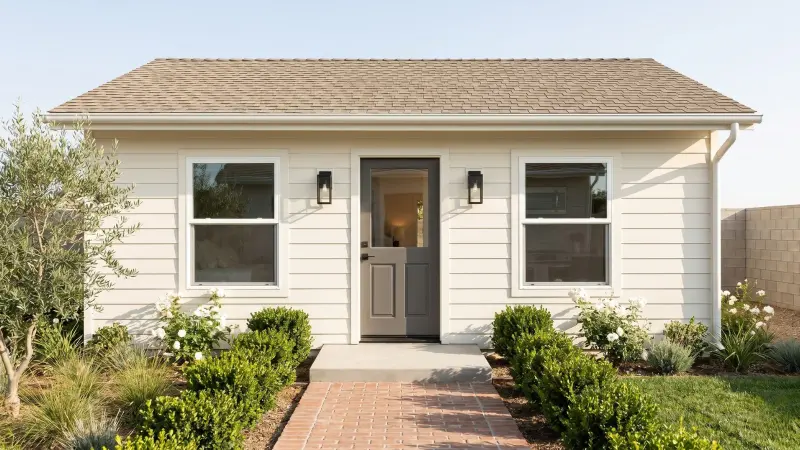
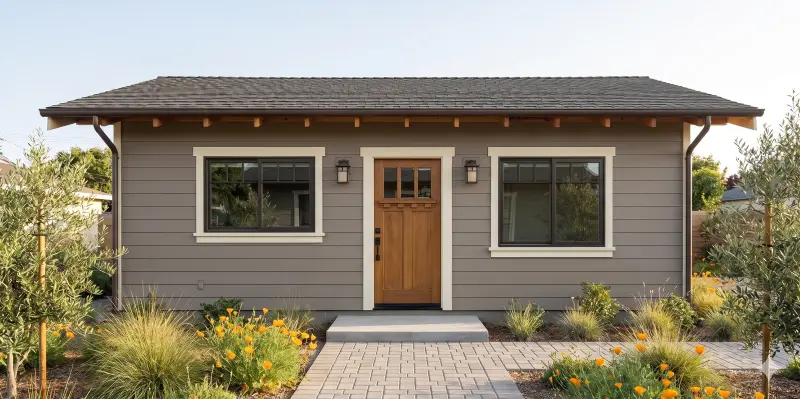
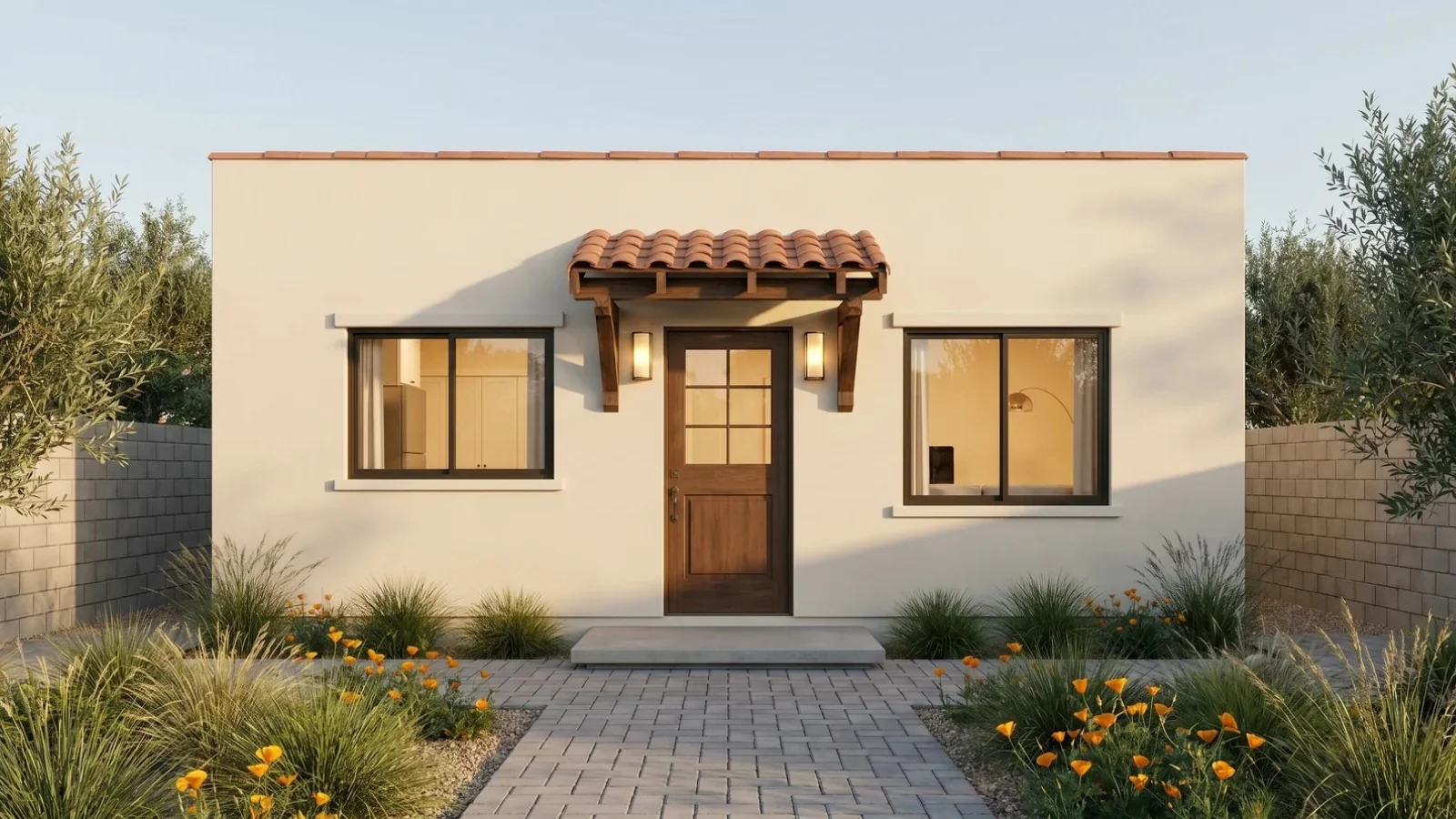
Signature Homes that permit here
Three picks for a city with a single-story detached envelope and a 1,000-square-foot ceiling.
The Westwood
The Melrose
The Lincoln
A note on what is not shown. Our two-story plans — the Fairfax, the Venice and the Culver — stand roughly 25 feet and are sold as detached units, so they cannot be permitted in Redondo Beach as drawn. The reason is the height rule above: a detached ADU tops out around 20 feet once every state allowance is counted, and the 25-foot envelope in the code belongs to attached units, which is not how these three are sold. Neither is a dead end. A two-story plan can be modified to fit a lower envelope, or we design a custom ADU from scratch at $9,990–$19,990 for design and permitting, bid per project. The cards above are the plans that permit as drawn, which is why they lead.
What an ADU costs in Redondo Beach (2026)
Plan pricing does not vary by neighborhood or by whether the lot is coastal. The fee covers architectural design, structural engineering, Title 24 energy compliance, and every piece of permit processing and plan check correspondence through to an issued permit. Once the plans are permitted, build with our construction partner or your own licensed contractor.
The build estimate covers labor and materials, interior finishes, cabinetry, countertops, flooring, fixtures, appliances and utility connections. What sits outside it: City permit and plan check fees, any coastal permit fee where one applies, and site-specific work such as grading on the sloped blocks above the Esplanade, retaining walls, long utility runs or drainage. We identify and price all of that in the proposal before you commit.
City fees
Building permit and plan check fees in Redondo Beach are set by the City Council through the Master Fee Schedule and are assessed at the building permit stage. They are not a flat ADU rate, so they scale with what you build. We pass them through at cost. The City does not publish a single clean ADU figure, so we would rather link the schedule than invent a number.
Impact fees are the part state law controls, and the local ordinance agrees with it. RBMC § 10-2.1506(c)(10) charges no impact fees on an ADU under 750 square feet and charges proportionally above it. Gov. Code § 66311.5(c)(1) makes that mandatory: an ADU with 750 square feet of interior livable space or less is exempt outright, and above that, fees must be charged in proportion to the size of the ADU relative to the primary dwelling. A unit under 500 square feet is also outside school impact fees (§ 66311.5(c)(3)).
What it returns
Long-term tenancy is the only option here, so the return is a rent roll rather than nightly income. For a government benchmark, HUD publishes Fair Market Rents for the Los Angeles–Long Beach–Glendale metro area. The FY2026 figures as revised, effective 21 May 2026, are $2,079 for a studio, $2,328 for a one-bedroom, $2,903 for a two-bedroom and $3,681 for a three-bedroom.
Read those as a floor rather than a forecast. They cover the whole metro across all housing stock and ages, including units decades older than anything you would build. A new, well-finished detached ADU typically rents above them, and a beach-adjacent South Bay address with the El Segundo employment corridor a short drive north supports that. Run your own numbers on our ADU ROI calculator.
When an ADU isn’t the right move
A guide that never says “not you” is a brochure. Four situations where an ADU here is the wrong call, or the wrong call right now.
- Your plan depends on nightly rental income. The 30-day minimum is not a technicality and it is not waivable. If short-term rental is the business case, there is no version of this that works in Redondo Beach.
- You are counting on selling the unit separately. No local AB 1033 opt-in has been adopted here, so an ADU cannot be sold as a condominium. If your exit depends on that, you are planning around a policy change that may not come.
- You wanted a two-story detached unit. The detached envelope is about 20 feet at its most generous. A stacked, small-footprint detached plan is not available as a stock design; it needs a modification or a custom design.
- You need it finished in under six months. Design through move-in runs roughly six to nine months on a Signature plan and longer on a custom one. A family situation that needs housing sooner is better served another way.
How long an ADU takes
Every Signature Home is pre-engineered, which is what compresses the front end. Plan on roughly two weeks to adapt the plan set to your lot. Then the City has 15 business days to tell you in writing whether the application is complete, a deadline SB 543 added effective 1 January 2026 (Gov. Code § 66317(a)(2)(A)). Once the application is complete, the 60-day ministerial clock runs (§ 66317(a)); miss it and the application is deemed approved.
Plan check on a pre-engineered set is a conformance review of drawings that are already engineered, not a from-scratch evaluation, so it clears in weeks. Construction then runs 4 to 6 months by model size: under 600 sqft in about four months, 600 to 800 in five, above 800 in six.
If your lot is in the Coastal Zone
This used to be the slow part of a Redondo Beach project, and the honest answer changed in October 2025. AB 462 rewrote Gov. Code § 66329 effective 10 October 2025. Redondo Beach has a certified Local Coastal Program, so the City issues the coastal permit itself and § 66329(a) governs: where there is an existing primary dwelling, the City must approve or deny a coastal development permit application for an ADU within 60 days of a complete application, that review runs concurrently with the ADU permit under § 66317 rather than after it, and the City is not required to hold a public hearing.
What genuinely extends a coastal schedule is the front end. Coastal Act protections for sensitive habitat, public view corridors and coastal hazards are not suspended by ADU law, and the City says it will not waive design rules that exist to serve them. Those studies are procurable in parallel and early, which is where the time is actually won.
The rules that make Redondo Beach different
Two rulebooks, one of them out of date
Most cities have a single ADU section. Redondo Beach has two. RBMC § 10-2.1506 sits in the zoning code and was last amended by Ord. 3264 c.s., effective 8 December 2023. RBMC § 10-5.1506 sits in the Coastal Land Use Plan Implementing Ordinance and was last amended in October 2022. Which one applies depends on whether your parcel is inside the Coastal Zone.
That four-year gap matters, because state ADU law changed three times inside it. The coastal section predates SB 1211, AB 1154 and AB 462 entirely, and it still cites the former Gov. Code § 65852.2 rather than the renumbered §§ 66310–66342. It is not a trap so much as a lag: where the coastal text falls below a state floor, Gov. Code § 66316 makes the state floor the operative rule.
Which lots are coastal
The Coastal Zone boundary is a mapped line, not a neighborhood, and it does not follow street names in a way you can reason about from an address. The only reliable answer is a parcel check against the City’s certified Local Coastal Program map, which we run before we quote a schedule. One line the code itself draws is worth knowing: an ADU Parking Overlay applies west of Catalina Avenue, where a parking space is expected unless a Gov. Code § 66322 exemption removes it.
There is one more piece of good news buried in the City’s own guidance. Redondo Beach says it uses Categorical Exclusion Orders where they apply, to exempt ADUs in heavily urbanized infill areas from coastal development permit requirements entirely, where there is no risk to coastal resources. That is worth asking about directly, because it can remove a whole permit from the schedule.
What the Coastal Act still protects
AB 462 streamlined the process; it did not suspend the Coastal Act. Setbacks and design rules that exist to protect sensitive habitat, public view corridors, or to reduce coastal flooding and erosion risk are not waivable, and the City says as much. The flexibility it offers is on the non-coastal design standards, through variances and modifications. Plan the site work around the resource constraints and the rest of the process is now genuinely fast.
Rental term and separate sale
An ADU or junior ADU here may not be rented for less than 30 days. State law backs the floor rather than fighting it: Gov. Code § 66323(e) requires a term longer than 30 days for a § 66323 unit, and § 66333(g) does the same for a junior ADU. Expect the restriction to be recorded.
On separate sale, RBMC § 10-2.1506(b)(1)(b) bars conveying an ADU apart from the primary dwelling except under the AB 1033 framework, now codified at Gov. Code § 66342. No local AB 1033 condominium opt-in has been adopted in Redondo Beach. Santa Monica and Culver City have opted in; this city has not, and until it does the prohibition stands.
Legalizing an older unit
If there is an unpermitted unit on your lot built before 1 January 2020, there is a route. Gov. Code § 66311.7, added by AB 2533, provides a streamlined legalization path and stops a city denying the permit over building-code issues alone unless they implicate health and safety. Redondo Beach publishes its own AB 2533 page through Building and Safety, which is the right place to start.
How the permit process works
Permits are issued by the Community Development Department. There is no design review board, no neighborhood compatibility finding and no council vote on an ADU. If the drawings meet the objective standards in RBMC § 10-2.1506 and Gov. Code §§ 66310–66342, the City must issue the permit. Submittals, fees, plan check and inspection requests run through the City’s online permit portal.
One sequencing rule to know on a coastal lot. Where a coastal development permit is required, it is filed and decided alongside the ADU permit rather than in front of it, on its own 60-day clock (Gov. Code § 66329(a)). That is a change from how these projects used to be scheduled, and it is worth confirming that whoever is quoting you a timeline knows it.
The pre-approved ADU program
Redondo Beach runs an ADU Master Plan Program through Building and Safety, its response to AB 1332, which required every California city to have a pre-approved ADU plan program in place by 1 January 2025 (Gov. Code § 65852.27). Building from a pre-approved set shortens the front end, because the standard drawings have already cleared review; site-specific work still gets checked. It is worth comparing against a Signature plan on both timeline and what the finished unit is actually worth as a rental.
If the City says no
There is a defined route. Under Gov. Code § 66317(d)(1) a city must provide an appeal process where an application is found incomplete or is denied, and § 66317(d)(2) requires a final written determination within 60 business days of the written appeal. And under Gov. Code § 66316, a local ordinance that does not comply with state ADU law is null and void, and the city must apply state standards until it fixes the text. Both of those matter more than usual here, because two provisions in the local code are already below the state floor.
Redondo Beach ADU questions, answered
The questions homeowners here actually ask before they start — each answered from RBMC § 10-2.1506, the coastal parallel at § 10-5.1506, and Gov. Code §§ 66310–66342.
Does Redondo Beach have its own ADU ordinance?
Yes — two of them. RBMC § 10-2.1506 governs ADUs and junior ADUs in single-family and multi-family residential zones, most recently amended by Ord. 3264 c.s., effective December 8, 2023. A parallel section, RBMC § 10-5.1506, applies to lots inside the Coastal Zone and sits in the City's Coastal Land Use Plan Implementing Ordinance. The coastal section was last amended in October 2022, so it is one legislative cycle behind the zoning section and several behind current state law. Where either is narrower than California Government Code §§ 66310–66342, state law is the operative rule (Gov. Code § 66316).
How big can an ADU be in Redondo Beach?
Up to 850 square feet for a studio or one-bedroom unit, and up to 1,000 square feet for a unit with two or more bedrooms (RBMC § 10-2.1506(c)(5)). A junior ADU is capped at 500 square feet (Gov. Code § 66313(d)). Two other numbers matter. The streamlined detached track covers a new detached ADU of up to 800 square feet, and the ordinance's own standards may not cut the allowance below 800 square feet. State law says the same from the other side: Gov. Code § 66321(b)(3) provides that no local floor area ratio, lot coverage, open space or setback rule may prevent an 800-square-foot ADU at 16 feet with 4-foot side and rear setbacks.
Can I build a two-story detached ADU in Redondo Beach?
Not as things stand. RBMC § 10-2.1506 caps a detached ADU at 16 feet, rising to 18 feet within half a mile of a major transit stop or high-quality transit corridor, 18 feet for a detached unit on a lot with a multistory multifamily building, and 2 feet more where that is needed to match the roof pitch of the house. About 20 feet is the practical ceiling, which is a single-story envelope. An attached ADU is a different question: it may reach 25 feet or the zone's height limit for the primary dwelling, whichever is lower, over no more than two stories (RBMC § 10-2.1506(c)(4)(d)(5); Gov. Code § 66321(b)(4)(D)).
Does Redondo Beach require owner-occupancy for an ADU?
The City still publishes the requirement, and it is preempted. RBMC § 10-2.1506(a)(10) states that for any ADU permitted after January 1, 2025 in a single-family residential zone, the primary unit or an ADU shall be occupied by the owner, and the City's own ADU page repeats it. Gov. Code § 66315 bars a local agency from imposing an owner-occupancy requirement on an ADU; the only occupancy term a city may require is a rental term longer than 30 days. That local sentence tracks an allowance in the former Gov. Code § 65852.2(a)(6) that did not survive the SB 477 renumbering. Under Gov. Code § 66316 the operative rule is that no owner-occupancy may be required. Raise it early with Planning rather than at plan check.
Does the rule change for a junior ADU?
Yes. A junior ADU still carries a recorded covenant under RBMC § 10-2.1506(b)(2)(g)(2), and that covenant historically required the owner to live on the property. AB 1154 narrowed the state rule effective January 1, 2026: under Gov. Code § 66333(b), owner-occupancy applies only where the junior ADU shares sanitation facilities with the primary dwelling. Give the junior ADU its own bathroom and the requirement falls away under state law, even though the local covenant language has not been rewritten yet.
What happens if my Redondo Beach property is in the Coastal Zone?
You may need a Coastal Development Permit alongside the building permit, and the timing is far better than it used to be. Redondo Beach has a certified Local Coastal Program, so the City issues the coastal permit itself rather than sending you to the Coastal Commission. AB 462 rewrote Gov. Code § 66329 effective October 10, 2025: where there is an existing primary dwelling, the City must approve or deny a coastal permit application for an ADU within 60 days of a complete application, that review runs concurrently with the ADU permit under Gov. Code § 66317 rather than after it, and the City is not required to hold a public hearing. The City also says it uses Categorical Exclusion Orders where they apply, which can take a coastal permit off the table entirely for an infill lot with no risk to coastal resources. Coastal Act protections for habitat, public views and coastal hazards still apply on their own terms.
Is the coastal permit deemed approved if the City misses 60 days?
Not automatically, and it is worth being precise about this. Gov. Code § 66329(a) sets the 60-day decision and the no-hearing rule for a city with a certified Local Coastal Program, which Redondo Beach has. The express deemed-approved remedy sits in Gov. Code § 66329(b)(5), and that subdivision governs the Coastal Commission's own review in jurisdictions whose certified program does not contain ADU provisions. Treat the 60-day coastal clock as a real, enforceable deadline and automatic approval at day 61 as unsettled. The ADU permit itself is different: under Gov. Code § 66317(a) a complete application not acted on within 60 days is deemed approved.
Is the 16-foot coastal height limit in the code enforceable?
Not as written. RBMC § 10-5.1506 states a flat 16 feet everywhere height appears, and § 10-5.1506(c)(4)(d) adds that no detached ADU structure shall exceed one story in height. That text dates from October 2022. Gov. Code § 66321(b)(4) guarantees four things a city must allow: 16 feet as the base, 18 feet within half a mile of a major transit stop or high-quality transit corridor, 18 feet for a detached ADU on a lot with an existing or proposed multistory multifamily dwelling, and 2 additional feet to match the primary dwelling's roof pitch. The zoning section, § 10-2.1506, carries all four. The coastal section carries none of them, so the flat 16-foot cap and the one-story rule are preempted (Gov. Code § 66316). Expect to have the conversation, and expect to cite the statute.
How many units can I add on a Redondo Beach single-family lot?
Up to three accessory units, not two. The local streamlined track reads as one ADU plus one junior ADU (RBMC § 10-2.1506(b)(4)), and the non-streamlined track at subsection (c) is limited to one ADU per lot. Gov. Code § 66323(a)(1)–(2) requires a city to allow a conversion ADU made from existing space, a junior ADU, and a newly built detached ADU of up to 800 square feet to be combined on one single-family lot, and the HCD ADU Handbook confirms the stack. Where the local reading is narrower, Gov. Code § 66316 makes state law the operative rule.
What about a lot with an apartment building on it?
More than the code suggests. RBMC § 10-2.1506(b)(5) allows conversions of non-livable space equal to 25 percent of the existing units, with at least one, plus two detached ADUs per lot. The two-detached figure is the part state law overtakes. Gov. Code § 66323(a)(4)(A)(ii), as amended by SB 1211 effective January 1, 2025, requires a city to allow up to eight detached ADUs on a lot with an existing multifamily dwelling, capped at the number of existing units. A proposed multifamily building gets up to two. Junior ADUs are a single-family product only.
Do I need to add a parking space for an ADU in Redondo Beach?
Usually not. One space per ADU is the default under RBMC § 10-2.1506(c)(8)(a), but the exemptions in Gov. Code § 66322 remove it in the situations that cover most lots here: within half a mile walking distance of public transit, inside a historic district, where the unit sits within the proposed or existing primary dwelling or an accessory structure, on a block where on-street parking permits are required but not offered to the occupant, or within one block of a car-share vehicle. Replacement parking can never be required when a garage is converted or demolished for an ADU (RBMC § 10-2.1506(c)(8)(c); Gov. Code § 66314(d)(11)), and a junior ADU needs no parking at all (Gov. Code § 66334(a)). One coastal wrinkle: the code applies an ADU Parking Overlay west of Catalina Avenue, where a space is expected unless a state exemption applies.
What setbacks apply to a Redondo Beach ADU?
Four feet from the side and rear lot lines, which is the maximum a city may require (RBMC § 10-2.1506(c)(4)(a); Gov. Code § 66314(d)(7)). No setback is required for an ADU created inside an existing structure or rebuilt in the same place and dimensions. One local rule catches people out: RBMC § 10-2.1506(b)(3)(f) requires at least 5 feet of separation between structures for fire and life safety, so a detached unit tucked hard against the house does not work even where the lot line setback is satisfied. Utility and recorded easements survive all of it.
Do I pay impact fees on a Redondo Beach ADU?
Not if the unit has 750 square feet of interior livable space or less. RBMC § 10-2.1506(c)(10) says so and Gov. Code § 66311.5(c)(1) makes it mandatory statewide. Above 750 square feet, impact fees must be charged in proportion to the size of the ADU relative to the primary dwelling, not at the full rate a new house would pay. A unit under 500 square feet is also outside school impact fees (Gov. Code § 66311.5(c)(3)) and does not increase assessable space. Building permit and plan check fees are separate, apply at any size, and are set by the City's Master Fee Schedule.
Can I rent a Redondo Beach ADU on Airbnb, or sell it separately?
No to both. The City states plainly that an ADU cannot be rented for stays shorter than 30 days, and state law backs the floor rather than fighting it: Gov. Code § 66323(e) requires a rental term longer than 30 days for a § 66323 unit and § 66333(g) does the same for a junior ADU. On separate sale, RBMC § 10-2.1506(b)(1)(b) bars conveying an ADU apart from the primary dwelling except under the AB 1033 framework, and no local AB 1033 condominium opt-in has been adopted in Redondo Beach. Until the City opts in under Gov. Code § 66342, an ADU here cannot be sold as a separate condominium.
Official sources
Where the local text and state law differ, Gov. Code § 66316 resolves it: a noncompliant local ordinance is null and void and the city applies state standards until it is fixed. On this page that rule does real work three times — on owner-occupancy, on the coastal height cap, and on the number of detached units a multifamily lot can carry.
| Source | What it governs |
|---|---|
| Redondo Beach Municipal Code § 10-2.1506 (opens in a new tab) eCode360, the City’s official code publisher · § 3, Ord. 2911 c.s., as amended through Ord. 3264 c.s., eff. 8 December 2023 | The binding local ordinance for non-coastal lots: unit counts, size caps, height, setbacks, parking, impact fees, the owner-occupancy sentence and the junior ADU covenant. |
| Redondo Beach Municipal Code § 10-5.1506 (opens in a new tab) eCode360 · Coastal Land Use Plan Implementing Ordinance · last amended §§ 6, 7, Ord. 3242 c.s., eff. 19 October 2022 | The coastal parallel. Read it alongside the state floor: it predates SB 1211, AB 1154 and AB 462, states a flat 16-foot height cap with a one-story rule for detached units, and adds a pre-permit owner-occupancy covenant. Both of those are preempted. |
| California Government Code §§ 66310–66342 (opens in a new tab) California Legislative Information · renumbered from former § 65852.2 et seq. by SB 477, eff. 25 March 2024 | State ADU law — the floor every city must meet. Source for the 60-day ministerial clock, the owner-occupancy and parking preemptions, the 800-sqft entitlement, the unit stack, the impact-fee exemption, and the coastal permit rules as rewritten by AB 462. |
| HCD ADU Handbook, March 2026 update (opens in a new tab) California Department of Housing and Community Development (PDF) | HCD’s official interpretation of state ADU law, including the worked unit stack for a single-family lot and the coastal-zone question-and-answer that explains how § 66329 now operates. |
| City of Redondo Beach ADU resource page (opens in a new tab) Community Development Department, Planning Division | The City’s own published summary: streamlined ministerial approval, the 60-day frame, the coastal lens it applies to coastal-zone applications, the categorical exclusions it says it uses — and the owner-occupancy requirement it still lists. |
| Coastal Commission ADU LCP Guidance, July 2026 (opens in a new tab) California Coastal Commission, issued with HCD under SB 1077 (PDF) | Guidance for local governments on simplifying ADU permitting in the coastal zone. The City cites it directly as the basis for the coastal lens it applies. |
| HCD ADU ordinance review letter to Redondo Beach (opens in a new tab) California Department of Housing and Community Development · 12 May 2023 (PDF) | HCD’s review of the ADU ordinance as it stood before Ord. 3264 c.s. Useful context for why the zoning section was amended later that year, and for the provisions HCD was already watching. |
| Redondo Beach ADU Master Plan Program (AB 1332) (opens in a new tab) Community Development Department, Building & Safety Division | The City’s pre-approved detached ADU plan program and its application forms, required statewide by AB 1332 (Gov. Code § 65852.27). |
| City of Redondo Beach Master Fee Schedule (opens in a new tab) Financial Services · adopted and amended by the City Council | Building permit and plan check fees, which are not a flat ADU rate. Impact fees are governed separately by Gov. Code § 66311.5 and RBMC § 10-2.1506(c)(10). |
Redondo Beach has roughly 71,576 residents (2020 census) on a built-out coastal footprint, which is why almost every new home here arrives as an ADU rather than as a subdivision. One live item to watch: Ord. 3309-25 c.s., adopted 16 December 2025, amends the Coastal Land Use Plan Implementing Ordinance and is still pending Coastal Commission certification. It is not yet codified into § 10-5.1506. Re-check this page against the sources above if you are reading it well after August 2026 — California amends ADU law nearly every January.
Not sure what your lot
can actually support?
In 15 minutes we will pull up your property, confirm whether the parcel is inside the Coastal Zone, run the § 10-2.1506 numbers against your lot, and give you an honest read on your options and a realistic budget — including whether an ADU is the right move at all.
15 minutes · No obligation