Building an ADU in Santa Clarita. Rules, costs, timeline.
What SCMC § 17.57.040 actually allows now that Ordinance 26-2 hands size, height, setbacks and parking to state law, and what it actually costs to build one on a Santa Clarita Valley lot in 2026.
Reviewed by CALI ADU’s ADU specialists · September 2026
What you can build — at a glance
Reviewed by CALI ADU’s ADU specialists · September 2026
Max ADU size
No local cap since Ord. 26-2 (April 28, 2026) — state floors govern: a city may not cap below 850 sqft (studio/1 BR) or 1,000 sqft (2+ BR), and an 800 sqft unit may never be refused (Gov. Code § 66321(b)(2)–(3))
Detached height
No local cap since Ord. 26-2 — Gov. Code § 66321(b)(4) governs: 16 ft base; 18 ft + 2 ft to match the primary’s roof pitch within ½ mile of transit; 18 ft (no roof-pitch bonus) on a lot with a multistory multifamily dwelling
Attached height
No local cap — Gov. Code § 66321(b)(4)(D) governs: 25 ft or the height limit the zone applies to the primary dwelling, whichever is lower · 2 stories
Side & rear setbacks
4 ft — no local ADU setback since Ord. 26-2; the Gov. Code § 66321(b)(3) 4-ft guarantee applies directly, and conversions take no setback (§ 66323(a))
Units per SFR lot
Up to 3: conversion ADU + JADU + new detached ≤800 sqft (Gov. Code § 66323; HCD Handbook). Ord. 26-2 removed the former 1 ADU + 1 JADU cap; the state stack applies directly.
Parking required
No local parking standard since Ord. 26-2 — Gov. Code § 66322 governs (one space maximum, with its statutory exemptions); no replacement parking may be required for a converted garage or carport (§ 66314(d)(11)), and parking may never be required for a JADU (§ 66334(a))
Permit timeline
60 days · ministerial review, no hearing (Gov. Code § 66317)
High Fire Hazard Severity Zone
No ADU-specific fire-zone standard in SCMC § 17.57.040 since Ord. 26-2 (the former two-access-way rule is gone). On a state-designated Very High Fire Hazard Severity Zone lot only, the California Fire Code and LA County Fire access requirements apply at building permit — as fire-safety standards, not a bar on ADUs; and sprinklers may not be required if the primary dwelling has none (Gov. Code § 66314(d)(12))
DetachedNo local size cap — state floors 850 sqft (0–1 BR) / 1,000 sqft (2+ BR) · 16 ft state base height (1-story default)
AttachedNo local size cap — same state floors · 25 ft / 2-story envelope, or the zone’s primary-dwelling height limit if lower
Interior conversionCarved out of existing primary dwelling space
Junior ADUUp to 500 sqft inside primary dwelling
Per SCMC § 17.57.040(L), as replaced by Ordinance 26-2 (April 28, 2026) — a state-deferential subsection that sets no local size, height, setback, parking or unit-count standard — and Gov. Code §§ 66310–66342, which therefore govern directly. Cross-checked against the HCD ADU Handbook (2026 Addendum); the City Planning Division’s ADU FAQ is cited only where it restates state law. Full citations in the sections below.
Every rule on this page traces to a primary source. We use
three:
The Santa Clarita Municipal Code. Accessory
Dwelling Units are governed by SCMC
§ 17.57.040(L), within Chapter 17.57 (Property
Development Standards — Residential) of the
city’s Unified Development Code, as codified by
Ordinance 26-2, adopted April 28, 2026 (which replaced the Ordinance 25-1 § 5 text of May 27, 2025). The official
text is published by the City through eCode360 at
ecode360.com/48597191.
California state law. Government Code
§§ 66310–66342, renumbered from former
§ 65852.2 by SB 477 effective March 25, 2024, plus
recent amendments (SB 1211, AB 1154, AB 1033, AB 462).
State law sets a floor that no city — including Santa
Clarita — can drop below.
The City of Santa Clarita Planning Division.
The Planning Division (23920 Valencia Blvd., Suite 140)
publishes an ADU FAQ handout. We rely on it only where it
restates state law or covers items outside the ADU
subsection, such as oak tree clearance.
When Santa Clarita’s ordinance and California state law
disagree, the more-permissive rule controls under Gov. Code
§ 66316 — and since Ordinance 26-2 the City’s
code says so itself: § 17.57.040(L) provides that if any
conflict arises between the subsection and California law,
California law controls. Three state-law amendments (SB 1211,
AB 1154, AB 1033) are material in 2026 and we cover each in
the state-law section below.
No third-party ADU-company blog summaries. To verify anything
yourself, call the Santa Clarita Planning Division at
(661) 255-4330, or contact the California Department of
Housing and Community Development (HCD) for state-law
questions.
What you can build in Santa Clarita
Since Ordinance 26-2 (April 28, 2026), Santa Clarita’s
ADU rules are the California state floor: SCMC
§ 17.57.040(L) sets no local size, height, setback,
parking or unit-count standard and defers to Gov. Code
§§ 66310 et seq. outright. Two local layers still
matter on the ground: oak tree protection, and the Fire Code
access requirements that apply on state-designated fire-hazard
lots. No detached-to-primary separation is set in
§ 17.57.040(L) after Ordinance 26-2 — confirm with
Planning whether a general accessory-structure spacing rule
elsewhere in Chapter 17.57 applies to your lot.
Number of units allowed
Single-family lots — the state-law § 66323 stack.
Ordinance 26-2 removed the former one-ADU-plus-one-JADU cap
from SCMC § 17.57.040; the subsection now defers to
Gov. Code § 66323 directly. Under the § 66323
stack, an eligible single-family lot can typically combine
all three of the following on the same parcel:
One conversion ADU — built inside an existing accessory structure or existing primary-dwelling space (Gov. Code § 66323(a)(1)).
One Junior ADU (JADU) — up to 500 sqft inside the primary dwelling’s existing walls (Gov. Code § 66333).
One new detached Statewide Exemption ADU — up to 800 sqft, 16 ft in height, with 4-ft side and rear setbacks (Gov. Code § 66323(a)(4) & (b)).
That is up to three units per lot, and in Santa Clarita it
is now the local rule as well as the state one. If an older
City handout still describes a one-ADU-plus-one-JADU
allowance, it no longer reflects § 17.57.040(L). The HCD
ADU Handbook confirms the stack as the governing rule for any
single-family lot. Before you formally submit your application,
ask the Santa Clarita Planning Division to confirm in
writing that the full three-unit § 66323 stack applies
to your lot. Getting that confirmation up front protects
the entitlement if questions come up later during plan
check.
Multifamily lots. Santa Clarita sets no local
multifamily count since Ordinance 26-2. California SB 1211 (effective January 1, 2025) raised the
state-law floor to up to eight detached ADUs
on a multifamily lot, not to exceed the number of existing
primary units, plus a 25% conversion-ADU allowance inside
the multifamily structure (Gov. Code § 66323(a)(4)(A)(ii)). With
no local cap in § 17.57.040(L), the state figure applies
directly.
Size limits
SCMC § 17.57.040(L) sets no local size cap since Ordinance 26-2, so Gov. Code § 66321 governs directly:
Detached ADU: the City may not cap a detached ADU below 850 sqft for studios and 1-bedroom units, or 1,000 sqft for units with two or more bedrooms (Gov. Code § 66321(b)(2)). These are the floors the City must allow, not local ceilings.
Attached ADU: the same 850/1,000 sqft floors apply. The former local limit of 50% of the primary residence’s floor area went with the rest of the Ord. 25-1 standards.
Junior ADU: up to 500 sqft, built entirely inside the primary residence’s existing or proposed walls (including an attached garage). Mirrors Gov. Code § 66313(d).
Garage conversion: must be constructed within the existing permitted garage footprint.
Statewide Exemption ADU floor: per Gov. Code § 66323, every eligible lot is entitled to at least one ADU of up to 800 sqft, 16 ft in height, with 4-ft side and rear setbacks, regardless of local development standards.
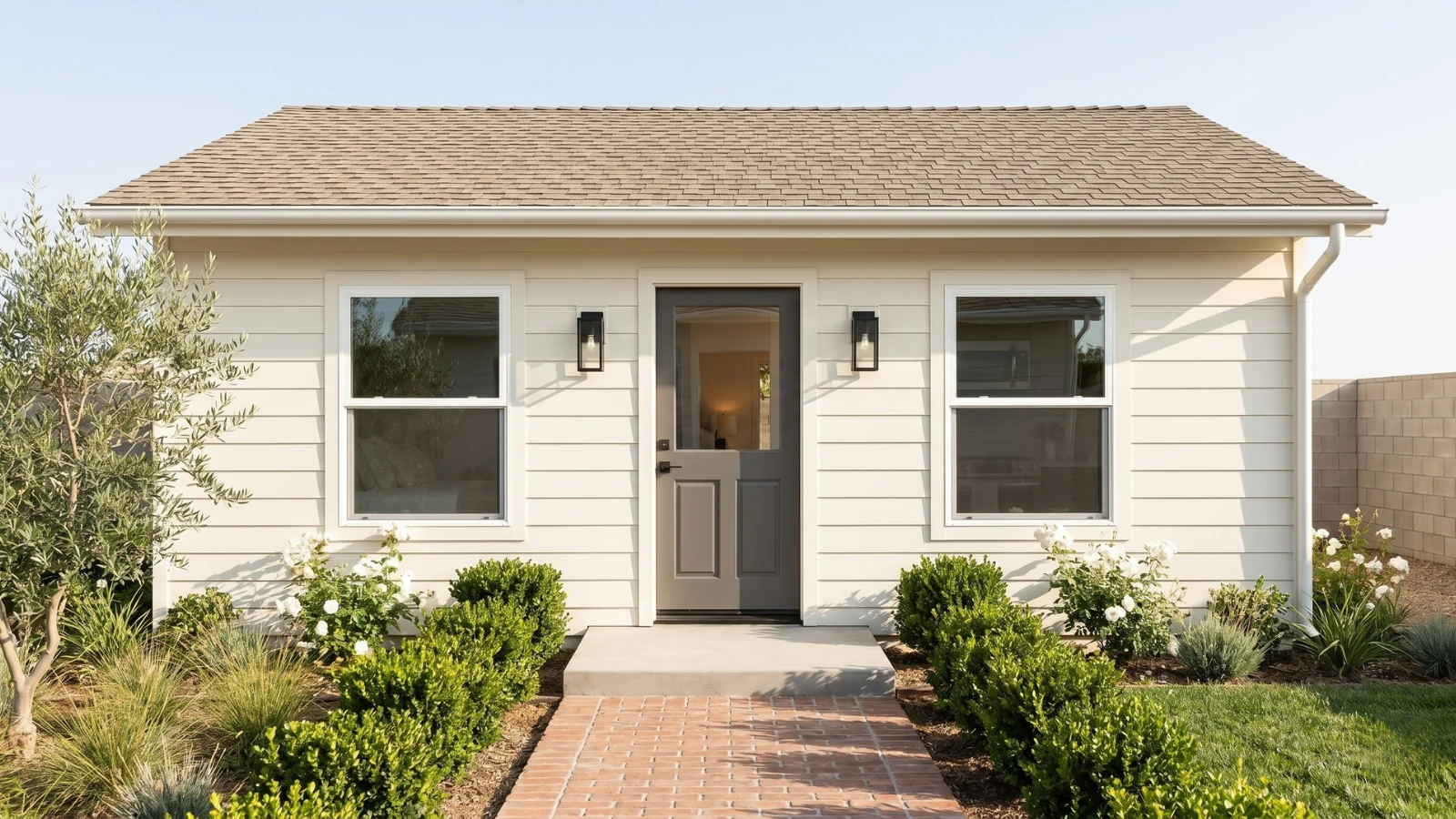
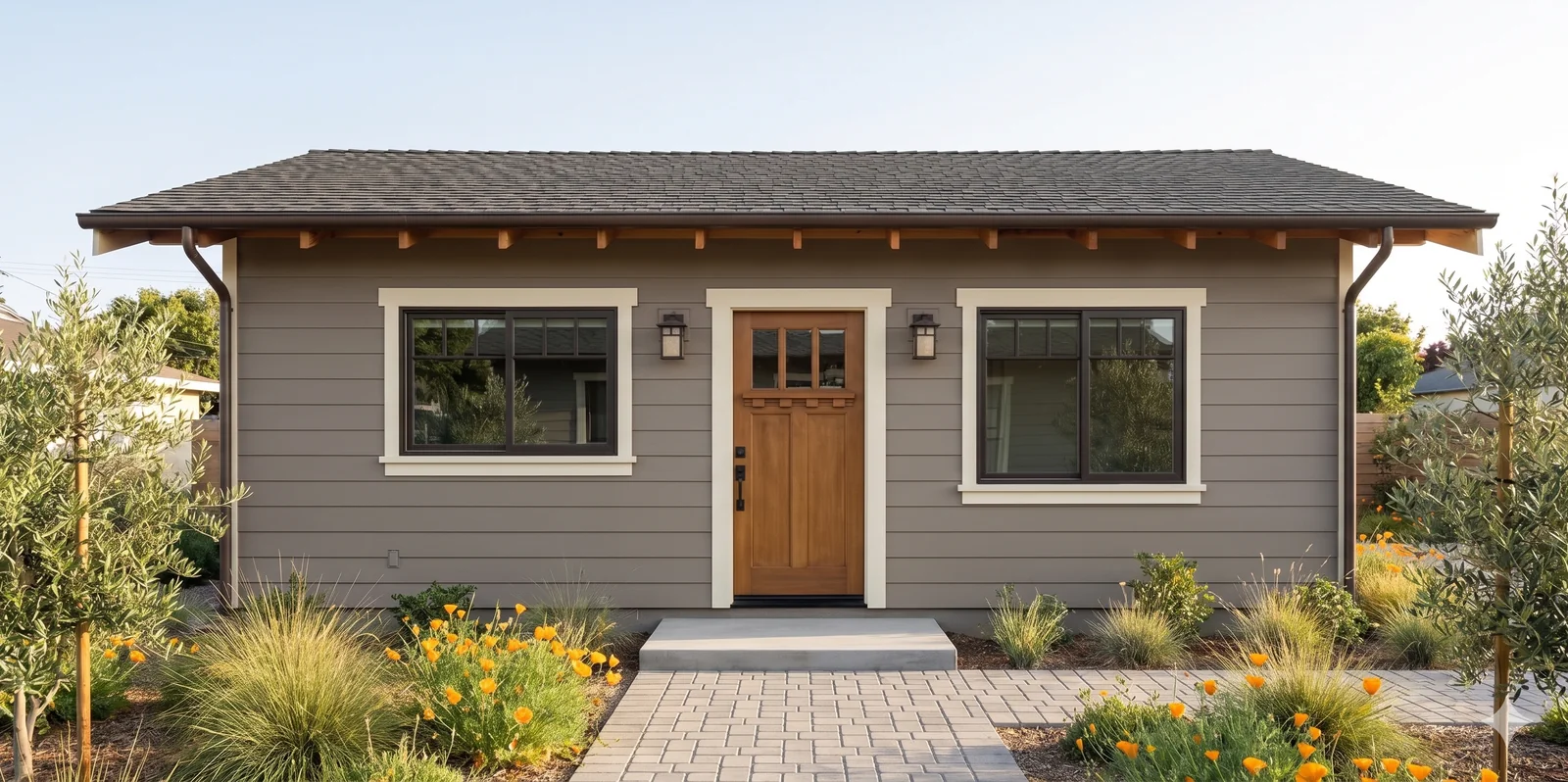
The Laurel Canyon
— 2 BR / 1 BA, 660 sqft. Stays well inside the
1,000 sqft 2-bedroom floor that governs in Santa Clarita
(Gov. Code § 66321(b)(2)) and below the 750 sqft
impact-fee threshold (Gov. Code § 66311.5(c)(1)).
Setbacks
SCMC § 17.57.040(L) sets no local ADU setback since Ordinance 26-2, so the state guarantees govern directly:
Side and rear setbacks: 4 feet — the state-law guarantee in Gov. Code § 66321(b)(3), applied directly.
Detached-to-primary separation: none is set in § 17.57.040(L) after Ordinance 26-2. Confirm at pre-submission whether a general accessory-structure spacing rule elsewhere in Chapter 17.57 applies to your lot.
Front setback: governed by the underlying base zone’s front-yard setback — which, under Gov. Code § 66321(b)(3), may not be applied so as to prevent an 800 sqft ADU with 4-foot side and rear setbacks.
Conversion: no additional setback required when the ADU is built inside the existing permitted garage footprint.
Maximum height
SCMC § 17.57.040(L) sets no local height cap since Ordinance 26-2, so Gov. Code § 66321(b)(4) governs directly:
Detached ADU — base:16 feet — the state base height in Gov. Code § 66321(b)(4)(A), applied directly.
Detached ADU — transit exception: within one-half mile walking distance of a major transit stop or high-quality transit corridor, 18 feet plus 2 ft to match the primary dwelling’s roof pitch (effective 20 ft) (Gov. Code § 66321(b)(4)(B)).
Detached ADU — multistory-multifamily exception: on a lot with an existing or proposed multistory multifamily dwelling, 18 feet, with no roof-pitch bonus (Gov. Code § 66321(b)(4)(C)).
Attached ADU: up to 25 feetor the height limit the zone applies to the primary dwelling, whichever is lower, and 2 stories (Gov. Code § 66321(b)(4)(D)). This floor defers to the zone — confirm the parcel’s zone limit before designing to 25 ft.
Garage conversion: within the existing garage footprint, no separate height increase.
What this means for design. Because the City
sets no cap of its own, the state 16-ft base is the operative
detached envelope on most lots — Santa Clarita is
effectively a 1-story detached-ADU market by
default, with a 2-story path available for
attached ADUs under the 25-foot envelope (or the
zone’s primary-dwelling limit, if lower). Our two-story
Signature plans stand roughly 25 feet, so they cannot be
permitted as detached units in Santa Clarita as drawn; we
modify them to fit the envelope, or design a custom ADU. Lots
within one-half mile of transit can stretch a detached ADU to
20 ft — useful for a vaulted ceiling but still a 1-story
envelope. The product story on most SCV lots is a
well-designed 1-story detached unit.
Parking
SCMC § 17.57.040(L) imposes no local parking requirement since Ordinance 26-2 (the former local waiver list is gone), so Gov. Code § 66322 governs directly:
Default rule: at most one off-street parking space per ADU (Gov. Code § 66322).
Five state-law exemptions (Gov. Code § 66322): no on-site parking required when the ADU meets any of the following:
Within one-half mile walking distance of public transit.
Contained entirely within the existing primary residence or an existing accessory structure.
Located within an architecturally and historically significant historic district.
On a lot subject to a residential permit parking program where the ADU occupant is not eligible for a permit.
Within one block of a car-share vehicle.
Garage conversion: no replacement parking required for the primary dwelling when a garage is demolished or converted in conjunction with ADU construction (Gov. Code § 66314(d)(11)). This rule preempts any local replacement-parking requirement.
JADU parking: parking may never be required for a JADU (Gov. Code § 66334(a)). The former local JADU garage-replacement language was deleted by Ordinance 26-2.
Lot coverage and FAR
Per Gov. Code § 66321(b)(3), a city cannot apply local FAR,
lot coverage, or open-space standards in a way that prevents
construction of at least an 800 sqft ADU with 4-foot side and
rear setbacks and 16 feet of height. Santa Clarita’s base
residential zones generally accommodate the 850/1,000 sqft
state floors on standard SCV single-family lots, which are typically
5,000–9,000 sqft and larger in master-planned
subdivisions. The Statewide Exemption ADU under § 66323
is the floor any eligible lot can rely on.
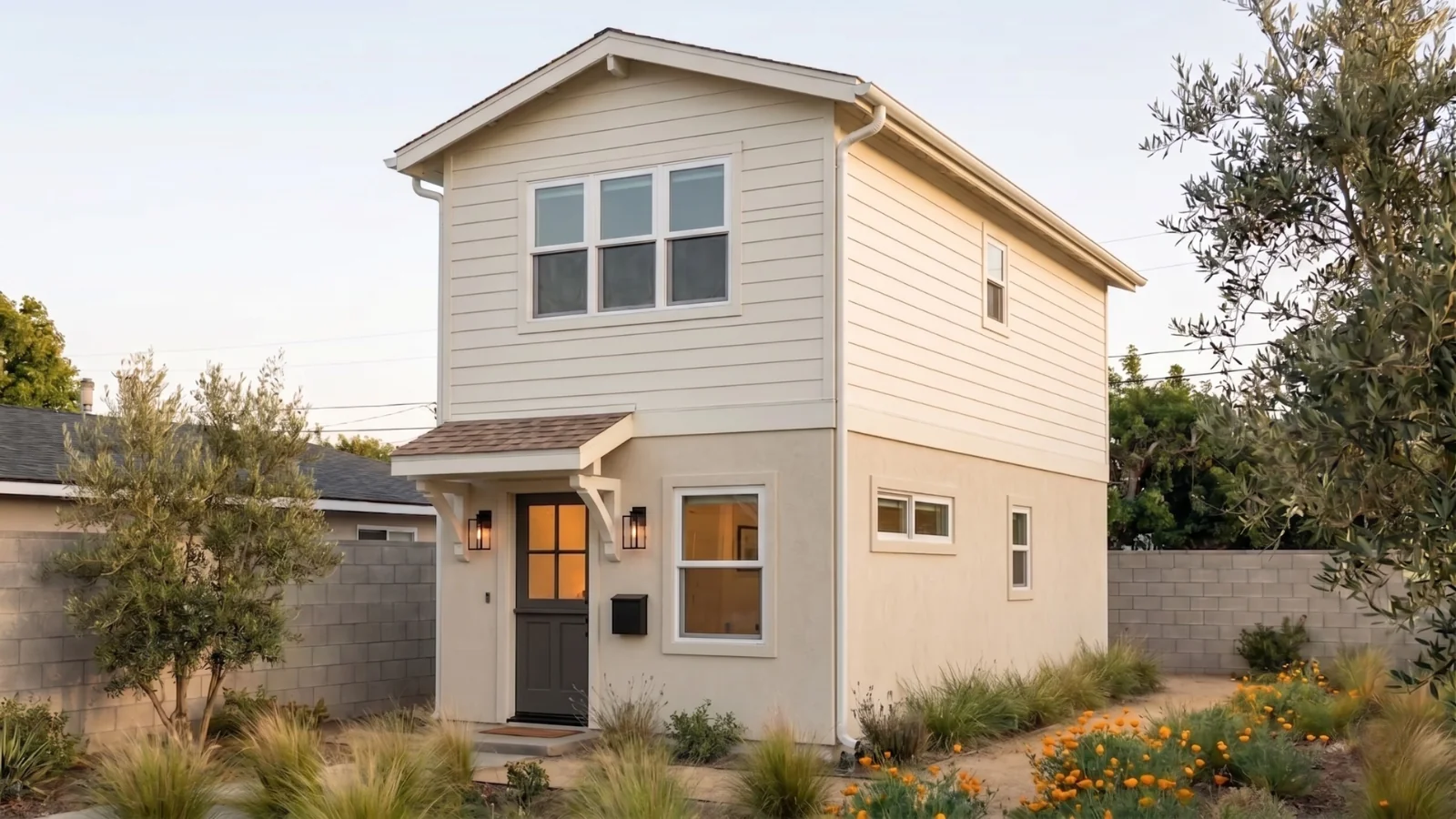
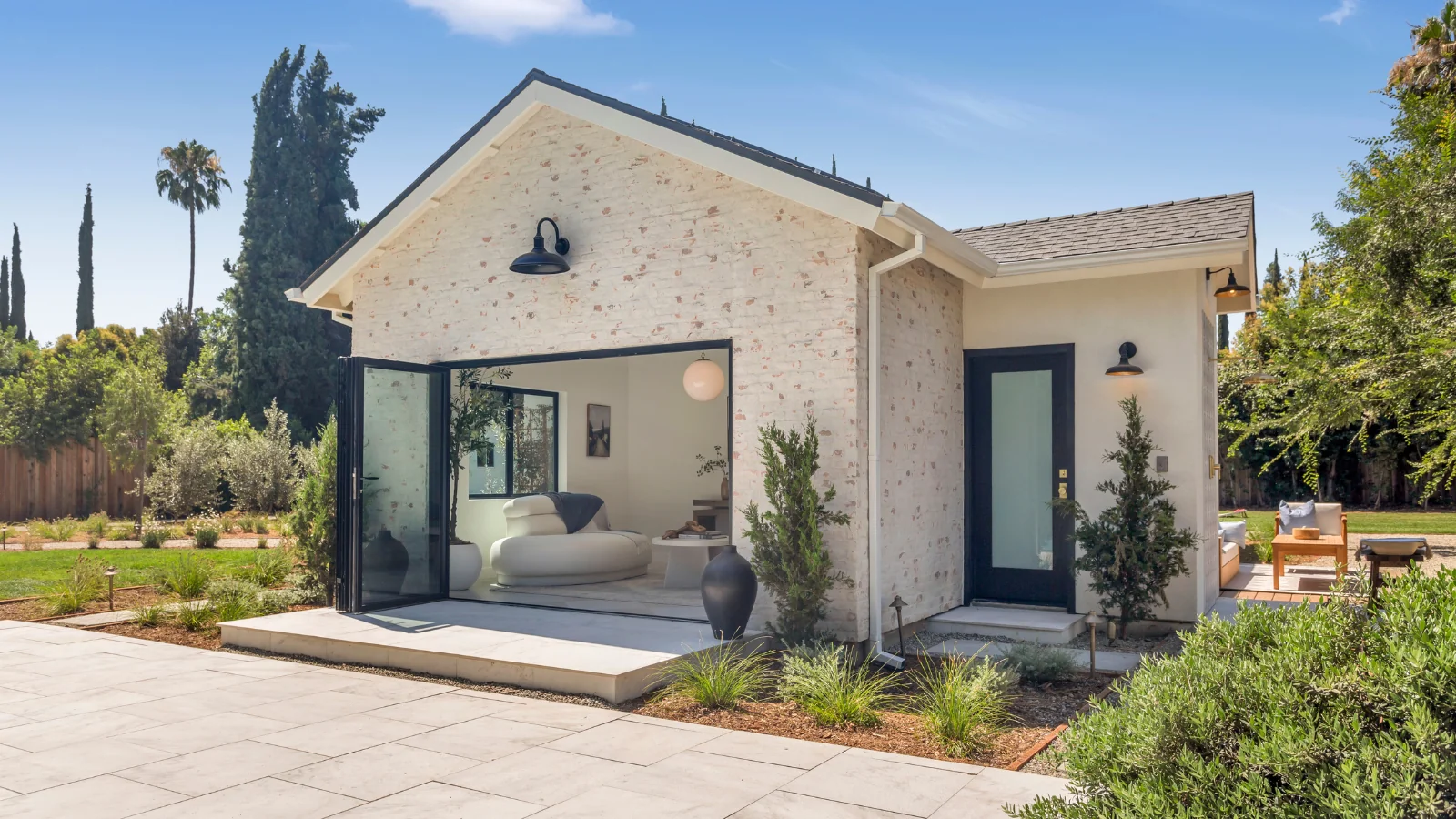
The Fairfax
— 2 BR / 1.5 BA, 840 sqft, two-story traditional
gable. In Santa Clarita, two-story Signature Homes are
the attached path under the 25-ft / 2-story
envelope in Gov. Code § 66321(b)(4)(D) (or the
zone’s primary-dwelling limit, if lower). Detached on
most lots stays 1-story under the 16-ft state base height.
Owner-occupancy
For ADUs: not required. Ordinance 26-2 deleted
the former SCMC § 17.57.040(L)(2)(n)(i) provision that put
an owner-occupancy condition on any ADU applied for on or
after January 1, 2025, and Gov. Code § 66315 bars a city
from imposing owner-occupancy on an ADU in any event. There is
nothing left in the code to be quoted at the counter.
For JADUs: SCMC § 17.57.040(L)(3)(b)
requires the property owner to occupy either the single-family
residence or the JADU, unless exempt under applicable law,
including Gov. Code § 66333(b). That is the AB 1154
exemption (effective January 1, 2026): owner-occupancy applies
only when the JADU shares sanitation facilities with
the primary residence. A JADU with its own dedicated
bathroom is not subject to owner-occupancy, and Santa
Clarita’s code now cites the exemption expressly.
Impact fees
Under 750 sqft: exempt from development impact fees per Gov. Code § 66311.5(c)(1).
750 sqft and above: impact fees are charged proportionally to the primary dwelling, calculated using the ADU’s square footage per § 66311.5(c)(1).
What the local code says: SCMC § 17.57.040(L)(5)(a) states that all ADUs and JADUs are subject to development impact fees, charged proportionally to the primary dwelling’s square footage, “except as provided in applicable law.” The local text omits both state exemption thresholds. Gov. Code § 66311.5(c)(1) governs: no impact fee on an ADU of 750 sqft or less, none on a JADU of 500 sqft or less, and proportional charging only above 750 sqft — and § 17.57.040(L) itself provides that California law controls on any conflict.
Utility connections: SCMC § 17.57.040(L)(5)(b) requires a separate utility connection for each ADU and JADU, subject to a connection fee or capacity charge, “except as provided by applicable law.” State ADU law bars requiring a new or separate connection for an ADU created by conversion within an existing single-family dwelling or accessory structure, and requires any connection fee to be proportionate to the unit’s burden on the system; the subsection’s own supremacy clause means the state rule controls.
Design implication: a 750-sqft ADU can shave thousands off the fee schedule compared to an 850–1,000 sqft unit. The Sunset Signature Home (480 sqft) and Wilshire Signature Home (400 sqft) both sit well inside the exemption.
Permitting timeline
Per Gov. Code § 66317, an ADU or JADU application that is
deemed complete must be approved or denied ministerially
within 60 days. No design review hearing, no
neighbor notice, no discretionary conditions. Real-world
elapsed time from initial submission to permit issuance in
Santa Clarita typically runs 3 to 5 months
because the 60-day clock starts only after the application is
deemed complete, and most projects go through a correction
cycle or two before that point. Lots with oak trees or in the
High Fire Hazard Severity Zone run longer because of the
additional review layers covered below.
How California state law overrides Santa Clarita
California ADU law has been amended almost every year since
2017. Since Ordinance 26-2 (April 28, 2026), Santa
Clarita’s ADU subsection defers to that law outright
— § 17.57.040(L) says California law controls on any
conflict — so the state floors below apply directly
rather than by preemption under Gov. Code § 66316. These
are the ones that matter for a Santa Clarita project in 2026.
1. The § 66323 stack — up to 3 units on a single-family lot
Ordinance 26-2 removed the former one-ADU-plus-one-JADU cap
from SCMC § 17.57.040. Gov. Code § 66323 now governs
directly: an eligible single-family lot can typically combine
a conversion ADU, a JADU, and a new detached Statewide
Exemption ADU (≤800 sqft / 16 ft / 4-ft setbacks) on the
same parcel — up to three units. If an older City handout
still describes the narrower allowance, it no longer reflects
the code. Before you formally submit, ask the assigned City planner to
confirm in writing that the three-unit stack applies to
your lot — that gets the entitlement on record before
plan check starts.
SB 1211 amended Gov. Code § 66323(a)(4)(A)(ii) to allow up to
eight detached ADUs on a multifamily lot,
capped at the number of existing primary units, plus a 25%
conversion-ADU allowance inside the multifamily structure.
Santa Clarita sets no local multifamily cap since Ordinance
26-2, so the state figure applies directly. On the relatively small number of SCV multifamily
parcels — mostly clustered along Lyons Avenue and in
Newhall — this is a meaningful unlock.
3. AB 1154 (effective January 1, 2026) — JADU owner-occupancy narrowing
SCMC § 17.57.040(L)(3)(b) requires the property owner to
occupy either the single-family residence or the JADU unless
exempt under applicable law, including Gov. Code
§ 66333(b). AB 1154 amended § 66333(b) (effective
January 1, 2026) so that owner-occupancy applies only
when the JADU shares sanitation facilities with the primary
residence. JADUs with their own dedicated bathroom
and sink — no shared plumbing — are not subject to
owner-occupancy, and Santa Clarita’s code cites the
exemption expressly.
The former SCMC § 17.57.040(L)(2)(n)(i) provision —
owner-occupancy for any ADU applied for on or after January 1,
2025 — was deleted by Ordinance 26-2. Gov. Code
§ 66315 bars a city from imposing owner-occupancy on an
ADU, full stop, and Gov. Code § 66316 makes a
noncompliant local provision null and void, so the deletion
changed nothing about your rights; it simply removed a clause
that used to get quoted at intake.
4. AB 1033 (Gov. Code § 66342) — Santa Clarita has NOT opted in
California AB 1033, now codified at Gov. Code § 66342,
authorizes cities to permit ADUs to be sold separately from
the primary dwelling as condominium units — but only if
the city adopts a local opt-in ordinance. Santa Clarita has
not. The City Planning Division’s ADU FAQ confirms: an
ADU may be rented separately from the primary residence, but
may not be sold or otherwise conveyed separately.
Unlike Santa Monica (SMMC § 9.31.026) and Culver City
(CCMC § 17.400.096), Santa Clarita ADU owners cannot
subdivide and sell the ADU as a condominium. If a condo-sale
exit is part of your investment thesis, this is a decision
point — either Santa Clarita is the wrong geography for
that strategy, or you wait until the City Council adopts an
AB 1033 opt-in.
5. Garage conversions — no replacement parking
Gov. Code § 66314(d)(11) prohibits a city from requiring
replacement parking when an existing garage, carport, or
covered parking structure is demolished or converted in
conjunction with ADU construction. Ordinance 26-2 deleted the
former local JADU garage-replacement language, so nothing in
§ 17.57.040(L) asks for it. If replacement parking is
nonetheless requested during plan check, this is the section
to cite.
Permitting your ADU
Ministerial review, 60-day clock
Per Gov. Code § 66317, Santa Clarita must approve or deny
a complete ADU or JADU application ministerially
within 60 days of the application being
deemed complete. No design review hearing. No Planning
Commission action. No neighbor notice. If your plans meet the
objective standards in SCMC § 17.57.040, the City must
approve.
The 60-day clock is statutory. The real-world elapsed time is
longer because most projects go through one or two correction
cycles, and because Building Safety plan check (Title 18 of
the Municipal Code) runs alongside Planning review. Expect
approximately 3 to 5 months from initial
submission to permit issuance in Santa Clarita on a
straightforward project — longer on lots with oak
protection, hillside grading, or High Fire Hazard Severity
Zone access review.
Where to submit
Applications go to the City of Santa Clarita Planning
Division at 23920 Valencia Blvd., Suite 140 (phone
(661) 255-4330). The City also operates an online Permit
Portal accessible through santaclarita.gov for application
submittal and plan-check tracking.
Pre-submission review we recommend
A pre-submission meeting with the assigned planner confirms
code compliance before you enter the fee-paid review queue,
catches High Fire Hazard Severity Zone access requirements
and oak protection nuances specific to your parcel, and
identifies the state-law preemption positions (SB 1211,
AB 1154, § 66323 Statewide Exemption) you may need to
assert. We do this on every Santa Clarita project and it
materially reduces correction cycles.
High fire hazard zones and ADU construction
Santa Clarita is one of the LA County cities most affected by
state-designated fire hazard severity zones. Significant
portions of the foothills, canyon edges, Newhall Pass slopes,
Placerita Canyon, and San Francisquito Canyon areas fall
within High Fire Hazard Severity Zones (HFHSZ) or Very High
Fire Hazard Severity Zones (VHFHSZ) per CalFire designation.
A meaningful share of SCV residential lots sit inside one of
these overlays.
Before Ordinance 26-2, SCMC § 17.57.040 carried its own
rule for these lots: an ADU had to front a highway or have two
non-overlapping access ways. Ordinance 26-2 deleted
that provision,
and the ADU subsection now contains no fire-zone standard at
all. What remains is the generally applicable layer: on a
state-designated Very High Fire Hazard Severity Zone lot, the
California Fire Code and LA County Fire fire-apparatus access
requirements apply at building permit, as they would to any
new construction — so that emergency vehicles can reach
the property and residents can evacuate during a fast-moving
fire event.
Why these rules apply at all.
California Fire Code §§ 503 and 903–915, and
Public Resources Code §§ 4201–4204, give
local jurisdictions authority to impose stricter fire-safety
rules in state-designated Very High Fire Hazard Severity
Zones. Those rules (fire-apparatus access, defensible space)
survive ADU-statute preemption because they trace to
fire-code authority, not ADU-statute authority — and
they apply as fire-safety standards on a VHFHSZ lot, never as
a categorical bar on ADUs. One state limit runs the other
way: sprinklers cannot be required for the ADU if the primary
dwelling has none (Gov. Code § 66314(d)(12)). The 60-day
ministerial approval clock and 4-foot setbacks still apply;
fire access is layered on top.
What this means for your project. Verify
your parcel’s designation against the CalFire fire
hazard severity zone maps (published at fire.ca.gov) and the
City’s Safety Element. If the lot is in a state-designated
VHFHSZ and only has a single dead-end access road, Fire Code
access review may call for frontage improvements or a
secondary access easement, or favor a design that places
the ADU within an existing structure (conversion ADU) rather
than as new detached construction. Pre-submission planning
review is essential on these sites.
Oak tree clearance. Separate from the
fire-zone rule, properties containing oak trees require
clearance from the City’s Urban Forestry Division
before any development can occur (City Planning ADU FAQ).
Santa Clarita’s heritage oak ordinance protects mature
California oaks; the Urban Forestry review evaluates
proposed grading, trenching, foundation work, and
tree-canopy impact. If mature oaks sit within roughly 50
feet of the proposed ADU footprint, plan for an early site
walk with the Urban Forester.
Signature Homes that fit Santa Clarita lots
All three are 1-story designs that sit inside the state-law detached envelope Santa Clarita now applies directly — 16 ft base height (Gov. Code § 66321(b)(4)) and the 850/1,000 sqft 0–1BR and 2+BR floors. Fixed-price plans (design and permit included); est. cost to build shown. Designed to permit through the Santa Clarita Planning Division.
Valley and Los Angeles-adjacent projects that translate to Santa Clarita single-family lots — Woodland Hills directly across the Newhall Pass, and three smaller-footprint case studies that map to the 850/1,000 sqft state floors that govern in SCV.
Our architect-designed
Signature Home plans are a single
fixed price — design and permit included, no change
orders. Plan fees run from
$7,490 to $12,990.
Est. cost to build runs
$180K–$420K across the lineup. Most of our Signature plans
fit as a 1-story detached unit inside the 850/1,000 sqft
floors that state law guarantees in Santa Clarita. The Lincoln
(3 BR / 2 BA, 1,000 sqft, est. $325K–$350K to
build) sits right at the 1,000 sqft 2+BR floor.
Building on a typical Santa Clarita lot in 2026 adds three line items beyond
the construction estimate:
Site work — foundation, trenching, and grading on hillside parcels.
Utility connections — water, sewer, and electric service drop (SCV Water and City Public Works review apply).
City fees and impact fees — ADUs under 750 sqft are exempt from impact fees per Gov. Code § 66311.5(c)(1).
The 750 sqft impact-fee threshold is the easiest way to
shave several thousand dollars off the fee schedule.
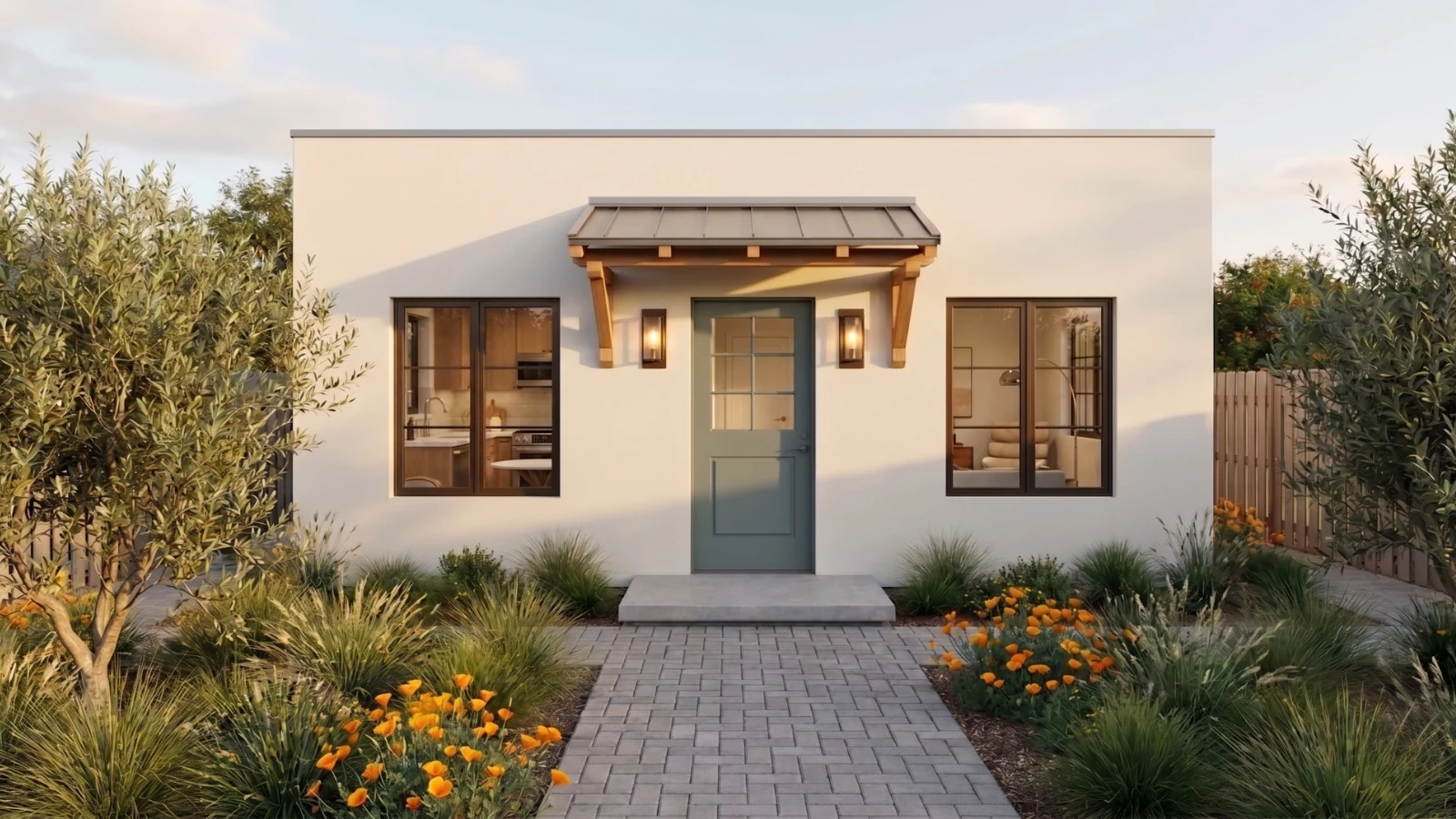
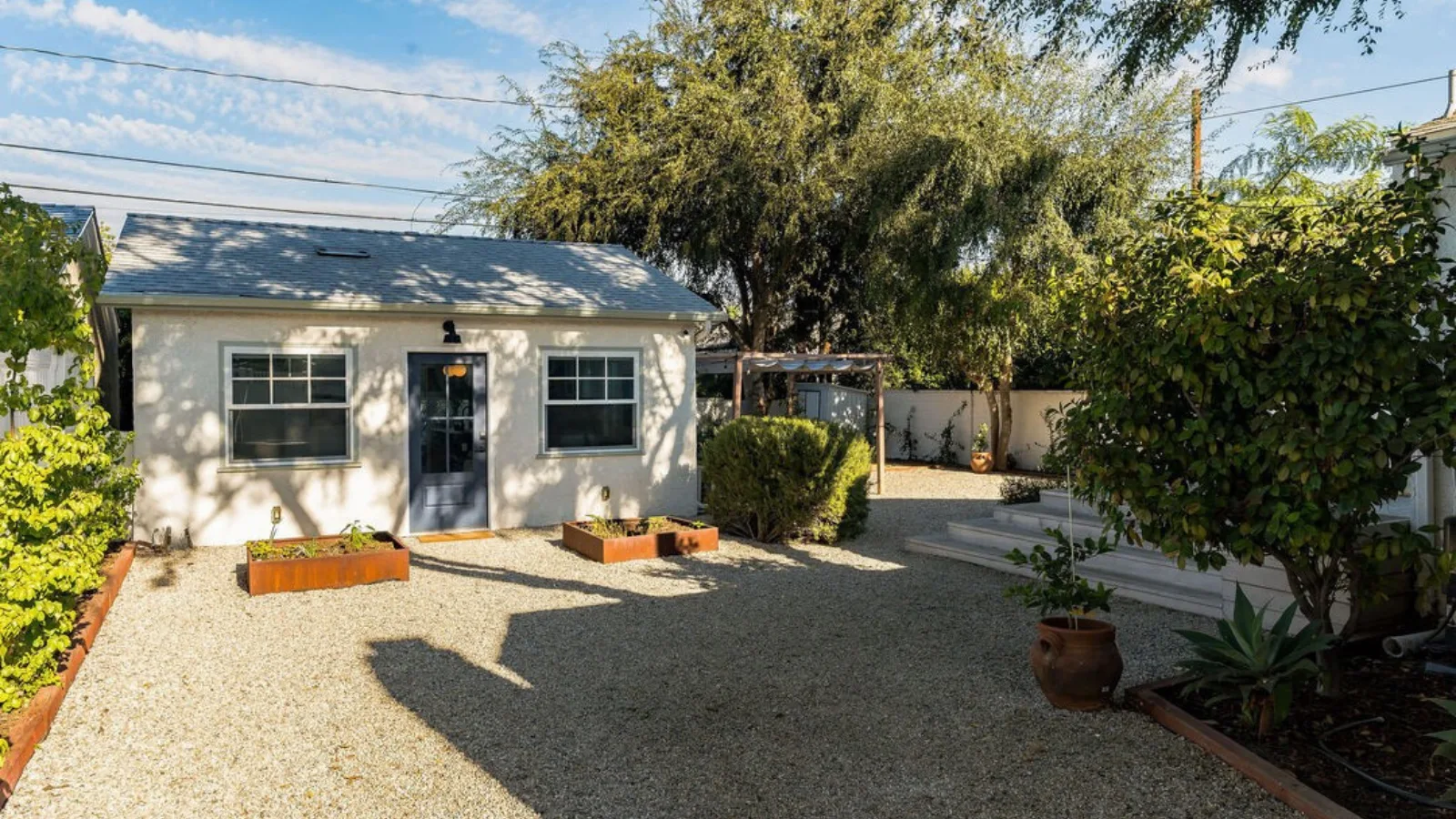
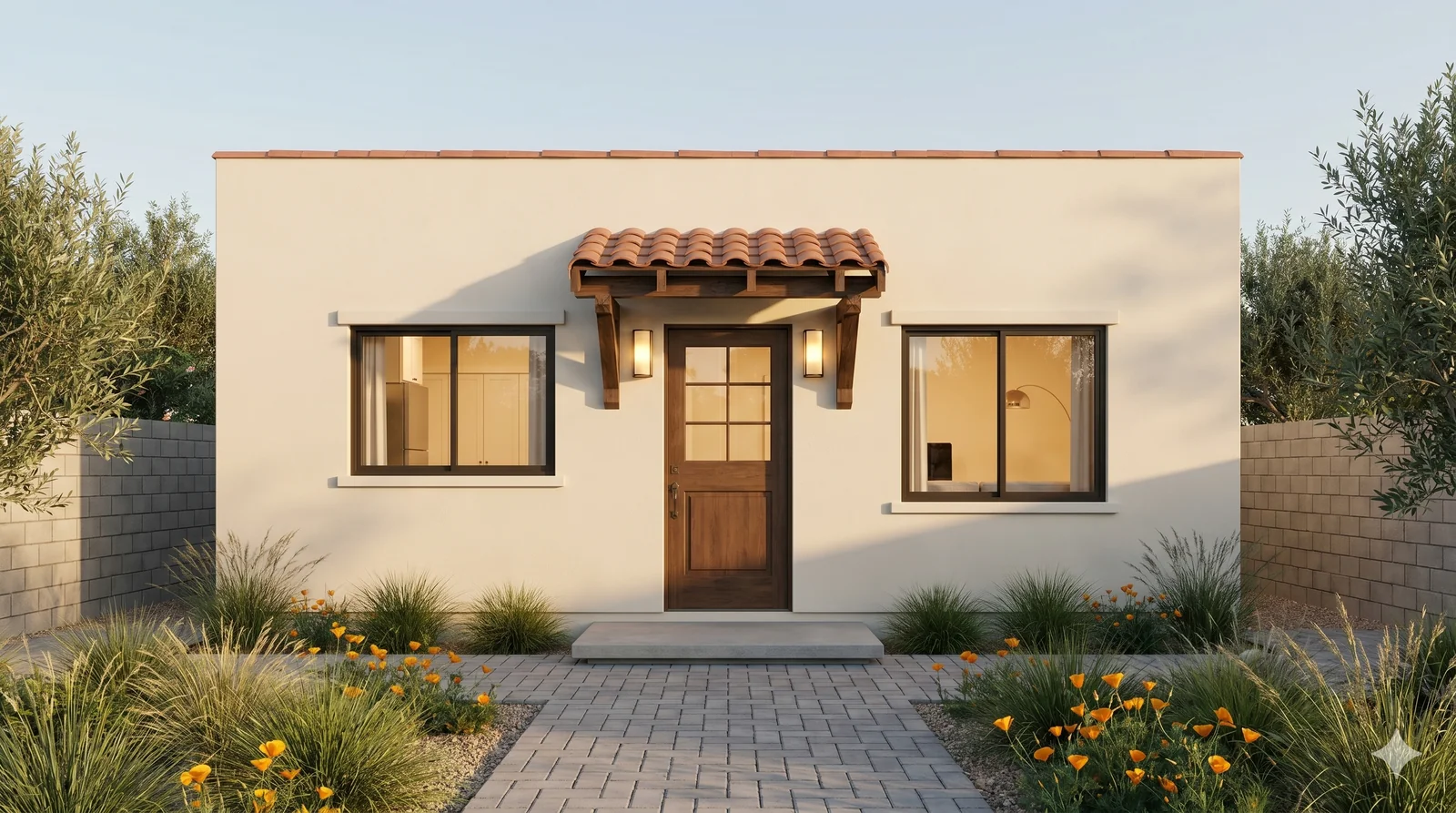
The Lincoln
— 3 BR / 2 BA, 1,000 sqft. Plans $12,990 fixed;
est. $325K–$350K to build. Lands exactly at the 1,000 sqft 2+BR floor
state law guarantees in Santa Clarita (Gov. Code
§ 66321(b)(2)), and the Spanish flat-roof exterior
reads well against the master-planned Mediterranean
character of Valencia, Saugus, and Stevenson Ranch
adjacent neighborhoods.
Lots in the High Fire Hazard Severity Zone carry extra
line items. These include fire-apparatus access work (if a
secondary access way is needed), fire-rated assemblies,
sprinklers where the primary dwelling triggers them, and
Class A roof assemblies. We price each item on your site
during the Backyard Review so your build estimate reflects the
parcel you own. Once your plans are permitted, build with our construction partner or your own licensed contractor.
Renting your new ADU
Per SCMC § 17.57.040(L)(3)(a), any rental of a Santa
Clarita ADU must be for a term of 30 days or longer (the JADU
rule at (L)(3)(b) is the same) — the 30-day floor
matches state law under Gov. Code § 66314(e).
Practically, that means a Santa Clarita ADU is a long-term
tenancy asset: monthly leases or longer, not nightly Airbnb
or weekly vacation rentals.
A few drivers anchor SCV rental demand. Six Flags Magic
Mountain and Henry Mayo Newhall Hospital both employ
locally in Valencia. CalArts pulls in a steady student and
faculty rental base. Princess Cruises runs its corporate
office population from Santa Clarita. SCV rents track the
broader north-county market. A well-finished 1- or
2-bedroom ADU in Valencia, Saugus, Newhall, or Canyon
Country usually leases within 60 to 90 days of completion.
A rough payback on the est. cost to build is 10 to 14 years at
2026 SCV rents. The exact number turns on which Signature
Home you build and the lot you build it on.
Why Santa Clarita is a strong ADU market
Santa Clarita is one of the few large LA County cities
where the typical lot is big enough to fit a 1,000 sqft
detached ADU without crowding the primary house or the
rear yard. Master-planned blocks in Valencia, Saugus, and
north Newhall mostly run 6,000 to 9,000+ sqft. The
city’s suburban setback culture lines up well with
the 4-foot side and rear setbacks.
The rules also work in your favor. Since Ordinance 26-2,
Santa Clarita’s ordinance simply adopts the state-law
floor. There is no citywide historic overlay like Pasadena,
no Coastal Zone, and no citywide rent control. Two
SCV-specific layers do need attention: Fire Code access on
state-designated fire-hazard lots, and the heritage oak
ordinance. Both are well defined and
solvable with early Planning Division engagement on the
parcels they touch.
ADU questions, answered
The questions Santa Clarita homeowners actually ask before
they start — with citations to SCMC § 17.57.040,
the City Planning Division’s ADU FAQ, and Gov. Code
§§ 66310–66342.
How large an ADU can I build in Santa Clarita?
Santa Clarita no longer sets a local ADU size cap.
Ordinance 26-2 (April 28, 2026) replaced SCMC
§ 17.57.040(L) with a short subsection that defers
to state law, so the Gov. Code § 66321 floors govern
directly: the City may not cap an ADU below
850 sqft for studios and 1-bedroom units
or 1,000 sqft for units with two or more
bedrooms, and an 800 sqft unit can never be refused on
size grounds. The former 50%-of-primary limit on attached
ADUs went with the rest of the local standards. JADUs are
capped at 500 sqft by state law and must be built
entirely inside the primary dwelling’s walls.
Can I build a two-story detached ADU in Santa Clarita?
Not as a free-standing detached unit on most lots. Since
Ordinance 26-2, SCMC § 17.57.040(L) sets no local
height cap, so the Gov. Code § 66321(b)(4) floors are
the operative rule: a detached ADU is guaranteed
16 feet, rising to 18 ft plus 2 ft to
match the primary’s roof pitch within one-half mile
of transit, or to 18 ft (no roof-pitch bonus) on a lot
with a multistory multifamily dwelling. That is a 1-story envelope on most lots, so our
two-story Signature plans, which stand roughly 25 feet,
cannot be permitted as detached units in Santa Clarita as
drawn — we modify them to fit, or design custom. The
2-story path is an attached ADU: Gov. Code
§ 66321(b)(4)(D) guarantees 25 ft or the
zone’s primary-dwelling height limit, whichever is
lower, and 2 stories. Confirm your parcel’s
zone limit with Planning before designing to 25 ft.
Do I need on-site parking for a Santa Clarita ADU?
Usually not. Since Ordinance 26-2, SCMC § 17.57.040(L)
imposes no local parking requirement, so Gov. Code
§ 66322 governs directly: at most one space, and
none at all under its five exemptions
— within one-half mile of public transit, contained
inside the existing primary or accessory structure, in a
historic district, on a permit-only parking street where
the ADU occupant is not offered a permit, or within one
block of a car-share vehicle. Garage conversions never
trigger replacement parking for the primary dwelling per
Gov. Code § 66314(d)(11), and parking may never be
required for a JADU (§ 66334(a)).
Does Santa Clarita require owner-occupancy for ADUs?
No. Ordinance 26-2 deleted the former SCMC
§ 17.57.040(L)(2)(n) provision that put an
owner-occupancy condition on ADUs applied for on or after
January 1, 2025, and Gov. Code § 66315 bars a city
from imposing owner-occupancy on an ADU in any event. For
JADUs, SCMC § 17.57.040(L)(3)(b) requires the owner
to occupy either the single-family residence or the JADU
unless exempt under applicable law, including Gov. Code
§ 66333(b). That is the AB 1154 exemption,
effective January 1, 2026: owner-occupancy applies only
when the JADU shares sanitation facilities with the
primary residence. A JADU with its own dedicated
bathroom is not subject to owner-occupancy, and Santa
Clarita’s code now cites the exemption expressly.
What if my lot is in the High Fire Hazard Severity Zone?
Ordinance 26-2 removed the former SCMC § 17.57.040
rule that an ADU on a High Fire Hazard Severity Zone lot
had to front a highway or have two non-overlapping access
ways; the ADU subsection now carries no fire-zone
standard. On a state-designated Very High Fire Hazard
Severity Zone lot, the California Fire Code and
LA County Fire access requirements still apply
at building permit — as fire-safety standards under
fire-code authority (California Fire Code §§ 503
and 903–915), not as a bar on ADUs — and
sprinklers cannot be required for the ADU if the primary
dwelling has none (Gov. Code § 66314(d)(12)). Verify
your parcel’s designation against CalFire fire
hazard severity zone maps (fire.ca.gov) and the
City’s Safety Element. Hillside, canyon, and
foothill neighborhoods are most likely affected.
Can I rent my Santa Clarita ADU on Airbnb?
No nightly or weekly stays. Per SCMC
§ 17.57.040(L)(3)(a), any rental of a Santa Clarita
ADU must be for a term of 30 days or
longer (the JADU rule at (L)(3)(b) is the same) —
the 30-day floor matches state law under Gov. Code
§ 66314(e). Santa Clarita ADUs are long-term tenancy
assets, leased monthly or longer.
Can a Santa Clarita ADU be sold separately from the main house?
No. Per the City Planning Division’s ADU FAQ, an
ADU in Santa Clarita may not be sold or otherwise
conveyed separately from the primary residence. AB 1033
(Gov. Code § 66342) allows cities to opt in to ADU
condominium sales, but Santa Clarita has not adopted an
opt-in ordinance. Santa Monica (SMMC § 9.31.026)
and Culver City (CCMC § 17.400.096) have opted in;
Santa Clarita has not. Monitor City Council ordinance
action if a condo-sale exit matters to your project
math.
Are there oak tree rules I need to know about?
Yes. Per the City Planning Division’s ADU FAQ,
properties containing oak trees require clearance from
the City’s Urban Forestry Division before any
development can occur. Santa Clarita’s heritage oak
ordinance protects mature California oaks; Urban
Forestry review checks proposed grading, trenching,
foundation work, and tree-canopy impact. Plan for an
early site walk if mature oaks sit within roughly 50
feet of the proposed ADU footprint.
Transparent pricing in writingPermit-ready fixed-price plansSCV fire-zone & oak protocols
Ready to build your ADU in Santa Clarita?
We’ll check your lot, walk you through the options, and
give you a transparent estimate — before you commit to anything.
15 minutes.