

Building an ADU in Los Angeles. Rules, costs, timeline.
The City's ADU ordinance is from 2019 and has never been amended. The rules plan check actually applies live in a memo. Here is the difference, and what it is worth to you.
What you can build — at a glance
Reviewed by CALI ADU’s ADU specialists · August 2026
- Units per SFR lot
- Code 1 · State 3+ The ordinance says one ADU. State law requires three in combination — a conversion ADU, a Junior ADU and a detached ADU — and the State told the City so directly in November 2024. HCD’s further position is that at least one more is required on top of those three.
- Max ADU size
- Up to 1,200 sqft Detached units go to 1,200 sqft under the City ordinance. An attached unit is half your primary dwelling, but can never be pushed below 850 or 1,000 sqft depending on bedroom count.
- Detached height
- 2 stories Under the ordinance route you get two stories and your zone’s height limit. The separate state-mandated 800 sqft unit is capped at 16 ft, or 18 ft near transit.
- Attached height
- Up to 25 ft 25 ft guaranteed, or your zone limit if that is lower.
- Side & rear setbacks
- 4 ft The ordinance is explicit that no more than four feet may be required. A conversion or a same-footprint rebuild needs none at all.
- Parking required
- At most 1 One space at most, removed by transit proximity, car-share, historic districts or conversion. Parking is never replaced when a garage is converted or demolished.
- Fire + hillside lots
- Not a hillside ban An ADU is barred only where the lot is in a Very High Fire Hazard Severity Zone and a designated Hillside Area — and even then two exceptions apply. Being in the hills alone does not stop you.
- Unpermitted units
- Legalize pre-2020 A unit built before 2020 without permits has a streamlined path under state law, backed by a published LADBS bulletin. No impact fees, and no connection charges except where utility work is genuinely needed for health and safety.
- Detached Up to 1,200 sqft · up to 2 stories under the ordinance route
- Attached 50% of the primary · never blocked below 850/1,000 sqft
- State 800 sqft unit ≤800 sqft · 16 ft · 4 ft setbacks · cannot be refused
- Garage conversion No added setback · no replacement parking
- Junior ADU Up to 500 sqft inside the primary dwelling
Per Los Angeles Municipal Code § 12.22 A.33 (Ordinance 186,481, effective December 19, 2019), read together with Zoning Administrator Memorandum No. 143 – Revision 1 (August 1, 2025), LADBS Information Bulletin P/BC 2026-161, and Gov. Code §§ 66310–66342. Cross-checked against HCD's findings letter to the City dated November 19, 2024 and the HCD ADU Handbook (March 2026). Full citations in the sections below.
On this page
Can I build an ADU in Los Angeles?
Los Angeles is the largest ADU market in the country and one of the more confusing places to read the rules, for a reason worth understanding before you spend money on drawings.
Five things to know before you start
These five decide most Los Angeles projects. Everything further down the page is detail underneath them.
| What to know | Why it matters for your project |
|---|---|
| The published code is out of date | Ordinance 186,481 has not been amended since December 2019. Looking up LAMC § 12.22 A.33 gives you rules the City no longer applies. |
| Three units, not one — maybe four | A conversion ADU, a Junior ADU and a new detached ADU combine under Gov. Code § 66323(a), and HCD reads § 66314 as adding one more on top. |
| Two routes, two envelopes | The state-mandated unit is capped at 800 sqft and 16 ft but cannot be refused. The City ordinance route allows 1,200 sqft and two stories. |
| Hillside is not a ban | The fire restriction applies only where a lot is in a fire severity zone and a Hillside Area, and even then two exceptions exist. |
| Old units can be legalized | An unpermitted unit built before January 2020 has a statutory path to a permit, with no impact fees and no penalties. |
Are you actually in the City of Los Angeles?
Check this first, because a mailing address does not settle it. Roughly a million people live in unincorporated Los Angeles County, and many of those places carry names that sound like cities and are not: Altadena, East Los Angeles, Ladera Heights, View Park-Windsor Hills, Willowbrook, Topanga, Hacienda Heights.
The county has its own rulebook, and on several points it is more generous than the City’s — 25-foot heights rather than 16, and no parking requirement at all outside a fire zone. If your parcel turns out to be county, nothing on this page applies to you: read our unincorporated Los Angeles County ADU page instead.
What can you build on your lot?
The two routes, and why you should care
Almost nobody explains this, and it is the single most valuable thing to understand about building in Los Angeles.
There are two different ways to get a detached ADU approved here, and they carry different envelopes. On most lots the question is not which one to pick. HCD reads state law as requiring the City to allow the ordinance unit in addition to the state-mandated ones — its March 2026 Handbook says that “in addition to the units described in Government Code section 66323, a local agency must allow at least one unit described in Section 66314.” Where a lot has room for only one detached building, the envelope difference below decides which one to draw.
| Route | What you get | What it costs you |
|---|---|---|
| State-mandated unit Gov. Code § 66323(a)(2), via LAMC (g)(1) | Up to 800 sqft, 16 ft tall, 4-ft side and rear setbacks. Rises to 18 ft within a half-mile of major transit, plus 2 ft to match your roof pitch. | The City cannot refuse it and may not add standards to it. It is capped at 800 sqft and single-story — but it does not use up your ordinance-route unit. |
| City ordinance unit LAMC § 12.22 A.33(d) | Up to 1,200 sqft of floor area and up to two stories, with the underlying zone setting the foot height. | Bigger and taller, but the lot’s own floor-area limits apply separately and can cut it down. |
This is why Los Angeles is a two-story ADU market and a city like Glendale is not. A 16-foot cap forces every detached unit onto one level. LAMC § 12.22 A.33(d)(2) says only that a structure containing a detached ADU “shall not be greater than two stories” — it sets no foot height of its own.
Where you can only build one, a deep lot with room at the rear usually favors the ordinance route, and a tight lot or a difficult reviewer favors the state route because the City has no discretion to say no. Where the lot can take both, HCD’s reading says you should not have to choose.
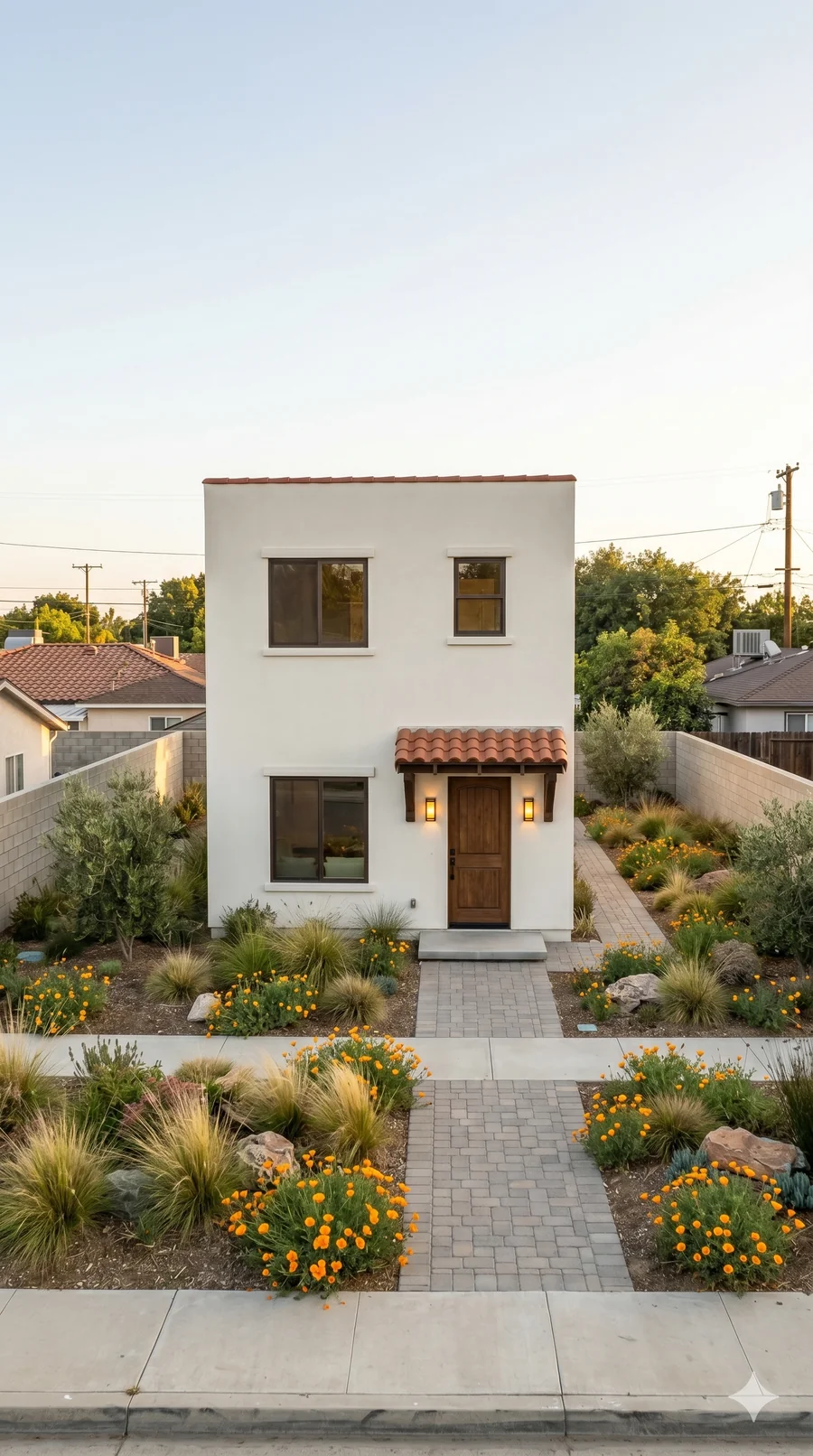
Which ADU type fits your property?
Start from what your lot already has rather than from a floor plan. The cheapest square footage in Los Angeles is almost always space that is already standing.
| If your lot has… | The type that usually fits | Why |
|---|---|---|
| A detached garage, in any condition | Garage conversion | No additional setback is required, and no replacement parking may be demanded (LAMC (c)(8), (c)(12)(iii)). |
| Open rear yard, 20 ft deep or more | Detached, ordinance route | Up to 1,200 sqft and two stories is the largest envelope available to you. |
| A tight lot, or a difficult planner | The state 800 sqft unit | It cannot be refused and no local standard may preclude it (LAMC (c)(1)(iii)). |
| Spare space inside the house | Junior ADU | Up to 500 sqft, and it stacks with both of the above on the same lot. |
| An apartment building | Conversion plus detached | Non-livable space converted — at least one unit, or 25 percent of existing units, whichever is more — plus up to eight detached on an existing multifamily lot (Gov. Code § 66323(a)(3)(B), (a)(4)(A)(ii)). |
| An unpermitted unit from before 2020 | Legalization | Gov. Code § 66311.7 and LADBS Bulletin P/BC 2026-161 give it a route to a permit. |
If you own an apartment building
Multifamily is where the arithmetic gets interesting, and where the gap between the printed code and the statute is widest. State law allows conversion of non-livable space inside the existing building — storage rooms, boiler rooms, passageways, attics, basements, garages — into ADUs numbering at least one, or up to 25 percent of your existing units, whichever is more. It separately allows up to eight detached ADUs on a lot with an existing multifamily dwelling, capped at the number of units you already have.
Those two allowances stack. On a twelve-unit building that is three conversions plus eight detached units, not a choice between them. Zoning Administrator Memo 143 implements the combination.
Fire zones and hillside lots
This is the most misread rule in Los Angeles, and reading it wrong costs people projects they could have built.
LAMC § 12.22 A.33(c)(4) prohibits an ADU on a lot located in a Very High Fire Hazard Severity Zone and a Hillside Area. Both conditions, not either. A lot in a fire severity zone that is not a Hillside Area is untouched by this provision, and so is a hillside lot outside the fire zone.
Where both do apply, the ordinance gives two ways through. The first is location: lots inside the Northeast Los Angeles or Silver Lake–Echo Park–Elysian Valley community plan areas are exempt. The second is performance, and the ordinance lists three conditions — fire sprinklers throughout, one off-street parking space, and a street frontage improved to at least 20 feet of unobstructed width.
Read that second route carefully, because two of those three conditions are not enforceable against you. Zoning Administrator Memo 143, Revision 1 instructs that the City may not impose the sprinkler condition where it conflicts with Gov. Code § 66314(d)(12) — which means it cannot be required if your main house has no sprinklers — and may not impose the parking condition where any Gov. Code § 66322(a) exemption applies. In most cases the only live condition is the 20-foot improved frontage, and even there the memo limits the City to requiring a dedication rather than the physical improvement.
The Signature ADU lineup
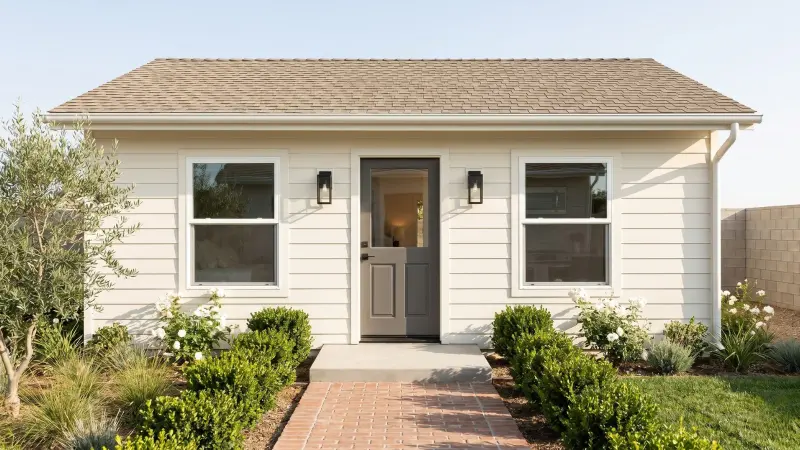
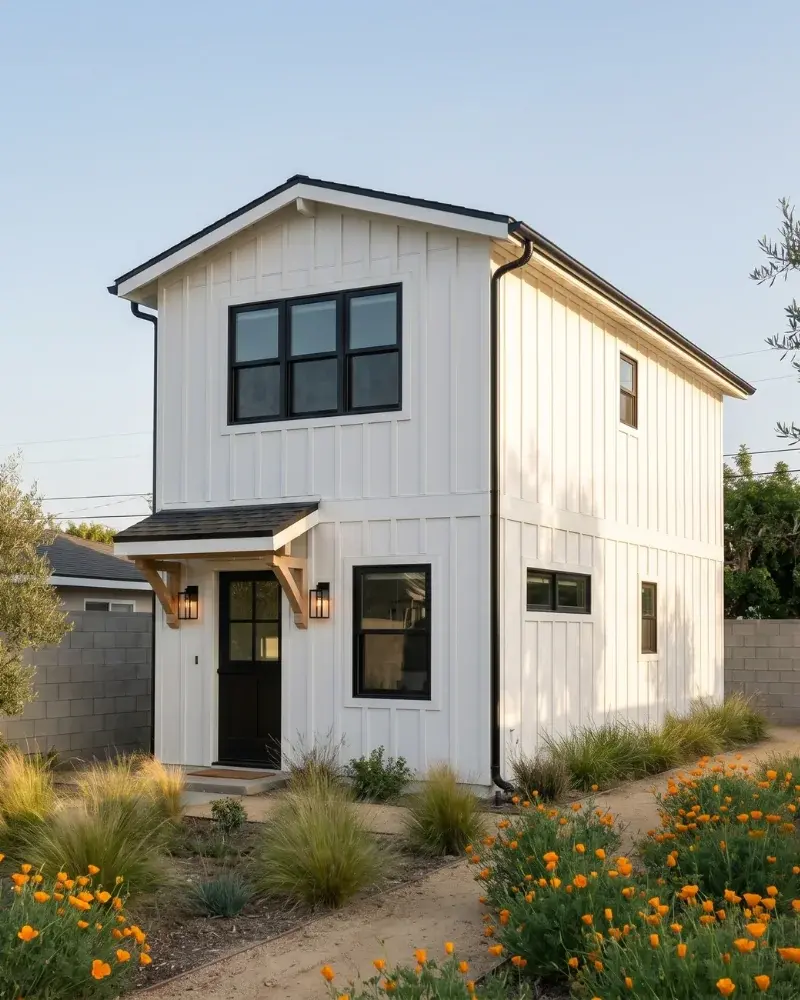
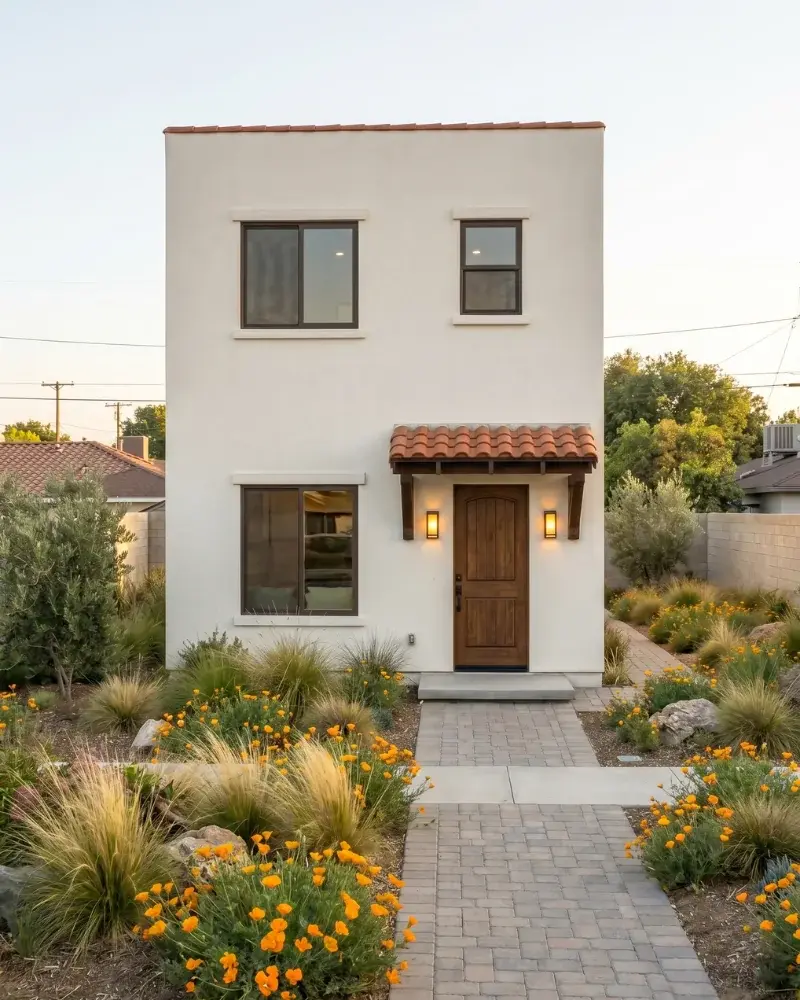
Architect-designed plans at fixed design and permit pricing, all within the 1,200 square foot detached limit Los Angeles allows. The two-story plans permit as drawn here, which is not true in most of the cities around it.
What an ADU costs in Los Angeles (2026)
Our plan fees are the same number on any lot, in Los Angeles or anywhere else we work. Construction is separate. Once your plans are permitted you can build with our construction partner or your own licensed contractor.
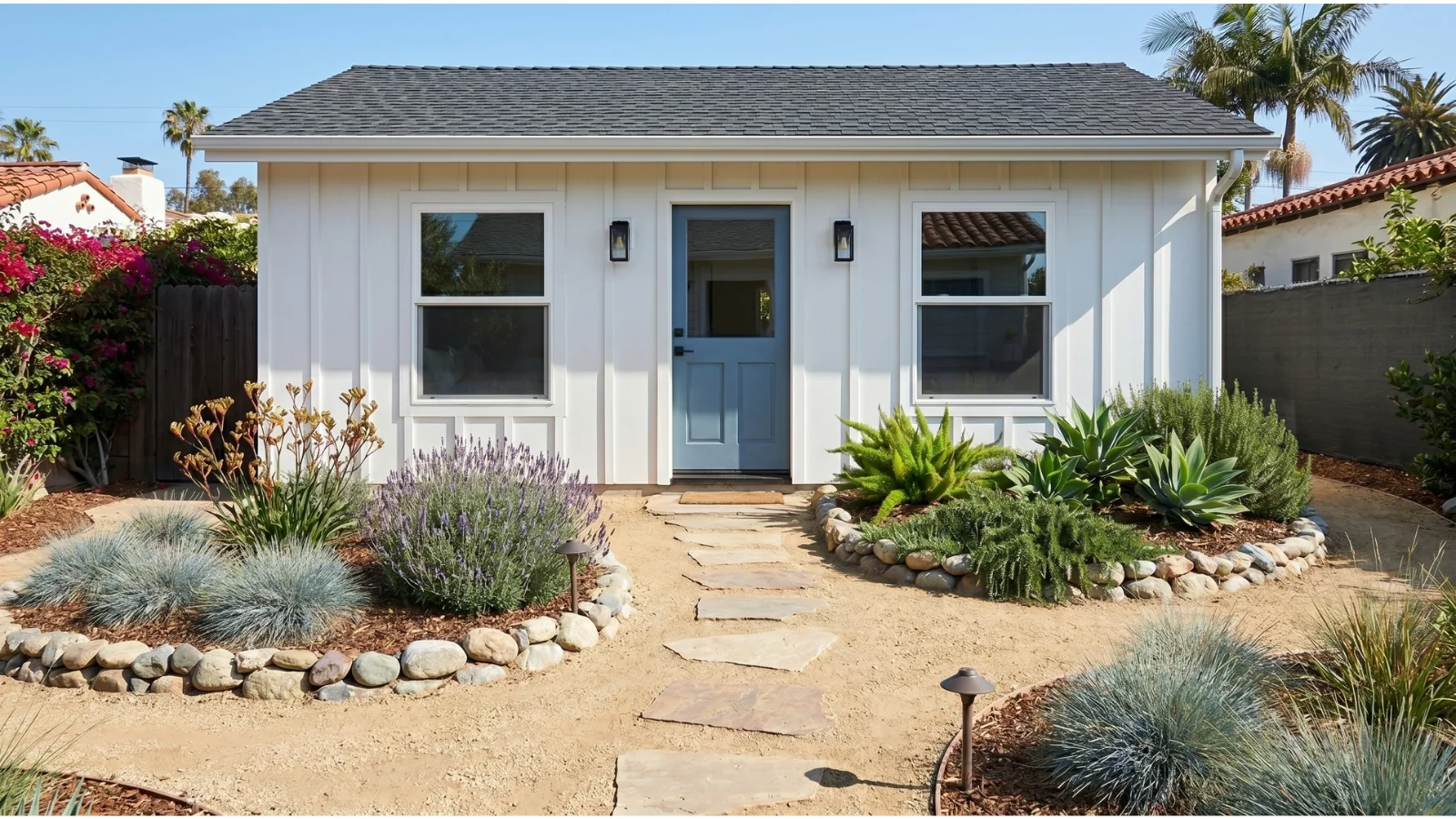
What the lineup costs to build
Plan fees are fixed. Construction is estimated, and varies with your site, access, and the finish level you choose.
| Plan | Size | Bed / bath | Est. build cost |
|---|---|---|---|
| The Wilshire | 400 sqft | Studio | $180K–$200K |
| The Sunset | 480 sqft | 1 BR / 1 BA | $200K–$215K |
| The Westwood | 550 sqft | 1 BR / 1 BA | $215K–$235K |
| The Laurel Canyon | 660 sqft | 2 BR / 1 BA | $240K–$265K |
| The Melrose | 800 sqft | 2 BR / 2 BA | $275K–$295K |
| The Fairfax | 840 sqft | 2 BR / 1.5 BA | $280K–$310K |
| The Lincoln | 1,000 sqft | 3 BR / 2 BA | $325K–$350K |
| The Venice | 1,080 sqft | 2 BR / 2.5 BA | $335K–$365K |
If none of the plans suits your lot, we also design custom ADUs from scratch — which runs $9,990–$19,990 for design and permit processing, bid per project.
City fees
Los Angeles does not publish a flat ADU permit fee, and anyone who quotes you one is estimating. The building permit and plan check are calculated from construction valuation under LAMC § 98.0403, so the figure depends on your specific project.
On top of that sit sewer capacity charges through the Bureau of Engineering, and school fees. A $200 dwelling unit construction tax under LAMC § 21.10.3 may also appear on your invoice. We have seen LADBS treat it as an impact fee and drop it below 750 square feet, but do not budget on that: Gov. Code § 66311.5(c)(2) defines an impact fee by reference to § 66000(b), which reaches “a monetary exaction other than a tax or special assessment,” so the statutory bar does not clearly cover a tax. Ask LADBS in writing how it is treating § 21.10.3 on your project.
Two exemptions are worth knowing about, because they are real money. The Affordable Housing Linkage Fee does not apply to ADUs at all — LAMC § 19.18 exempts them by name. And no impact fee of any kind may be charged on an ADU of 750 square feet or less under Gov. Code § 66311.5(c)(1). That includes park fees, because § 66311.5(c)(2) brings § 66477 fees inside the definition of an impact fee.
One charge survives the exemption and surprises people. Connection fees and capacity charges are excluded from the statutory definition of an impact fee under Gov. Code § 66311.5(c)(2), so the Bureau of Engineering’s sewerage facilities charge can still be billed. Three limits apply. It may not be calculated as though the ADU were a new residential use (§ 66311.5(b)). It must be proportionate to the actual burden (§ 66311.5(e)). And for a conversion ADU or Junior ADU created inside existing space under § 66323(a)(1), no separate connection may be required and no related charge imposed at all (§ 66311.5(d)).
What it returns
Los Angeles ADUs are long-term rentals. For current rents, use the HUD Fair Market Rent schedule for the Los Angeles–Long Beach–Glendale area, published annually and a defensible baseline, then check local listings for what comparable units in your own neighborhood are asking.
How long an ADU takes
Both clocks have teeth, and they bite in different ways. If the City misses the 15 business days, your application is deemed complete. If it does send a completeness notice in time, that notice has to list every missing item and how to cure it — and when you resubmit, the City may not demand an item it left off its own list. If it misses the 60 days, the application is deemed approved (Gov. Code § 66317(a)(3)).
The 60-day window covers the whole permitting agency. Gov. Code § 66313(k) defines that term to include planning departments, building departments, utilities and special districts, so LADBS plan check happens inside the window rather than after it. A denial must also arrive with a full set of comments rather than a single objection at a time.
| Stage | Typical duration | What governs it |
|---|---|---|
| Design and construction documents | 6–10 weeks | Your decisions, mostly. This is the stage you control. |
| Completeness determination | 15 business days | Statutory. Written notice of what is missing and how to cure it, or the application is deemed complete. |
| Plan check and approval | Within 60 days | Statutory, and it covers building and utilities too, not just planning. |
| Corrections and resubmittal | 2–6 weeks | Depends on how complete the first submittal was. This is where most schedules slip. |
| Construction | 4–8 months | Site access, weather, and your contractor’s schedule. |
A pre-approved plan from the LADBS Standard Plan Program can compress the plan check stage. LADBS says the program “greatly reduces the time required for plan check” but publishes no numeric commitment, so treat any specific day count you are quoted as an estimate rather than a promise.
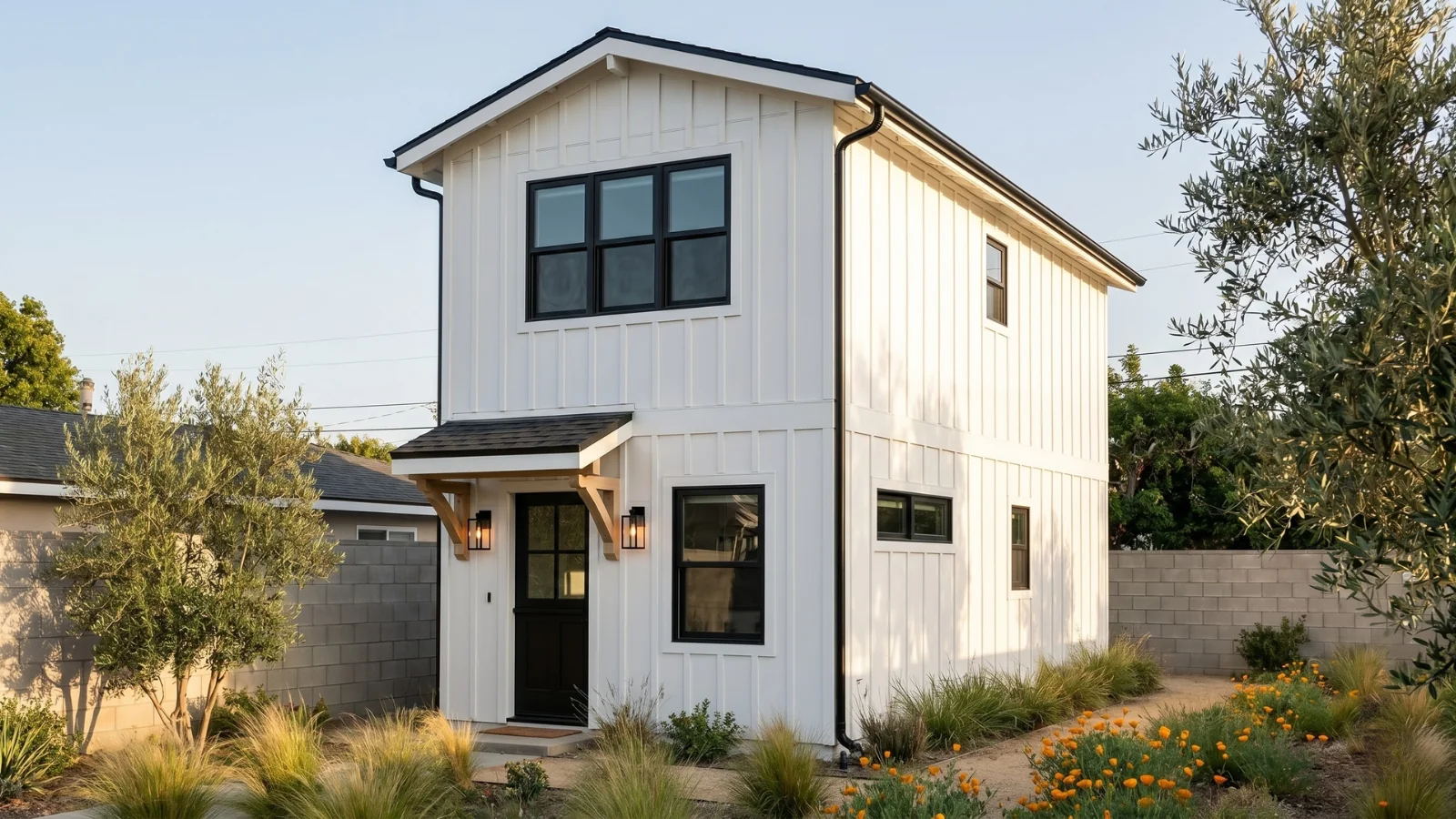
The Los Angeles ordinance, and the memo that overrides it
This is unusual enough to be worth setting out plainly, because it explains almost every confusing thing about building an ADU here.
Ordinance 186,481 took effect on December 19, 2019. Since then the Legislature has passed SB 1211, AB 1033, AB 976, AB 1332, AB 2533, SB 477, AB 1154 and SB 543, all of which change ADU law. The ordinance text still reflects none of them.
| Date | What happened |
|---|---|
| December 19, 2019 | Ordinance 186,481 takes effect, adding LAMC § 12.22 A.33. It has not been amended since. |
| November 19, 2024 | HCD issues a findings letter under Gov. Code § 66326: “HCD finds that the Ordinance does not comply with State ADU and JADU Law.” Seventeen numbered findings, with a December 19, 2024 response deadline. |
| August 1, 2025 | Zoning Administrator Memorandum No. 143 – Revision 1 issued. It supersedes LAMC § 12.22 A.33(b)(6) and (g)(2), and retires ZA Memos 134 and 142 entirely. |
| August 14, 2025 | HCD writes again: the City may not use the ADU unit caps to block legalization of an older unpermitted unit. |
| March 24, 2026 | HCD repeats the point under the renumbered statute — “units that must be legalized under section 66311.7 cannot be limited by the maximum unit counts in section 66323.” |
| August 5, 2026 | LADBS revises Information Bulletin P/BC 2026-161, the legalization pathway for pre-2020 units. The newest ADU document the City has issued. |
| As at August 2026 | No amending ordinance adopted. A full redline exists on the City Planning website, but its caption still reads “ORDINANCE NO. ________” — it has not been given a number. |
What HCD actually found
The findings letter runs to seventeen items. Four of them change what you can build.
| What the code says | What HCD found |
|---|---|
| “Only one ADU is permitted per lot” (c)(5) | Gov. Code § 66323(a) permits a conversion ADU, a detached new-construction ADU and a Junior ADU together, “totaling three units.” The City must amend. |
| A 16-foot height cap on state-mandated units (g)(1) | Gov. Code § 66321(b)(4) requires 18 feet near transit and up to two more feet to match a roof pitch. The City must amend. |
| Detached ADUs “shall not be greater than two stories” (d)(2) | Two stories must be permitted, and the City may not use the cap to block an ADU above a detached garage. The City must remove the language. |
| No ADU in a fire severity zone and a Hillside Area (c)(4) | The City “has not adequately demonstrated that ADUs will impact public safety in the VHFHSZ.” It must remove the prohibition or produce evidence by resolution. |
The memo, and its own gap
Zoning Administrator Memorandum No. 143, Revision 1, is the document plan check works from. It implements the four state ADU types, the eight-detached allowance on multifamily lots, ADU stacking with SB 9, and the current height tiers. It is a redline: superseded language is struck through in the text.
It also has a date, and the date matters. Revision 1 was issued on August 1, 2025 — before AB 1154 and SB 543 took effect on January 1, 2026. So the memo does not carry the narrowed Junior ADU owner-occupancy rule or the 15-business-day completeness deadline. Those apply anyway, because they are statute.
How the permit process works
Ministerial means a reviewer applies the numbers to your drawings. Design taste, neighborhood opinion and discretion are not part of it.
What you submit
A complete application is the single biggest factor in how long this takes. Expect a site plan, floor plans, elevations, structural drawings, and Title 24 energy documentation. On hillside parcels, add a survey. Submittal runs through ePlan LA.
The completeness step is bounded. Gov. Code § 66317(a)(2) gives the City 15 business days to decide in writing, with a list of what is missing and how to fix it, and it cannot later demand something it left off that list.
Legalizing an unpermitted unit
Los Angeles has more unpermitted dwelling units than any city in California, and there is now a real pathway for them.
Gov. Code § 66311.7 bars the City from denying a permit for an unpermitted ADU or Junior ADU built before January 1, 2020 on the grounds that it violates building standards or does not comply with ADU law. It also bars impact fees and connection or capacity charges on the legalized unit, except where utility infrastructure has to be brought up to Health and Safety Code § 17920.3 standards and the charge is one § 66311.5(e) authorizes. LADBS Information Bulletin P/BC 2026-161, revised August 5, 2026, sets out how: submission through ePlanLA with proof of pre-2020 construction, a streamlined submittal that does not require a full architectural and engineering set for most units, and inspection against the City’s substandard checklist. Units may comply with the code in effect when they were built. Some projects fall outside the streamlined track and do need full architectural and structural plans, a soils report and calculations — a basement or anything over one story among them.
Those protections fall away entirely in two cases, so know them before you rely on the section: where the City finds that correcting the violation is necessary to protect health and safety, and where the building is deemed substandard under Health and Safety Code § 17920.3.
One point is worth raising early if it comes up. HCD has twice told the City — in August 2025 and again in March 2026 — that the unit caps in Gov. Code § 66323 cannot be used to block a legalization under § 66311.7. If you are told your lot is already at its limit, that is the answer.
If you are refused
You are not finished. Gov. Code § 66317(d) requires Los Angeles to give you a written appeal — on a denial or on an incompleteness determination — running to the governing body or the planning commission, with a final written determination within 60 business days.
Los Angeles ADU questions, answered
The questions Los Angeles homeowners and property owners actually ask — answered against LAMC § 12.22 A.33, Zoning Administrator Memo 143, and current state law.
How many ADUs can I build on a Los Angeles single-family lot?
At least three, and on HCD's reading four. LAMC § 12.22 A.33(c)(5) states that "except as otherwise permitted by this subdivision, only one ADU is permitted per lot," but that sentence is preempted. Gov. Code § 66323(a) requires the City to ministerially approve a conversion ADU, a Junior ADU, and a newly built detached ADU of up to 800 square feet, in combination. HCD told the City so in writing on November 19, 2024: the statute "permits a homeowner, who meets specified requirements, to create one (1) converted ADU, one (1) detached, new construction ADU, and one (1) JADU, in any order without prejudice, totaling three units." The City has not amended the ordinance, but it applies the state combinations through Zoning Administrator Memo 143. HCD's Handbook (March 2026, p. 18) adds that a local agency must allow at least one unit under Gov. Code § 66314 on top of those three — in Los Angeles that is the LAMC (d) ordinance ADU, up to 1,200 sqft and two stories. That fourth unit is HCD guidance rather than express statutory text, so put it in writing at pre-application rather than assuming it at the counter.
Why does the Los Angeles ADU ordinance say something different from what the City actually does?
Because the City never amended it. Ordinance 186,481 took effect on December 19, 2019 — before SB 1211, AB 1154, SB 543 and the current height rules. Rather than rewrite the code, Los Angeles relies on LAMC § 12.22 A.33(i), which gives the Zoning Administrator authority to "clarify, amend or revoke any provision of this subdivision as may be necessary to comply with any state law." That authority produced ZA Memorandum No. 143, now at Revision 1 dated August 1, 2025, which expressly supersedes parts of the ordinance. Plan check applies the memo. The code you can look up online is not the rule.
Can I build an ADU on a hillside lot in Los Angeles?
Usually yes. The restriction is narrower than most people think, and the most important part is not about geography at all. Zoning Administrator Memorandum 143, Revision 1 instructs plan check that the prohibition "may not be enforced on State ADU types approved pursuant to LAMC 12.22 A.33(b)(4-6) and GC § 66323." A conversion ADU, a Junior ADU and the by-right detached 800 square foot unit are all state ADUs, so no lot in Los Angeles is barred from an ADU by the fire map. What the provision reaches is the larger City ordinance ADU, and even then only where the lot sits in a Very High Fire Hazard Severity Zone and a Hillside Area — both, not either. If your lot is in one but not the other, it does not apply to you at all. Where both apply, there are two ways through: the lot is in the Northeast Los Angeles or Silver Lake–Echo Park–Elysian Valley community plan areas, or the ADU meets three performance conditions the ordinance lists. Read that second route carefully: the same memorandum instructs that the City may not enforce the sprinkler condition where Gov. Code § 66314(d)(12) applies, or the parking condition where a Gov. Code § 66322(a) exemption applies, so in most cases the only live condition is the 20-foot improved frontage. HCD has separately told the City the prohibition is not adequately justified, but it remains in the code.
How tall can an ADU be in Los Angeles?
It depends which route you take, and this is the most useful distinction on the page. A detached ADU built under the City ordinance may be up to two stories under LAMC § 12.22 A.33(d)(2), with the underlying zone governing the foot height — the subdivision itself sets no foot cap. A state-mandated ADU under Gov. Code § 66323(a)(2) is capped at 800 square feet and 16 feet by LAMC (g)(1), though Gov. Code § 66321(b)(4)(C) lifts that to 18 feet within a half-mile of a major transit stop or high-quality transit corridor, plus two more feet to match your roof pitch. An attached ADU is guaranteed 25 feet or the zone limit, whichever is lower, under Gov. Code § 66321(b)(4)(D) — though note that same subparagraph does not require the City to allow more than two stories.
How big can a Los Angeles ADU be?
A detached ADU may be up to 1,200 square feet of floor area (LAMC § 12.22 A.33(d)(1)), though the lot’s own floor-area limits apply separately and may cut it down. An attached ADU is limited to 50 percent of the existing primary dwelling — but the City may not prohibit an attached ADU under 850 square feet, or under 1,000 square feet with more than one bedroom (LAMC (e)(3)). Separately, no size, lot-coverage, floor-area-ratio or open-space rule may prevent an 800 square foot ADU that is 16 feet tall with four-foot side and rear setbacks (LAMC (c)(1)(iii)). A Junior ADU is capped at 500 square feet.
What are the setback rules for an ADU in Los Angeles?
Four feet from the side and rear lot lines is the most the City may require, and LAMC § 12.22 A.33(c)(8) says so directly: "a setback of no more than 4 feet from the side and rear lot lines shall be required." A conversion of existing living area or an accessory structure needs no additional setback at all, and neither does a structure rebuilt in the same location and to the same dimensions. Front setbacks follow the underlying zone, subject to Gov. Code § 66321(b)(3), which bars any front-setback rule that would prevent an 800 square foot ADU with four-foot side and rear setbacks.
Does Los Angeles require parking for an ADU?
Frequently not. The default is one space, removed entirely where the lot is within a half-mile of transit, within one block of a car-share pick-up point, in a historic district or HPOZ, or where the ADU is part of the existing primary or accessory structure (LAMC § 12.22 A.33(c)(12); Gov. Code § 66322). Most of the city is inside one of those. And replacement parking is never required: LAMC (c)(12)(iii) states that "no replacement parking shall be required when a garage, carport or covered parking structure is demolished in conjunction with the construction of an ADU or converted to an ADU."
How long does an ADU permit take in Los Angeles?
Two statutory clocks bind the City. It has 15 business days to determine in writing whether your application is complete, and 60 days from a complete application to approve or deny, after which the application is deemed approved (Gov. Code § 66317). The 60 days covers the whole permitting agency — Gov. Code § 66313(k) defines that term to include planning departments, building departments, utilities and special districts — so building plan check happens inside the window, not after it. In practice, budget six to twelve months from first drawing to permit in hand, then construction on top.
Can I legalize an unpermitted unit as an ADU in Los Angeles?
Often yes, and LADBS has a published pathway for it. Gov. Code § 66311.7 bars the City from denying a permit for an unpermitted ADU or Junior ADU built before January 1, 2020 on the grounds that it violates building standards or does not comply with ADU law, and bars impact fees and connection or capacity charges on the legalized unit, except where § 66311.7(e) applies — that is, where utility infrastructure has to be brought up to Health and Safety Code § 17920.3 standards and the charge is one § 66311.5(e) authorizes. LADBS Information Bulletin P/BC 2026-161, revised August 5, 2026, sets out the process: submission through ePlanLA with proof of pre-2020 construction, no full architectural and engineering set required, and inspection against the City’s substandard checklist. The protections fall away where correcting the violation is necessary for health and safety, or where the building is deemed substandard under Health and Safety Code § 17920.3.
Do the ADU unit limits stop me from legalizing an old unit?
No, and HCD has now said so twice. HCD wrote to the City on August 14, 2025 under the then-current numbering, and again on March 24, 2026 under the renumbered statute: "units that must be legalized under section 66311.7 cannot be limited by the maximum unit counts in section 66323," and the City "may not use one section to preclude units under the other." If a plan checker tells you your lot is already at its ADU limit and therefore an old unit cannot be legalized, those letters are the answer.
What does Los Angeles charge for an ADU permit?
There is no flat ADU permit fee — the building permit and plan check are calculated from construction valuation under LAMC § 98.0403, so the number depends on your specific project. On top of that sit sewer capacity charges and school fees, plus a $200 dwelling unit construction tax under LAMC § 21.10.3. LADBS has been seen to treat that tax as an impact fee and drop it below 750 square feet, but the statutory definition at § 66311.5(c)(2) reaches a monetary exaction 'other than a tax,' so do not budget on it — ask LADBS in writing. An ADU under 500 square feet is not subject to school fees at all under Gov. Code § 66311.5(c)(3). Two real exemptions are worth knowing: the Affordable Housing Linkage Fee does not apply to ADUs at all under LAMC § 19.18, and no impact fee of any kind — park fees included — may be charged on an ADU of 750 square feet or less (Gov. Code § 66311.5(c)(1), and § 66311.5(c)(2) which brings § 66477 park fees inside the definition).
Does Los Angeles have pre-approved ADU plans?
Yes. LADBS runs a Standard Plan Program with a filterable catalog of pre-approved ADU designs. The plans are designed and owned by private firms and purchased directly from the plan owner, then adapted to your lot and submitted through ePlan LA. LADBS says the program "greatly reduces the time required for plan check" but publishes no numeric commitment, so treat any specific day count you are quoted with care. Every California city has been required to run a pre-approval program since January 1, 2025 under AB 1332.
Do I have to live on the property to build an ADU in Los Angeles?
No. Owner-occupancy may not be required for an ADU under Gov. Code § 66315. Junior ADUs are different, but the rule narrowed on January 1, 2026: under Gov. Code § 66333(b) as amended by AB 1154, owner-occupancy applies only where the Junior ADU shares sanitation facilities with the main house. Give the Junior ADU its own bathroom and the requirement does not apply. A deed restriction is still recorded either way under § 66333(c), covering separate sale and unit size.
Can I rent a Los Angeles ADU on Airbnb?
No. Gov. Code § 66323(e) requires a local agency to impose a rental term longer than 30 days on these units, and it is mandatory rather than optional. Los Angeles separately restricts short-term rentals to a host’s primary residence under its Home-Sharing Ordinance, and an ADU is not the host’s primary residence. Plan for a tenancy of at least 31 days.
Is my property in the City of Los Angeles or in unincorporated county?
It matters enormously, and a mailing address does not settle it. An address that reads "Los Angeles, CA" can be City of Los Angeles or an unincorporated county pocket, and communities like Altadena, East Los Angeles, Ladera Heights, View Park-Windsor Hills and Willowbrook are county jurisdiction despite having strong local identities. The City rulebook on this page is LAMC § 12.22 A.33. The county rulebook is a different document — County Code Title 22 § 22.140.640 — with different unit counts, a 25-foot height allowance and its own fire-zone rules. Check your parcel before you design anything.
Official sources
Los Angeles
- LAMC § 12.22 A.33 — the ADU ordinance, added by Ordinance 186,481 effective December 19, 2019 and not amended since. View on American Legal
- Zoning Administrator Memorandum No. 143 – Revision 1, issued August 1, 2025 — the document plan check actually applies. Read the memo (PDF)
- LADBS Information Bulletin P/BC 2026-161 — legalizing an unpermitted unit built before 2020, revised August 5, 2026. Read the bulletin (PDF)
- LADBS Standard Plan Program — the catalog of pre-approved ADU plans. dbs.lacity.gov
California
- HCD findings letter to the City of Los Angeles, dated November 19, 2024 — the seventeen findings, issued under Gov. Code § 66326. Read the letter (PDF)
- Gov. Code §§ 66310–66342 — state ADU law, renumbered by SB 477 effective March 25, 2024. leginfo.legislature.ca.gov
- HCD ADU Handbook — the state’s official interpretive guidance, March 2026. hcd.ca.gov
Rules change, and Los Angeles is mid-rewrite. A draft amending ordinance exists but had not been adopted when this page was last verified. If you are reading this later, confirm whether Council has acted — or call us and we will confirm it for you.
Not sure what your lot
can actually support?
Get clarity before you spend anything on plans. In 15 minutes we will pull up your property, confirm you are in the City rather than the county, run the numbers the memo actually applies rather than the ones printed in the code, and give you an honest read on your options and a realistic budget — including whether an ADU is the right move at all.
15-minute video call · No obligation