Table of Contents
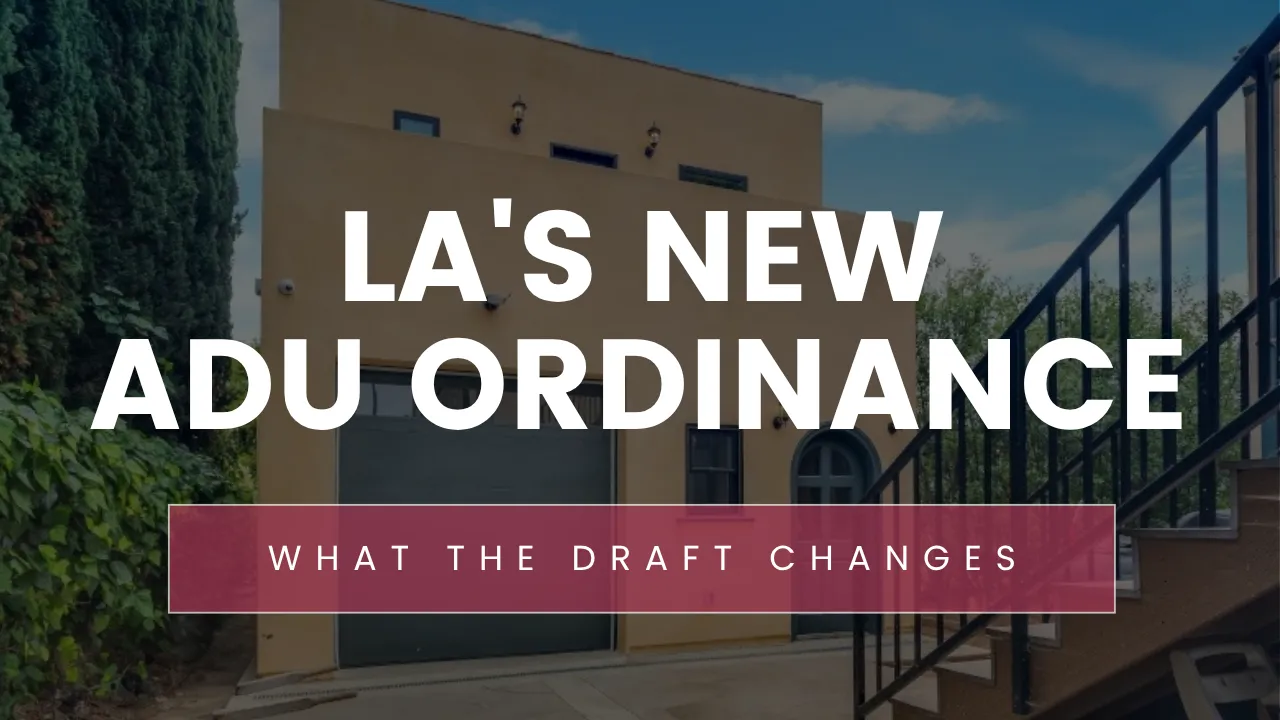
Los Angeles has released a draft rewrite of its ADU ordinance, LAMC §12.22 A.33, and for most homeowners it is a clear upgrade: it spells out how to stack state and city ADUs on one lot, adds a height bonus of up to 23 feet, creates a new “Opportunity ADU” for larger lots, and opens the door to selling an ADU as a condominium. We have designed and permitted 126 ADUs across Los Angeles County since 2017, and we read the draft line by line against the code it replaces. This guide covers what changes, what doesn’t, and what it means if you’re planning an ADU in the City of Los Angeles.
The city published the draft as a redline, with added text underlined and deleted text struck through. Every comparison below comes from that redline (dated September 3, 2026), the current LAMC §12.22 A.33 (Ordinance 186,481), or the state ADU statute at Government Code §§66310–66342, as amended through January 1, 2026.
What the Draft LA ADU Ordinance Does, and Where It Stands
This is a draft, not law yet. Until the City Council adopts it, the current LAMC §12.22 A.33 still governs, with state law filling any gaps. The ADU amendment is one of the four “Missing Middle LA” ordinances the city released as drafts in June 2026, alongside duplex and small-lot measures, and City Planning has scheduled a virtual public hearing on the package for October 1, 2026. Draft ordinances usually change before adoption, and this one still has some unfinished language in places. We’ll update this post when the final version is adopted.
Why LA is rewriting its ADU rules. The current ordinance took effect in December 2019. It still cites the old state section numbers (Gov. Code §65852.2), which the Legislature moved to §§66310–66342 in 2024 (SB 477). Since then, state law has added multifamily ADU counts, condo sales, legalization of older unpermitted units, and SB 543’s 2026 permitting changes. HCD, the state agency that reviews local ADU ordinances and can find them noncompliant (Gov. Code §66326), has reviewed Los Angeles’s ordinance more than once. Much of the old code works only because of a catch-all that says the ordinance “shall be interpreted to be compatible with state enactments.” The draft replaces those cross-references with the actual rules.
The biggest structural change is two categories of ADU. The draft sorts every ADU into one of two types (draft §12.03 and §12.22 A.33(b)(1)–(2)):
- State ADUs are the four types state law requires every city to approve (Gov. Code §66323(a)): a conversion ADU inside a single-family home or accessory structure plus a JADU inside the home; one new detached ADU of up to 800 sqft on a single-family lot; conversions of non-livable space in apartment buildings; and detached ADUs on multifamily lots.
- Ordinance ADUs are LA’s own category, governed by the city’s development standards. They can be larger: a detached ordinance ADU can be up to 1,200 sqft and two stories.
That split tells you which rulebook your project uses, and it is what makes combining ADU types on one lot possible (see below).
Old vs. New: The LA ADU Ordinance Side by Side
This table compares the current ordinance with the draft on the provisions that matter most to homeowners. “Draft” references are to the paragraphs of the proposed §12.22 A.33.
| Topic | Current LAMC §12.22 A.33 | Draft ordinance | Source |
|---|---|---|---|
| ADUs per lot | “Only one ADU per lot,” with state-mandated units allowed only by cross-reference | One ordinance ADU (plus one Movable Tiny House), combined with the state ADU types; bonus ADUs on qualifying lots | Draft (d)(4), (h)(5), (i)(5); §66323(a) |
| Detached ADU size | 1,200 sqft floor area, two stories max | Unchanged: 1,200 sqft, two stories max | Draft (e)(1)–(2) |
| Size floor the city can’t block | 800 sqft, 16 ft tall, 4-ft side/rear setbacks | 800 sqft of interior living space with 4-ft side/rear setbacks; front setbacks can’t block it either | Draft (d)(1)(iii); §66321(b)(3) |
| Height (ordinance ADUs) | Zone height district governs; 16-ft floor | The zone’s residential height limit or the state minimum, whichever is greater | Draft (d)(8); §66321(b)(4) |
| Height bonus | None | +3 ft for detached ADUs, capped at 23 ft | Draft (i)(1) |
| Setbacks | 4 ft side/rear; none for conversions or rebuilding in place | Same, plus existing structures can grow up to 2 ft in any direction with no added setback (except sideways into the 4-ft side/rear setback) | Draft (d)(7); (h)(1)(i) |
| Parking exemptions | Transit (½ mile walking distance), car share, historic district, within primary/accessory structure | Adds: on-street permits not offered, built together with a new home, and studios/units under 500 sqft; “walking distance” dropped from the transit test | Draft (d)(9)(i); §66322(a) |
| Hillside fire areas | No ADU in a Very High Fire Hazard Severity Zone that is also a Hillside Area, with exceptions | Same area, renamed “Fire Restriction Area,” but applied to ordinance ADUs; the sprinkler exception adds state Fire Safe Regulations (Title 14); the old clause extending the bar to state ADUs is deleted | Draft (d)(3); Low-Rise Ordinance |
| Front-yard placement | Only on through lots or in an existing garage/accessory building | Adds: allowed when 50%+ of the main house sits in the rear 35% of the lot | Draft (e), Location ¶(iii) |
| Selling an ADU | May be rented, not sold separately (state §66341 already allows nonprofit-built units to be sold as tenancy-in-common interests) | Opts in to condominium sales under §66342; restates the §66341 nonprofit route | Draft (l); §§66341, 66342 |
| Unpermitted ADUs built before 2020 | Enforcement delay only | Must be approved unless there’s a health-and-safety problem; no impact or connection fees to legalize, except a proportional connection charge where new utility infrastructure is required for health and safety | Draft (c)(6), (q)(5); §66311.7 |
| Permit timeline | 60 days, deemed approved | 15 business days to rule on completeness, 60 days to approve or deny, deemed approved if the city misses it | Draft (k)(2); §66317 |
The Biggest Wins for Single-Family Lots
Most of our clients own a single-family home in Los Angeles. For them, the draft does five things.
1. Clear rules for combining ADUs
State law already requires cities to approve a combination of state ADU types (Gov. Code §66323(a)). LA’s current code handles this only by pointing to old state section numbers, and it opens with “only one ADU per lot.” The draft says it directly: “A detached State ADU may be combined with an attached Ordinance ADU, or an attached State ADU can be combined with a detached Ordinance ADU,” and “one local ADU may be combined with the allowable combination of State ADU types” (draft (h)(5)). You can’t build two of the same type. That last rule is worth reading closely: you can’t build two of the same type, so a lot that already has a detached state ADU can only add an attached ordinance ADU. That is a local choice, not a state requirement. State law guarantees the §66323 stack plus at least one ordinance ADU, and it lets the city put objective standards on that ordinance unit (Gov. Code §66314(b)(1); HCD ADU Handbook, p. 18), but nothing in state law tells LA to make it attached. Outside the Bonus Program, the only way to put two detached units behind one house is the Opportunity ADU on a 7,500-sqft-or-larger lot in a Higher Opportunity Area (draft (i)(5)(i)).
Our view: the attached-only rule should go. We can’t find the problem it solves. A second detached unit uses the same setbacks, the same height limit, and the same lot-coverage math as the first one. What it changes is the kind of housing you get. Most LA homes weren’t designed to take on an attached unit; the result is usually a converted bedroom wing or a garage bump-out sharing a wall with the owner. A detached unit gives a renter a front door, a bit of yard, and daylight on all four sides, which is exactly what most people looking for a small rental want. Two detached ADUs behind a house is also the modern version of the cottage court, the small clusters of standalone homes around a shared garden that LA built by the hundreds in the 1920s and then zoned out of existence for most of the last century. Those courts still command a premium in Silver Lake, West Hollywood, and Pasadena, and they house more people per lot than one house and one garage apartment ever will. If the city wants ADUs to add real housing rather than spare rooms, the draft should let the ordinance ADU be detached whether or not the state unit is. That’s a comment worth submitting before the draft is adopted.
Start with what state law guarantees on its own: a conversion ADU, an 800-sqft detached ADU, and a JADU inside the house, all on one single-family lot (Gov. Code §66323(a)(1)–(2); HCD ADU Handbook, p. 17). The draft’s contribution is the ordinance ADU you can swap in or add. In practice, a typical LA lot with a detached garage could convert the garage under the state path and also build a detached ordinance ADU of up to 1,200 sqft and two stories, instead of settling for the 800-sqft state unit. A lot without a garage could build an 800-sqft state detached ADU with 4-ft setbacks plus an attached ordinance ADU. On either, the JADU can be added under §66323(a)(1) and draft (c)(4).
Real-World Example: The Garage-Plus-Backyard Lot
A 50×140 lot in the Valley with a detached two-car garage at the back. Under the draft, the owner converts the garage into a one-bedroom state ADU (existing footprint, with the draft’s 2-foot growth allowance or the Bonus Program’s setback option, draft (h)(1)(i) and (i)(2)), and builds a detached two-story ordinance ADU of up to 1,200 sqft elsewhere in the yard. That is two rentable units, both approved ministerially, with no replacement parking for the demolished or converted garage (draft (d)(9)(iii)).
2. A 3-foot height bonus, up to 23 feet
State law guarantees detached ADUs 16 feet, 18 feet within ½ mile walking distance of a major transit stop or high-quality transit corridor, plus 2 more feet to match the main house’s roof pitch (Gov. Code §66321(b)(4)(A)–(C)). The draft’s ADU Bonus Program adds 3 feet on top of those limits for detached state ADUs, and for ordinance ADUs where the state minimum applies, up to 23 feet as measured under the zoning code (draft (i)(1)). A 16-foot state ADU becomes 19 feet. That’s enough for a pitched roof, a sleeping loft, or vaulted ceilings instead of a flat box.
One catch: the Bonus Program opens with “one of the following benefits shall be approved.” Read literally, a project gets one bonus, not all of them. We expect this to be clarified before adoption.
3. Room to grow when converting a garage
State law lets a conversion ADU expand up to 150 sqft beyond an existing accessory structure, but only to accommodate ingress and egress (Gov. Code §66323(a)(1)(A)). The draft adds room in two places. First, no added setback is required when an existing structure is extended up to 2 feet in any direction, except sideways into the 4-foot side and rear setback (draft (d)(7)); the state-ADU conversion paragraph carries the same 2-foot language, though the redline still shows the 150-sqft state text alongside it (draft (h)(1)(i)). Second, a Bonus Program option lets a detached ADU made from an existing accessory structure keep the old structure’s setbacks and grow past the state expansion limit; only the new portion must meet the 4-foot setbacks (draft (i)(2)). Under the current “one bonus” wording, that may use up your bonus. For the many LA garages built right on the property line, it is still the difference between a cramped studio and a real one-bedroom.
The draft also allows an ADU in any existing enclosed or partially enclosed space within or beneath a permitted structure, including crawlspaces, attics, mezzanines, and underfloor areas, whether or not that space ever counted as floor area (draft (h)(6)). Hillside homes with large underfloor areas are the obvious winners.
4. Fewer parking and placement headaches
The draft adds three parking exemptions: when on-street parking permits are required but not offered to the ADU tenant, when the ADU is permitted together with a new home, and for any efficiency unit, studio, or ADU under 500 sqft (draft (d)(9)(i)(e)–(g)). The first two track Gov. Code §66322(a)(4) and (6). The studio exemption is LA going beyond state law. The draft also drops “walking distance” from the ½-mile transit exemption, which appears to allow a straight-line measurement; state law (§66322(a)(1)) uses walking distance. Replacement parking is waived for uncovered spaces as well as garages and carports (draft (d)(9)(iii)), which matches what Gov. Code §66314(d)(11) already requires.
On placement, a detached ADU may now go between the house and the street when 50% or more of the main house sits in the rear 35% of the lot (draft (e), Location, paragraph (iii); numbered (e)(2)(iii) in the redline). That fixes an awkward problem on deep lots where the old house sits far back and the only open land is in front.
5. No sprinkler trigger, no occupancy-change trap
ADUs and JADUs don’t need fire sprinklers if the main house doesn’t, and building one can’t force sprinklers into the existing home (draft (j)(7); Gov. Code §66314(d)(12), §66323(d)). Building an ADU also isn’t treated as a Group R occupancy change under the building code unless the building official makes a written, evidence-based health-and-safety finding (draft (j)(5)). Our ADU fire sprinkler guide covers the sprinkler rules in depth.
The New ADU Bonus Program: Opportunity ADUs and More
Beyond height and setbacks, the draft’s Bonus Program (draft (i)) creates new ways to add units. Each bonus ADU is recorded with an affidavit at the County Recorder and can’t be used to qualify for other state or local housing incentives (draft (i)(5)).
- Opportunity ADU. One additional ADU of any type on lots of 7,500 sqft or larger in a Higher Opportunity Area (the state TCAC opportunity map, used to identify high-resource neighborhoods), outside Fire Restriction Areas (draft (i)(5)(i)). Check your lot against the TCAC map before assuming you qualify.
- Affordable ADU Bonus. In a Transit Priority Area that is also a Moderate or Higher Opportunity Area, a project that reserves at least one ADU as a restricted affordable unit can build one ADU or JADU per 1,500 sqft of lot area, up to six, each up to 1,200 sqft. It isn’t available in Fire Restriction Areas, HPOZs, or the A and RA zones (draft (i)(5)(ii)). On a 7,500-sqft lot, that’s five units plus the house. This is an alternative track, not a stack: the draft grants these units “as an alternative to” the state and ordinance ADU provisions, and it also isn’t available where a Designated Historic Resource would be demolished.
- ADU on mixed lots. A lot with both a single-family home and a multifamily building can add one more ADU of any type, up to 1,200 sqft (draft (i)(5)(iii)).
- Two-unit developments. An SB 9 two-unit project (LAMC 12.22 A.30) can add an attached ordinance ADU, as long as the site never has more than one detached ADU (the second paragraph numbered (i)(4) in the redline; it ends mid-sentence and needs cleanup).
For small multifamily owners, the draft also restates the state rules: conversions of non-livable space in up to 25% of existing units (rounded to the nearest whole number), and up to eight detached ADUs, capped at the number of existing units (draft (h)(3)–(4), (i)(5)(v); Gov. Code §66323(a)(3)–(4)). Ground-floor commercial space in mixed-use buildings can become ADUs two years after its certificate of occupancy (draft (i)(5)(iv)).
Selling an ADU Separately: LA Opts Into ADU Condos
Under the current code, an LA ADU “may be rented but shall not be sold separate” from the house. State law lets cities go further: Gov. Code §66342 allows a city to adopt an ordinance letting the house and ADU be sold separately as condominiums. The draft does it (draft (l)(2)). Requirements include:
- Creation under the Davis-Stirling Common Interest Development Act and the Subdivision Map Act (draft (l)(2)(i)–(ii); §66342(a)–(b))
- A safety inspection of the ADU before the condo plan is recorded (draft (l)(2)(iii))
- Written consent from every lienholder, meaning your lender can say no (draft (l)(2)(iv))
- HOA board approval where an existing association covers the property (draft (l)(2)(vii))
- Notice, a right of first purchase, and relocation assistance for eligible tenants (draft (l)(3))
The city also can’t use an ADU condo map to require street dedications, new improvements, or correction of nonconforming conditions (draft (l)(5)). Separately, ADUs built by qualified nonprofits can be sold as tenancy-in-common interests under §66341, a state rule that applies today with no local opt-in (draft (l)(1) restates it).
Why this matters: an ADU you can sell is a different investment from one you can only rent. For homeowners weighing a larger two-story ADU, a future condo sale is a real exit that didn’t exist in LA before. Condo mapping takes time and money, so plan for it from the start rather than adding it later. See our ADU rental income guide for the rental side of the math.
What Didn’t Change and What to Watch
Two-story detached ADUs are still in. A detached ordinance ADU can still be up to 1,200 sqft of floor area and two stories, subject to the zone’s residential height limit (draft (e)(1)–(2), (d)(8)). That is the rule behind our two-story ADUs in Los Angeles, and it survives the rewrite. Floor-area limits for the whole lot still apply separately and can reduce what you can build (draft (e)(1)).
Hillside fire areas are still restricted for ordinance ADUs. Ordinance ADUs remain barred in a “Fire Restriction Area,” which the Low-Rise Ordinance defines as land in both a Very High Fire Hazard Severity Zone and a Hillside Area, unless the lot is in the Northeast LA or Silver Lake–Echo Park–Elysian Valley plan areas, or the ADU is sprinklered, has one off-street space, and fronts a street at least 20 feet wide (draft (d)(3)). The draft adds a fourth condition to that second exception: compliance with the State Minimum Fire Safe Regulations in Title 14 of the California Code of Regulations (draft (d)(3)(iv)). What changes is scope: the current code extends the fire-area bar to state-law ADUs through its old paragraph (h)(2), and the draft deletes that paragraph. The new fire rule sits under the development standards for ordinance ADUs, so as written, an 800-sqft state detached ADU or a conversion ADU under Gov. Code §66323(a) is no longer subject to it. That matches §66323(b), which bars cities from imposing standards on state ADUs that the statute doesn’t authorize. Whether the city intended that result is worth watching. If you’re on a hillside lot, confirm the fire designation before anything else.
Attached ADUs keep the 50% rule and gain a hard cap. An attached ordinance ADU still can’t exceed 50% of the existing house, and the draft adds a new ceiling of 1,200 sqft (draft (f)). Either way, the city can’t use floor-area limits to block one under 850 sqft (1,000 sqft with more than one bedroom) (draft (i)(3); Gov. Code §66321(b)(2)).
Language to watch before adoption:
- Draft (h)(1) allows “one state attached ADU or JADU” per single-family lot, while §66323(a)(1) says “one accessory dwelling unit and one junior accessory dwelling unit.” State law controls, and the draft’s own interpretation clause says the ordinance is read to be compatible with state law (draft (n); §66325).
- The “one of the following benefits” wording in the Bonus Program (above).
- Draft (q)(2) applies proportional impact fees to ADUs “of 750 square feet or more,” while state law exempts ADUs of 750 sqft or less and charges proportionally above that (Gov. Code §66311.5(c)(1)). At exactly 750 sqft, state law controls.
- Several draft paragraphs still contain overlapping edits from the redline and should be cleaned up in the adopted version.
Featured Project: A Two-Story ADU in West Adams
This West Adams project shows what the unchanged two-story rule can deliver in the City of Los Angeles: a 1,200 sqft, 3-bedroom, 2-bath detached ADU with an attached garage at ground level, designed for a family that had outgrown its 2-bedroom house. Under the draft, the same lot could also add a converted or attached unit through the state/ordinance combination rules. The ordinance change doesn’t just protect a building like this; it lets you build more alongside it.
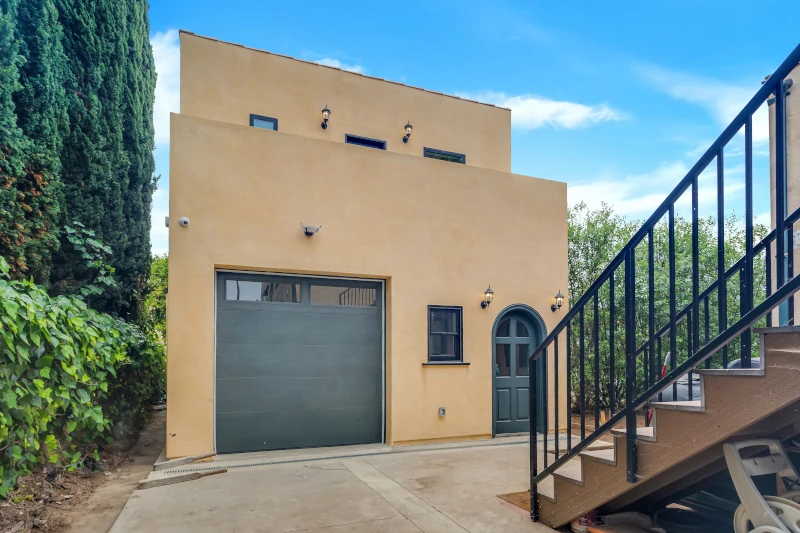
The West Adams two-story ADU: 1,200 sqft, 3 bedrooms, and an attached garage. Click through for the full case study.
What LA Homeowners Should Do Now
Don’t wait for adoption to start designing. Most of the draft puts in writing what state law already guarantees: the state ADU combinations (§66323), the 800-sqft/4-foot-setback floor (§66321(b)(3)), the 60-day deemed-approved clock (§66317), the parking exemptions (§66322), and the impact-fee exemption for ADUs of 750 sqft or less (§66311.5). Those apply today, with or without the new ordinance.
The parts that are new to LA, including the 3-foot height bonus, the Opportunity ADU, the 2-foot expansion allowance, the studio parking exemption, front-yard placement, and ADU condos, depend on adoption. If your project needs one of them, design with it in mind, but don’t submit on it until it’s law.
- Find out which rulebook fits your lot. Single-family or multifamily, lot size, fire designation, TCAC opportunity category, and distance to transit determine which ADU types and bonuses are available.
- Pick the combination before you pick a floor plan. A detached two-story ordinance ADU plus a garage conversion is a very different project from one 800-sqft state ADU.
- Start with a plan that works either way. Our Signature Home plans, including the two-story models, are designed around LA’s current rules, so a project doesn’t depend on the draft passing.
For the full state rulebook, see California ADU Rules in 2026. For the permitting steps and timeline, see our ADU permitting process guide and our Los Angeles ADU page. For how the new transit-area upzoning interacts with ADUs, read SB 79 in Los Angeles, explained.