
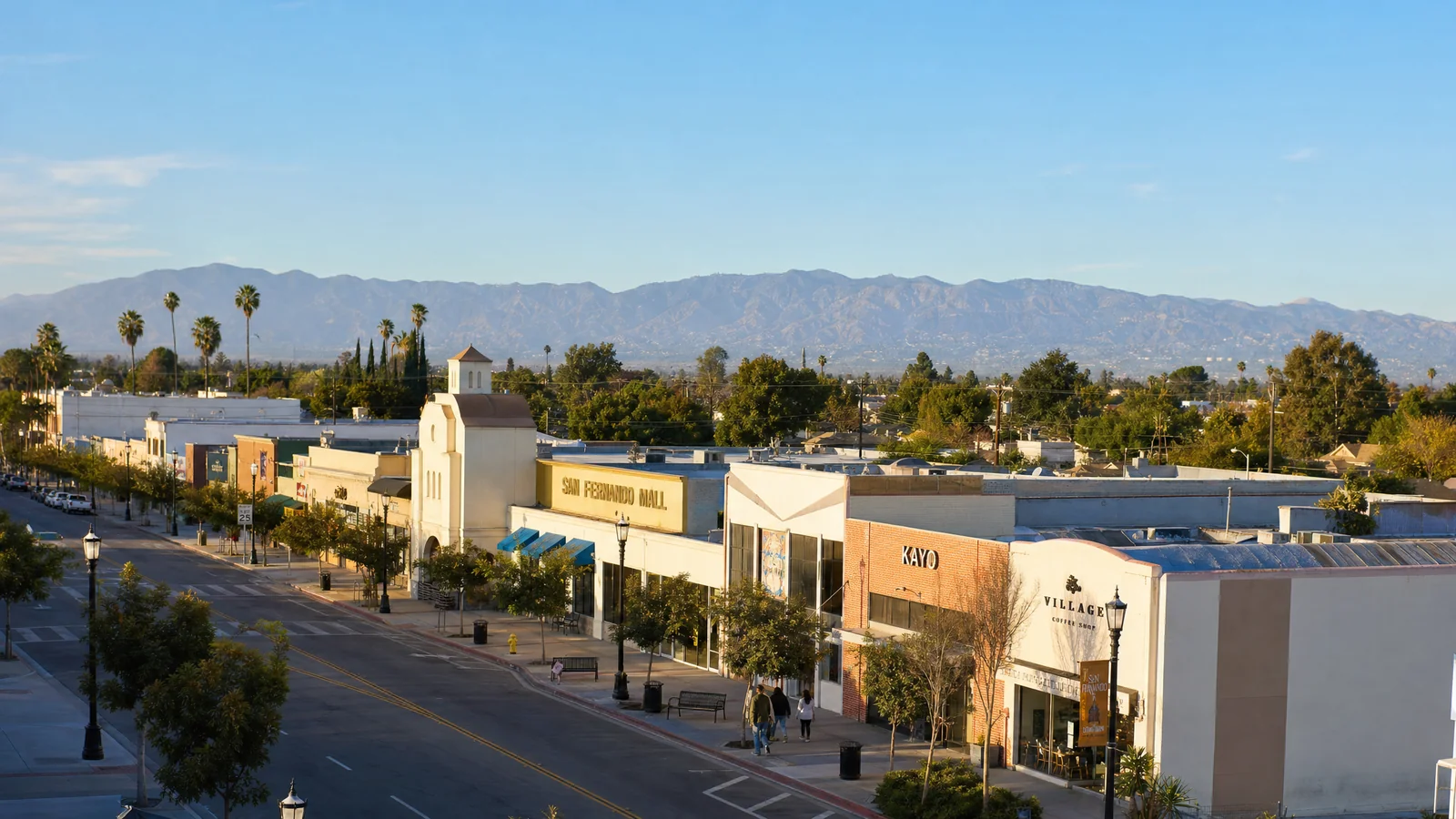
Building an ADU in San Fernando. Rules, costs, timeline.
What SFMC § 106-521 actually allows after the ordinance the City adopted in June 2026, why the code you will find online is still the old one, and what a build costs on a San Fernando lot in 2026.
What you can build — at a glance
Reviewed by CALI ADU’s ADU specialists · September 2026
- Max ADU size
- 850–1,200 sqft 850 sqft with one bedroom, 1,200 sqft with two or more. An attached or interior unit is also held to 50% of the main house; a detached unit is not. An 800 sqft unit is guaranteed either way.
- Detached height
- 18 ft + 2 ft pitch Granted citywide with no transit test — state law would only require 16 ft on a standard lot. The extra 2 ft applies where the roof pitch matches the main house. One story.
- Attached height
- 25 ft, 2 stories State law takes the lower of 25 ft and the zone limit for the main house. San Fernando’s R-1 zone allows 35 ft, so the full 25 ft is available.
- Side & rear setbacks
- 4 ft Four feet from side and rear lot lines. Front setback follows your zone — 20 ft in R-1. A conversion inside an existing structure needs no setback at all.
- Units per SFR lot
- 2 ADUs + 1 JADU One unit converted from existing space, one newly built detached unit, and one junior ADU, in combination — the full state stack, written into the local ordinance rather than left to preemption.
- Parking required
- None No parking and no replacement parking, for ADUs and junior ADUs alike. State law already bars any parking requirement on the § 66323 units; San Fernando extends that to every ADU in the city.
- Permit timeline
- 60 days Ministerial review, no hearing — and deemed approved if the City misses the 60 days. A completeness determination is owed in writing within 15 business days.
- Governing ordinance
- Ord. 1742 — not yet codified Adopted 6/15/2026, effective 7/15/2026. It renumbered the ADU rules from § 106-520 into §§ 106-520–106-523. The online municipal code still shows the superseded 2025 text.
- Detached Up to 1,200 sqft (2BR+) · 18 ft + 2 ft pitch, one story
- Attached Up to 1,200 sqft or 50% of the house, whichever is less · 25 ft
- Garage conversion Within the existing footprint · garage door must be removed
- Interior conversion Carved out of existing house or accessory structure · no setback
- Junior ADU Up to 500 sqft inside the primary dwelling (Gov. Code § 66313(d))
Per SFMC §§ 106-520–106-523, as restated by Ordinance No. 1742 (adopted June 15, 2026; effective July 15, 2026), and Gov. Code §§ 66310–66342. Cross-checked against the HCD ADU Handbook (March 2026). Full citations in the sections below.
On this page
Can I build an ADU in San Fernando?
Five things to know before you start
If you read nothing else on this page, read these. They are the five points that change the most San Fernando projects.
| What to know | Why it matters for your project |
|---|---|
| 1. The rules changed in July 2026, and the code you will find online has not caught up | Ordinance No. 1742 was adopted on June 15, 2026 and took effect on July 15. It rewrote the ADU rules and moved them from a single section, § 106-520, into four sections, §§ 106-520 through 106-523. The published municipal code is still current only through January 2026 and still shows the superseded text. Any advice citing “§ 106-520(6)” predates the change. |
| 2. Check that you are actually in the city | San Fernando is 2.4 square miles and completely surrounded by the City of Los Angeles. Sylmar, Mission Hills and Pacoima all carry San Fernando mailing addresses and are governed by Los Angeles rules, not these. The two codes differ on height, unit counts and parking, so confirm the jurisdiction of your parcel first. |
| 3. Parking is not required, and you do not have to qualify for that | SFMC § 106-521.I removes the parking requirement outright, for every ADU in the city. State law already bars any parking requirement on the § 66323 units; for an ordinance ADU under § 66314 it would otherwise allow one space unless the lot cleared a § 66322 exemption. Here there is no test to pass either way, and no replacement parking when a garage is converted. |
| 4. Detached means one story | A detached ADU is capped at 18 ft plus 2 ft where the roof pitch matches the house, and a unit above a garage is expressly limited to one story (§ 106-521.F.1.d). The 25 ft available to an attached ADU is the only two-story path on a San Fernando lot. Design around this before you fall in love with a floor plan. |
| 5. Two square-foot lines decide what you pay in fees | Under 500 sqft and school impact fees do not apply. At 750 sqft or less, impact fees do not apply at all (Gov. Code § 66311.5(c)). Above those lines the City’s fees attach (§§ 106-523.A.5–A.6). The jump from a 750 sqft unit to an 800 sqft one is not a design decision, it is a budget decision. |
First, confirm which city’s rules apply to your lot
We lead with a jurisdiction check here, and on no other city page. San Fernando is the LA-area address most likely to be the wrong one. The city occupies 2.4 square miles. It is ringed entirely by the City of Los Angeles. The postal boundary is much wider than the civic one, so a letter addressed to San Fernando may arrive at a house governed by the Los Angeles Municipal Code.
The difference is not academic. The two codes part ways on detached height, on how many units a lot may carry, and on the design standards a project must meet. If your parcel sits in Sylmar, Mission Hills, Pacoima or anywhere else outside the city limits, nothing on this page governs it. The San Fernando Community Development Department will confirm your parcel’s status. We confirm it for every project before we draw anything.
How many units a San Fernando lot can carry
SFMC § 106-521.F.1 permits all of the following on a lot with an existing or proposed single-family dwelling, in combination:
| Unit | How many | Conditions |
|---|---|---|
| Conversion ADU | 1 | Within the existing or proposed square footage of the house, or the existing square footage of an accessory structure, with its own exterior access (§ 106-521.F.1.a) |
| New detached ADU | 1 | Newly built and free-standing. An attached ADU may be built in its place instead (§ 106-521.F.1.b) |
| Junior ADU | 1 | Within the existing or proposed space of the house · up to 500 sqft · deed restricted (§§ 106-521.F.1.c, 106-522.A) |
That is two ADUs and a junior ADU on top of the house you already have. It is the combination Gov. Code § 66323(a)(1)–(2) obliges every California city to permit, and the HCD ADU Handbook (March 2026, p. 17) states it the same way. One detail is worth noticing. San Fernando wrote the stack into its own ordinance, rather than leaving homeowners to argue preemption at the counter. That matters when a plan checker is reading the local code and not the Government Code. One thing the local list does not say: on top of the three § 66323 units, a city must also allow at least one ordinance ADU under Gov. Code § 66314 (HCD ADU Handbook, March 2026, pp. 17–18). That is the unit the larger size caps on this page describe.
On a lot with an existing multifamily building the arithmetic is different and considerably larger: conversion units in non-livable space such as storage rooms, attics, basements or garages, up to 25% of the existing unit count with a minimum of one, plus up to eight detached ADUs, capped at the number of units already on the lot (§ 106-521.F.2). That eight-unit ceiling is SB 1211 (Gov. Code § 66323(a)(4)(A)(ii)), and San Fernando has codified it. A lot with a proposed multifamily building gets two detached units rather than eight (§ 66323(a)(4)(A)(iii)).
Owner-occupancy
You do not need to live on the property to build or rent an ADU. SFMC § 106-521.K says so directly, which is what Gov. Code § 66315 requires. The junior ADU is the exception, and San Fernando’s version of it is narrower than the rule still sitting in most cities’ codes: § 106-522.A.6 requires owner occupancy but waives it where the junior ADU and the primary dwelling have separate sanitation facilities, or where the owner is a government agency, land trust, or housing organization.
What can you build?
Every number below comes from SFMC §§ 106-521 and 106-522 as restated by Ordinance No. 1742, cross-checked against Gov. Code §§ 66310–66342 and the HCD ADU Handbook. On parking and on detached height San Fernando is more permissive than the state floor. On unit counts it matches the floor exactly. It falls below in one place only — the impact-fee paragraph at § 106-523.A.5 — and the city-rules section covers that.
Which ADU type fits your property?
San Fernando permits five types, and the right one is usually settled by your lot and your goal rather than by preference. Start here, then read the standards below against the type you land on.
| If this sounds like you | Start with | What that means |
|---|---|---|
| You have usable backyard and want the most space, privacy and rental value | Detached ADU | Up to 850 sqft with one bedroom or 1,200 sqft with two or more, 18 ft plus 2 ft for a matched pitch, 4-ft side and rear setbacks. Not subject to the 50% rule that binds attached units. |
| Your house is small and you still want two bedrooms | Detached ADU | The same 1,200 sqft ceiling, and critically no 50% test. On a 1,400 sqft house the 50% rule would cut an attached unit back to its 800 sqft floor; a detached one is not cut at all. |
| You want two stories, or the yard cannot take a separate building | Attached ADU | Up to 25 ft and two stories — the only two-story route in the city. Held to 850 or 1,200 sqft or 50% of the main house, whichever is less. |
| You have a garage or accessory structure you rarely use | Garage or interior conversion | No setback required where fire-safety clearances are adequate, no replacement parking, and up to 150 sqft of expansion for ingress and egress. The garage door has to come out and be replaced with windows or doors. |
| You are housing a family member and want the simplest, lowest-cost path | Junior ADU | Up to 500 sqft carved out of the house, deed restricted. Owner occupancy applies only if it shares a bathroom with the main home. May use an attached garage, never a detached structure. |
| You want the maximum the lot will carry | All three, stacked | A conversion ADU, a new detached ADU and a junior ADU may be combined on one single-family lot (§ 106-521.F.1). Most homeowners do not know this is permitted. |
Maximum size
| Standard | Limit |
|---|---|
| Detached ADU, one bedroom | Up to 850 sqft (§ 106-521.C.2) |
| Detached ADU, two or more bedrooms | Up to 1,200 sqft (§ 106-521.C.2) — no percentage-of-house test |
| Attached or interior ADU | 850 sqft with one bedroom or 1,200 sqft with two or more, or 50% of the main house’s gross floor area, whichever is less (§ 106-521.C.1) |
| Guaranteed floor | 800 sqft of interior livable space, which no local standard may be applied to prohibit (§ 106-521.B; Gov. Code § 66321(b)(3)) |
| Minimum size | 150 sqft, including a kitchen and at least one three-quarter bathroom (§ 106-521.D) |
| Junior ADU | Up to 500 sqft of interior livable space (§ 106-522.A.1; Gov. Code § 66313(d)) |
| Conversion of an existing accessory structure | May expand up to 150 sqft, and only to accommodate ingress and egress (§ 106-521.H.3) |
For a homeowner with a modest house, the gap in that table is the most useful thing on this page. The 50% test reaches attached and interior units only. San Fernando’s housing stock runs to compact post-war bungalows. On a 1,400 sqft house the 50% test would compute to 700 sqft — but the floor is 800 sqft, because no percentage-of-the-house rule may be applied to prevent an 800 sqft unit (§ 106-521.B; Gov. Code § 66321(b)(3)). A detached unit on the same lot may be built to 1,200. If the yard can take a separate building, going detached is worth 400 sqft of finished space.
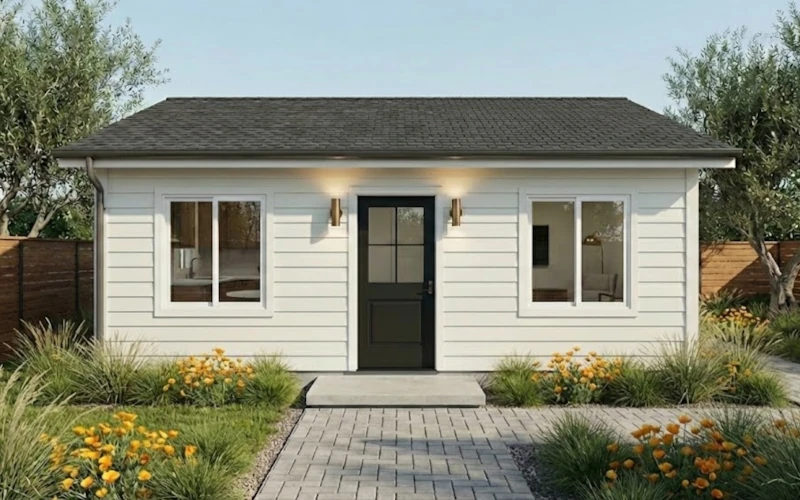
Height: 18 feet detached, 25 feet attached
| ADU type | Height limit |
|---|---|
| Detached ADU | 18 ft, plus 2 ft where the roof pitch aligns with the main house (§ 106-521.F.1.d) |
| Attached ADU | 25 ft (§ 106-521.F.1.d). Two stories is available on this path only |
| ADU above a garage | Expressly limited to one story, floor to ceiling (§ 106-521.F.1.d) |
| Detached, on a multistory multifamily lot | 18 ft plus 2 ft for roof pitch (§ 106-521.F.2.c) |
| R-1 limit for the main house | 35 ft (Table 106-43.2) — the figure that decides whether the attached 25 ft is real |
Two things here are worth reading slowly. The first is that the 18-foot detached allowance is a real local advantage. Gov. Code § 66321(b)(4)(A) only obliges a city to permit 16 feet on an ordinary lot. The 18-foot tier at § 66321(b)(4)(B) reaches only parcels within half a mile walking distance of a major transit stop or a high-quality transit corridor, and in most cities you have to prove your lot qualifies. San Fernando gives 18 feet to every detached ADU in the city, plus the 2-foot pitch bonus, with no transit test at all.
The second is that the 25-foot attached figure survives the state-law test. Gov. Code § 66321(b)(4)(D) caps an attached ADU at 25 feet or the zone’s height limit for the primary dwelling, whichever is lower. In a low-rise city that second number frequently collapses the 25-foot envelope to something much smaller. San Fernando’s R-1 zone allows 35 feet, so the lower of the two is 25 — and two stories attached is genuinely available, even alongside a single-story house.
Setbacks and separation
| Standard | Rule |
|---|---|
| Side and rear setbacks | 4 ft (§ 106-521.L.1) — the maximum a city may require (Gov. Code § 66314(d)(7)) |
| Front setback | Per the underlying zone — 20 ft in R-1 (Table 106-43.2). It may not be applied so as to block an 800 sqft unit (§ 106-521.B) |
| Conversions inside an existing structure | No setback required, where side and rear clearances are sufficient for fire safety as determined by the Los Angeles Fire Department (§ 106-521.L.2) |
| Above or as a second story to a garage | 4 ft from side and rear lot lines; front setback per the zone (§ 106-521.L.3) |
| Minimum lot size | None for an ADU (§ 106-521.A), notwithstanding the 7,500 sqft R-1 minimum lot size for subdivision purposes |
San Fernando contracts its fire service from the Los Angeles Fire Department. The ordinance names that department as the authority on whether a conversion’s existing clearances are adequate. On a narrow lot with an old detached garage close to a property line, that is not a formality. It is the finding that decides whether the conversion proceeds without a setback variance.
Parking
| Requirement | San Fernando rule |
|---|---|
| On-site parking for an ADU | None. Not required, in any zone, on any lot (§ 106-521.I) |
| On-site parking for a junior ADU | None (§ 106-522.A.4; Gov. Code § 66334(a)) |
| Replacement parking when a garage is converted | Not required (§ 106-521.I; Gov. Code § 66314(d)(11)) |
This is the cleanest rule in the ordinance, and worth stating plainly, because most California homeowners have been told otherwise. Two separate rules do the work. For the state-mandated units under Gov. Code § 66323 — the conversion ADU, the junior ADU and the detached unit up to 800 sqft — no California city may require parking at all (§ 66323(b); HCD ADU Handbook, March 2026, pp. 19, 33). For an ordinance ADU under § 66314, state law would allow one space unless the lot cleared an exemption in § 66322 — nearness to transit, a historic district, a car-share stop within a block. San Fernando does not impose the requirement on that unit either. On every path, then, there is no exemption to establish and no evidence to gather. On a compact lot that is worth real money in design freedom.
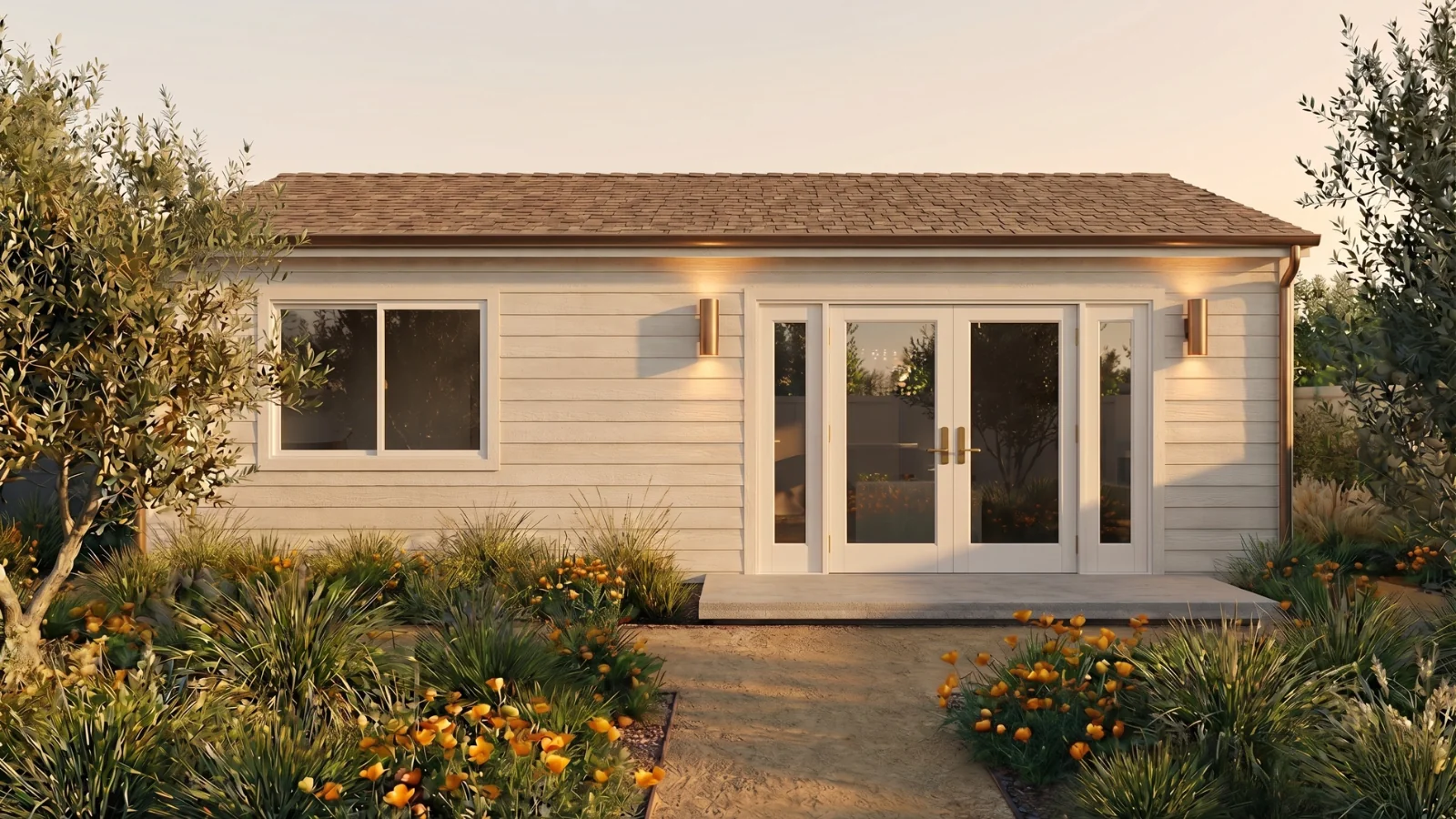
Your ADU has to look like your house
San Fernando is more prescriptive here than most cities, and it catches people out late. SFMC § 106-522.B.4 requires the materials and colors of the exterior walls, roof, windows and doors to match the primary dwelling, and requires the roof slope to match the dominant slope of the main house — defined as the slope shared by the largest portion of its roof. Exterior lighting is limited to down-lights. Landscape screening must be planted and maintained between the ADU and the side and rear lot lines (§ 106-522.B.7), and the unit needs a pedestrian path to the sidewalk at least four feet wide (§ 106-522.B.6). Where a garage is converted, the garage door must be removed and replaced with windows or entry doors (§ 106-522.B.3).
These are objective standards, which is the point of them. They are checked against a drawing at the counter, not argued at a hearing. But they do shape the design. The roof-slope rule in particular means your existing house decides the elevation, not your taste. It is one reason the pitched-roof variants of our plans do more work in San Fernando than the flat-roof ones. Read the next box before you treat any of it as fixed: on the state-mandated units these standards do not apply.
Three plans that permit as drawn
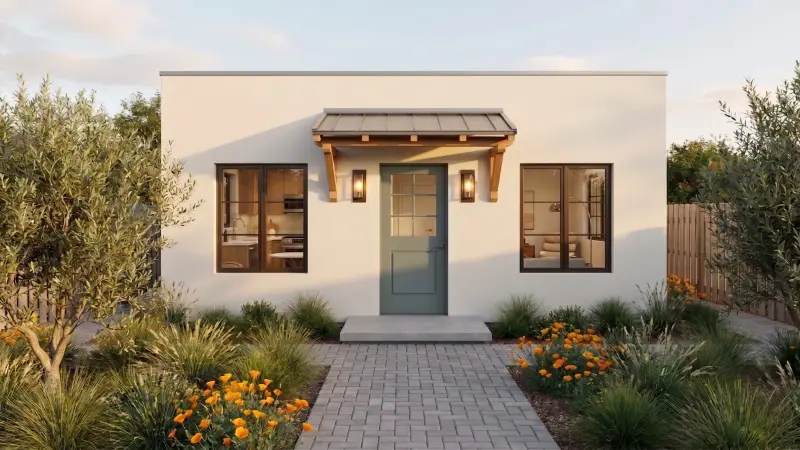
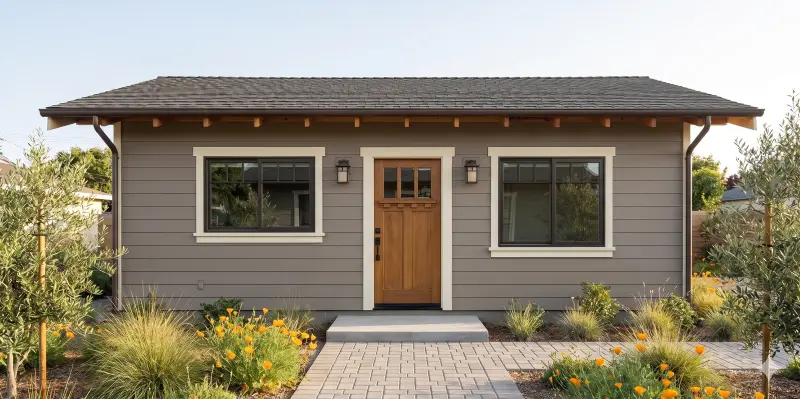
Single-story Signature Homes engineered to clear SFMC §§ 106-521 and 106-522 on paper — one under both fee lines, one two-bedroom that still clears the impact-fee line, one at family size.
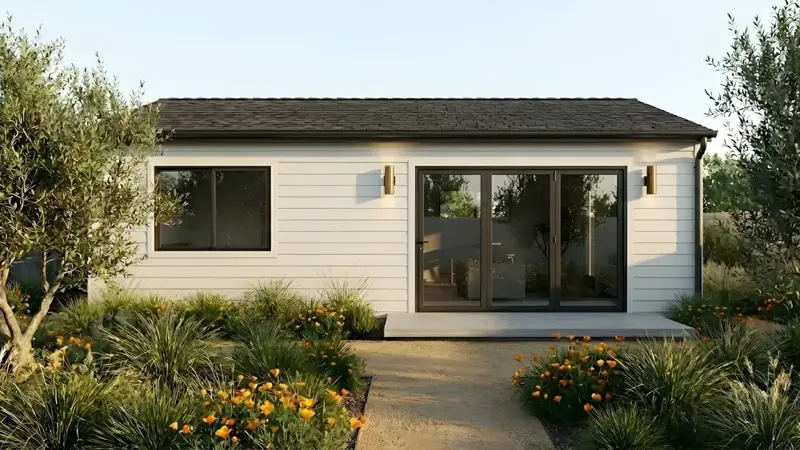
The Sunset
The Laurel Canyon
The Lincoln
Our two-story plans stand roughly 25 ft as free-standing buildings, so they cannot be permitted in San Fernando as drawn: the detached envelope is 18 ft plus 2 ft for a matched pitch, and an above-garage unit is capped at one story. They are not shown on this page for that reason. The single-story plans permit as-is, which is why they lead. A two-story plan can be modified to fit the 18-ft envelope, or we design a custom ADU from scratch, for a fixed design-and-permit fee of $9,990–$19,990.
Recent CALI ADU work that fits a San Fernando lot
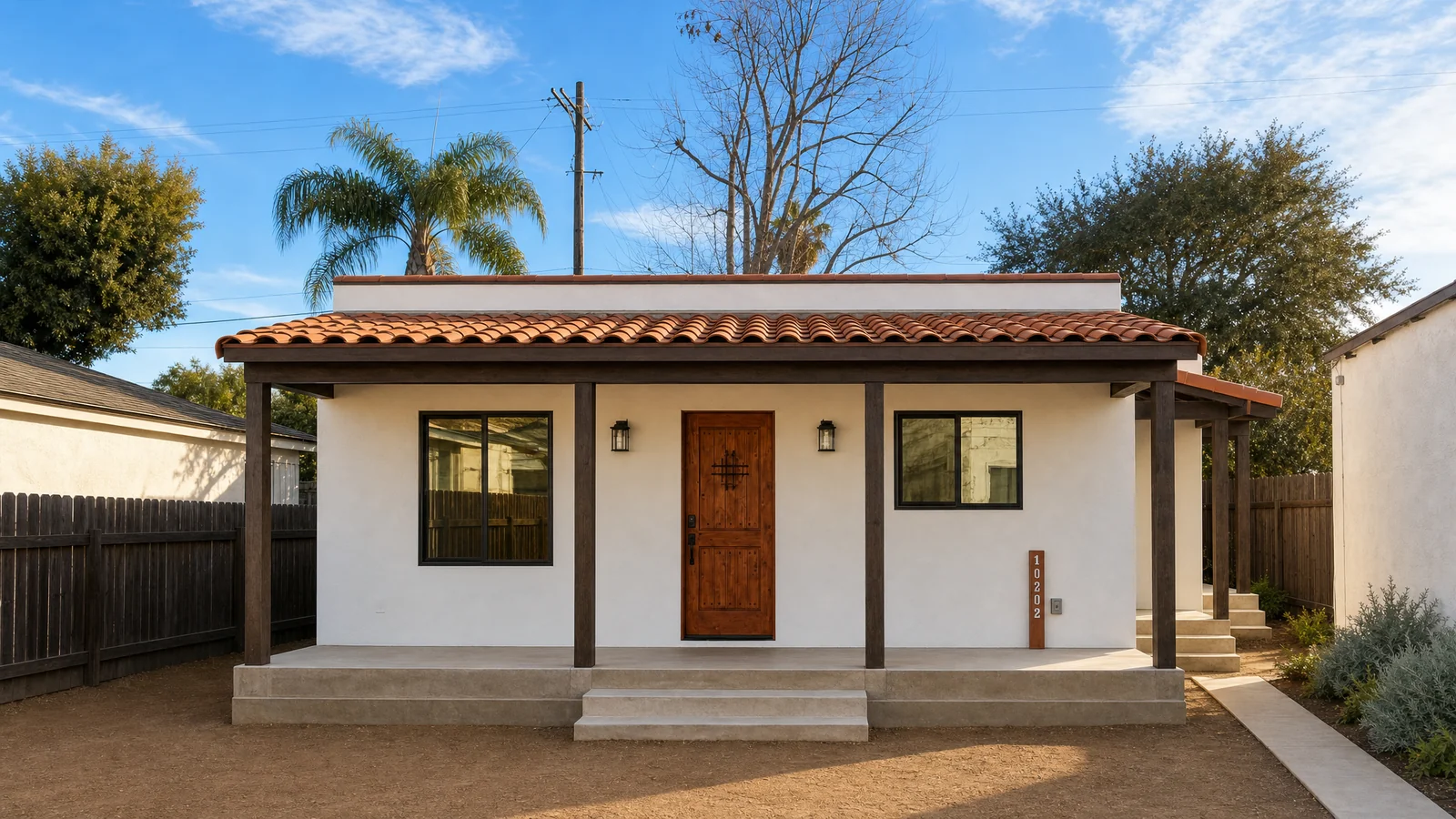
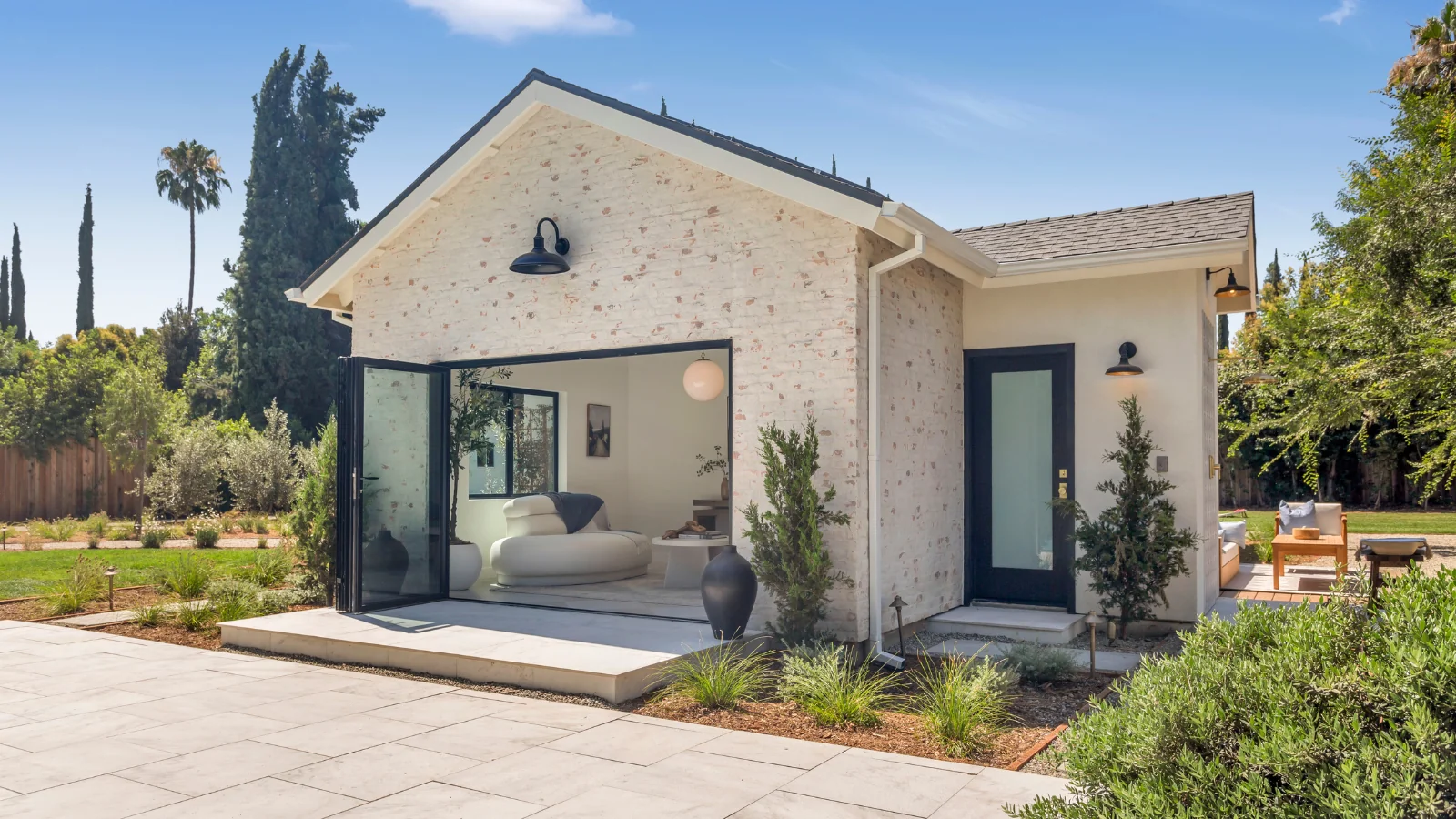
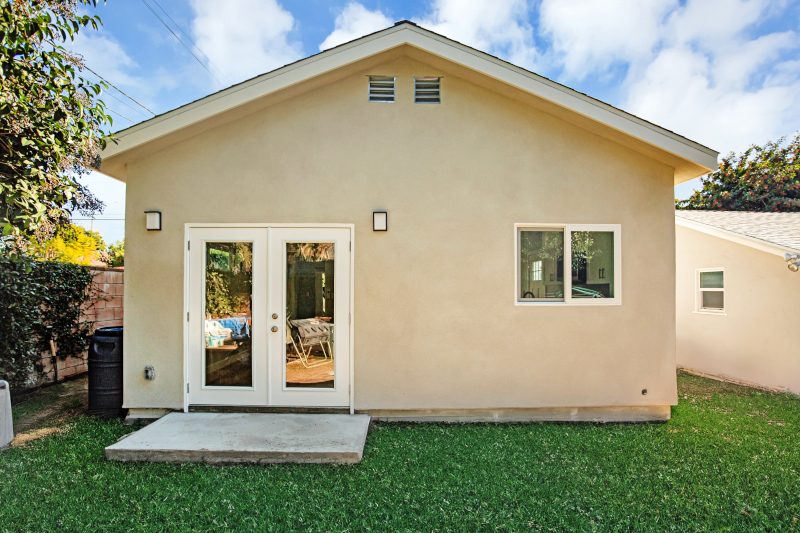
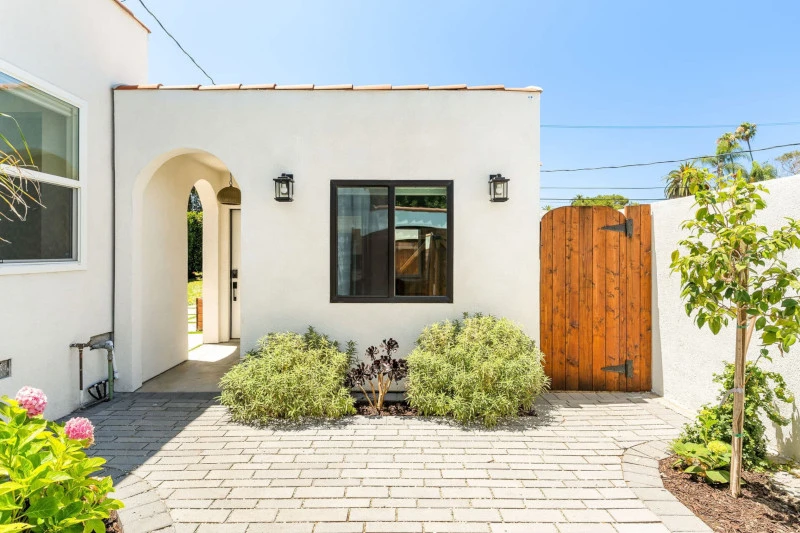
Single-story detached builds and garage conversions from our portfolio — the typologies that permit under an 18-ft detached envelope, and the Valley lots closest in character to San Fernando's.
What an ADU costs in San Fernando (2026)
Our Signature plans are fixed-price — architectural design and full permit processing included, the same number whether the lot is in San Fernando, Burbank or the Westside. Construction is separate: once your plans are permitted, you build with our construction partner or your own licensed contractor. The figures below are the estimated cost to build each model.
Only the six single-story plans appear here. The three two-story Signature Homes are detached buildings of roughly 25 ft and cannot be permitted on a San Fernando lot as drawn, so quoting them on this page would be quoting something you cannot build.
| Model | Configuration | Size | San Fernando fee position | Est. cost to build |
|---|---|---|---|---|
| The Wilshire | Studio / 1BA | 400 sqft | Under both fee lines | $180K–$200K |
| The Sunset | 1BR / 1BA | 480 sqft | Under both fee lines | $200K–$215K |
| The Westwood | 1BR / 1BA | 550 sqft | School fees apply · no impact fees | $215K–$235K |
| The Laurel Canyon | 2BR / 1BA | 660 sqft | School fees apply · no impact fees | $240K–$265K |
| The Melrose | 2BR / 2BA | 800 sqft | Both apply — over the 750 sqft line | $275K–$295K |
| The Lincoln | 3BR / 2BA | 1,000 sqft | Both apply · 200 sqft under the size cap | $325K–$350K |
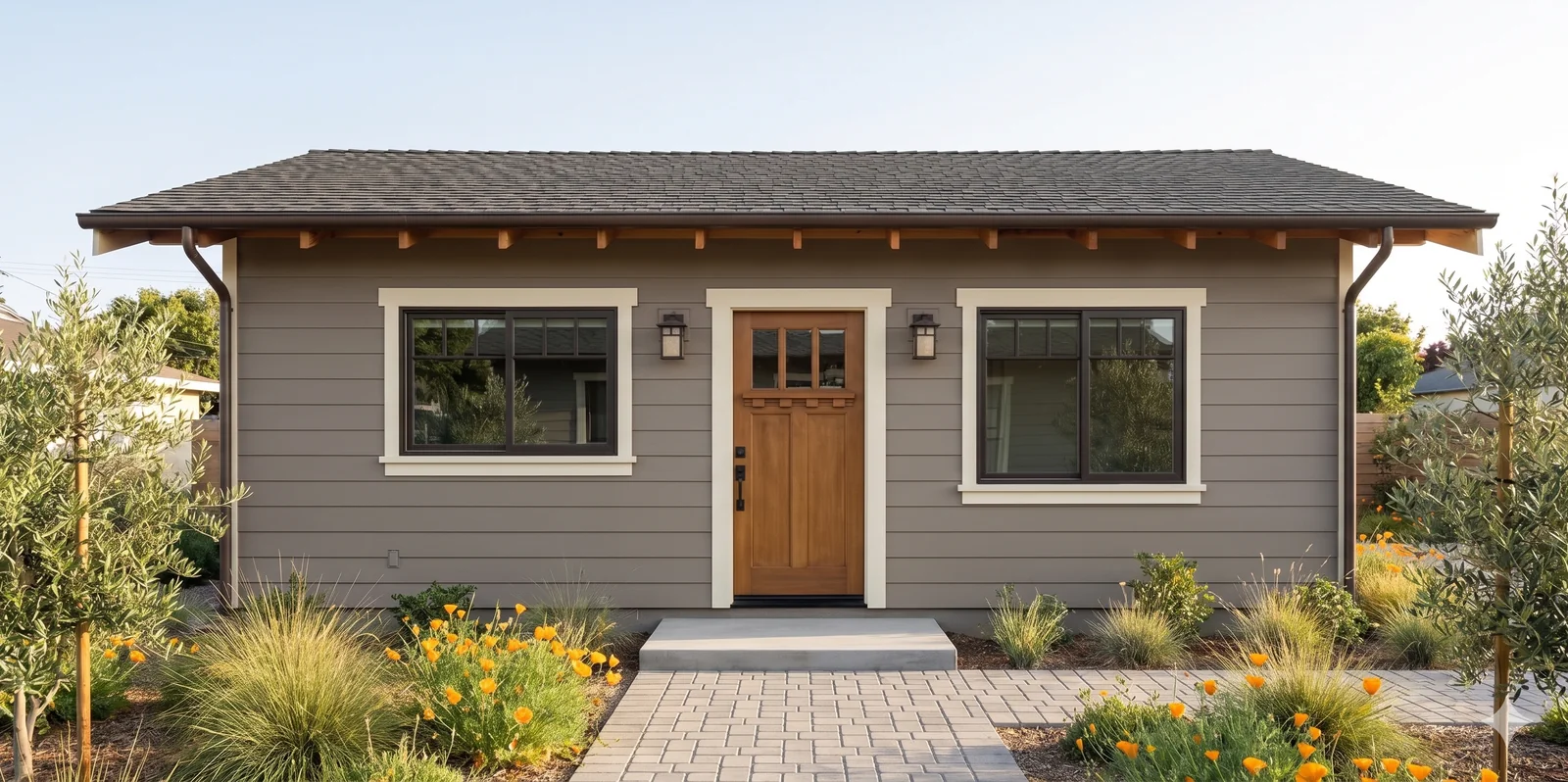
What is fixed is the plan: our Signature plan fees run $7,490 to $12,990 — architectural design and full permit processing included. We can price it because the Signature Homes were engineered to pass objective ADU standards on paper, and San Fernando’s standards are objective throughout. The build figures above are estimates. Your plans, your choice of builder.
For sizing and payback math, try our ADU calculator and the ROI calculator.
Development fees
Two square-foot thresholds do most of the work in San Fernando, and both come from state law before they come from the ordinance. An ADU of 750 sqft or less is exempt from impact fees entirely (Gov. Code § 66311.5(c)(1)). An ADU under 500 sqft is not subject to school impact fees (§ 66311.5(c)(3)). Above those lines, SFMC §§ 106-523.A.5 and 106-523.A.6 apply the City’s fees, and water and sewer connection and capacity charges are expressly excluded from the impact-fee calculation.
Separately, and regardless of size, § 106-523.A.4 requires an Address Assignment Request fee and application to the Public Works Department before the building permit issues. Standard building-permit and plan-check fees are based on project valuation rather than on the fact that you are building an ADU. We have not published dollar figures for those here because the City’s current fee schedule was not retrievable at the time of writing; confirm them with the Community Development Department, and your Backyard Review includes a line-item estimate of the pass-through costs for your specific lot.
What it returns: renting your ADU
San Fernando ADUs are long-term rental assets. Rentals of 30 days or less are barred (§ 106-521.K), which is also what Gov. Code § 66323(e) requires, so the income case has to be built on a 30-day-plus tenancy.
The trusted benchmark is HUD’s Fair Market Rent for the Los Angeles–Long Beach–Glendale metro area. A new, fully permitted detached ADU typically rents at or above the metro figure, because the comparison pool includes older and smaller stock across the whole county.
| Unit type | Typical ADU size | Signature plan at that size | HUD FMR (FY 2026, LA metro) |
|---|---|---|---|
| Studio | ~400 sqft | Wilshire | $2,079 |
| 1 bedroom | 480–550 sqft | Sunset, Westwood | $2,328 |
| 2 bedroom | 660–800 sqft | Laurel Canyon, Melrose | $2,903 |
| 3 bedroom | 1,000 sqft | Lincoln | $3,681 |
We have deliberately not published a San Fernando-specific rent spread alongside those figures. The HUD number is a government benchmark we can point you to and you can check; a city-level range would be our estimate wearing the same clothes. For payback math keyed to your lot and your financing assumptions, use the ADU ROI calculator.
HUD FMR figures: FY 2026 Fair Market Rents, Los Angeles–Long Beach–Glendale HUD Metro FMR Area, as revised effective May 21, 2026 (91 FR 21301, published April 21, 2026). Metro-wide across all housing stock and ages, so treat them as a floor rather than a forecast. Your specific ADU’s performance depends on finish level, lot, access and the rental market at the time you lease it.
Why the San Fernando market rewards the investment
- No parking requirement on any ADU path. State law already bars a parking requirement on the § 66323 units, and San Fernando extends that to the ordinance ADU as well. On a compact lot, not having to fit a stall is worth real square footage.
- Two ADUs and a junior ADU, codified locally. The stack is written into § 106-521.F.1 rather than left to a preemption argument at the counter. That is a materially easier permit conversation.
- Detached units escape the 50% rule. On San Fernando’s compact housing stock this is the single biggest lever on finished square footage.
- 18 ft detached, granted citywide. Two feet above the state floor, plus a pitch bonus, with no transit test — which buys usable ceiling height and better rooflines.
- A current ordinance. Ord. 1742 already reflects AB 1154, SB 1211 and SB 543. Many neighboring cities are still operating on pre-2025 text and resolving the gap by preemption.
- Ministerial approval is real. Meet the objective standards and the City has no discretion to refuse. No design review, no hearing, no neighbor appeal path.
When an ADU isn’t the right move
Not every San Fernando property is a good candidate, and it is cheaper to learn that now than after you have paid for plans. Four situations where we would tell you to wait, choose a different unit type, or not build:
- Your numbers depend on short-term rental income. They will not work. Rentals of 30 days or less are barred for both ADUs and junior ADUs (§§ 106-521.K, 106-522.A.7). Build the case on a 30-day-plus tenancy or reconsider the project.
- You need a two-story detached building. There is no path to one here. The detached envelope is 18 ft plus a pitch bonus and an above-garage unit is capped at one story. If two stories is non-negotiable and the unit cannot attach to the house, San Fernando is the wrong lot for that design.
- You want to sell the unit separately in the near term. San Fernando has not opted in to AB 1033, so the condominium route does not exist here (§ 106-521.K). Only the qualified-nonprofit conveyance under Gov. Code §§ 66340 and 66341 is available, which is not a homeowner exit.
- Your house is architecturally unusual and your budget is tight. The matching requirements at § 106-522.B.4 reach materials, colors and roof slope. Matching an unusual roof pitch or a discontinued finish adds cost that a standard plan does not carry, and it is better priced before design than discovered during plan check.
How long an ADU takes
Here is what the timeline actually looks like on a Signature plan:
| Phase | Duration | Notes |
|---|---|---|
| Signature plan preparation | ~2 weeks | Pre-engineered plan customized to your lot |
| City completeness check | 15 business days | SFMC § 106-523.A.1 — the City must deem the application complete or give you written notice with a list of what is missing and how to cure it. New in Ord. 1742; it mirrors SB 543 and Gov. Code § 66317(a)(2)(A) |
| Plan check & approval | 60 days to a decision | SFMC § 106-523.A.3 and Gov. Code § 66317(a), which also deems the application approved if the City neither approves nor denies it inside the 60 days. Ministerial — no hearing and no discretionary review. A pre-engineered plan clears plan check in weeks rather than months, because the review is a conformance check rather than a first reading. If the project is denied, the City must return a full list of comments with remedies |
| Construction | 4–6 months | By model size — under 600 sqft about 4 months, 600–800 about 5, over 800 about 6. The schedule is guaranteed in writing, with a daily delay penalty if the contracted finish date is missed |
| Total, start to finish | 6–9 months | Signature plans only. Custom designs add bespoke design time and a longer plan check, because the City is reviewing those drawings for the first time |
One genuine local advantage on the calendar: there is no Coastal Development Permit here, no very high fire hazard severity zone overlay in the ADU division, and no hillside review track. San Fernando sits on the flat valley floor and its ADU permit is a single ministerial path. The extenders that stretch coastal and foothill cities by months do not exist on a San Fernando lot. The one exception is a designated or eligible historic property, covered in the next section.
The rules that make San Fernando different
The ordinance that governs your project is not the one published online
On June 15, 2026 the City Council adopted Ordinance No. 1742, the zoning code update prepared under the City’s Housing Implementation Plan. It took effect on July 15, 2026. Among much else, it restated the ADU rules in full and broke them out of a single section into four.
The published municipal code has not been updated to match. It is current only through Ordinance No. 1738, adopted in January 2026, and still shows the superseded 2025 text under the old section number. Nothing on those pages warns that the rules have changed. Look up San Fernando’s ADU standards today, in the obvious place, and you will read last year’s ordinance.
| What you will find cited | Where the rule now lives | Covers |
|---|---|---|
| SFMC § 106-520 (all of it) | § 106-520 | Purpose and the state-law supremacy clause only |
| § 106-520(1)–(12) | § 106-521.A–L | ADU development standards — size, height, setbacks, parking, occupancy |
| § 106-520(13)–(14) | § 106-522.A–B | Junior ADU standards and the architectural requirements |
| § 106-520(15) | § 106-523 | Application process and review procedure |
Most of the substance carried across unchanged, which is why this matters less than it might. But three changes are real. Ord. 1742 added the 15-business-day completeness determination at § 106-523.A.1, which the 2025 ordinance did not contain. It added an express bar on denying a permit over nonconforming zoning conditions, building-code violations or unpermitted structures built before January 1, 2020 (§ 106-523.A.7) — the AB 2533 legalization pathway, now at Gov. Code § 66311.7 after SB 543 renumbered it. Both § 106-523.A.7 and the decision clock at § 106-523.A.3 still cite the pre-renumbering sections, which is a cross-reference slip rather than a substantive one. And it wrote the AB 1154 separate-sanitation carve-out into the junior ADU owner-occupancy rule at § 106-522.A.6. All three favor the applicant.
The impact-fee formula in the code does not match state law
This is the one place where the local text and the Government Code come apart, and it is worth knowing before you receive an invoice rather than after. Section 106-523.A.5 has two problems.
None of this makes San Fernando unusual in intent. The same drafting error appears in several LA County ordinances, and it reads as a transcription slip rather than policy. But the fee is worked out from the text unless someone raises it. If your unit is over 750 sqft, check the arithmetic on the invoice against the statute.
Historic properties and the Preservation Survey
San Fernando maintains a Historic Preservation Survey and a historic preservation division of the zoning code at Article III, Division 11 (§§ 106-490 and following). Under § 106-191, a project involving the alteration, demolition or relocation of an eligible historic resource identified in that survey must provide a historic evaluation of the property, and designated resources are subject to the Secretary of the Interior’s Standards for the Treatment of Historic Properties.
Most ADU projects never trigger it. A new detached unit in a back yard alters nothing on the survey. It becomes live when the project touches the historic building itself — a garage conversion on a designated property, an attached unit, or any work that removes or relocates a contributing structure. If your house is on the survey, find that out at the start rather than at plan check. A historic evaluation is a real schedule item, and the ADU permit is otherwise the fastest thing the City does.
Recent state-law changes and where San Fernando stands
California ADU law has been amended almost every year since 2017. San Fernando’s ordinance must comply with the current statute even where its own text has not been updated — and Ord. 1742 has brought most of it current. Here is where the recent changes land on a San Fernando lot.
| Bill | What changed | On a San Fernando lot |
|---|---|---|
| AB 1154 (eff. Jan 1, 2026) | Junior ADU owner-occupancy narrowed to units sharing sanitation facilities with the primary dwelling (Gov. Code § 66333(b)) | Already codified at § 106-522.A.6 — unusually current; most local ordinances still state the broader rule |
| SB 543 (eff. Jan 1, 2026) | 15-business-day completeness review and related timing (Gov. Code § 66317(a)(2)(A)) | Codified at § 106-523.A.1 by Ord. 1742 |
| SB 1211 (eff. Jan 1, 2025) | Up to eight detached ADUs on a lot with an existing multifamily dwelling; no replacement parking (Gov. Code § 66323(a)(4)(A)(ii)) | Codified at § 106-521.F.2.e, capped at the number of existing units |
| AB 2533 (eff. Jan 1, 2025) | Legalization pathway for unpermitted ADUs built before January 1, 2020 (now Gov. Code § 66311.7 after SB 543 renumbering) | Codified at § 106-523.A.7 — though the ordinance cites the pre-renumbering section |
| AB 1332 (program due Jan 1, 2025) | Every city must run a preapproved ADU plan program (Gov. Code § 65852.27) | Not established in the zoning code. The June 2026 rewrite creates no program; ask the City whether one runs administratively |
| AB 1033 (2023) | Cities may permit an ADU to be sold separately as a condominium (Gov. Code § 66342) | Not opted in. Separate sale is barred at § 106-521.K except the qualified-nonprofit conveyance under §§ 66340–66341, which is mandatory statewide |
Read as a whole, that table is a good result for a small city. San Fernando has written the recent owner-friendly changes into its own code rather than leaving them to preemption. That is the difference between a rule you can point to and a rule you have to argue for. Two items are still open: the preapproved-plan program and the AB 1033 opt-in. Neither one blocks a conventional ADU project.
How the permit process works
SFMC § 106-520 states the purpose of the ADU division as establishing standards and a ministerial review process, and § 106-523.A.3 requires the Building Division to approve or deny a complete application within 60 days where a single-family or multifamily dwelling already exists on the lot. If your plans meet the objective standards, the City has no discretion to refuse them. If it denies the application anyway, Gov. Code § 66317(d)(1) requires the City to give you an appeal process and a final written determination within 60 business days. Where the ADU application is filed alongside an application for a new primary dwelling, the ADU is still considered without discretionary review or hearing, but no ADU permit issues until the primary dwelling application has been decided.
The mechanics are straightforward. A completed building permit application goes to the Building Safety Division on the form the Building Official prescribes, and to be deemed complete the plans must comply with current development standards and any applicable department handouts (§ 106-523.A.2). Before the permit issues you submit an Address Assignment Request fee and application to Public Works (§ 106-523.A.4), and pay any impact and school fees that the size thresholds trigger (§§ 106-523.A.5–A.6). If the project is denied, the City must give you a full list of comments with the remedies needed to correct each deficiency.
The preapproved ADU plan program
AB 1332 required every California city to establish a preapproved ADU plan program by January 1, 2025 (Gov. Code § 65852.27). The Chapter 106 rewrite adopted in June 2026 contains no provision creating one. A city can run such a program administratively without codifying it, so the honest position is that we could not confirm one exists rather than that none does — ask the Community Development Department directly.
In practice the question matters less in San Fernando than in cities with slower counters. What makes a preapproved plan faster is the 30-day decision Gov. Code § 65852.27 gives to a plan the agency has preapproved, or one identical to a plan it approved before — which is also why such a plan gives you little room to change it. Our Signature Homes are individually permitted on your lot, engineered from the start to meet the objective standards in §§ 106-521 and 106-522 on paper, and adapted to your site’s setbacks, grade, utilities and existing structures — including the roof-slope match that § 106-522.B.4 requires and a catalog plan cannot anticipate.
San Fernando ADU questions, answered
The questions San Fernando homeowners actually ask before they start — with citations to SFMC §§ 106-520–106-523 (Ord. 1742) and Gov. Code §§ 66310–66342.
How big an ADU can I build in San Fernando?
A detached ADU may be up to 850 square feet with one bedroom, or 1,200 square feet with two or more bedrooms (SFMC § 106-521.C.2). An attached ADU, or one carved out of the existing house, gets the same 850 and 1,200 square foot ceilings but is also held to 50% of the main house’s gross floor area, whichever figure is smaller (§ 106-521.C.1). The 50% test applies only to attached and interior units — a detached ADU escapes it entirely, which on a small San Fernando house is often the difference between a one-bedroom and a two-bedroom. The floor in every case is 800 square feet: no local standard may be applied to block an 800 square foot unit (§ 106-521.B; Gov. Code § 66321(b)(3)). Minimum size is 150 square feet including a kitchen and a three-quarter bathroom (§ 106-521.D). A junior ADU is capped at 500 square feet of interior livable space (§ 106-522.A.1; Gov. Code § 66313(d)).
Can I build a two-story ADU in San Fernando?
Attached to your house, yes. A detached one, no. SFMC § 106-521.F.1.d caps a detached ADU at 18 feet plus an additional 2 feet where the roof pitch matches the main house, and separately limits an ADU above a garage to one story floor-to-ceiling. An attached ADU may reach 25 feet. Gov. Code § 66321(b)(4)(D) sets that attached ceiling at 25 feet or the zone’s height limit for the primary dwelling, whichever is lower, and San Fernando’s R-1 zone allows 35 feet (Table 106-43.2) — so 25 feet is the operative number and two stories attached is real here. Our two-story Signature plans are detached buildings of roughly 25 feet and cannot be permitted in San Fernando as drawn. A two-story plan can be modified to fit the 18-foot detached envelope, or we design a custom ADU from scratch.
How many ADUs can I build on a San Fernando single-family lot?
Two ADUs plus a junior ADU, on top of the house already standing. SFMC § 106-521.F.1 allows one ADU created within the existing square footage of the house or an existing accessory structure, plus one newly built detached ADU (or an attached one in its place), plus one junior ADU. That is the full combination Gov. Code § 66323(a)(1)–(2) requires every California city to permit, and the HCD ADU Handbook (March 2026, p. 17) confirms it. Most homeowners assume the limit is one unit. On a lot with an existing multifamily building the numbers are different and larger: conversion units in non-livable space up to 25% of the existing unit count, plus up to eight detached ADUs, capped at the number of existing units (§ 106-521.F.2).
Does San Fernando require parking for an ADU?
No — and there is no test to pass. SFMC § 106-521.I states that parking for an ADU and replacement parking are not required, full stop, and § 106-522.A.4 says the same for a junior ADU. For the state-mandated units under Gov. Code § 66323 — the conversion ADU, the junior ADU and the detached unit up to 800 square feet — no California city may require parking at all, and there is no exemption to establish (§ 66323(b); HCD ADU Handbook, March 2026, pp. 19, 33). Where San Fernando goes further is on the ordinance ADU under § 66314, for which state law would otherwise allow one space unless the lot cleared an exemption in § 66322. Here it does not. If you convert a garage, you do not have to replace the spaces it held (§ 106-521.I; Gov. Code § 66314(d)(11)).
Do I have to live on the property to build an ADU in San Fernando?
Not for an ADU. SFMC § 106-521.K states plainly that owner occupancy is not required, which matches Gov. Code § 66315. A junior ADU is the exception, and San Fernando’s rule is narrower than most cities still have on their books: § 106-522.A.6 requires owner occupancy but waives it where the junior ADU and the primary dwelling have separate sanitation facilities, or where the owner is a government agency, land trust, or housing organization. That separate-bathroom carve-out is AB 1154 (effective January 1, 2026, amending Gov. Code § 66333(b)), and San Fernando wrote it into the ordinance rather than waiting to be preempted. Give the junior ADU its own bathroom and the requirement does not reach you.
Can I rent a San Fernando ADU on Airbnb?
Plan on 30-day minimum tenancies. SFMC § 106-521.K bars using an ADU for rentals of 30 days or less, and § 106-522.A.7 states the same rule for junior ADUs without qualification. The ADU sentence in the adopted ordinance ends on the word "unless" and never states the exception it was reaching for — a drafting defect carried forward from the 2025 ordinance and not fixed by Ord. 1742. Because the exception has no text, there is nothing to rely on, and a 30-day floor is in any event what Gov. Code § 66323(e) requires the City to impose. Confirm your specific situation with the Planning Division before you count on anything shorter.
Can a San Fernando ADU be sold separately from the main house?
Generally no. San Fernando has not opted in to AB 1033, the state law that lets a city permit an ADU to be sold as a condominium (Gov. Code § 66342). SFMC § 106-521.K bars separate sale or conveyance with one exception written into the ordinance: a qualified nonprofit corporation may convey a unit separately to a qualified buyer under Gov. Code §§ 66340 and 66341. That nonprofit route is mandatory statewide and needs no local opt-in, so it is available in San Fernando the same as anywhere. The condominium route is not. Junior ADUs may not be sold separately in any case (§ 106-522.A.7).
How tall can a detached ADU be in San Fernando?
Eighteen feet, plus 2 more feet if the roof pitch is aligned with the main house — so 20 feet with a matched pitch (SFMC § 106-521.F.1.d). That is better than the state floor and worth understanding. Gov. Code § 66321(b)(4)(A) only obliges a city to allow 16 feet on a standard lot; the 18-foot tier at § 66321(b)(4)(B) reaches only lots within half a mile walking distance of a major transit stop or a high-quality transit corridor. San Fernando grants the 18-foot allowance and the 2-foot pitch bonus to every detached ADU in the city with no transit test at all. On a lot with an existing or proposed multistory multifamily building, a detached ADU gets the same 18 feet plus 2 feet (§ 106-521.F.2.c).
What are the setback requirements for a San Fernando ADU?
Four feet from the side and rear property lines (SFMC § 106-521.L.1), which matches the state maximum a city may require under Gov. Code § 66314(d)(7). The front setback follows your underlying zone — 20 feet in R-1 (Table 106-43.2) — but it cannot be applied so as to block an 800 square foot unit (§ 106-521.B; Gov. Code § 66321(b)(3)). An ADU built entirely inside the existing house or an existing accessory structure has no setback requirement at all, provided the side and rear setbacks are sufficient for fire safety as determined by the Los Angeles Fire Department, which serves San Fernando under contract (§ 106-521.L.2). A unit built above a garage still takes the 4-foot side and rear setbacks and the zone’s front setback (§ 106-521.L.3).
Will I pay impact fees on a San Fernando ADU?
Not at or below 750 square feet. Gov. Code § 66311.5(c)(1) exempts an ADU of 750 square feet or less from impact fees outright, and school impact fees do not reach a unit under 500 square feet (§ 66311.5(c)(3)). Above those lines SFMC § 106-523.A.5 and § 106-523.A.6 apply the City’s fees, and water and sewer connection and capacity charges are expressly carved out of the impact-fee calculation. Read the local text carefully on two points. It charges a unit of exactly 750 square feet, which state law exempts. And the worked example it gives for the proportional calculation divides the primary dwelling by the ADU, which is inverted — state law prorates the fee to the ADU’s share of the primary dwelling, not the reverse (HCD ADU Handbook, March 2026, p. 22). Both are addressed in the city-rules section on this page.
How long does it take to get an ADU permit in San Fernando?
The City must tell you within 15 business days whether your application is complete, and must approve or deny a complete application within 60 days (SFMC § 106-523.A.1 and § 106-523.A.3). Ord. 1742 added the 15-business-day completeness step, which the 2025 ordinance did not contain; it mirrors SB 543 and Gov. Code § 66317(a)(2)(A). Review is ministerial, so there is no hearing and no discretionary design review. On a pre-engineered Signature plan the realistic figure from first design to move-in is 6 to 9 months, most of which is the 4 to 6 months of construction. A custom design takes longer, because the City is reviewing those drawings for the first time.
Am I actually in the City of San Fernando, or in Los Angeles?
Worth checking before anything else, because a San Fernando mailing address does not settle it. The City of San Fernando is an independent 2.4 square mile city completely surrounded by the City of Los Angeles, and neighboring Los Angeles communities — Sylmar, Mission Hills, Pacoima — carry San Fernando postal addresses while being governed by the Los Angeles Municipal Code, not by SFMC §§ 106-520 to 106-523. The two sets of rules differ materially on height, unit counts and parking. Nothing on this page applies to a lot outside the city limits. Confirm the jurisdiction for your parcel with the San Fernando Community Development Department before you design anything.
Can I convert my garage into an ADU in San Fernando?
Yes, and it is one of the two units the ordinance lets you stack. SFMC § 106-521.F.1.a permits an ADU created within the existing square footage of the house or an existing accessory structure, and a conversion may expand by up to 150 square feet purely to accommodate ingress and egress (§ 106-521.H.3). No replacement parking is required (§ 106-521.I; Gov. Code § 66314(d)(11)). One specific local requirement to plan for: when a garage becomes an ADU or junior ADU, the garage door must be removed and replaced with windows or entry doors (§ 106-522.B.3). A junior ADU may use an attached garage but never a detached accessory structure (§ 106-522.A.3.a).
Does my ADU have to match my house in San Fernando?
Yes, and this is more prescriptive than most cities. SFMC § 106-522.B.4 requires the materials and colors of the exterior walls, roof, windows and doors to be the same as the primary dwelling, and requires the roof slope to match the dominant roof slope of the main house — the slope shared by the largest portion of its roof. Exterior lighting is limited to down-lights. Landscape screening must be planted and maintained between the ADU and the side and rear lot lines (§ 106-522.B.7), and the unit needs a pedestrian path to the sidewalk at least four feet wide (§ 106-522.B.6). These are objective standards, so they are checked at the counter rather than debated at a hearing — but none of them may be applied so as to prohibit the 800 square foot, 18-foot unit the ordinance itself guarantees (§ 106-521.B).
Does San Fernando have a preapproved ADU plan program?
Not one established in the zoning code. AB 1332 required every California city to run a preapproved ADU plan program by January 1, 2025 (Gov. Code § 65852.27), and the Chapter 106 rewrite adopted in June 2026 contains no provision creating one. A city can operate a program administratively without codifying it, so ask the Community Development Department directly rather than assuming there is none. In practice the distinction matters less here than elsewhere: a preapproved plan clears the counter faster because Gov. Code § 65852.27 gives it a 30-day decision, which is also why it leaves little room to change it, while our Signature plans are engineered to meet the objective standards in SFMC §§ 106-521 and 106-522 on paper and are adapted to your lot’s setbacks, grade and utilities.
Official sources
One caution about that list, and it is the reason this page exists in the form it does. The municipal code as published is not current for ADUs. It is codified through Ordinance No. 1738 (January 2026) and does not yet include Ordinance No. 1742. Where the two differ, the adopted ordinance governs; where the local rule falls below the state floor, state law governs (SFMC § 106-520; Gov. Code § 66316).
| Source | What it governs |
|---|---|
| City of San Fernando — Zoning Code Update (Ordinance No. 1742) (opens in a new tab) Adopted June 15, 2026 · effective July 15, 2026 · Chapter 106 clean copy (PDF, 275 pp.) — ADU division at §§ 106-520 to 106-523 | The binding text behind every local figure on this page: size caps, height, setbacks, parking, unit counts, architectural standards, and the application process. This is the document the published code does not yet reflect. |
| San Fernando Municipal Code, Chapter 106 (Zoning) (opens in a new tab) Municode · codified through Ord. No. 1738 (January 20, 2026), Supp. 43 — the ADU division shown here is superseded | The zoning chapter as published, including the residential zone standards at Table 106-43.2, the historic preservation division at Article III Division 11, and the two-unit (SB 9) provisions at § 106-762. Useful for everything except the ADU sections. |
| California Government Code §§ 66310–66342 (opens in a new tab) California Legislative Information · renumbered from former § 65852.2 et seq. by SB 477, eff. March 25, 2024 | State ADU law — the floor every city must meet. Source for the 60-day ministerial clock, the owner-occupancy and parking preemptions, the 800 sqft entitlement, the unit stack and the impact-fee exemption. |
| HCD ADU Handbook (opens in a new tab) California Department of Housing and Community Development · updated March 2026 | The state’s official interpretation of that law, and the position that controls when a local rule reads more narrowly. Every regulatory claim on this page was cross-checked against it. |
| City of San Fernando — Community Development (opens in a new tab) sanfernando.gov · Planning and Building Safety Divisions | Submittal information, department handouts, the current fee schedule, the Objective Design Standards, and confirmation of whether a given parcel is inside the city limits. Start here to confirm anything with staff directly. |
Last verified against primary sources on September 8, 2026. State ADU law changes every January 1, and San Fernando’s own ADU provisions changed in July 2026 without the published code following. If you are reading this six months from now, confirm the current version before you commit to a design — or call us and we will confirm it for you.
Not sure what your lot
can actually support?
Get clarity before you spend anything on plans. In 15 minutes we will pull up your property, confirm you are inside the San Fernando city limits, run the § 106-521 numbers against your lot, and give you an honest read on your options and a realistic budget — including whether an ADU is the right move at all.
15-minute video call · No obligation