Table of Contents
For most Los Angeles homeowners, an ADU is the faster, cheaper, less restricted way to add a home, and SB 9 only wins when you need something an ADU legally can’t give you: a unit you can sell on its own lot, a second home bigger than the ADU caps, or the absolute maximum unit count on the lot. We have designed and permitted ADUs across Los Angeles since 2017, and we design SB 9 homes too, so this is the comparison we walk homeowners through before they spend a dollar on plans.
Every rule below is cited to the law itself: Government Code §65852.21 (SB 9 two-unit developments), §66411.7 (SB 9 urban lot splits), the State ADU Law in §§66310–66342, HCD’s March 2026 ADU Handbook, and the City of Los Angeles’s own SB 9 implementation guidance. Where the City’s practice differs from the state floor, we say so.
ADU vs. SB 9: The 30-Second Answer
Start with what you want the property to do, not with the law. The goal picks the path.
| Your goal | Best path | Why |
|---|---|---|
| Rental income or family housing, keep one property | ADU | No owner-occupancy affidavit, no City impact fees at 750 sqft or less, one permit at LADBS |
| Sell a home separately | SB 9 lot split | Creates a second legal parcel; an ADU can’t be sold separately without a city condo ordinance |
| A second home bigger than 1,200 sqft | SB 9 two-unit development | SB 9 guarantees 800 sqft and lets the unit grow to the zone’s floor-area limit |
| Most units on one lot, one title | SB 9 two-unit development plus ADUs | HCD confirms the two laws stack when the lot isn’t split |
| Lot was tenant-occupied in the last three years | ADU | SB 9 can’t demolish or alter tenant-occupied housing |
| Property in the Palisades Fire area’s very high fire zone | ADU | SB 9 applications are suspended there |
Two Different Laws: What an ADU Is and What SB 9 Is
An ADU is an accessory unit. It shares the primary home’s lot and title. Los Angeles allows detached ADUs up to 1,200 square feet and two stories on single-family lots (LAMC §12.22 A.33(d)), and state law guarantees certain ADUs regardless of the local ordinance (Gov. Code §66323).
SB 9 creates primary homes, not accessory units. Passed in 2021 as Chapter 162, it added two tools that work only in single-family zones:
- Two-unit development (§65852.21): up to two primary homes on one single-family lot, approved ministerially “without discretionary review or a hearing.” Adding one new home next to an existing house counts (§65852.21(i)(1)).
- Urban lot split (§66411.7): a parcel map that divides one lot into two, each of which can then carry up to two units.
In Los Angeles, SB 9 applies in the RA, RE, RS, R1, RU, RZ, and RW zones (LA City Planning, Implementation of SB 9 memo, rev. March 16, 2023). You can check a specific address in ZIMAS: open “Planning and Zoning” and look for the “SB 9 Eligibility” entry.
Don’t confuse the two SB 9s.
A second, unrelated SB 9 (Chapter 510, Statutes of 2025) voids a city’s ADU ordinance if the city doesn’t submit it to HCD on time (Gov. Code §66326(d); HCD ADU Handbook, March 2026, p. 45). This post compares the 2021 lot-split and duplex law.
ADU vs. SB 9 in Los Angeles: Side-by-Side Rules
| Rule | ADU | SB 9 unit | Source |
|---|---|---|---|
| Who approves it in LA | LADBS plan check | Two-unit: LADBS plan check. Lot split: City Planning parcel map, then LADBS | LA SB 9 memo §IV |
| Decision deadline | 60 days from a complete application | 60 days, or the application is deemed approved | §66317; §65852.21(h)(1); §66411.7(b)(1)(B) |
| Size | Detached up to 1,200 sqft in LA; state-guaranteed detached unit up to 800 sqft | At least 800 sqft guaranteed; larger up to the zone’s floor-area limit | LAMC §12.22 A.33(d)(1); §66323(a)(2); §65852.21(b)(2)(A) |
| Height | 16 ft state floor; LA allows two-story detached ADUs on single-family lots | Underlying zone height limit | §66321(b)(4); LAMC §12.22 A.33(d)(2); §65852.21(b)(1) |
| Side and rear setbacks | 4 ft max; none for conversions or rebuilds in place | 4 ft max; none for existing structures or rebuilds in place | §66314(d)(7); §65852.21(b)(2)(B) |
| Front setback | Can’t block an 800-sqft ADU | Zone’s front yard, plane break, and encroachment plane still apply | §66321(b)(3); LA SB 9 memo §III |
| Parking | Max one space; none within ½ mile of transit and other exemptions | Up to one covered space per unit; none within ½ mile walking of high-quality transit or a major stop, or with a car share within one block | §66322; §65852.21(c)(1); LA SB 9 memo §III |
| Impact fees | No City impact fees, including park fees, at 750 sqft of interior livable space or less; school fees can apply above 500 sqft | LAUSD school fee, park fee ($8,928 per new home; $18,216 after a split), and Affordable Housing Linkage Fee may apply | §66311.5(c)(1)–(2); HCD Handbook p. 22; LA SB 9 FAQ Q28; LA Rec. & Parks fee schedule (July 1, 2026) |
| Owner-occupancy | None for ADUs | Two-unit: none. Lot split: three-year affidavit | §66315; §66411.7(g)(1) |
| Short-term rental | City may require terms over 30 days | Terms over 30 days required | HCD Handbook p. 36; §65852.21(e); §66411.7(h) |
| Sell separately | No, unless the city adopts a condo ordinance | Yes, after a lot split | §66314(d)(1); §66342; §66411.7 |
| Grounds for denial | Must meet objective standards; ministerial | Only a written finding of a specific, adverse impact on public health and safety that can’t be mitigated | §66317; §65852.21(d); §66411.7(d) |
Fees are where the two paths really split apart, and the lot split is what drives it. An ADU of 750 square feet of interior livable space or less pays no City impact fees (Gov. Code §66311.5(c)(1)), park fees included (§66311.5(c)(2)), and LA’s park fee ordinance exempts ADUs outright (LAMC §12.33 C.3(e)). School districts are the exception: they may charge ADUs over 500 square feet (HCD ADU Handbook, March 2026, p. 22), and LAUSD does. An SB 9 home is a primary dwelling, and City Planning says SB 9 units “will be assessed” applicable impact fees such as the LAUSD fee, the park fee, and the Affordable Housing Linkage Fee (SB 9 FAQ, Q28).
Real-World Example: An ADU and an SB 9 Home on the Same Lot
On a Woodland Hills RA lot we permitted in 2026, the owner added an 800-sqft detached ADU and an 800-sqft SB 9 home, with no lot split. The building-permit fees paid in September 2026 were nearly identical: $6,576 for the ADU and $5,942 for the SB 9 home, each including LAUSD’s school fee, with no linkage fee charged on either. The SB 9 home also paid a $1,528 sewer facility charge to the Bureau of Engineering. The park fee isn’t collected on the building-permit receipt, so confirm it with Recreation and Parks for your lot. Without a split, SB 9 costs about the same as an ADU to permit.
A lot split changes the math. Here is what the City charges, at current rates, for a split with two new 1,200-sqft homes on the new parcel:
| City fee | Amount | Source |
|---|---|---|
| Lot split approval: City Planning case fee, Bureau of Engineering review, other agencies’ map fees | About $10K–$20K | SB 9 FAQ Q28 (Administrative Review – Major; see the City’s Fee Estimator); BOE takes a $5,000 deposit for SB 9 review |
| Park fee, subdivision rate | $18,216 × 2 = $36,432 | LA Rec. & Parks fee schedule, effective July 1, 2026 |
| LAUSD school fee | $5.38/sqft × 2,400 sqft = $12,912 | LAUSD rate effective Aug. 11, 2026 |
| Total | About $59K–$69K | Plus the linkage fee where it applies, which varies by market area |
Where SB 9 Beats an ADU
1. You can sell the new home
This is the main reason to use SB 9. A lot split creates a second legal parcel with its own title. An ADU stays on the primary home’s title: it can’t be sold separately (Gov. Code §66314(d)(1)) unless the city adopts a condominium ordinance under §66342. Los Angeles’s September 2026 draft ADU ordinance would opt into ADU condos (we break that down in our analysis of the new LA ADU ordinance), but until it is adopted, the lot split is the only ministerial way to create a separately sellable home on a single-family lot in the City.
2. A bigger second home
LA caps a detached ADU at 1,200 square feet (LAMC §12.22 A.33(d)(1)). An SB 9 home has no separate size cap. It’s a primary dwelling limited by the zone’s Residential Floor Area, and the City must allow each unit at least 800 square feet (§65852.21(b)(2)(A)). Where the existing house has already used most of the lot’s floor area, City Planning allows a two-unit development to exceed the limit by the gap between 800 square feet and what’s left; a unit over 800 square feet gets no such allowance (SB 9 FAQ, Q7). On a large R1 lot with a modest house, that can mean a 1,500- or 1,800-square-foot second home that an ADU could never be.
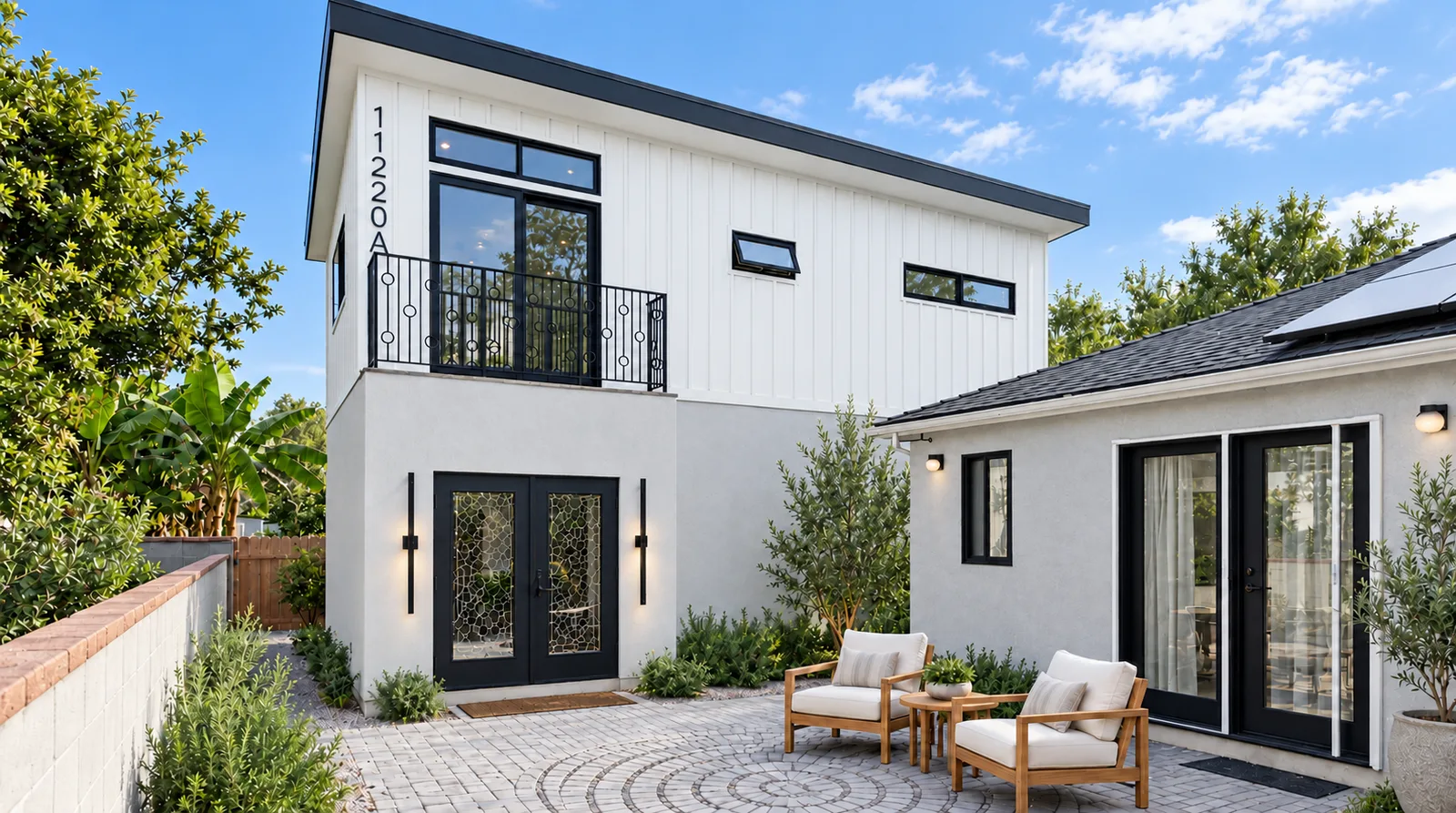
A two-story ADU designed by CALI ADU, sharing a courtyard with the main house. Under 1,200 sqft, the ADU path is usually simpler; above it, SB 9 is the tool.
Where SB 9 Loses in Los Angeles
The disqualifiers
SB 9 has disqualifiers that ADUs don’t:
- Tenants. SB 9 can’t demolish or alter housing occupied by a tenant in the last three years, rent-controlled housing (in LA, units under the Rent Stabilization Ordinance), or deed-restricted affordable housing (§65852.21(a)(3); §66411.7(a)(3)(D)).
- Ellis Act. A lot where rental units were withdrawn under the Ellis Act in the past 15 years is out (§65852.21(a)(4); §66411.7(a)(3)(D)(iii)).
- Sensitive sites. SB 9 borrows the site exclusions of §65913.4(a)(6)(B)–(K): wetlands, hazardous waste sites, flood zones and floodways, conservation and habitat areas, and others, with exceptions for fire and earthquake fault zones when the project meets current fire-hazard mitigation or seismic standards (§65852.21(a)(2)). Los Angeles screens for protected habitat and may require a biologist’s statement (forms CP-3608 and CP-3610).
- The Palisades. Executive Order N-32-25 suspended SB 9 in very high fire hazard severity zones inside the Palisades and Eaton fire boundaries, and Mayor Bass’s Emergency Executive Order No. 9 (July 30, 2025) stopped the City from accepting SB 9 applications in the Palisades Fire area’s very high fire zones. As of October 2026, the Mayor’s office still lists EO 9 among its emergency orders, and no later order revises or rescinds it. ADUs aren’t affected by either order.
- Historic properties. AB 1061, effective January 1, 2026, narrowed the old blanket exclusion. A two-unit development is now barred only from a contributing structure in a historic district and from individually listed or landmarked properties (§65852.21(a)(5)); a lot split is barred from landmark sites and from demolishing or altering a contributing structure or an existing exterior structural wall in a historic district (§66411.7(a)(3)(E)–(F)). City Planning now applies this to HPOZs: a two-unit development is allowed on an HPOZ lot improved with a non-contributing structure, and a lot split is allowed if it doesn’t demolish or alter a contributing structure or an exterior structural wall (SB 9 FAQ, Q3). Objective HPOZ design standards still apply (§65852.21(b)(4)).
The hidden costs of a lot split
The statute says the City can’t require street dedications or off-site improvements as a condition of the parcel map (§66411.7(b)(3)). LA’s memo adds the catch: those requirements “would still apply for the construction of residential units.” In practice, the bill can come due at the building permit instead. Then there’s the split itself: on our projects, surveying, engineering, the parcel map, and coordination are estimated at $30K–$45K before any home is designed. Add parcel map fees from other City agencies, and separate water and power for units on separate lots (LADWP requires separate service once the lots are split, and the owner may pay for equipment upgrades; LA City Planning SB 9 FAQ, rev. Aug. 24, 2026, Q22). None of that applies to an ADU.
Street access is the design constraint on a rear lot. The statute lets the City require that each new parcel have access to, provide access to, or adjoin the public right-of-way (§66411.7(e)(2)). The City’s default is the LAMC §12.03 lot definition: a 20-foot-wide street frontage, or a 20-foot access strip for a flag lot (SB 9 FAQ, Q19). That 20 feet is not absolute. Frontage, lot width, and access-strip rules are objective subdivision standards, and City Planning will waive or reduce them when they would physically preclude the split or two 800-square-foot units (Q6). Its own example: when an existing house sits closer to the side line than the access strip requires, the narrower strip that’s actually there can satisfy the lot access, passageway, and driveway rules (Q19). The limit that can’t be waived is the fire code. LAFD’s Hydrants and Access Unit requires fire access to within 150 feet of every unit and a hydrant within 300 feet, and Fire Code requirements “cannot be waived or modified pursuant to SB 9” (Q23). On deep, narrow LA lots, that 150-foot rule usually decides whether a back parcel works.
The owner-occupancy affidavit
To split a lot, the applicant must sign an affidavit stating they intend to live in one of the units as their principal residence for at least three years (§66411.7(g)(1)). The statute starts the clock at approval of the split; LA’s memo starts it at recordation of the parcel map. Either way, a lot split is a poor fit for an investor who doesn’t plan to live there. ADUs carry no owner-occupancy requirement (§66315), and a two-unit development without a split doesn’t either.
Two units per lot after a split, ADUs included
Once a lot is split, the City isn’t required to allow more than two units on either new parcel, and “unit” expressly includes ADUs and JADUs (§66411.7(j)). A parcel that uses both the split and the two-unit allowance gets no ADU (§65852.21(f); LA SB 9 memo §III.B). The split trades unit count for separate titles.
Doing Both: How SB 9 and ADUs Combine
Here is how the counts work on a typical 7,500-square-foot R1 lot with an existing house, using HCD’s reading that the two laws “are complementary” (HCD ADU Handbook, March 2026, pp. 36–37; LA SB 9 memo §III.A):
| Strategy | What you can build | Titles | Key limits |
|---|---|---|---|
| ADUs only | House + detached ADU + junior ADU inside the house (two detached ADUs from 2027) | 1 | ADUs can’t be sold separately |
| SB 9 two-unit + ADUs, no split | House + new SB 9 home + the ADUs the lot already qualifies for | 1 | If the total passes four units, the City need not approve a later split |
| Lot split | Two parcels (e.g., 3,750 + 3,750 sqft), up to two units on each: four total | 2 | Three-year owner-occupancy affidavit; no ADUs beyond the two-unit cap |
The sequencing trap: if ADU law is used, alone or with SB 9, to put more than four units on a lot, the City isn’t required to approve a lot split afterward (HCD Handbook p. 37). If a future split is the exit, plan it before you build the third unit. Each new parcel must also be at least 40 percent of the original lot and at least 1,200 square feet (§66411.7(a)(1)–(2)), and a parcel created by a split can never be split again (§66411.7(a)(3)(G)).
The 2027 ADU numbers come from AB 956; see our AB 956 breakdown.
Real-World Example: Rental Income vs. a Future Sale
A homeowner on a 7,500-sqft R1 lot in the Valley wants rental income now and, possibly, a home to sell in ten years. ADUs get the rental income fastest, but the only future sale is the whole property. Splitting first keeps a separate sale open but adds the split costs and three years of owner-occupancy. If the sale is a real plan, we design the split first; if it’s a maybe, we build the ADU and keep the lot at four units or fewer so a split stays available.
What Has Changed Since 2021
- SB 450 (Chapter 286, Statutes of 2024), effective January 1, 2025: the 60-day deemed-approved clock, written correction comments with any denial, denials limited to public health and safety, and no standards that don’t apply uniformly in the zone (§65852.21(b)(3), (d), (h); §66411.7(b)(1), (d)).
- AB 1061, effective January 1, 2026: narrower historic-resource exclusions.
- Executive Order N-32-25 and Mayor’s EO 9, July 30, 2025: SB 9 suspended in the burn areas’ very high fire zones.
- SB 1426 (Chapter 56, Statutes of 2026): nonsubstantive cleanup, effective June 30, 2026. The rules above are current through it.
- Missing Middle LA: launched October 2025 to write SB 9 into the City’s code (SB 9 FAQ, Q26).
If LA adopts the ADU condo option in its draft ordinance, SB 9’s biggest advantage, a separately sellable home, gets real competition.
How We Decide Between an ADU and SB 9
On every Los Angeles lot, we check four things before recommending a path: ZIMAS SB 9 eligibility and overlays, the lot’s tenancy history, how much Residential Floor Area the existing house has used, and whether a separate sale is a real goal. If the answer points to an ADU, our Signature Home lineup covers it with fixed plan prices: plans $7,490–$12,990, est. cost to build $180K–$420K across the lineup. If it points to SB 9, any Signature Home model can be built as the second primary home, or we design a custom home. SB 9 plans include architectural, structural, and Title 24 drawings, permit processing through issuance, and any SB 9 waiver requests. Without a split, the plan price matches the ADU version of the model, $7,490–$12,990. A lot split adds an estimated $30K–$45K for surveying, engineering, the parcel map (filed by a licensed land surveyor), and our coordination. Build with our construction partner or your own licensed contractor.
For the ADU numbers, see our ADU cost guide, pricing page, and guide to the two-story ADU in Los Angeles.