
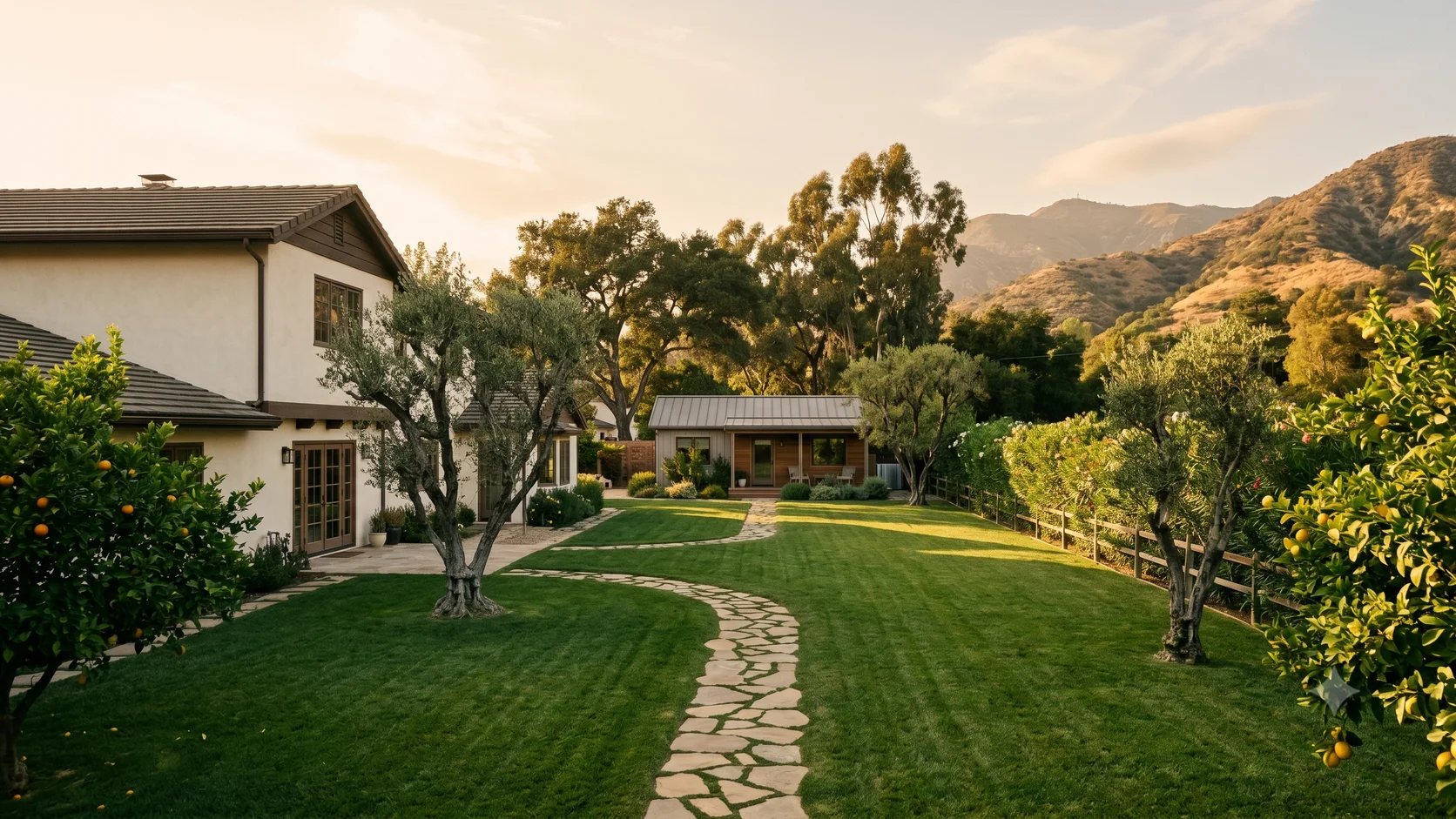
Building an ADU in Woodland Hills. Rules, costs, timeline.
Most lots here have room for the full 1,200 square feet Los Angeles allows. The interesting question is where that room runs out — and the answer is not the one most owners guess.
What you can build — at a glance
Reviewed by CALI ADU’s ADU specialists · August 2026
- Realistic ADU size
- Up to 1,200 sqft Unusually, the citywide maximum is achievable on most lots here. Measured lot by lot across Woodland Hills’ non-hillside R1 lots, two-thirds have the floor area for a 1,200 sqft ADU. Only 17% have under 800 sqft of headroom — the floor area you have left to build with. The neighborhoods east of here are far tighter.
- What people actually build
- 914 sqft median Across the 294 new-construction ADU permits here with a recorded size, the median is 914 sqft and only 42% are 800 sqft or smaller. Studio City’s 97 new-construction permits run to a 662 sqft median with 78% at or under 800. This is a bigger-unit market.
- The RA surprise
- 29% under 800 sqft Counterintuitive and worth checking first: RA is the largest single-family zone here and the tightest for ADU headroom, at 29% of parcels under 800 sqft — against 17% in R1 and 2% in RS. The lower floor-area ratio beats the bigger lot. A quarter-acre is not a guarantee.
- Hillside lots
- 35–47% under 800 sqft This is where Woodland Hills has its squeeze. Hillside floor area runs on slope bands, so a steeper lot gets less. Across hillside R1 parcels, between a third and a half fall under 800 sqft of headroom depending on the band — for those owners the state protection is the whole project.
- Fire zone
- Never bars a state ADU The fire-and-hillside rule cannot be enforced against a state ADU at all, so the 800 sqft detached unit, a conversion and a Junior ADU stay available wherever your lot sits. It can only reach the larger ordinance ADU, and only where a lot is in the fire zone and the Hillside Area. Here those maps genuinely diverge: about 17% of single-family land is in one without the other.
- Detached height
- 28–36 ft Depends on your zone, and the difference is worth real money. R1 and RS: 33 ft where the top story’s roof slope is 25% or steeper, 28 ft where it is shallower. RA, RE11, RE15, RE20 and RE40: 36 ft and 30 ft — and those zones are a plurality of Woodland Hills’ single-family parcels. Almost all single-family land here is Height District 1, but about 2% is 1XL, which is lower, so check your zone string.
- Units per SFR lot
- Code 1 · State 3+ The ordinance says one ADU; state law requires a conversion ADU, a Junior ADU and a detached ADU in combination, and the State told the City so in November 2024. HCD reads at least one more as required on top. Unlike the neighborhoods east of here, floor area is usually not what limits you.
- Extra planning steps
- Fewer than most The River Improvement Overlay behind 87% of Studio City’s ADU permits reaches essentially none of Woodland Hills. Three things still can add a City Planning step: a hillside lot’s Slope Analysis Map, which needs the Director of Planning’s sign-off before LADBS on roughly 46% of single-family land; the Girard Tract, where two City documents disagree; and the Mulholland Specific Plan, which reaches 14.9% of single-family lots. All three are parcel-specific.
- Detached Up to 1,200 sqft on most lots · 28–33 ft · 2 stories
- Attached 850–1,000 sqft protected · 25 ft or the zone limit if lower
- Conversion No size cap · bounded by the existing structure +150 sqft
- Junior ADU Up to 500 sqft inside the house · never any parking
- Legalization Pre-2020 unpermitted units · no impact fees
Per Los Angeles Municipal Code § 12.22 A.33 (Ordinance 186,481) and Zoning Administrator Memorandum No. 143 – Revision 1 (August 1, 2025). Read with Ordinance 184,802 and ZI-2462 (the citywide 0.45 R1 floor-area ratio) and CP-7150 (January 2026). Local plans: the Girard Tract Specific Plan and ZI-1383, the Warner Center 2035 Specific Plan (Ordinance 182,766) and the Mulholland Scenic Parkway Specific Plan. Read together with Gov. Code §§ 66310–66342 and cross-checked against the HCD ADU Handbook (March 2026). Lot, permit and housing-stock figures are computed by us from City of Los Angeles and LA County open data. The method and sample sizes are stated in the sources section below.
On this page
Can I build an ADU in Woodland Hills?
Woodland Hills is one of the busiest ADU markets in the San Fernando Valley. Among Los Angeles Neighborhood Councils it comes second, behind Reseda. The Woodland Hills–Warner Center Neighborhood Council area has pulled 809 ADU permits since January 2020, 148 in 2025 and 120 by August of 2026. The more telling number is size: a median of 914 square feet against Studio City’s 662. That difference, not the raw count, is what the floor-area math below predicts.
The reason is not that Los Angeles treats Woodland Hills differently. The rules at LAMC § 12.22 A.33 and Gov. Code §§ 66310–66342 are identical across the city, and we cover them in full on our Los Angeles ADU page. The reason is the lots.
Five things to know before you start
Three of these are specific to Woodland Hills rather than to Los Angeles. Everything further down the page is detail underneath them.
| What to know | Why it matters for your project |
|---|---|
| You probably have the room | Measured lot by lot, two-thirds of non-hillside R1 lots here can fit a 1,200 sqft ADU within their remaining floor area. In Studio City, 58% cannot. |
| RA lots are the tight ones | The largest zone with the biggest lots is also the worst for headroom — 29% of RA parcels have under 800 sqft left. The ratio beats the acreage. Check before you design. |
| The hills are the real squeeze | Between a third and a half of hillside R1 lots fall under 800 sqft of headroom, depending on slope band. That is where the state protection does the work here. |
| The fire map never blocks a state ADU | It cannot be enforced against the 800 sqft detached unit, a conversion or a Junior ADU. It can only reach the larger ordinance ADU — and only on a lot in the fire zone and the Hillside Area, which about 17% of single-family land here is not. |
| Fewer planning steps than your neighbors | The River Improvement Overlay barely touches Woodland Hills. Three things still can: a hillside lot’s Slope Analysis Map approval, the Girard Tract, and the Mulholland Specific Plan. |
What can you build on your Woodland Hills lot?
The floor underneath you, if your lot is one of the tight ones
Some lots here do run short. That means the 17 percent of non-hillside R1 owners, the 29 percent of RA owners and the third-to-half of hillside owners with little room left. If that is you, both state and City law put a floor under the project. You get 800 square feet whatever the cap works out to.
The City rule is LAMC § 12.22 A.33(c)(1)(iii). No limit on lot coverage, floor area ratio, open space or minimum lot size may be applied in a way that fails to permit at least an 800 square foot ADU, at least 16 feet in height, with four-foot side and rear setbacks. Then it closes: “to be constructed in compliance with all other local development standards.” Read that last clause. The square footage is protected against floor area, not against everything.
Gov. Code § 66321(b)(3) says the same at state level, and goes further in two ways. It adds front setbacks to the protected list. And it names “any requirement for a zoning clearance or separate zoning review” among the things a city may not impose where that would prevent an 800 square foot unit. That second point bears directly on the Girard Tract question below.
The number is 800 detached — but 1,000 attached
The 800 is not the ceiling on the protection. State law separately bars the City from capping an ADU below 850 square feet, or 1,000 with more than one bedroom. In Los Angeles that matters most for an attached unit, where the ordinance would otherwise hold you to half the size of your house.
Does that higher number also beat the floor-area cap? The statute does not answer directly. The City’s own guidance says it does. Zoning Administrator Memorandum 143 tells plan check that floor-area rules “may not be enforced on State ADUs, nor to the extent they prevent the minimum sizes allowed for detached (800 sq. ft.) and attached (850 and 1000 sq. ft.) in State law and the LAMC.” On a tight RA or hillside lot, that is the provision to cite — in writing, before you design to it.
Which ADU type fits your property?
Start from what your lot already has, and from which of the three constraint cases you fall into.
| If your lot is… | The type that usually fits | Why |
|---|---|---|
| Non-hillside R1 or RS with an average house | Detached new build, full size | You almost certainly have the floor area. Design for what the household needs rather than for a cap. |
| RA with a large existing house | Attached, or detached at 800 sqft | The lower floor-area ratio bites hardest here. Attached protects 850 to 1,000 sqft; detached protects 800 regardless of the cap. |
| Hillside, moderate to steep slope | Detached at 800 sqft, designed to the slope | Slope-band floor area leaves a third to a half of hillside lots under 800 sqft. The state protection is what makes the project. |
| Holding a sound detached garage or workshop | Conversion | No square-foot cap under state law — bounded by the existing structure plus 150 sqft for ingress and egress — and it adds little to your floor-area total. |
| Fire zone but not Hillside Area | Anything — the bar does not apply | The ordinance requires both designations together. About 17% of single-family land here is one without the other. |
| Holding a unit built before 2020 without permits | Legalization | A streamlined state pathway with no impact fees, and LADBS publishes the process. |
The Signature Home lineup for Woodland Hills
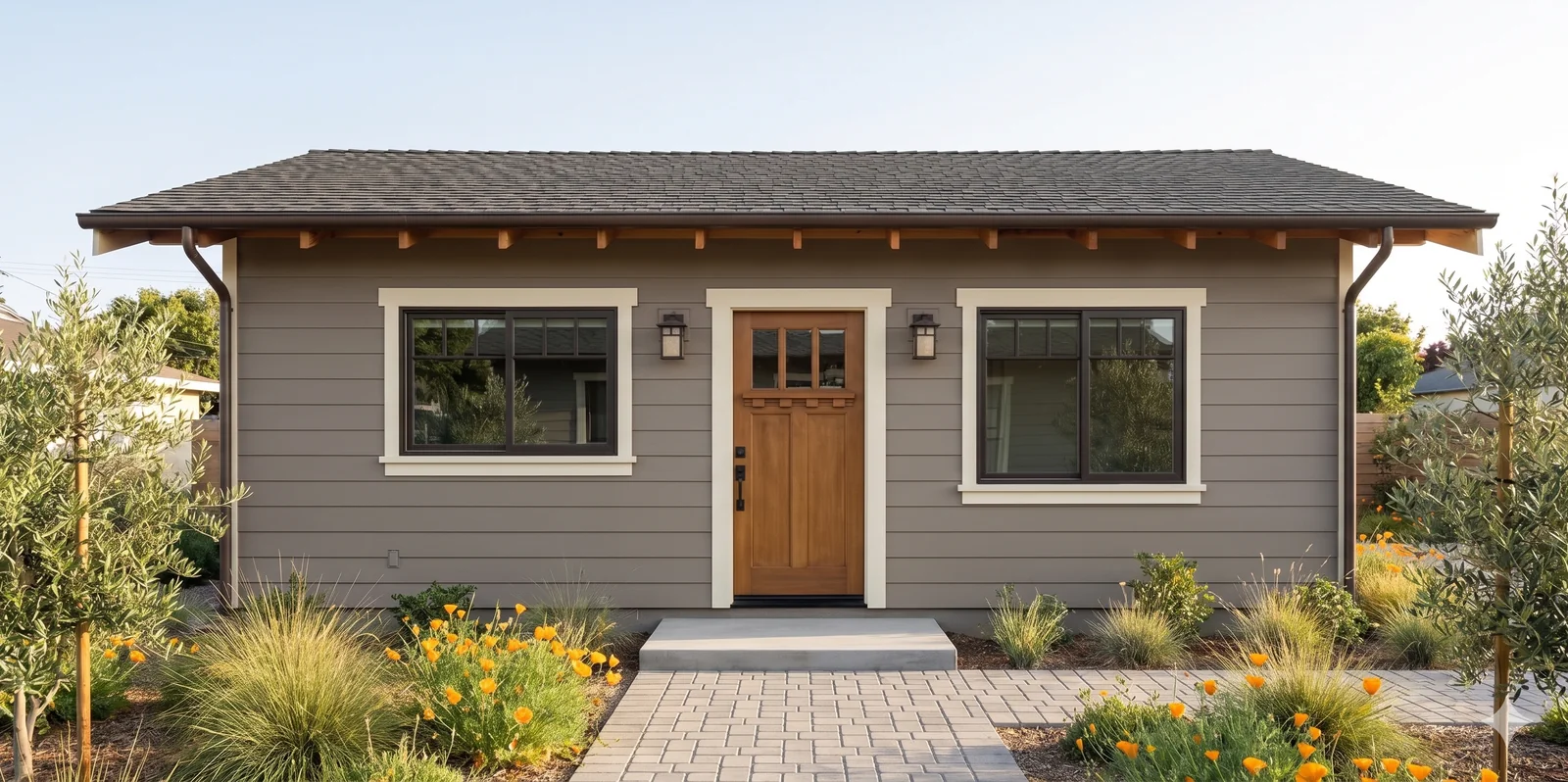
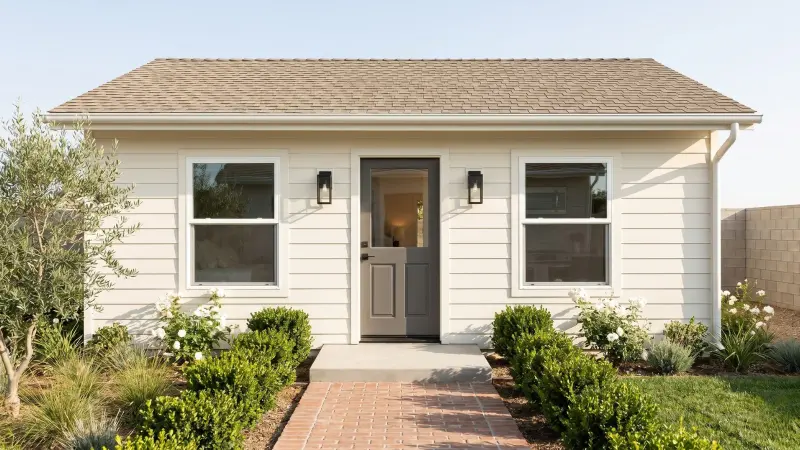
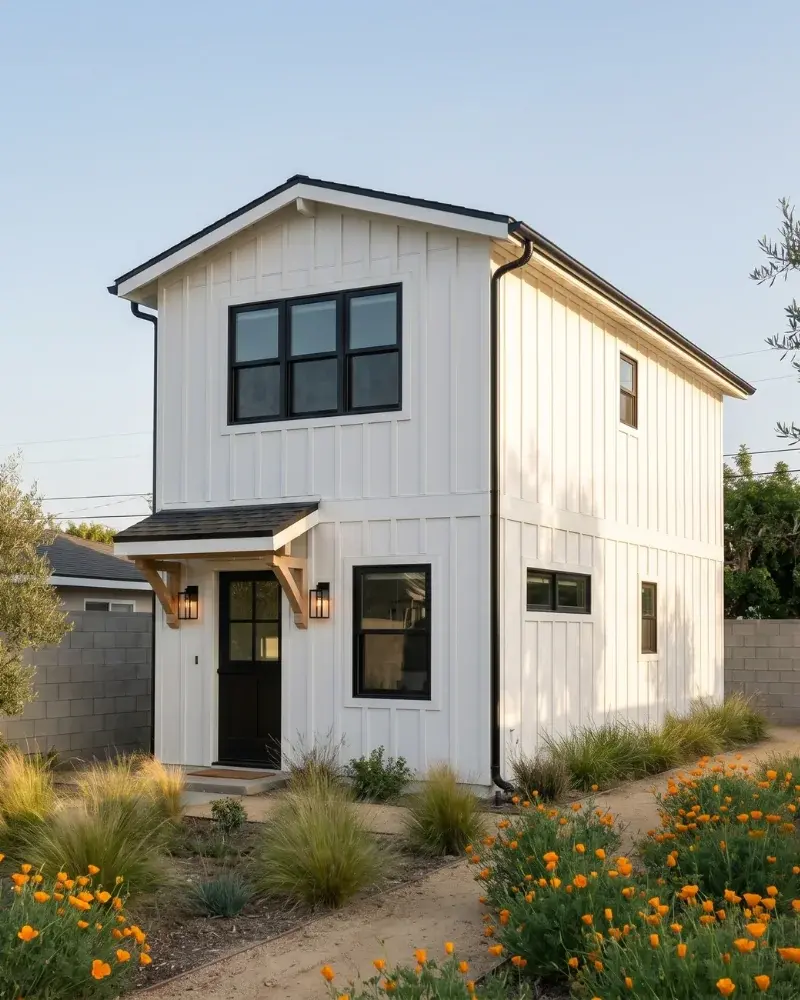
These three bracket what Woodland Hills actually builds. The median new ADU permitted here is 914 square feet, so we lead with the larger plans rather than the compact ones we show in tighter neighborhoods.
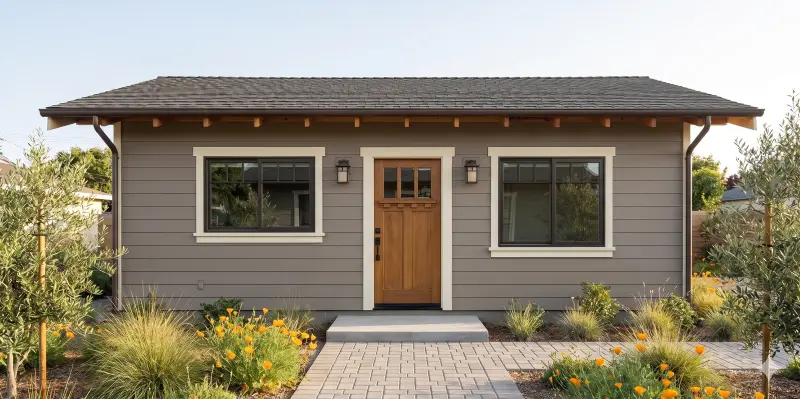
What an ADU costs in Woodland Hills (2026)
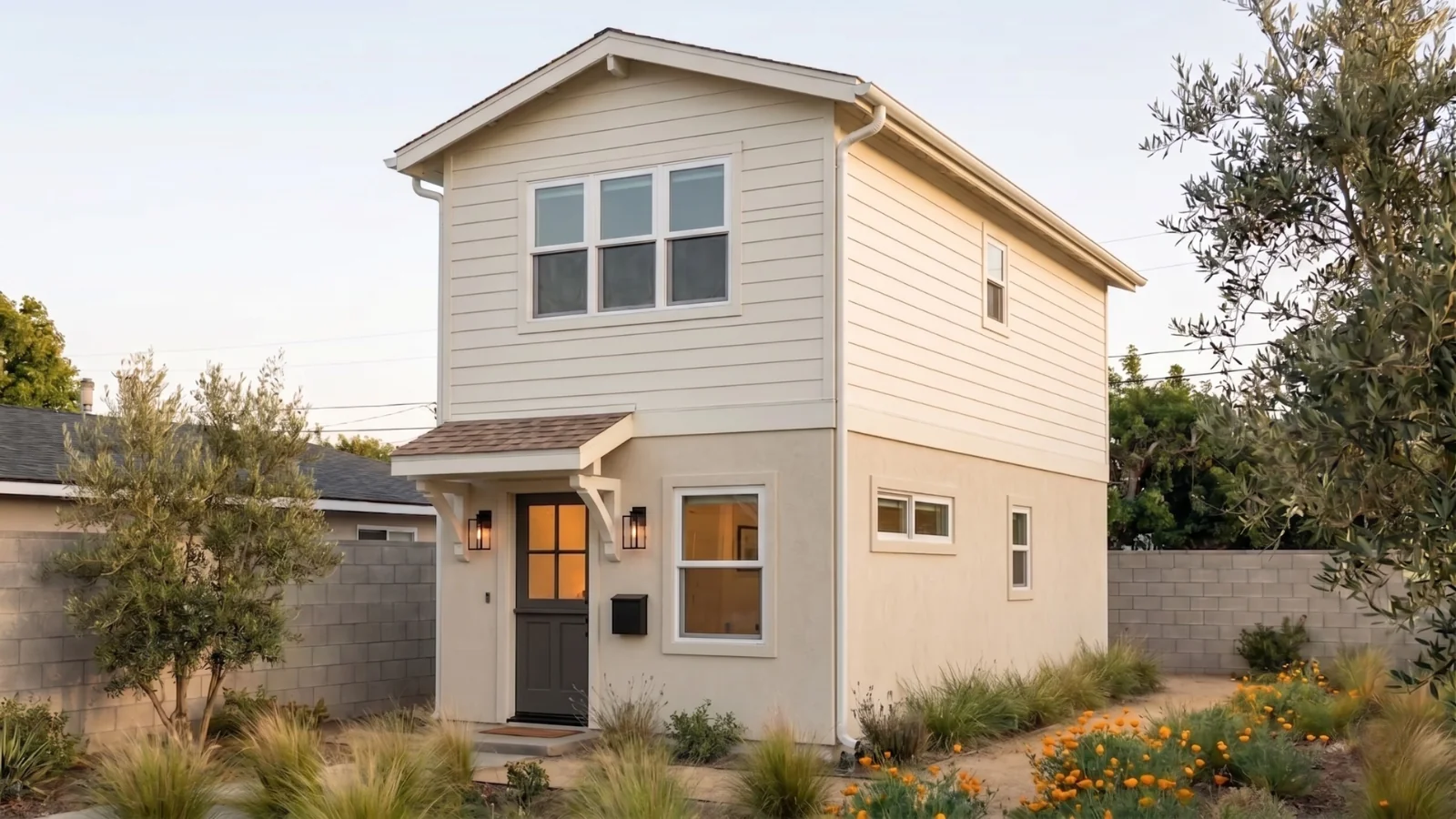
What the lineup costs to build
Plan fees are fixed. Construction is estimated, and varies with your site, access, and the finish level you choose. Across the whole lineup, the estimated cost to build runs roughly $180K–$420K.
| Plan | Size | Bed / bath | Est. build cost |
|---|---|---|---|
| The Laurel Canyon | 660 sqft | 2 BR / 1 BA | $240K–$265K |
| The Melrose | 800 sqft | 2 BR / 2 BA | $275K–$295K |
| The Fairfax | 840 sqft | 2 BR / 1.5 BA | $280K–$310K |
| The Lincoln | 1,000 sqft | 3 BR / 2 BA | $325K–$350K |
| The Venice | 1,080 sqft | 3 BR / 2 BA | $335K–$365K |
Custom work is priced per project rather than from a plan fee, and runs $9,990–$19,990 for design and permit processing.
City fees, and where Woodland Hills is cheaper than its neighbors
LADBS plan check and permit fees are valuation-based — they scale with what your project is worth. So they should be priced against real drawings rather than guessed at from a table. The structural difference here is what you avoid. The River Improvement Overlay clearance sat under 87 percent of Studio City’s ADU permits. It reaches essentially none of Woodland Hills, which takes a City Planning fee and a step off your critical path.
Two things can still add a step, and both depend on where your lot is.
- The Girard Tract. Whether a Planning clearance is required at all is an unresolved question, covered below.
- The Mulholland Scenic Parkway Specific Plan. This is the expensive one, and it reaches 14.9 percent of the single-family lots here — 11.9 percent in the Outer Corridor and 3.0 percent in the Inner. City Planning publishes an ADU-specific Administrative Review for it, signed by its Southwest Valley/Mulholland Unit, which is a clearance rather than a hearing; whether that clearance can be required for a state ADU is unresolved. Above the threshold it is a different animal. City Planning’s own handout describes a 6 to 12 month Design Review Board process, and fees of “approximately $9,700 +” for anything over 900 square feet. Read that 900 closely: it is cumulative since 1992, counting every addition made to the property. An ADU at the 914 square foot local median crosses it, and a smaller one may too. Under the threshold, an administrative clearance runs about $1,342. Even then it can turn into a full compliance case if the lot is within 200 feet of parkland, 50 feet of a prominent ridge or 100 feet of an identified stream.
Size cuts the other way on fees. An ADU of 750 square feet or less pays no development impact fees at all under Gov. Code § 66311.5(c)(1), and school fees are exempt below 500 square feet of interior livable space. This is one place where Woodland Hills’ extra room works against you. The median new ADU here is 914 square feet, so more projects land above the 750 square foot line than in tighter neighborhoods. If you are near it, price the fees at 750 and just above before you settle on a size.
What it returns
Well, relative to what the property costs. That is the quiet financial case for building here. Woodland Hills splits into two ZIP codes, though, and they behave differently enough that we report them separately rather than blending them. 91364 is the southern half — the hills and Ventura Boulevard. Zillow’s observed rent index there runs about $3,774 a month against a home value index near $1.31 million. That is a better rent-to-value ratio than Studio City’s $3,448 on $1.70 million. 91367 is the northern flats and Warner Center, where rent runs about $2,965 on $1.12 million. The rent is lower than Studio City’s, but so is the entry price. Other markets we work in run stronger ratios still, so treat this as a good one rather than the best one.
We are not going to publish a bedroom-level asking rent. The sources we would have to use are either blended across all unit sizes or are voucher payment standards rather than market rents, and presenting either as an asking rent would mislead you. Do this instead. Start from HUD’s Small Area Fair Market Rents for your own ZIP code — 91364 or 91367 — rather than the metro-wide schedule. Both Woodland Hills ZIPs sit above Studio City’s at every bedroom count. Check the current-year file, because HUD revises it mid-year. Then check live listings for comparable units in your part of the neighborhood. One last thing: a Woodland Hills ADU is a long-term rental. State law requires the City to condition a Gov. Code § 66323 unit on rentals longer than 30 days.
How long the permit takes
Gov. Code § 66317 requires the City to approve or deny a complete ADU application within 60 days. Two things about that clock are worth knowing. It binds the permitting agency, not just LADBS — so any City Planning clearance sits inside the 60 days rather than in front of them. And if the City misses the deadline without acting, the application is deemed approved.
| Stage | What drives it |
|---|---|
| Confirm your zone and remaining floor area | Before design. On an RA or hillside lot this is the step that determines the size of the project. |
| Check Girard Tract and Mulholland status | Parcel-specific, and along with hillside status the things that can add a City Planning step here. Resolve in writing at the start. |
| Slope Analysis Map and Planning sign-off, if hillside | Not just a survey. On a Hillside Area lot — 46% of Woodland Hills’ single-family-zoned land — a stamped Slope Analysis Map goes to the Director of Planning, who approves your maximum floor area before you may apply to LADBS. Start it first. |
| Design and permit set | Fixed plan fee, and the schedule is largely yours to control. |
| LADBS plan check | 60 days statutory, ministerial, no hearing. |
Sequencing is not extra time. Whatever order the steps run in, the statutory 60 days runs against the City as a whole. A clearance that has not been finished is not a reason the clock stops. If a Woodland Hills project is drifting past 60 days on a complete application, say so in writing and cite Gov. Code § 66317.
The rules, and the overlays
Fire zone and hillside, and why the distinction matters here
Start with the part that settles most of this. The fire-and-hillside restriction cannot be applied to a state ADU at all. Zoning Administrator Memorandum 143 says so in terms: the prohibition at LAMC § 12.22 A.33(c)(4) “may not be enforced on State ADU types.” A conversion ADU, a Junior ADU and the by-right detached 800 square foot unit are all state ADUs. Wherever your lot falls on either map, that route stays open to you.
What the rule can reach is the larger City ordinance ADU, the route to 1,200 square feet. These are two different maps and two different tests, and the ordinance bars that ADU only on a lot in both a Very High Fire Hazard Severity Zone and a designated Hillside Area. In some neighborhoods that makes no practical difference, because the two maps overlap almost exactly.
Where the two maps diverge here
Woodland Hills is where the difference matters most. About 17 percent of the single-family-zoned land here is in the fire zone but outside the Hillside Area, so the restriction never reaches it. The RE11 land is the clearest illustration: thousands of lots, roughly a third of them in the fire zone, and none of them in the Hillside Area. The permit record agrees. Of the 225 ADU permits pulled on fire-zone land in Woodland Hills, more than half were on non-hillside lots and never engaged the rule at all.
The other side of that number belongs here too: about 46 percent of Woodland Hills’ single-family-zoned land is in both designations, and the rule does apply there. The 17 percent is the land the rule misses, not the land it covers.
So check both designations for your own lot, separately. A fire-zone answer on its own decides nothing. Being told otherwise is the most common way a Woodland Hills owner is talked out of a project they could have had.
If both designations do apply
The state ADU is still available. That does not change here, and it is worth repeating because it is the answer most owners need. For the larger ordinance ADU, two exceptions follow, and the first one is closed to you. Geography decides it: that exception reaches only the Northeast Los Angeles and Silver Lake–Echo Park–Elysian Valley Community Plan Areas. Woodland Hills sits in the Canoga Park–Winnetka–Woodland Hills–West Hills plan area instead. So every affected lot here runs the second exception: fire sprinklers, one off-street parking space, and frontage on a street improved to at least 20 feet of unobstructed width.
That is lighter than it reads. But the relief is conditional, and the conditions are the substance. Zoning Administrator Memorandum 143 states that the restriction may not be enforced against state ADU types at all — the whole of it, frontage included. For an ordinance ADU the memorandum strips out those conditions only where they conflict with state law. The sprinkler condition falls away where sprinklers were not required by code for your existing house. The parking condition falls away where one of the statutory parking exemptions reaches your lot.
Where neither of those is true, the conditions survive. So if your house already required sprinklers, or if no parking exemption reaches you — and Woodland Hills is less transit-served than the neighborhoods east of it — you will be doing both. The frontage requirement is satisfied by dedication rather than by physically widening the street. Ask in writing which provision authorizes anything demanded of you.
The Girard Tract, where two City documents disagree
This is the one place on the page where we cannot give you a clean answer, because the City has not given one either. About 7 percent of Woodland Hills’ single-family land sits in the Girard Tract Specific Plan, most of it R1.
Zoning Information File ZI-1383 instructs staff to “issue no building permit until a clearance from the City Planning Department, Community Planning Valley Bureau is obtained.” The Specific Plan itself, at section 6.C, exempts “any building or structure which is accessory to an existing single-family dwelling” — which is a fair description of an ADU. Those two documents do not obviously agree.
Read the rest of that list before you rely on it, because the very next item cuts the other way. Section 6.E provides that “the total cumulative floor area of all such additions shall not exceed a cumulative floor area of 500 square feet” on lots over 5,000 square feet, and 250 square feet below that. It is drafted as part of an exceptions list but reads as a limit, and “all such additions” has no clear antecedent. If 6.E caps what 6.C exempts, an ADU at the 914 square foot Woodland Hills median is not exempt at all.
Twenty-four ADU permits have been issued inside the Girard Tract, so something workable is happening in practice. There is also a state argument available: Gov. Code § 66321(b)(3) now names a requirement for “a zoning clearance or separate zoning review” among the things a city may not impose where that would prevent an 800 square foot ADU. We would not present that as settled. If your parcel is in the Girard Tract, ask City Planning in writing whether a clearance will be required before you build a schedule around the answer.
Mulholland, and what does not apply at all
The Mulholland Scenic Parkway Specific Plan runs along the southern edge of Woodland Hills. In absolute terms it reaches more single-family land here than in Studio City. City Planning’s handout describes a 6 to 12 month review and fees around $9,700 above 900 cumulative square feet. Whether that can lawfully be applied to a ministerial ADU is an open question we are not going to resolve for you. Note only that seven ADU permits have been issued in the Inner Corridor here, where Studio City has none.
Then a longer list of things that do not apply here, because clearing them away is as useful as finding one that does.
- No historic protections. Woodland Hills has no Historic Preservation Overlay Zone, no listed historic district, and no Hillside Construction Regulation district.
- The River Improvement Overlay barely reaches you. It sat under 87 percent of the ADU permits issued in Studio City — though only about a third of its single-family land — and reaches essentially none of Woodland Hills.
- Warner Center does not touch a house. The Warner Center 2035 Specific Plan covers a large part of the neighborhood, but contains no single-family-zoned land at all. If you own a house here, it does not apply to you. It does apply to multifamily projects inside its boundary. There an Administrative Clearance is required, and the plan’s 300 square foot minimum dwelling unit sits awkwardly against state law allowing a smaller efficiency-unit ADU.
How the permit process works
Ministerial means a reviewer applies the numbers to your drawings. Design taste and neighborhood opinion are not part of it. Building review runs through LADBS. Add Bureau of Engineering and Bureau of Sanitation clearances as your project requires. Add City Planning where your lot is in the Hillside Area, or where the Girard Tract or Mulholland reaches it.
What you submit
A complete application is the single biggest factor in how long this takes. Expect a site plan, floor plans, elevations, structural drawings and Title 24 energy documentation. On a Woodland Hills lot, add a floor-area calculation showing what allowance you have left. That matters most on RA land, where it is usually the number that shapes the design.
If you are on a hillside lot
Hillside lots carry a step the flats do not, and it is more than a survey. You need a Slope Analysis Map, stamped by a registered civil engineer or licensed land surveyor. It goes to the Director of Planning, who approves your maximum Residential Floor Area — the total floor space the City counts on your lot — before you may apply to LADBS. That is a mandatory City Planning approval on roughly 46 percent of Woodland Hills’ single-family-zoned land. It sets the size of your project, and it sits at the front of the schedule, not the end.
The completeness step
It is bounded. Gov. Code § 66317(a)(2)(A) gives the City 15 business days to rule on completeness in writing. And § 66317(a)(2)(B) requires that notice to list every incomplete item, and to say how the application can be made complete.
If you already have an unpermitted unit
Gov. Code § 66311.7 gives you a streamlined route. Where the unit was built before January 1, 2020, the City may not deny a permit to legalize it over building-code violations — unless correcting them is necessary for health and safety. It also may not charge impact fees or connection charges, except where utility infrastructure has to be brought up to Health and Safety Code § 17920.3 standards. LADBS Information Bulletin P/BC 2026-161 sets out the process.
One more thing worth knowing. HCD has twice told the City in writing that units legalized under § 66311.7 “cannot be limited by the maximum unit counts in section 66323,” so legalizing an old unit should not spend the ADU you were planning to build.
A related protection matters too. The City may not require you to correct an existing nonconforming zoning condition on the main house as a condition of approving your ADU. If a correction letter asks you to fix something about the existing dwelling that has nothing to do with the new unit, that is the point to raise in writing.
If you are refused
You are not finished. Gov. Code § 66317(d) requires the City to give you a way to appeal — either a denial, or a finding that your application is incomplete. The City then has 60 business days from your written appeal to issue a final written determination.
Woodland Hills ADU questions, answered
The questions Woodland Hills homeowners actually ask — answered against LAMC § 12.22 A.33, the City’s own zoning memoranda, and current state law.
How big an ADU can I build in Woodland Hills?
Bigger than in most of the San Fernando Valley, and usually the full 1,200 square feet the City allows for a detached unit. Your lot carries a total floor-area cap alongside the ADU rules — 45 percent of lot area in R1 — but in Woodland Hills that cap rarely binds. We measured it parcel by parcel across 2,328 non-hillside R1 lots, matching each house to its own lot: the median has about 1,475 square feet of floor-area headroom left, and only 17 percent have under 800. Two-thirds of lots have room for a 1,200 square foot unit. That is a different picture from neighboring Studio City, where 39 percent of the 3,716 non-hillside R1 lots we measured the same way have under 800 square feet of headroom. The permit record agrees — the median new-construction ADU built in Woodland Hills is 914 square feet, against 662 in Studio City.
I am in an RA zone with a big lot. Am I in good shape?
This is the most counterintuitive thing on the page, so read it before you design. RA covers more ground than any other single-family zone in Woodland Hills — 19 percent of all zoned land against R1's 15 percent — and it has the biggest lots, a median of about 17,900 square feet across the non-hillside RA parcels we measured. It is also the zone with the least ADU headroom. About 29 percent of the 1,853 non-hillside RA parcels we measured have under 800 square feet of floor-area room left, against 17 percent of non-hillside R1 parcels and 2 percent of RS. The reason is the ratio rather than the lot: RA is held to a much lower floor-area percentage than R1, and on a large lot people have generally built a large house against it. A quarter-acre lot is not a guarantee of anything. Get your remaining floor area calculated before you commission drawings, and know that the state 800 square foot protection sits underneath you regardless.
Does the 800 square foot state protection matter here?
Less often than in Studio City. But for the owners it does reach, it is the whole project. LAMC § 12.22 A.33(c)(1)(iii) provides that no limit on lot coverage, floor area ratio, open space or minimum lot size may apply in a way that fails to permit at least an 800 square foot ADU, at least 16 feet in height, with four-foot side and rear setbacks — "to be constructed in compliance with all other local development standards." Read that closing clause: the size is protected against the floor-area cap, not against every other rule. Gov. Code § 66321(b)(3) says the same at state level. As amended effective January 1, 2026, it also adds front setbacks, and it bars any requirement for a separate zoning clearance that would prevent that unit. In Woodland Hills the protection is decisive for the 17 percent of non-hillside R1 lots under 800 square feet of headroom, for 29 percent of RA parcels, and for a third to a half of hillside lots. Note too that the floor is higher for an attached ADU: 850 square feet, or 1,000 with more than one bedroom.
How tall can an ADU be in Woodland Hills?
It depends on your zone, and the gap between zones is worth real money. A detached ADU built under the City ordinance route gets two stories, plus your zone height limit. In R1 and RS that is 33 feet where the uppermost story has a roof slope of 25 percent or more, and 28 feet where it is shallower. In RA, RE11, RE15, RE20 and RE40 it is 36 feet and 30 feet, and those zones cover a plurality of Woodland Hills parcels. Almost all single-family land here is Height District 1. But about 2 percent is Height District 1XL, which is lower, so check your zone string rather than assuming. If you have read that Woodland Hills allows up to 45 feet, that is an apartment-zone figure and it does not apply to your lot. An attached ADU is guaranteed 25 feet, or your zone limit if that is lower. The separately protected state unit works the other way round. State law guarantees you at least 16 feet detached. It guarantees at least 18 feet within one-half of one mile walking distance of a major transit stop or high-quality transit corridor, plus two more feet to match your main house's roof pitch. Those are floors the City may not go below, not ceilings on your design.
My lot is in a fire hazard zone. Does that stop me?
No. That is worth stating flatly, because the fire map is the most common reason a Woodland Hills owner talks themselves out of a project. The restriction cannot be applied to a state ADU at all — Zoning Administrator Memorandum 143 says the prohibition at LAMC § 12.22 A.33(c)(4) "may not be enforced on State ADU types." A conversion ADU, a Junior ADU and the by-right detached 800 square foot unit are all state ADUs, so that route stays open wherever your lot sits on either map. What the fire rule can reach is the larger City ordinance ADU — the route to 1,200 square feet — and even then only where your lot is in both a Very High Fire Hazard Severity Zone and a designated Hillside Area. Both, not either. Woodland Hills is where that distinction pays off most: about 17 percent of the single-family-zoned land here is in the fire zone but outside the Hillside Area, so the rule never reaches it even on the ordinance route. The RE11 land is the clearest case — thousands of parcels, roughly a third in the fire zone, none in the Hillside Area. Of the 225 ADU permits pulled on fire-zone land here, more than half were on non-hillside lots. Check both designations for your parcel rather than assuming the fire map settles it.
What if my lot is in both the fire zone and the Hillside Area?
Then the ordinance route engages the rule — but remember the state route does not, so a conversion ADU, a Junior ADU or the by-right detached 800 square foot unit is still available to you regardless. For the ordinance ADU, two exceptions follow. The first is unavailable to you as a matter of geography. It reaches only the Northeast Los Angeles and Silver Lake–Echo Park–Elysian Valley Community Plan Areas, and Woodland Hills is in the Canoga Park–Winnetka–Woodland Hills–West Hills plan area. That leaves the second exception: fire sprinklers, one off-street parking space, and frontage on a street improved to at least 20 feet of unobstructed width. It sounds heavier than it is, though the relief is conditional. Zoning Administrator Memorandum 143 states that this restriction may not be enforced against state ADU types at all — the whole of it, frontage included. For an ordinance ADU the memorandum strips out those conditions only where they conflict with state law. The sprinkler condition falls away where sprinklers were not required by code for your existing house. The parking condition falls away where a statutory parking exemption reaches your lot. If neither applies, they survive. The frontage requirement is satisfied by dedication rather than by physically widening the street. If sprinklers or parking are demanded of you on fire-zone grounds, ask in writing which provision authorizes it.
I am on a hillside lot. How much can I actually build?
Less than the flats, and this is where Woodland Hills has its squeeze. Hillside floor area runs on slope bands rather than a flat percentage, so the answer depends on how steep your lot is. Across 3,113 hillside R1 parcels, even at the most generous slope band the median has about 1,267 square feet of headroom and 35 percent are under 800 square feet. A band down, the median falls to around 907 and 47 percent are under 800. So roughly a third to a half of hillside owners are in the position where the state 800 square foot protection is not a safety net but the actual rule. Hillside lots also carry a Slope Analysis Map, stamped by a registered civil engineer or licensed land surveyor, as a submittal item — budget for it as a survey cost at the start rather than a correction later.
Does Warner Center affect my ADU?
Not if you have a house. The Warner Center 2035 Specific Plan covers a substantial part of Woodland Hills. But it contains no single-family-zoned land anywhere in its footprint. It is a commercial and mixed-use plan, and its own text describes providing a transition to the single-family pattern west of it. So if you own a single-family home in Woodland Hills, it does not apply to you. It does apply if you are adding units to an apartment property inside the plan area. There an Administrative Clearance is required, and the plan sets a 300 square foot minimum dwelling unit that sits awkwardly against state law allowing an efficiency-unit ADU below that. Only five of the 809 ADU permits pulled in Woodland Hills since 2020 fall in this category, all at two adjacent Canoga Avenue apartment addresses.
What is the Girard Tract, and does it add a step?
It might, and the City's own documents do not obviously agree with each other — which is worth knowing before you are surprised at the counter. The Girard Tract Specific Plan covers about 7 percent of Woodland Hills single-family land, most of it R1. Zoning Information File ZI-1383 instructs staff to "issue no building permit until a clearance from the City Planning Department, Community Planning Valley Bureau is obtained." But the Specific Plan itself, at section 6.C, exempts "any building or structure which is accessory to an existing single-family dwelling" — which is a fair description of an ADU. Then the very next item, section 6.E, caps "the total cumulative floor area of all such additions" at 500 square feet on lots over 5,000 square feet, which if it applies would put a typical Woodland Hills ADU outside the exemption entirely. Twenty-four ADU permits have been issued inside the Girard Tract, so something workable is happening in practice. We are not going to tell you which document wins. If your parcel is in the Girard Tract, ask City Planning in writing whether a clearance will be required for your ADU before you build a schedule around the answer.
How many ADUs can I put on a Woodland Hills lot?
The City ordinance says one ADU. State law requires more, and the State told Los Angeles so directly in a findings letter in November 2024. Gov. Code § 66323(a) requires the City to allow a conversion ADU, a Junior ADU and a newly built detached ADU in combination rather than as alternatives. HCD's March 2026 Handbook adds, at page 18, that a local agency must allow at least one further unit under Gov. Code § 66314 on top of that stack. That would make four. Treat the fourth as an argument to raise in writing at pre-application rather than something to assume at the counter. Unlike Studio City, floor area is usually not what limits you here — on a median non-hillside R1 lot there is room for more than one unit.
Do I need parking for an ADU in Woodland Hills?
Usually not, and on several routes never. No parking of any kind may be required for a Gov. Code § 66323 unit — a conversion ADU, a Junior ADU or the by-right detached unit. A Junior ADU may never be required to provide parking on any route. For everything else, at most one space per ADU is required, and six statutory exemptions remove it. Five of them stand on their own: within a half-mile walking distance of public transit; within one block of a car share vehicle; where the ADU is part of the existing primary residence or an accessory structure; where on-street parking permits are required but not offered to the ADU's occupant; and inside an architecturally and historically significant historic district. That last one is not available to you, because Woodland Hills has none. The sixth exemption applies where the ADU is permitted alongside a new primary dwelling, but only if the lot also meets one of the five above, so it does not stand on its own. Guest parking may never be required for an ADU at all. One local caution: Woodland Hills is less transit-served than the neighborhoods east of it, so the half-mile exemption reaches fewer lots here. Check yours rather than assuming.
What does an ADU permit cost in Woodland Hills?
LADBS plan check and permit fees are valuation-based, so we would rather quote you against real drawings than guess from a table. What is worth knowing is that Woodland Hills carries fewer extra planning steps than its neighbors. The River Improvement Overlay that sat under 87 percent of Studio City's ADU permits reaches essentially none of Woodland Hills. Two things can add a City Planning step. One is the Girard Tract clearance question above. The other is the Mulholland Scenic Parkway Specific Plan, where City Planning's own handout describes a 6 to 12 month review and roughly $9,700 in fees above 900 cumulative square feet. On the protective side, an ADU of 750 square feet or less pays no development impact fees at all under Gov. Code § 66311.5(c)(1), and school fees are exempt below 500 square feet of interior livable space. Because the median new ADU here is 914 square feet, more Woodland Hills projects land above the impact-fee line than in Studio City — worth modeling before you settle on a size.
How long does an ADU take to permit here?
The statutory clock is 60 days from a complete application. Review is ministerial — a checklist, not a judgment call, with no public hearing, no discretionary design approval and no neighbor sign-off. Two things about that clock are worth knowing. It binds the permitting agency as a whole rather than LADBS alone, so a City Planning clearance sits inside the 60 days rather than in front of them. And if the City misses the deadline without acting, the application is deemed approved. Woodland Hills generally moves faster than the neighborhoods east of it because fewer overlays touch a given parcel — but if your lot is in the Girard Tract or the Mulholland Specific Plan, resolve that question in writing at the start rather than discovering it in plan check.
Is a conversion or a new build better in Woodland Hills?
New construction, more often than in most of Los Angeles — because here you generally have the floor area to spend. A conversion is still the better move if you have a sound detached structure worth reusing. It carries no square-foot cap under state law: it is bounded by the existing structure's own dimensions, plus up to 150 square feet for ingress and egress. And it usually adds little to your floor-area total. One trap to check first. If the garage you are converting counted as required covered parking, it may have been exempt from Residential Floor Area — the total floor space the City counts on your lot — up to 400 square feet. Converting it can cost you that exemption. But the median non-hillside R1 lot here has 1,475 square feet of headroom left, so most Woodland Hills owners can build the unit they actually want rather than the unit their floor area allows.
What will an ADU rent for in Woodland Hills?
Well relative to what the property costs, which is the quiet financial case for building here — though Woodland Hills splits into two ZIP codes that behave differently, so we report them separately rather than blending them. In 91364, the southern half, Zillow's observed rent index runs about $3,774 a month against a home value index near $1.31 million — a better ratio than Studio City's $3,448 on $1.70 million. In 91367, the northern flats, rent runs about $2,965 on $1.12 million, so the rent is lower than Studio City's but so is the entry price. Other markets we work in run stronger ratios still. We are not going to publish a bedroom-level asking rent, because the sources we trust are either blended across all unit sizes or are voucher standards rather than market rents, and quoting either as an asking rent would be misleading. Start from HUD's Small Area Fair Market Rents for your own ZIP code — 91364 or 91367 — rather than the metro-wide schedule, since both Woodland Hills ZIPs sit above Studio City's at every bedroom count. Check the current-year file, because HUD revises it mid-year. Then check live listings for comparable units in your part of the neighborhood. Note also that a Woodland Hills ADU is a long-term rental: state law requires the City to condition a Gov. Code § 66323 unit on rentals longer than 30 days.
Official sources
City of Los Angeles
- LAMC § 12.22 A.33 — the citywide ADU ordinance, adopted by Ordinance 186,481. Covered in full on our Los Angeles ADU page. Ordinance 186,481 (City Clerk)
- Zoning Administrator Memorandum No. 143 – Revision 1 (August 1, 2025) — the City’s operating instructions to plan check, and the source for the floor-area, sprinkler and parking limits described above. ZA Memo 143 Rev. 1 (PDF)
- Ordinance No. 184,802 and ZI-2462 — the citywide 0.45 residential floor area ratio for R1, with the 20 percent bonus options eliminated in that zone. Ordinance 184,802 · ZI-2462
- Girard Tract Specific Plan and ZI-1383 — the two documents quoted above, which do not obviously agree on whether an ADU needs a Planning clearance. ZI-1383 (PDF)
- Warner Center 2035 Specific Plan — Ordinance 182,766, effective December 25, 2013. Contains no single-family-zoned land. planning.lacity.gov
- Mulholland Scenic Parkway Specific Plan — including City Planning’s applicant handout with the review timeline and fee figures cited above. City Planning handout (PDF)
- LADBS Information Bulletin P/BC 2026-161 — the published pathway for legalizing pre-2020 unpermitted units. LADBS Bulletin (PDF)
State law
- Gov. Code §§ 66310–66342 — California ADU law, including the 800 square foot protection at § 66321(b)(3) as amended effective January 1, 2026. Gov. Code § 66321 (leginfo)
- HCD ADU Handbook (March 2026) — the Department of Housing and Community Development’s interpretation, including the additional unit discussed above. HCD ADU Handbook (PDF)
A note on the numbers
We worked the floor-area figures out ourselves rather than quoting them from a report. Here is the method, so you can weigh it.
- One lot at a time (parcel by parcel). We matched each Los Angeles County Assessor 2025 single-family record to the City parcel polygon it sits in — the mapped outline of that one property. We measured the lot from that outline. Then we took that property’s own recorded house size off what its zone allows. Sample: n = 2,328 non-hillside R1 parcels in Woodland Hills, and n = 3,113 hillside R1 parcels.
- We report the spread, not an average. An average conceals exactly the lots that matter.
- Permit figures. These come from the LADBS permits-issued dataset, filtered to accessory dwelling units in the Woodland Hills–Warner Center Neighborhood Council area, January 2020 to August 2026. That is n = 809 ADU permits. Of those, 744 geocode inside the Woodland Hills neighborhood boundary, and the overlay and fire-zone shares use the 744.
Three honesty notes. First, our figures are upper bounds rather than plan-check numbers. The Assessor’s floor area is not identical to the City’s Residential Floor Area, and we do not subtract garage area.
Second, we have deliberately not published three things for Woodland Hills: a price per square foot, a count of how many properties have a usable garage, and a bedroom-level asking rent. We could not source any of the three to a standard we would want to be held to.
One more, about units. Our headroom figures are gross floor area, which is the measure the City’s floor-area cap uses. The state’s 800, 850 and 750 square foot figures are interior livable space, measured inside the walls, which is the smaller number for the same building. So an 800 square foot protected ADU eats somewhat more than 800 square feet of your remaining floor area, and the shares above are optimistic in that respect too. It does not change the protection — that is written in the smaller unit, so it protects a slightly larger building than it sounds like. It does mean a lot we count as having “just enough” may not.
Rules change. Los Angeles updates its zoning memoranda regularly. The Southwest Valley community plans are being revised, and those cover Canoga Park–Winnetka–Woodland Hills–West Hills. The City is also weighing whether to adopt new state fire hazard maps. If you are reading this later, confirm the overlay status of your own lot before you rely on any of it — or call us and we will confirm it for you.
Not sure what your lot
can actually support?
Get clarity before you spend anything on plans. In 15 minutes we will pull up your property and work out the floor area you have left. We will check whether the fire, hillside, Girard Tract or Mulholland lines touch your lot. Then you get an honest read on your options and a realistic budget — including whether an ADU is the right move at all.
15 minutes · No obligation